CORN BUY ALERT
Disclaimer: there is risk of loss trading futures and options. Past performance does not necessarily indicate future results. This is our opinion and should be treated as such.
Why the alert?
We feel like corn is at a good spot to consider some re-ownership strategies for those who are oversold or made sales near our Sep 2nd sell alert. We also think this is a good time for getting coverage for end users.
Before we get into some strategies you could consider, let’s look at the charts and reason behind the alert.
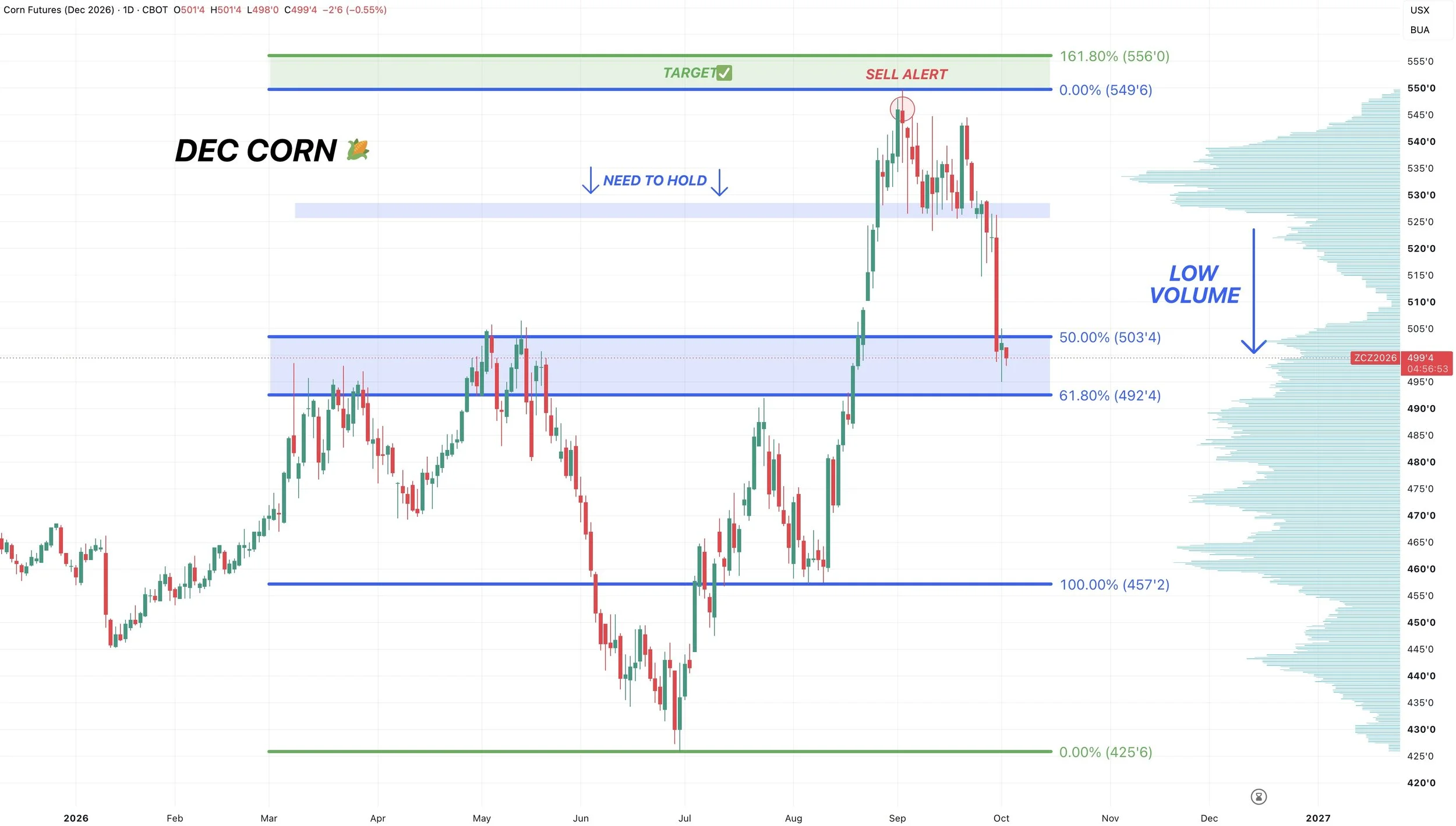
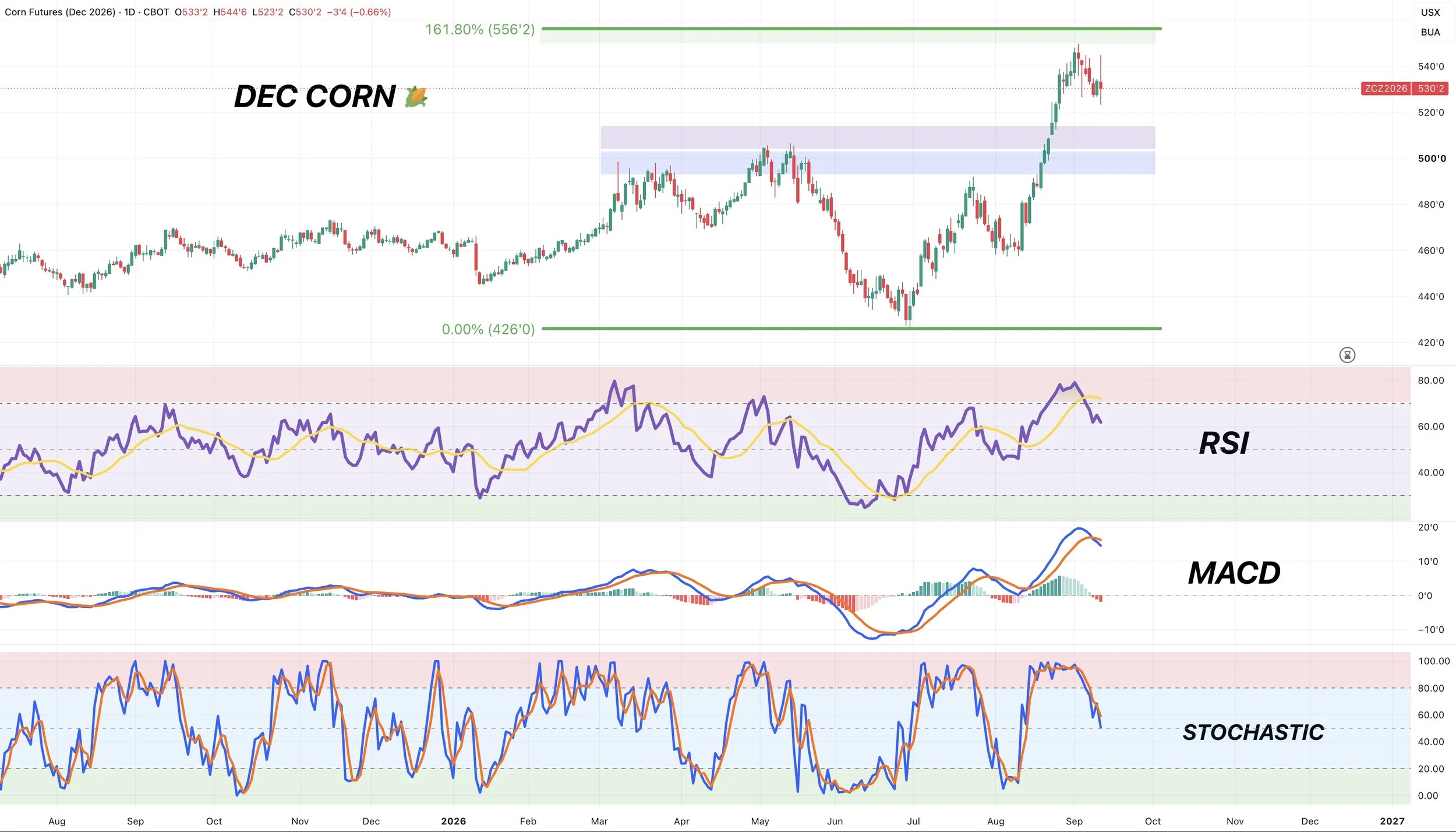
Dec Corn:
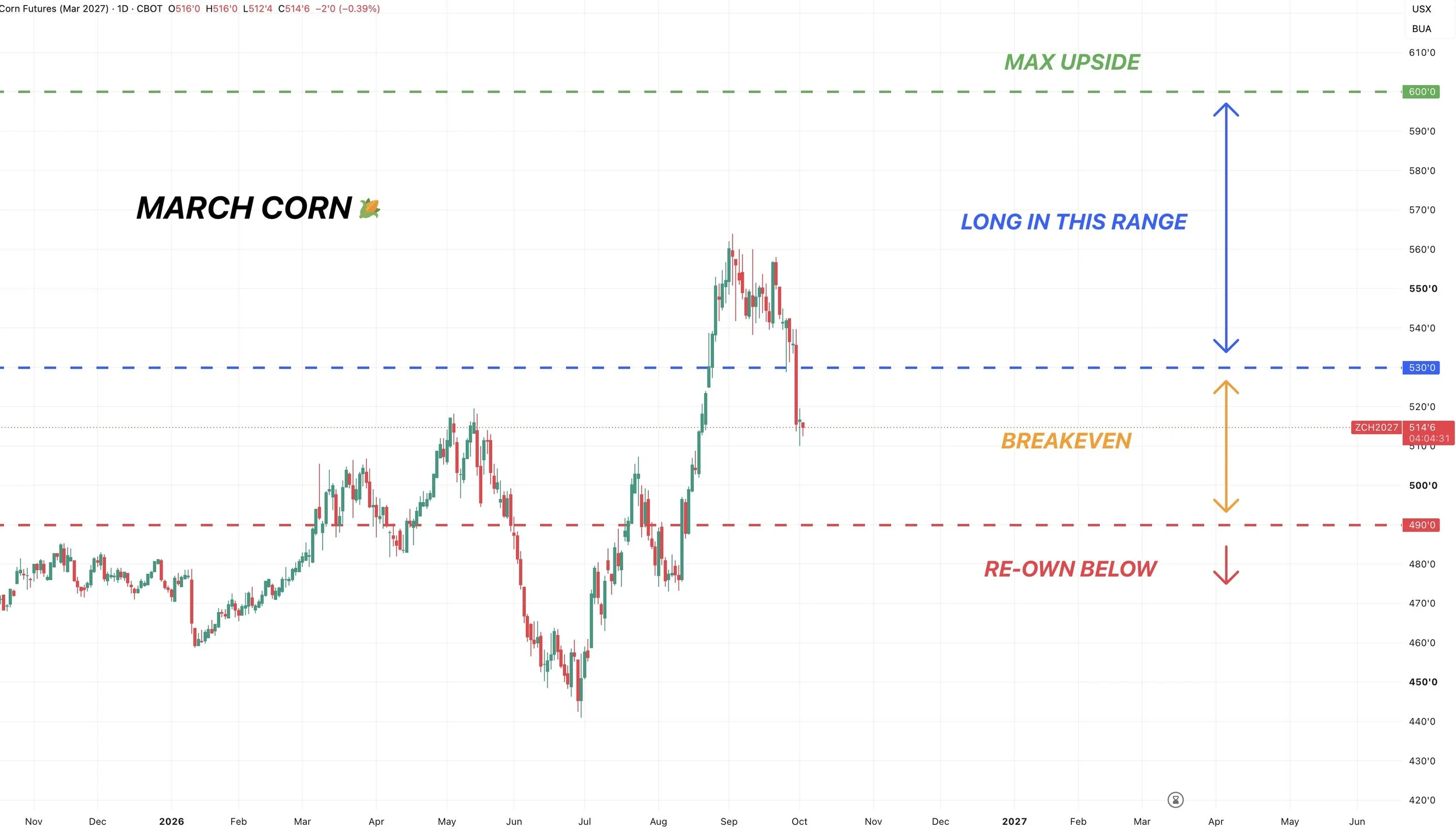
We broke that big support level and prior range. As a result, we sliced right through that massive volume gap to the downside.
We’ve now given back 50% to 61.8% of the entire rally from August.
Now re-testing those highs from May. Trying to turn them into our new floor.
At the same time, since we ran through the volume gap we are back at an area of high volume.
So this would be an area where a bottom would make sense. However, we ideally do not want to break below the 61.8% level and $4.90.
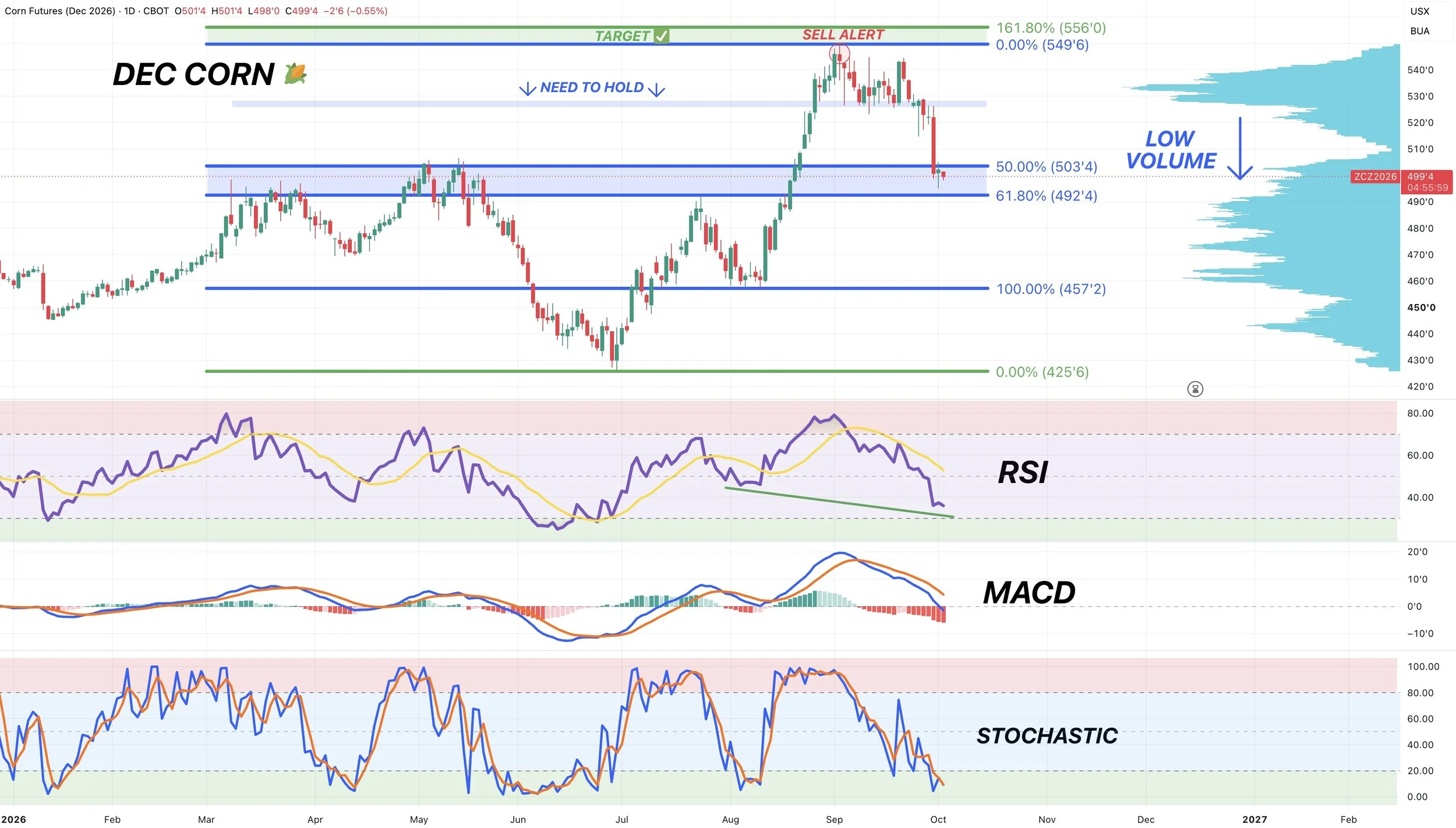
If we look at the indicators.
Corn is finally oversold.
The RSI is the most oversold it has been since corn was trading at $4.25.
The stochastics have now also bottomed out. Something we want to see when searching for a major bottom. This doesn’t mean we “have” to bottom here. But often times we won’t bottom until they are bottomed first.
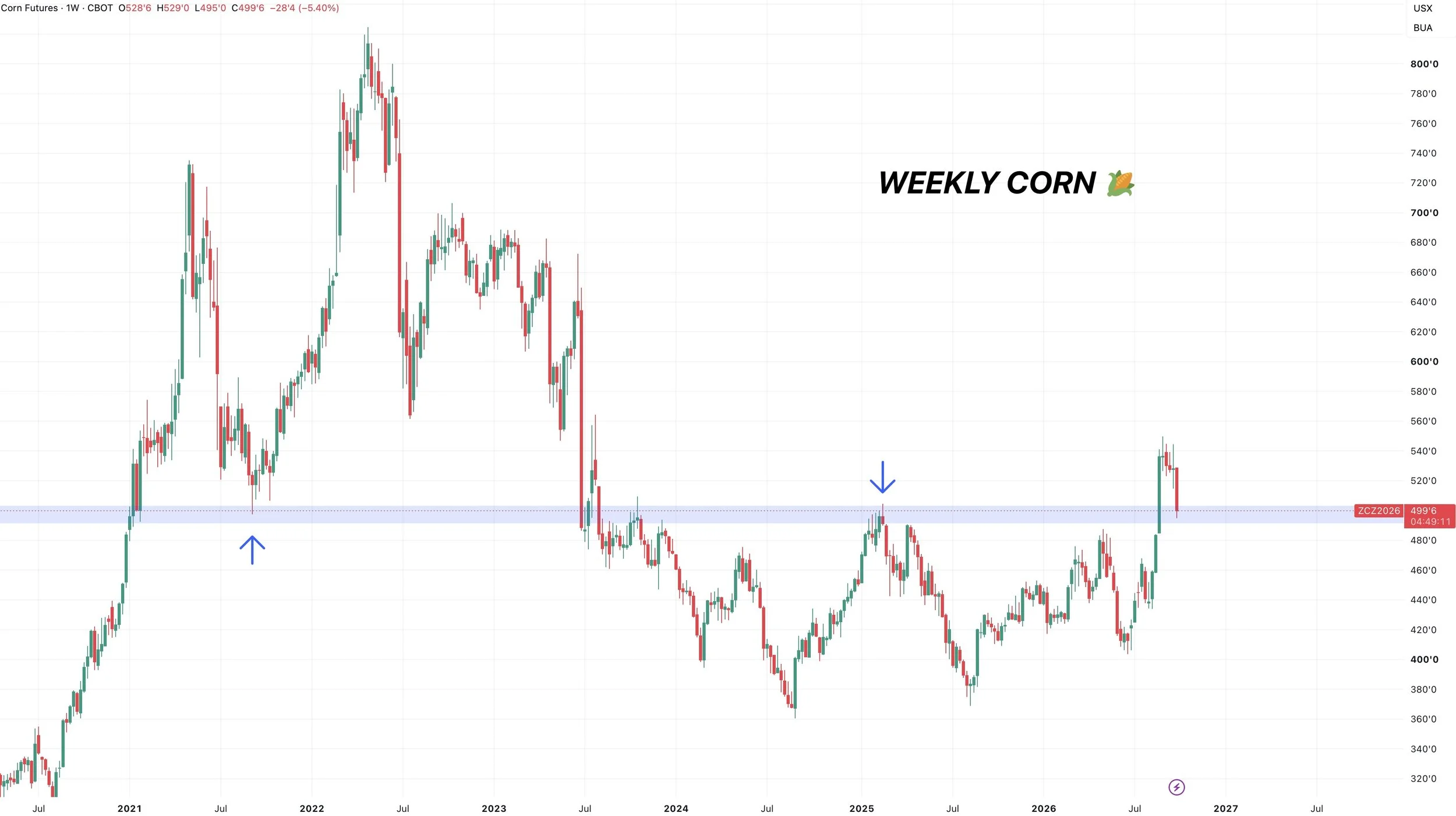
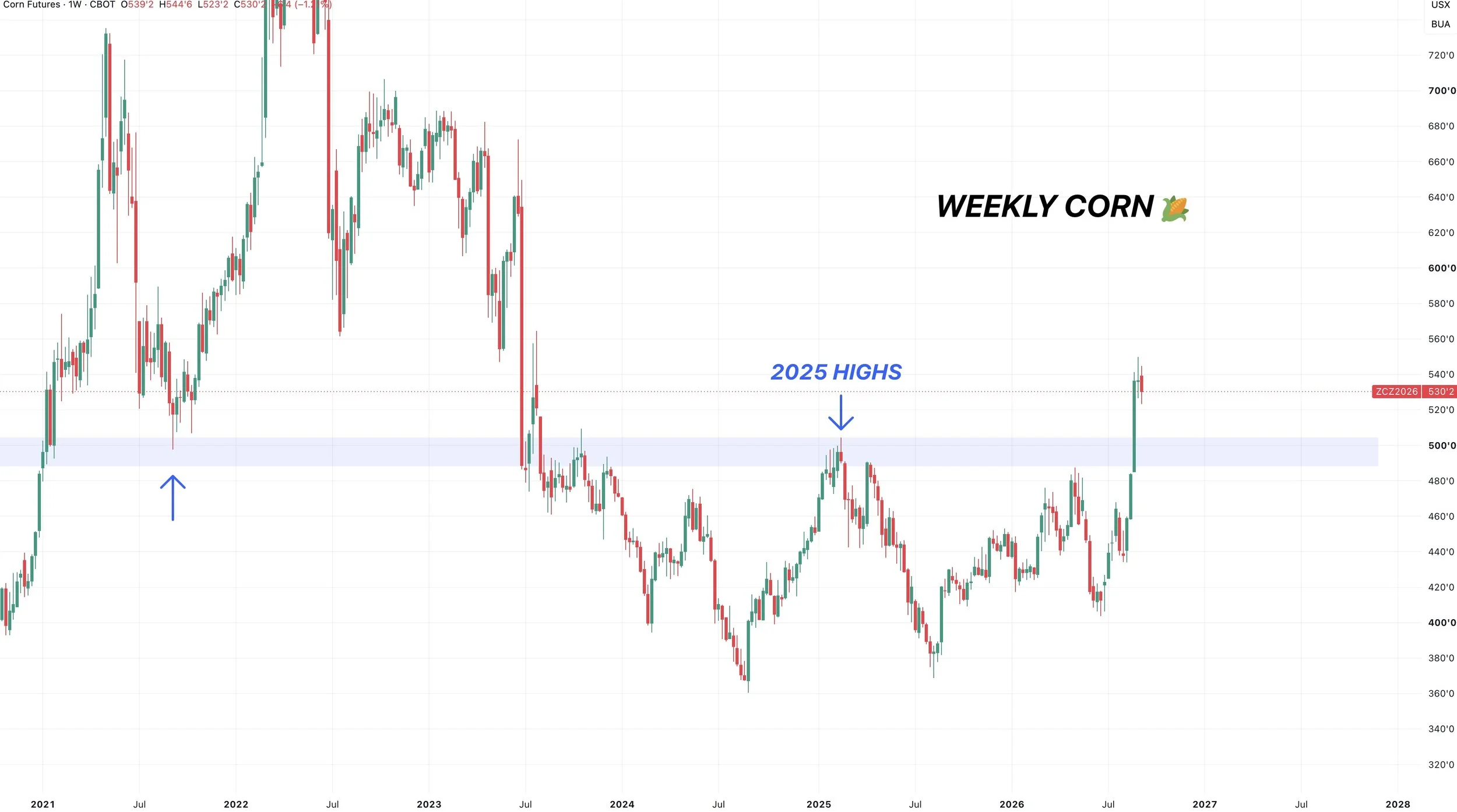
If you zoom out to the weekly chart.
This also appears like a high time frame re-test for now.
We were trapped in a massive sideways range for 3 years.
We broke out. Busting those 2025 highs and 2021 lows.
We are now re-testing that point of breakout. Trying to turn the old resistance into new support.
What strategies could you consider?
There are several ways you could go about it.
For end users, we like extending coverage. What route you take depends on your situation. For a specific recommendation call or text us at (806)484-1214
For producers who are oversold or made sales higher than we are today, if you would like some upside exposure, here are some routes we like considering:
1) For shorter term re-ownership we like buying near the money calls.
2) Bull spreading futures is another possible strategy to consider. An example would be buying March-27 futures and selling Dec-27 futures.
3) For longer term re-ownership, we like selling puts to buy a call spread using the March or July.
An example of this would be:
Sell $4.90 March Put
Buy $5.30 March Call
Sell $6.00 March Call
At expiration, this specific trade would give you a max upside of $6.00 or 70 cents of upside. If we dropped below $4.90, which is 24 cents below the market, you would re-own via futures. With a breakeven of $4.90 to $5.30.
(I attached a visual of this one below)
For more information on any of these possible strategies, of if you’d like to discuss what strategies may be best for you, give us a call or a text. As not all of these strategies are for everyone.
Office: (806)484-1214
Don’t Miss Future Updates or Alerts
Your free trial has ended. Don’t lose access
Want to Talk?
Our phones are open 24/7 for you guys if you ever need anything or want to discuss your operation.
Jeremey & Office: (806)484-1214
Sebastian: (605)280-1186
Email: sfrost@dailymarketminute.com
Hedge Account
Interested in a hedge account? Use the link below to set up an account or give us a call.
REPEAT OF 2010? BEARISH STOCKS FAVOR REVERSAL?
MARKET UPDATE
You can scroll to read the usual update as well. As the written version is the exact same as the video.
Timestamps for video:
USDA: 0:00min
2010 Deep Dive: 5:30min
Corn: 8:45min
Beans: 13:45min
Wheat: 16:15min
Cattle: 17:30min
Want to talk?
Office: (806)484-1214
Your free trial has ended
Don’t lose access to our updates or alerts
Futures Prices Close
Overview
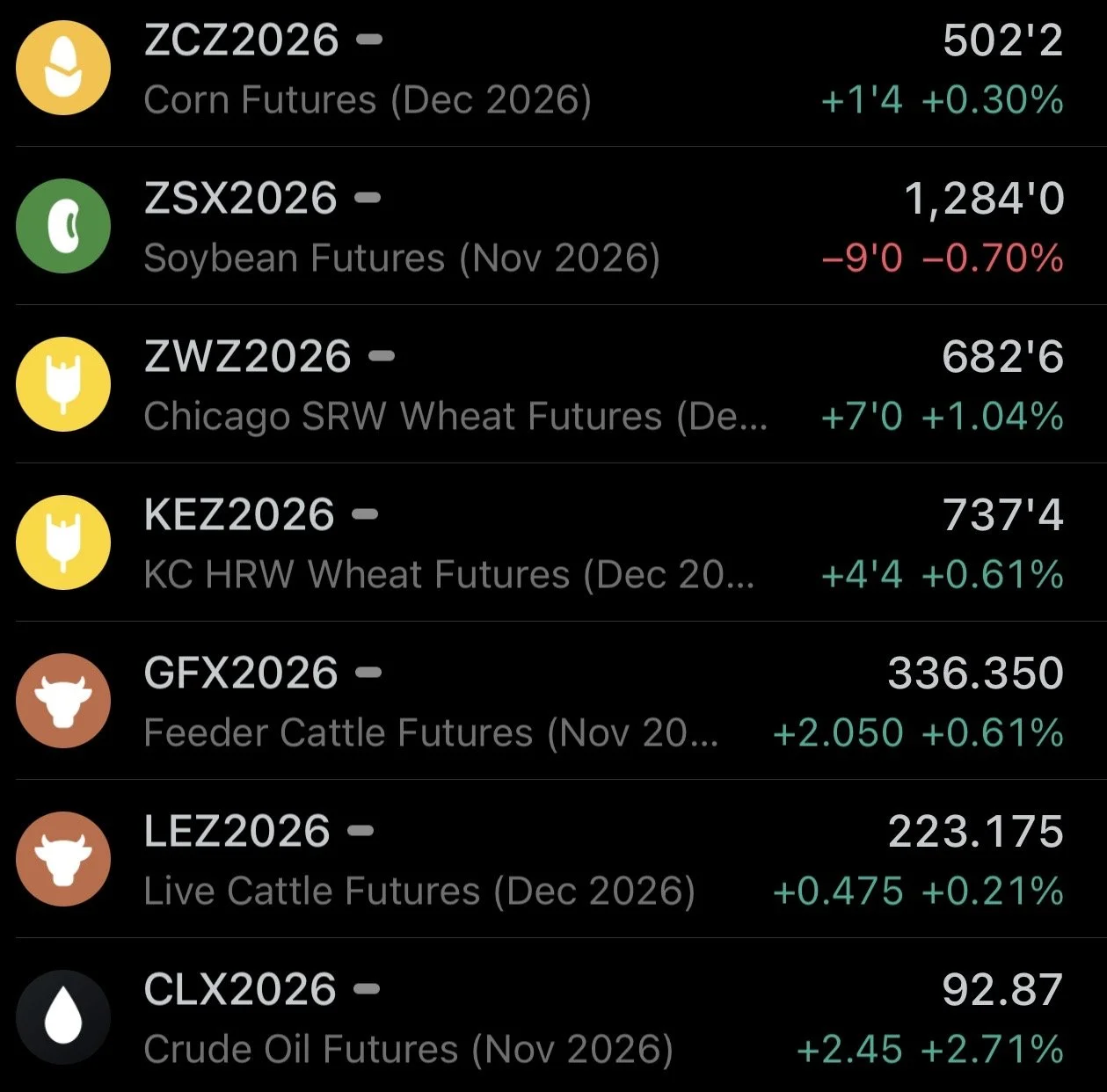
Corn and wheat slightly higher while the soybean market traded lower today following yesterday's eventual USDA quarterly stocks report.
Meanwhile, the cattle market, specifically feeders continues to catch a bid.
Today we'll be going into what this report actually means and doing a deep dive into what happened back in 2010. As there are some interesting comparisons that shouldn’t go unnoticed.
Then we'll of course be going over the charts. As I do believe both corn and wheat are approaching some good areas of support.
But let's jump right into the report.
USDA Breakdown
Jeremey broke a lot of it down yesterday, but let's look at the potential impacts this report could have and what it all means.
Below are the numbers vs the estimates.
Corn production came in slightly lower on less harvested acres. While they left yield alone. However the big surprise was of course the stocks. As they came in +170 million higher than the USDA's WASDE report.
Since the USDA didn’t really cut production that much, this means that the USDA cut old crop demand. Which was were the shock came in.
But before we get too far into corn, let's run through the rest of the report quick.
For wheat, it wasn’t a big market mover. The stocks number was slightly friendly, while the production number was slightly bearish.
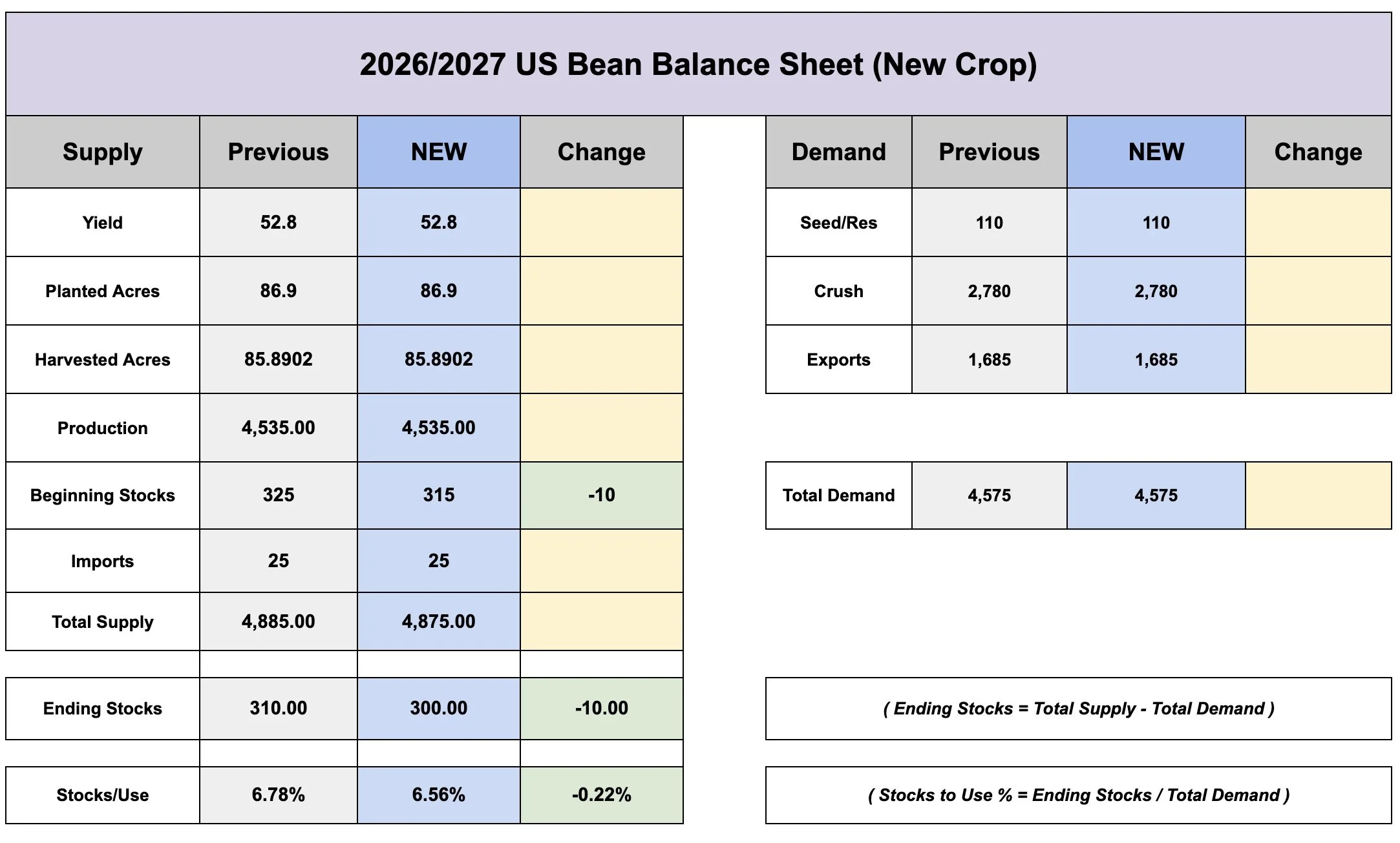
For soybeans, the report was on the friendly side. They did not cut soybean production, but soybean stocks came in down -10 million bushels vs the WASDE.

Since the USDA did not cut soybean production, yet stocks were lower. This means that the USDA has old crop soybeans gaining +10 million bushels of demand.
Who knows exactly how the USDA will change things next report, but if we take this report at surface level. This 10 million would carry over to the new crop balance sheet in the form of less beginning stocks.
Bringing the carryout from 310 million down to 300 million.
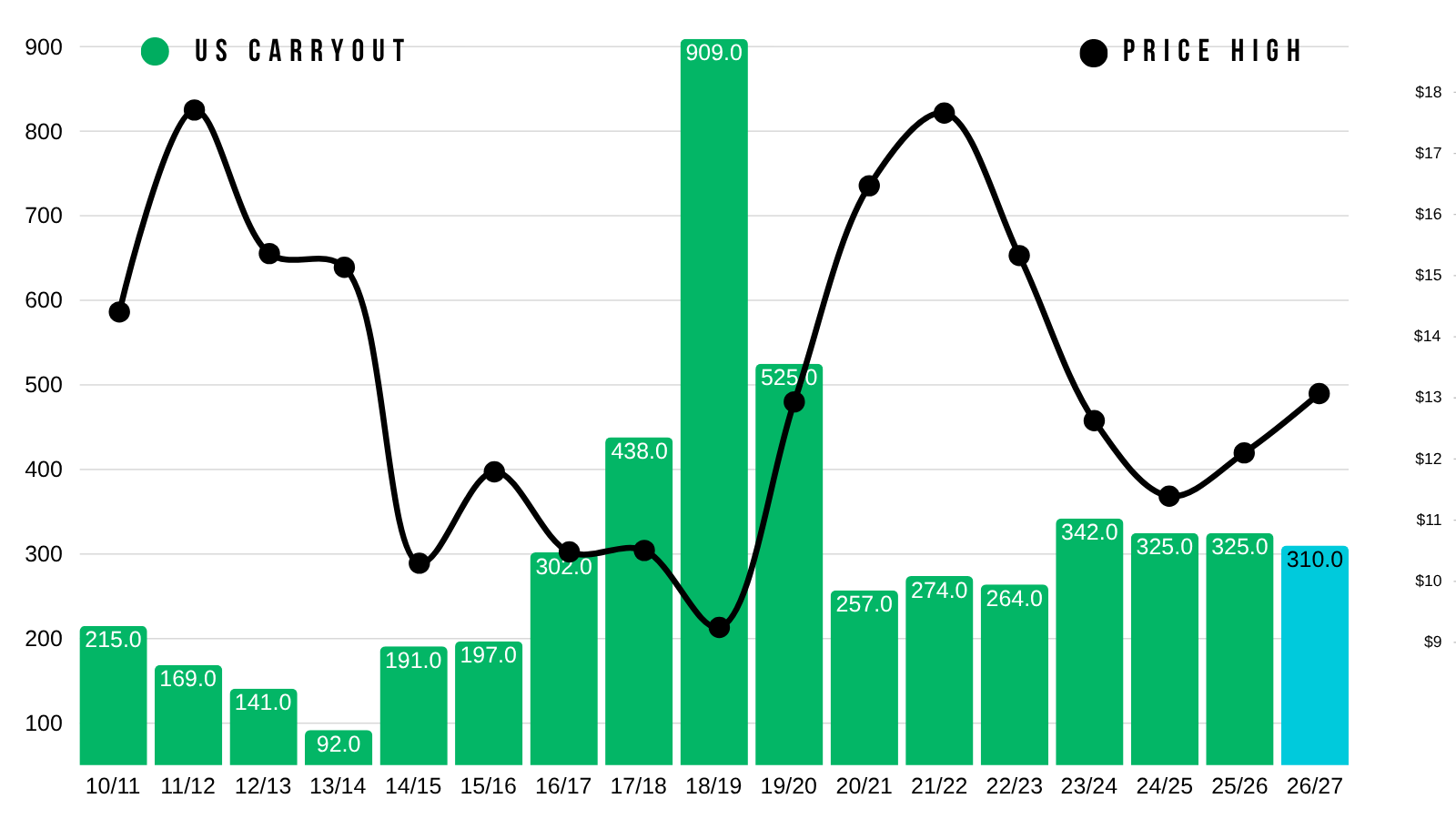
We always talk about how a sub 10% stocks to use in corn is viewed as bullish.
Well a sub 300 million carryout in soybeans would be viewed in a similar way.
We haven’t had a sub 300 million carryout since the bull market.
Now for corn.
As we mentioned, the USDA bumped stocks by +170 million.
Why did they do this?
As we mentioned, since they only cut production slightly, this means the USDA cut the old crop demand numbers.
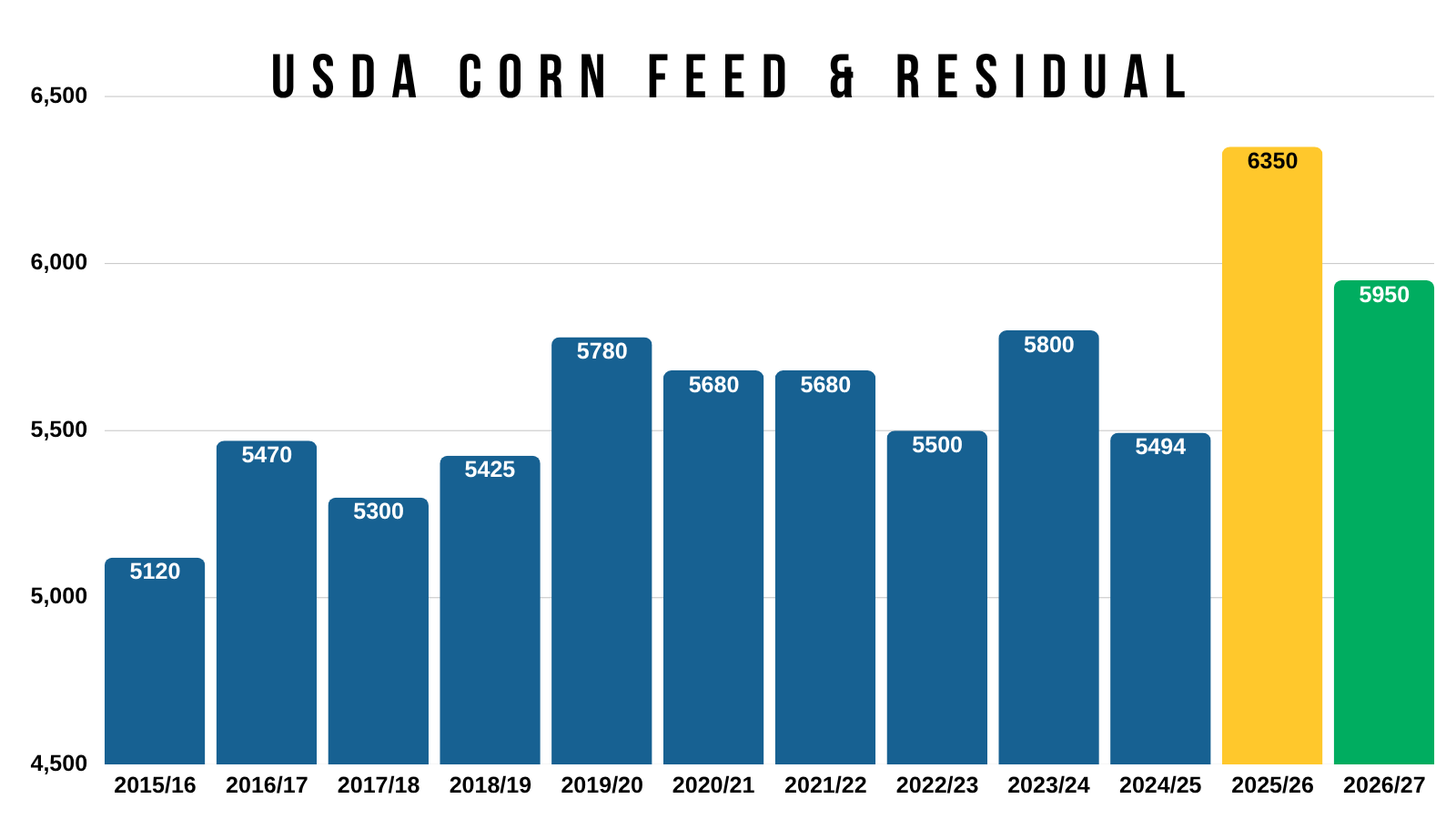
We already have a good grasp on exports and ethanol. As there are reports to track those two. Which means the USDA likely dropped the feed and residual demand.
The feed and residual number has been a heavily debated topic since last year. The number didn’t make a ton of sense to begin with, as the old crop number was +900 million more than the prior year and +400 million more than the new crop balance sheet. Both of which are massive differences. So it's not shocking the USDA finally lowered it.
The USDA literally uses this number to mess with the balance sheet however they want. It's the category where they put unexplained bushels. There is no way for anyone to track this number. It's simply a "play" number. No one knows how the USDA even comes up with this number. So yes, it's somewhat bogus, but that's what we have to deal with.
You would’ve liked to see the USDA offset that drop in feed and residual with a bigger cut to old crop production, but they didn’t.
We'll touch more on this in a little bit...
But what exactly does this do to the balance sheet?
At surface value, since the USDA increased the old crop balance sheet by +170 million, you would then add +170 million bushels to the new crop balance sheet via beginning stocks.
Column 1 is the current balance sheet.
Column 2 is the balance sheet with the extra beginning stocks.
This change drasticallly bumps the old crop stocks to use from 9.7% all the way up to 10.7%. No longer below that magic 10% number. Which is why the market had as bearish of a reaction as it did.
What this also did is it gives the balance sheet a larger room for error when it comes to yield.
Column 3 is the balance sheet with the new beginning stocks, minus -2 bpa on the yield. From 178.5 down to 176.5. If you notice, the balance sheet and stocks to use stays the exact same as was before the extra beginning stocks even with -2 bpa of less yield.
So basically, there is an extra 2 bpa of wiggle room on yield now. In the next report, the USDA could cut yield by 2 bpa and it would stay the exact same. Without touching demand of course.
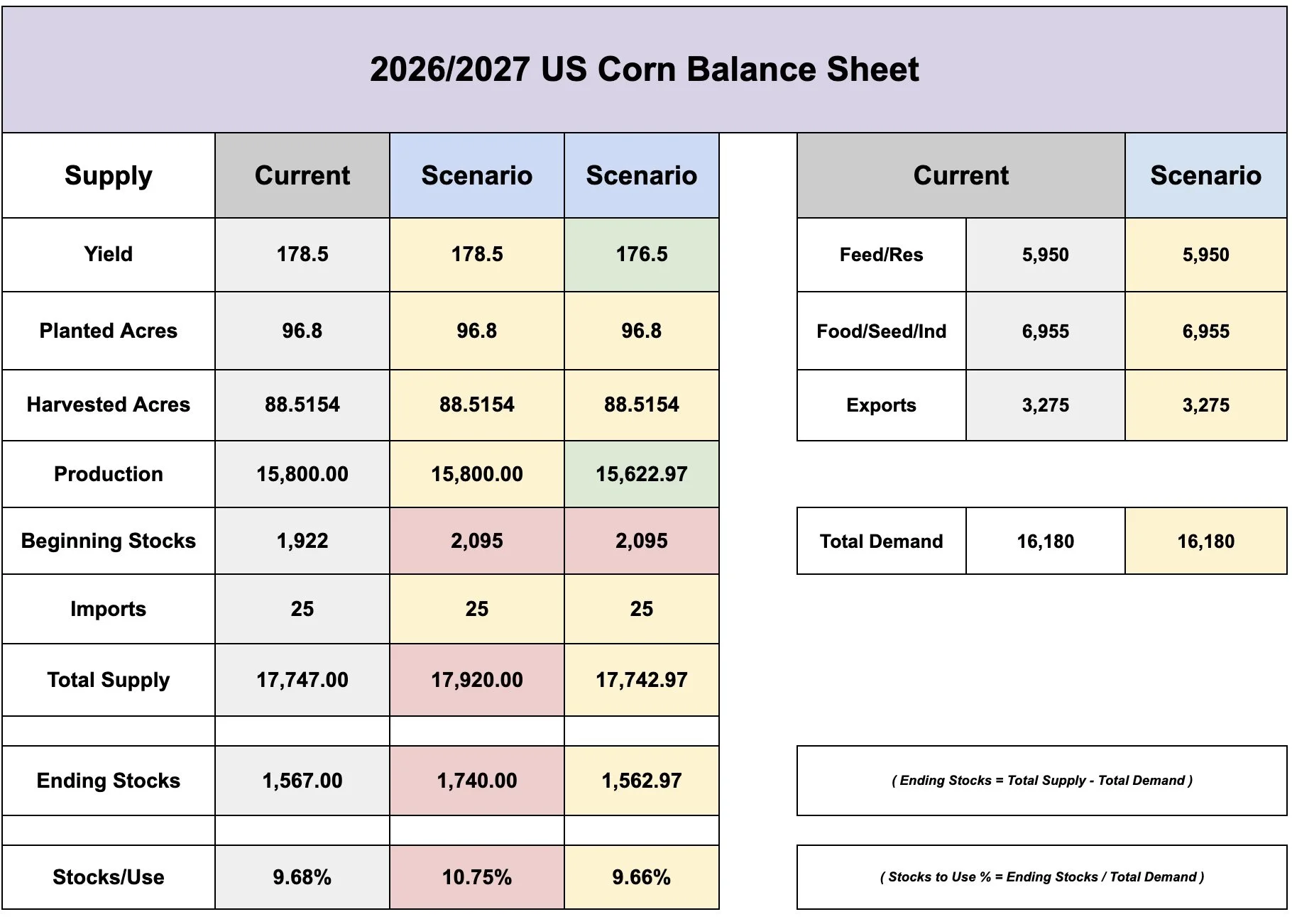
Here is what a 9.7% vs a 10.7% stocks to use looks like.
The current number vs how these extra stocks would affect the balance sheet without changing anything else such as yield or demand.
It would be a big change.
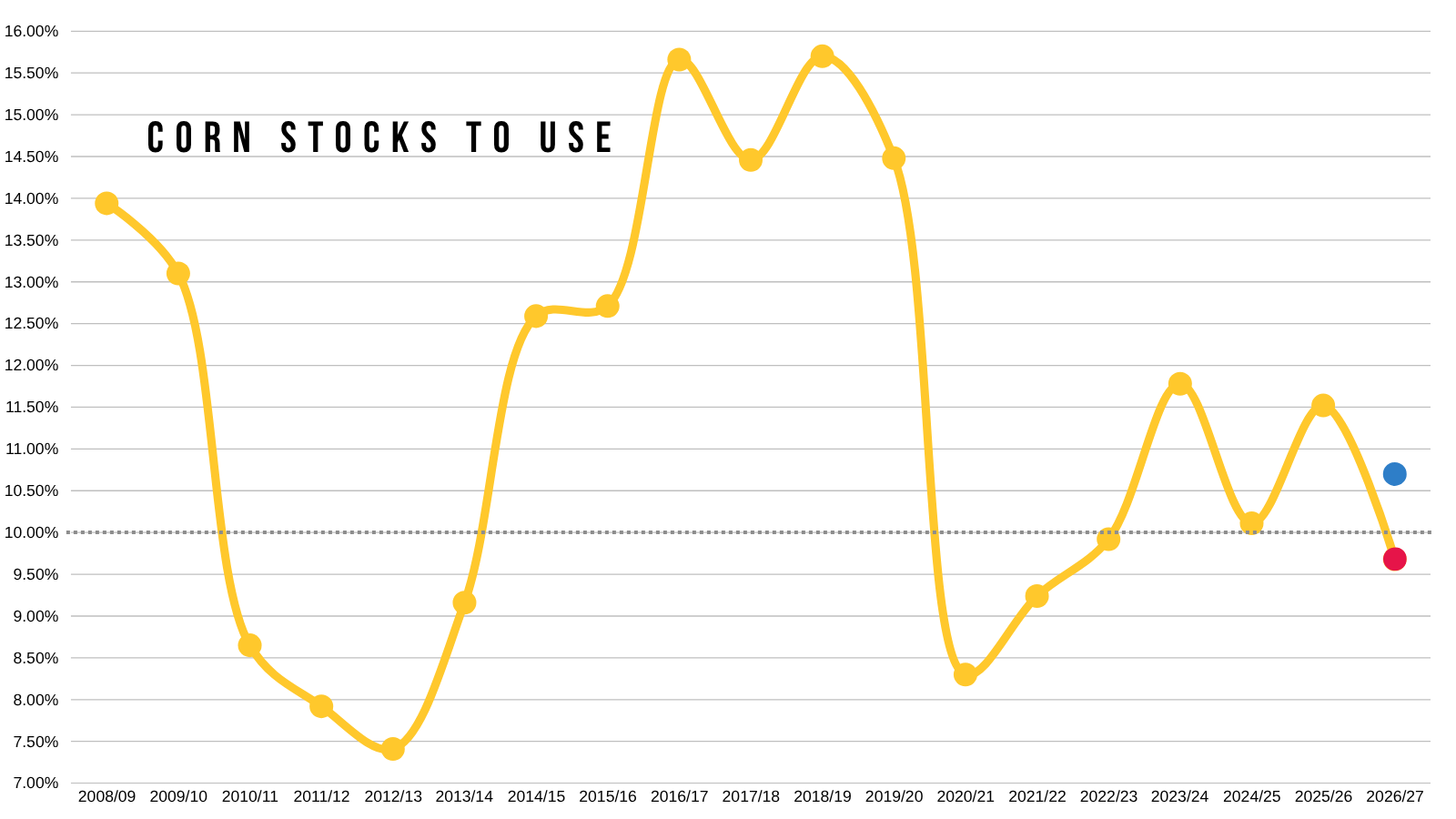
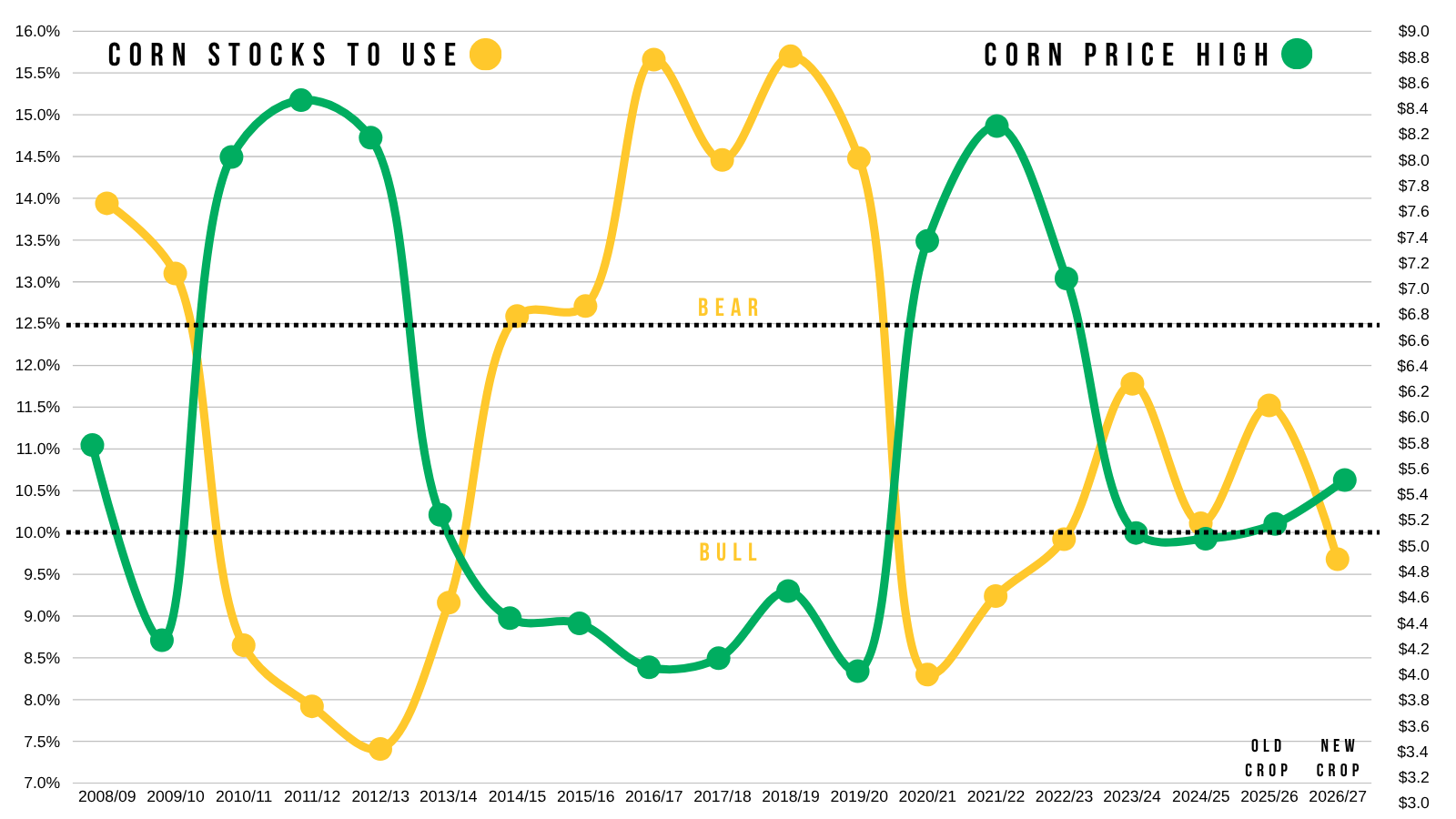
That change would bring you out of that "bullish" territory we always talk about.
So on the surface you would say that it's bearish. And the market had a valid reason for reacting the way it did.
(This chart shows stocks to use vs corn prices)
But I am very confident the USDA will be lowering yield from here.
Why would the USDA cut the old crop demand by that much? Maybe it's because they already know they are going to be dropping the new crop yield..
Small crops get smaller.
The trend for the balance sheet has clearly been lower.
Which brings me to my topic..
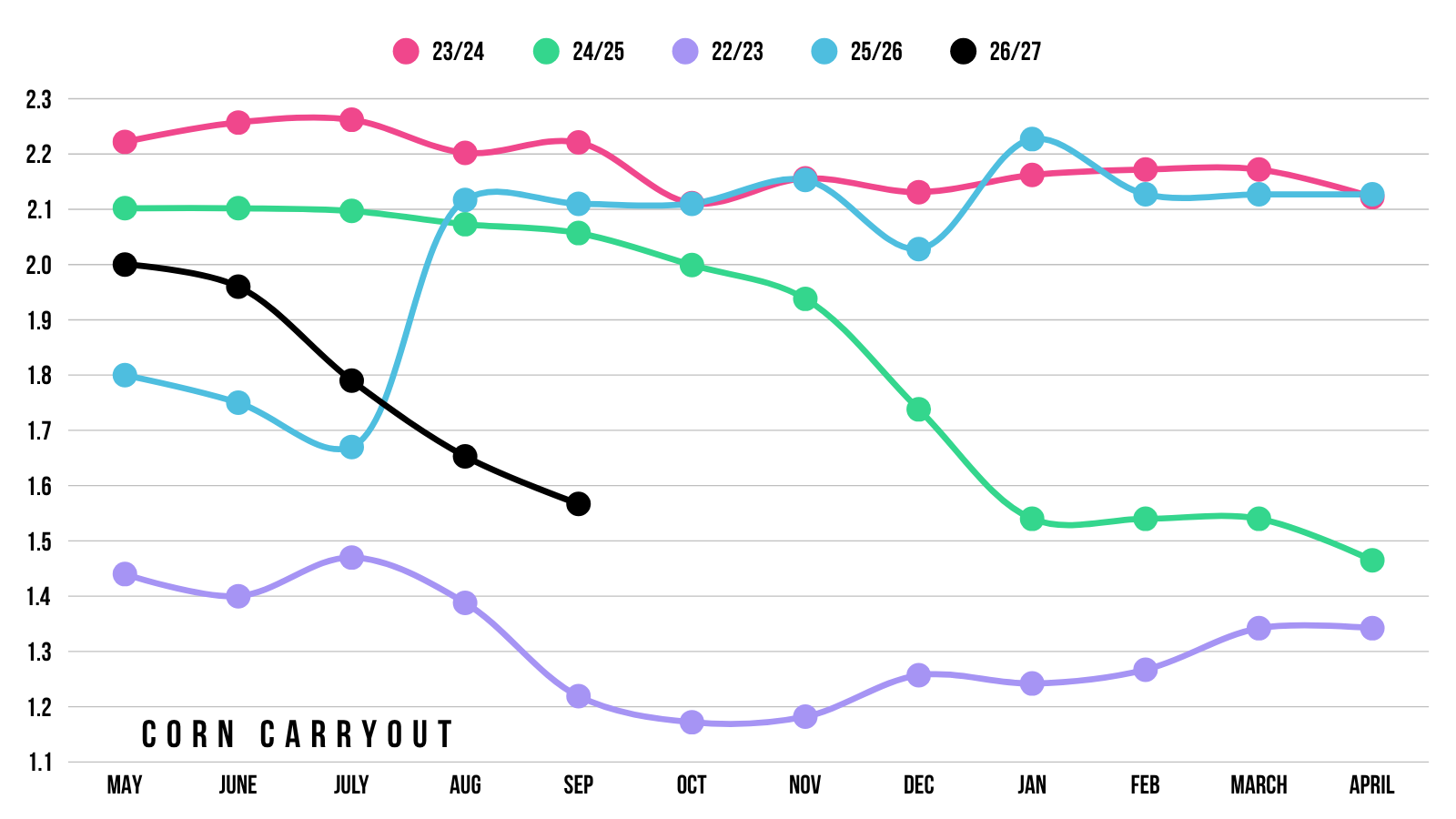
Deep Dive into 2010 vs 2026
You've heard us compare this year to 2010 several times this year.
But that comparison might’ve actually just got stronger believe it or not.
In yesterday's audio, Jeremey talked about what happened on this report back in 2010. But let's dive deeper into this comparison.
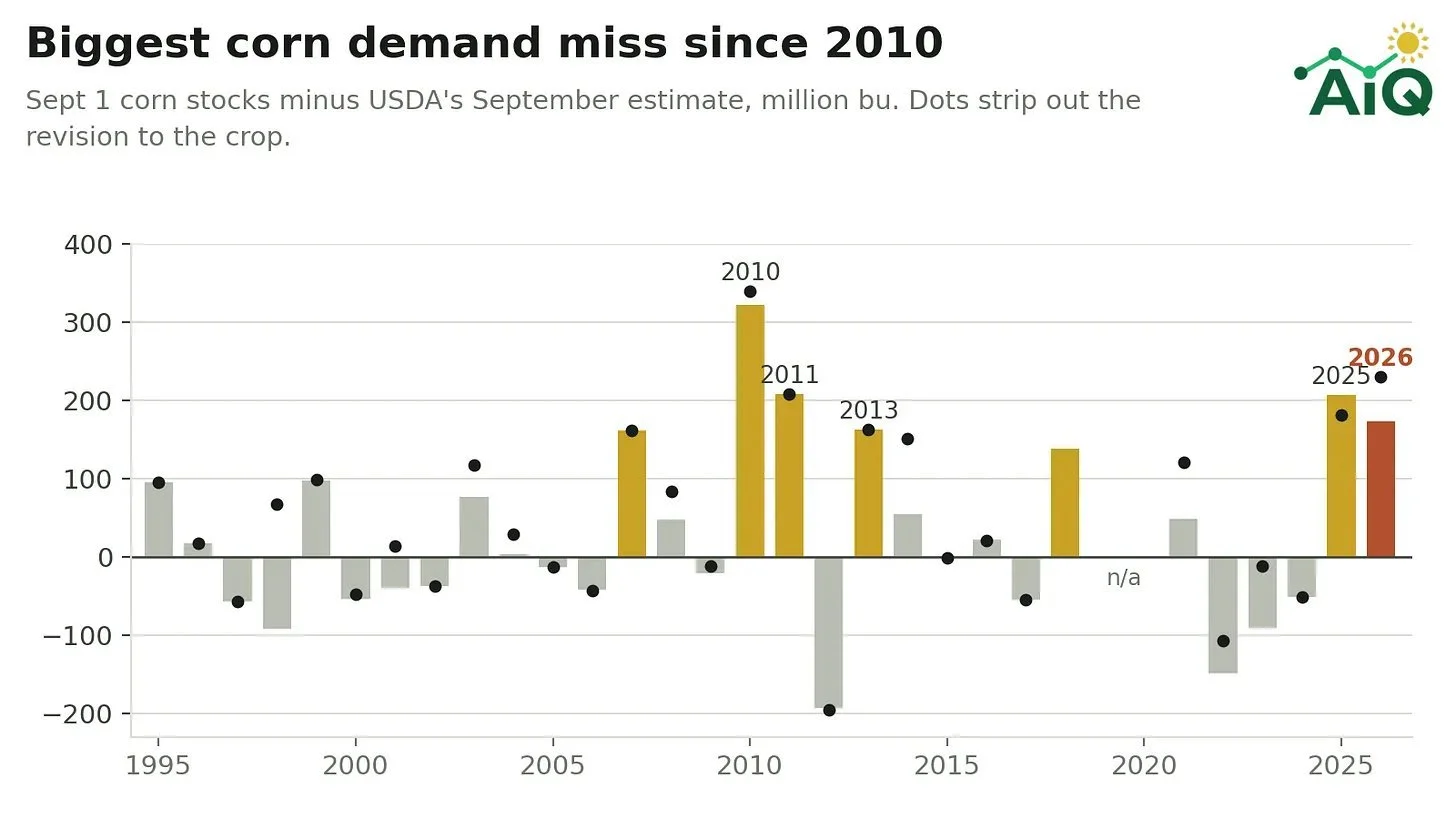
First off, here is a great chart from Nico (@NicoAIQ on X).
The bars show the Sep corn stocks minus the USDA's Sep estimates.
The dots take away the changes to the production, aka they track the demand change.
The USDA missed demand by 230 million bushels yesterday.
The only year that had a larger demand miss?
2010.
What exactly happened in 2010?
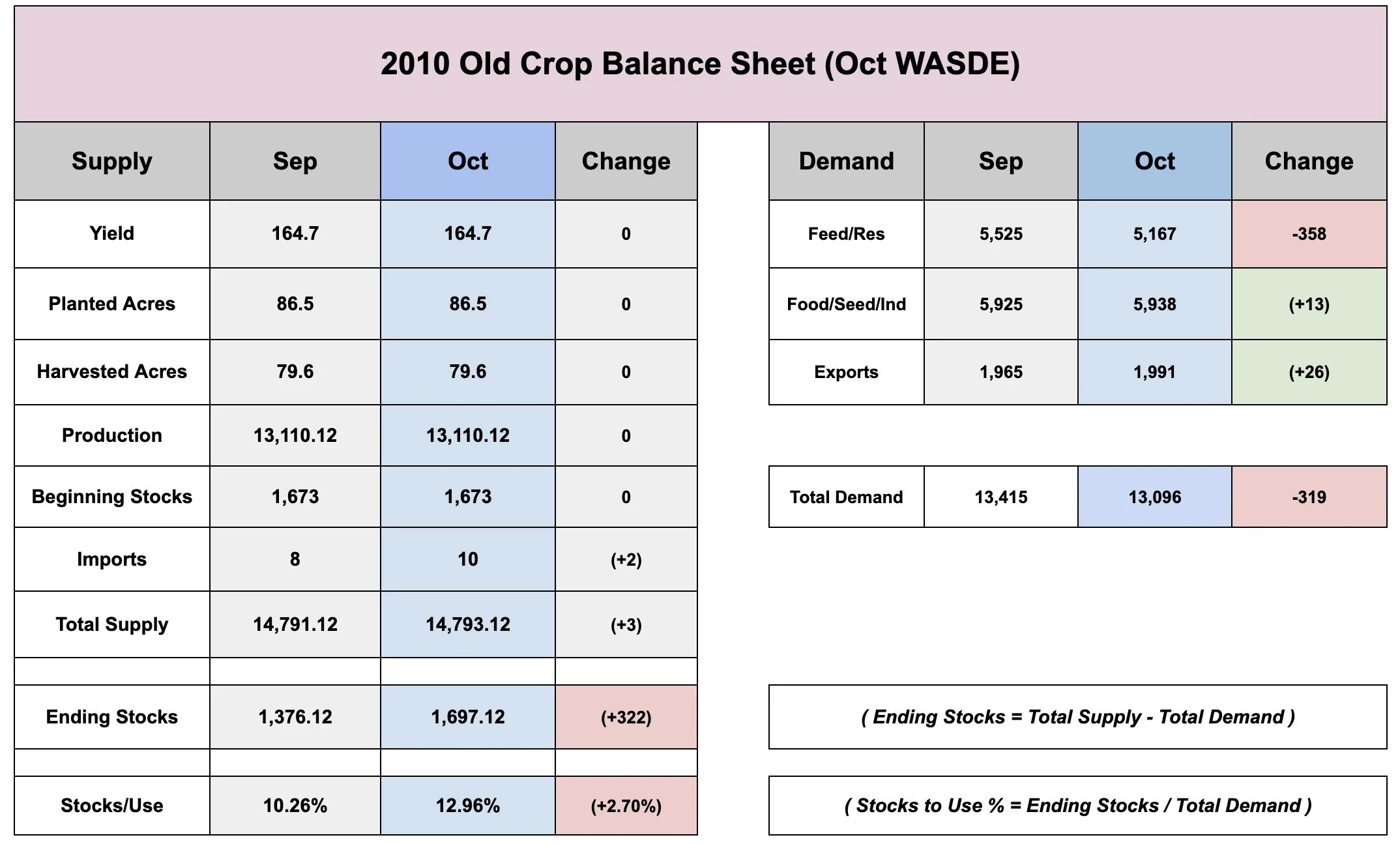
In the 2010 Sep stocks report, the USDA added 322 million bushels of old crop. Due to a massive miss on feed and residual demand. Similar to this year, although 2010's was an even larger miss.
Here was the changes they made to the old crop balance sheet in the October WASDE. All they did was cut feed and residual massively.
What happened next?
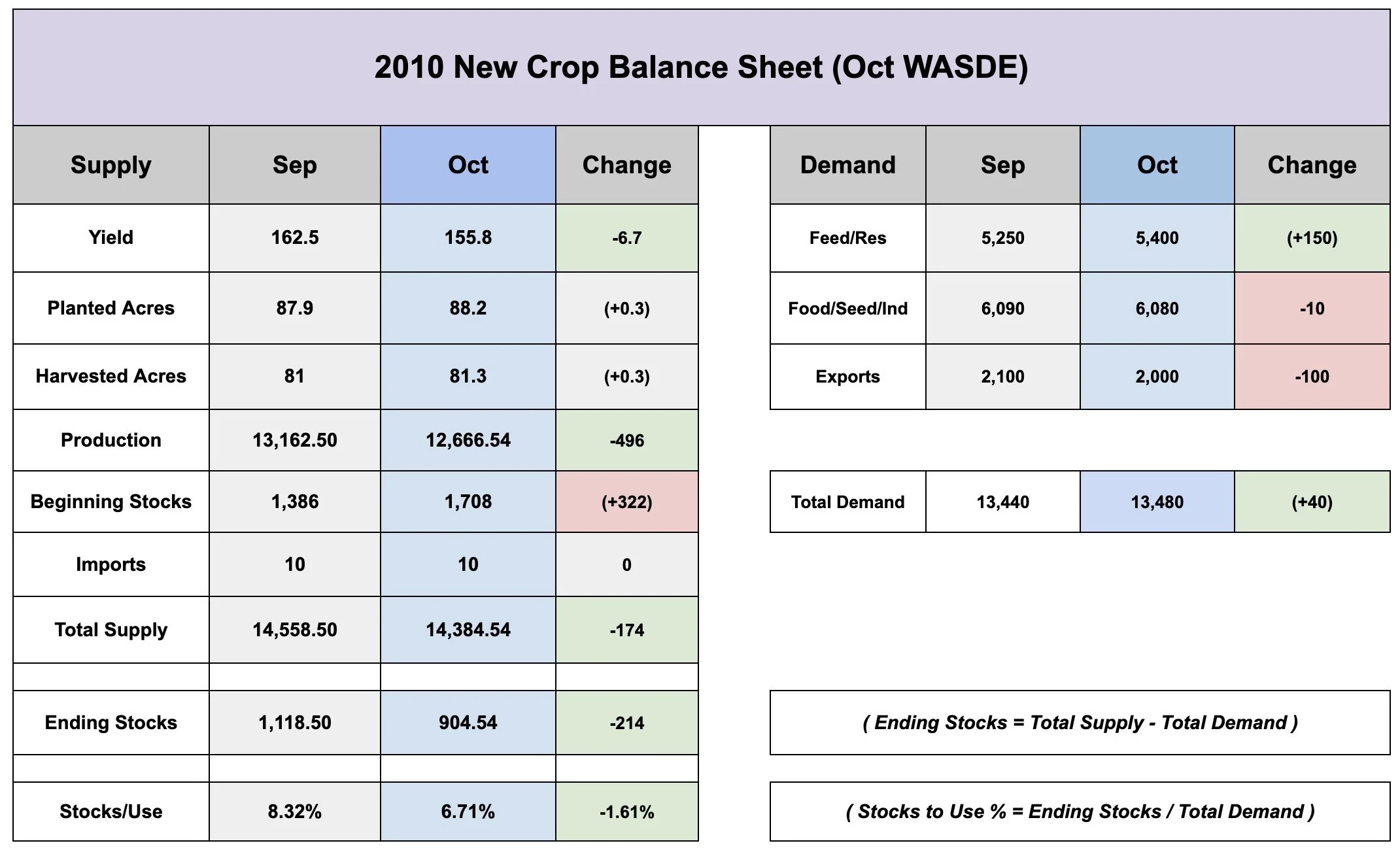
Here is the new crop balance sheet changes from the October WASDE. Which happened 8 days after the stocks report.
Beginning stocks increased by over 300 million from the old crop stocks report.
The USDA then cut yield from 162.5 down to 155.8 bpa.
Which led to production dropping nearly 500 million.
So despite the massive increase in old crop, the new crop balance sheet actually got smaller. As new crop carryout dropped over 200 million.
Because the drop in yield more than offset the extra old crop.
Maybe we don’t see the exact same situation play out this year, but I would have to imagine that the USDA will be cutting the crop to some extent.
Again.. maybe the USDA knows they are going to have to cut yield this year.
So they dropped the feed and residual first to help offset the losses to supply. Just like they did back in 2010. Given that feed and residual is their "plug n play" number.
This report isn’t the only thing that makes me think this year has similar vibes to 2010.
The other big one is price action.
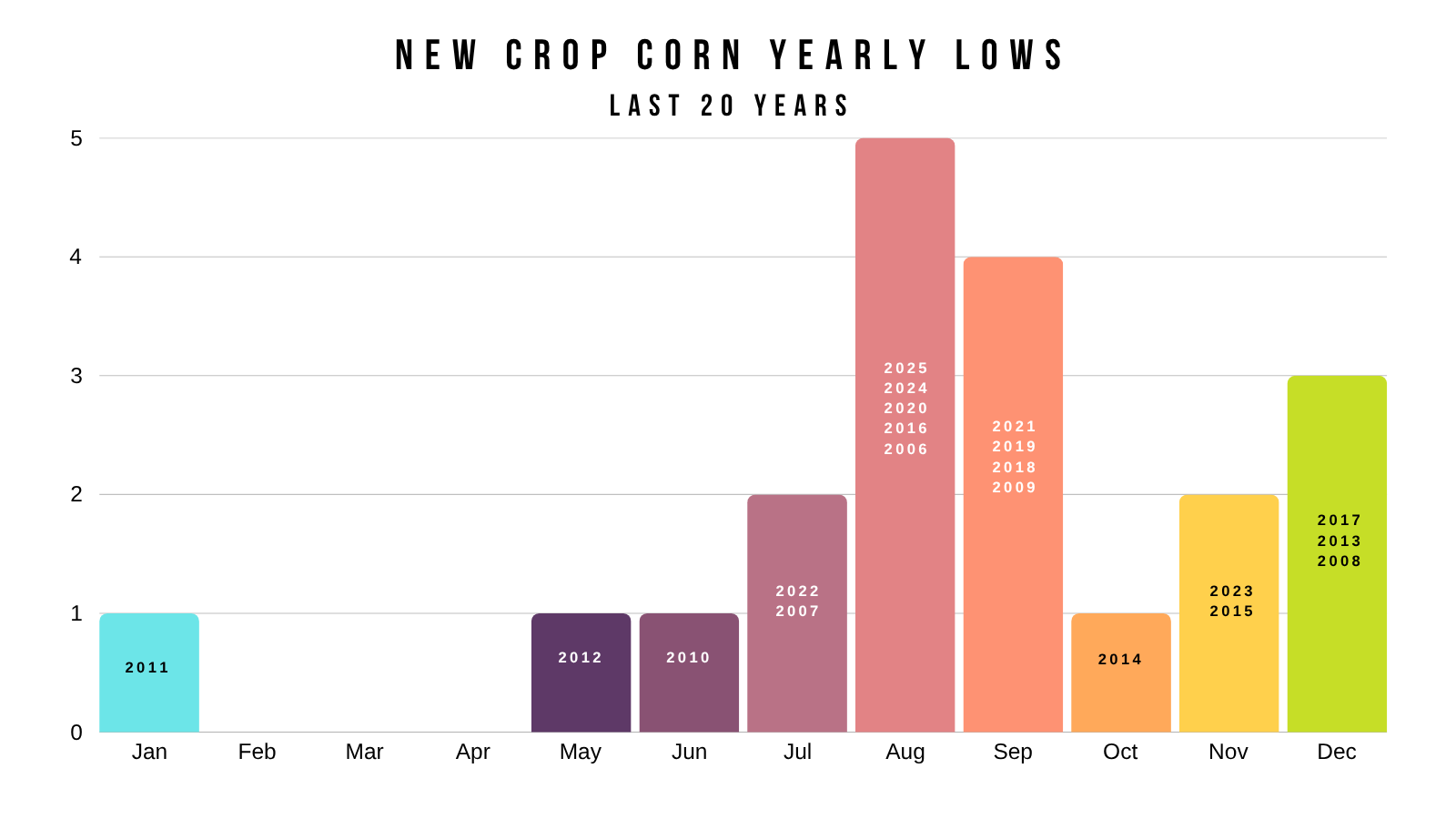
Before this year, corn has only posted it's lowest price of the year in June one time ever.
The year was 2010.
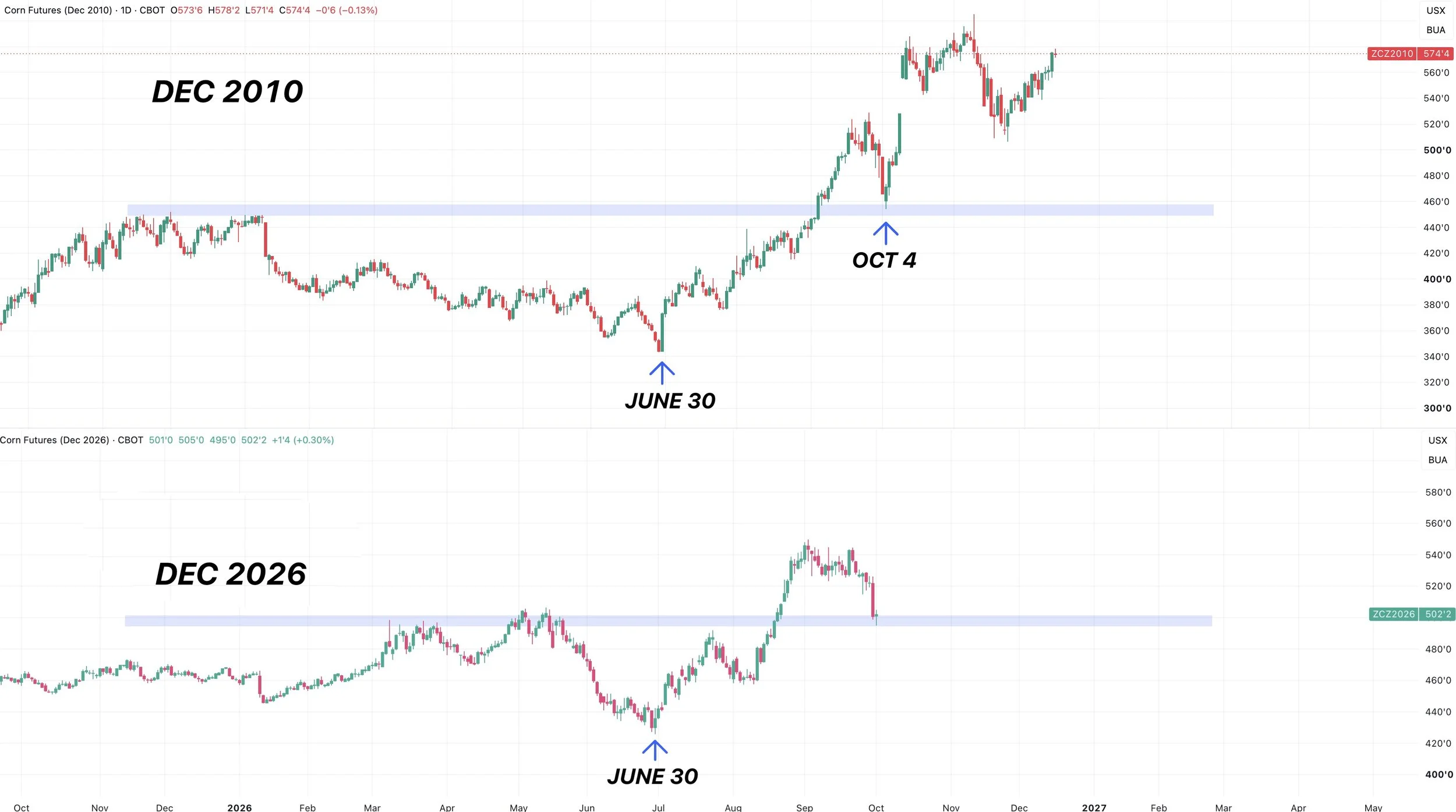
Here is a side by side chart comparison.
In 2010, corn bottomed on June 30th.
When did we bottom this year?
June 30th.
In 2010 we sold off after the Sep stocks report.
We then came down and tested the previous highs before finding a floor and heading higher.
Similar to what corn is doing right now. We sold off on the Sep report. We are testing the previous highs.
This year doesn’t have to play out exactly like 2010.
History does not repeat. But often times it does rhyme.
You can’t deny that the two years offer some intriguing comparisons.
Today's Main Takeaways
Corn
Fundamentals:
I'm not going to spend much time on the fundamentals today.
Overall, long term corn still has plenty of friendly factors going for it heading into 2027.
I still believe the crop is getting smaller from here.
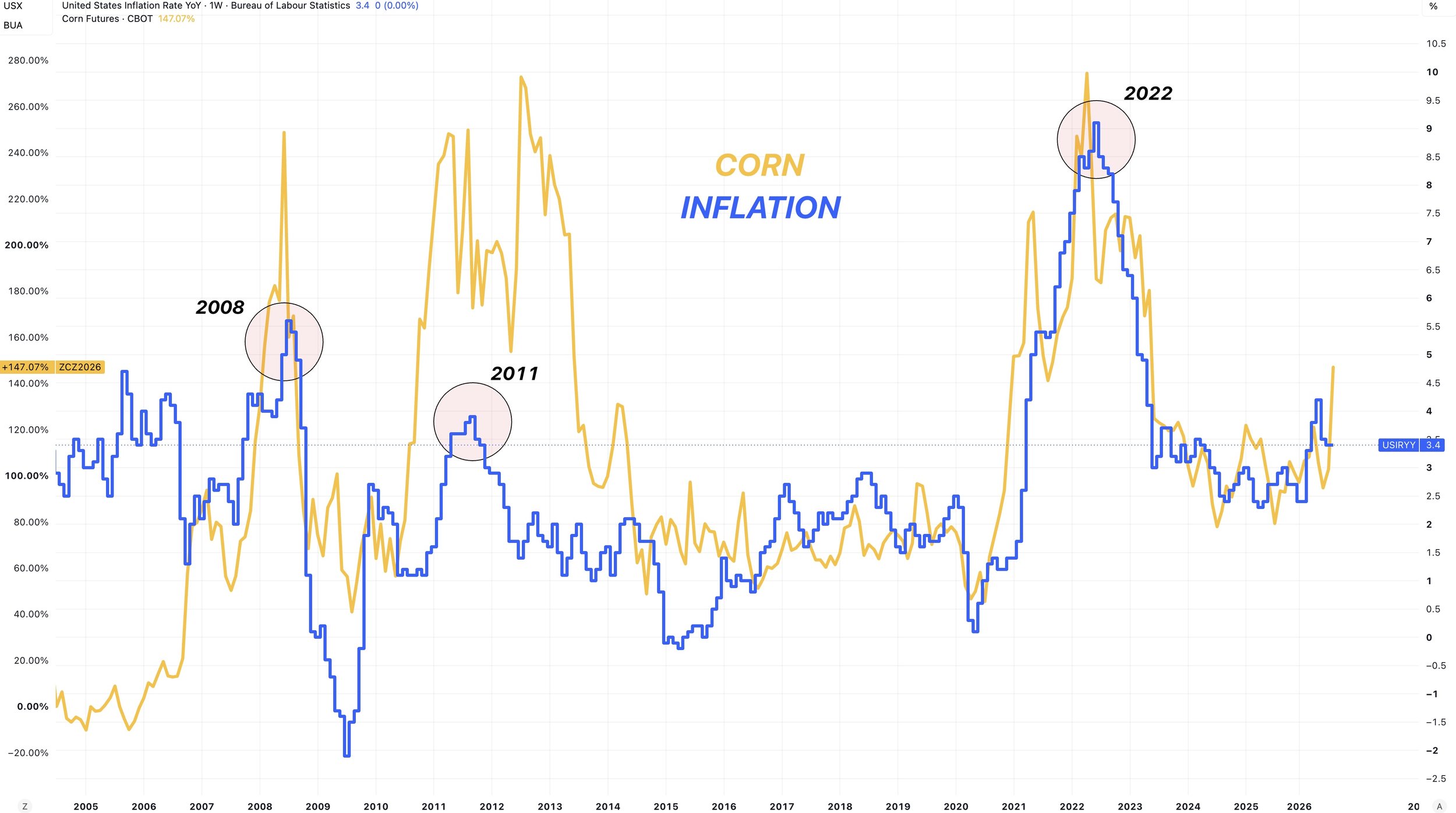
You have the macro story with inflation, diesel, and crude.
The inflation story hasn’t went away.
Inflation is a common theme in bull markets, and probably one reason for the record length in funds from the grains.
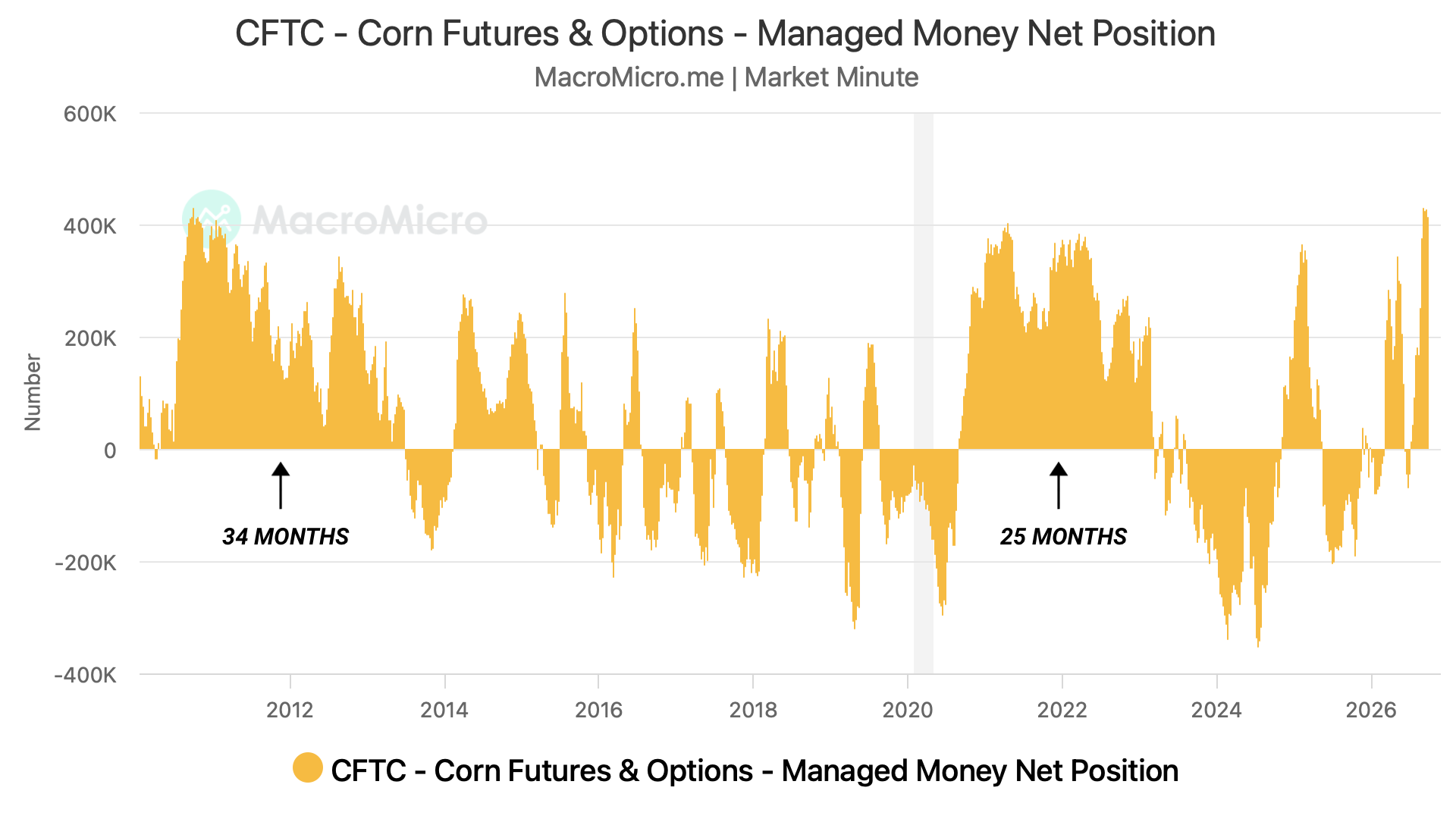
It was estimated that the funds sold 75k of that record position yesterday.
Some would argue, what happens if they liquidate the rest?
Valid concern.
But I still think they are going to defend that long position for the most part.
There are only 2 other times in history the funds have been long over 400k contracts.
2010 and 2021.
Both times they didn’t give up that position without a fight, and held on for a few years.
Bottom Line:
I've seen a lot of people who were super bullish when corn was trading at $5.50 suddenly saying the corn story is over.
They have it completely backwards.
Human emotions are a funny thing. Everyone gets the most bullish at the top as it builds confidence. Everyone gets the most bearish at the bottom because it sparks fear.
I sent out a sell and hedge alert on Sep 2nd, as I have been very vocal about the short term risks heading into harvest. As there was a reason to be cautious up at those levels.
Now we've got the pullback we've been waiting for. One report isn’t a reason to think the big picture story in corn is suddenly super bearish.
The time to be cautious was 50 cents ago. Down here at support is not the time to finally flip bearish on corn.
Do you remember the last super bearish report in corn this year?
In January we tanked. But it ended up marking the lows.
Markets often bottom on bad news and top on good news.
Bearish Report Favors Reversal?
Here is one last thing I wanted to show.
Corn just had it's worst performance for this report since back in 2011.
It's 3rd worst in at least the last 20 years.
But what has historically happened next when we traded lower on the day of this report?
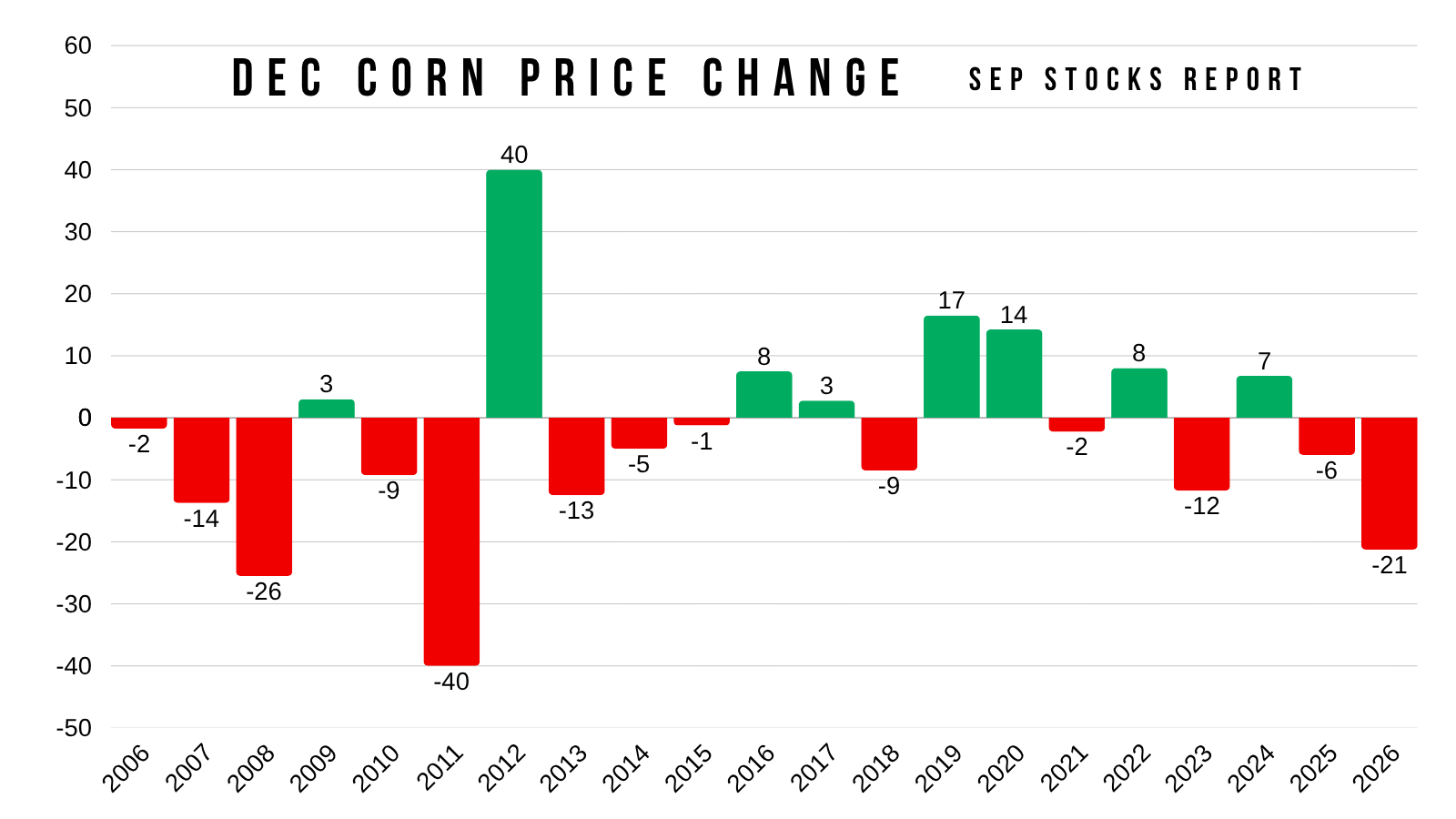
This next chart shows every year we traded lower on the day of the report, and what happened to prices exactly a week later.
In 9 of the 12 years we were higher just a week later.
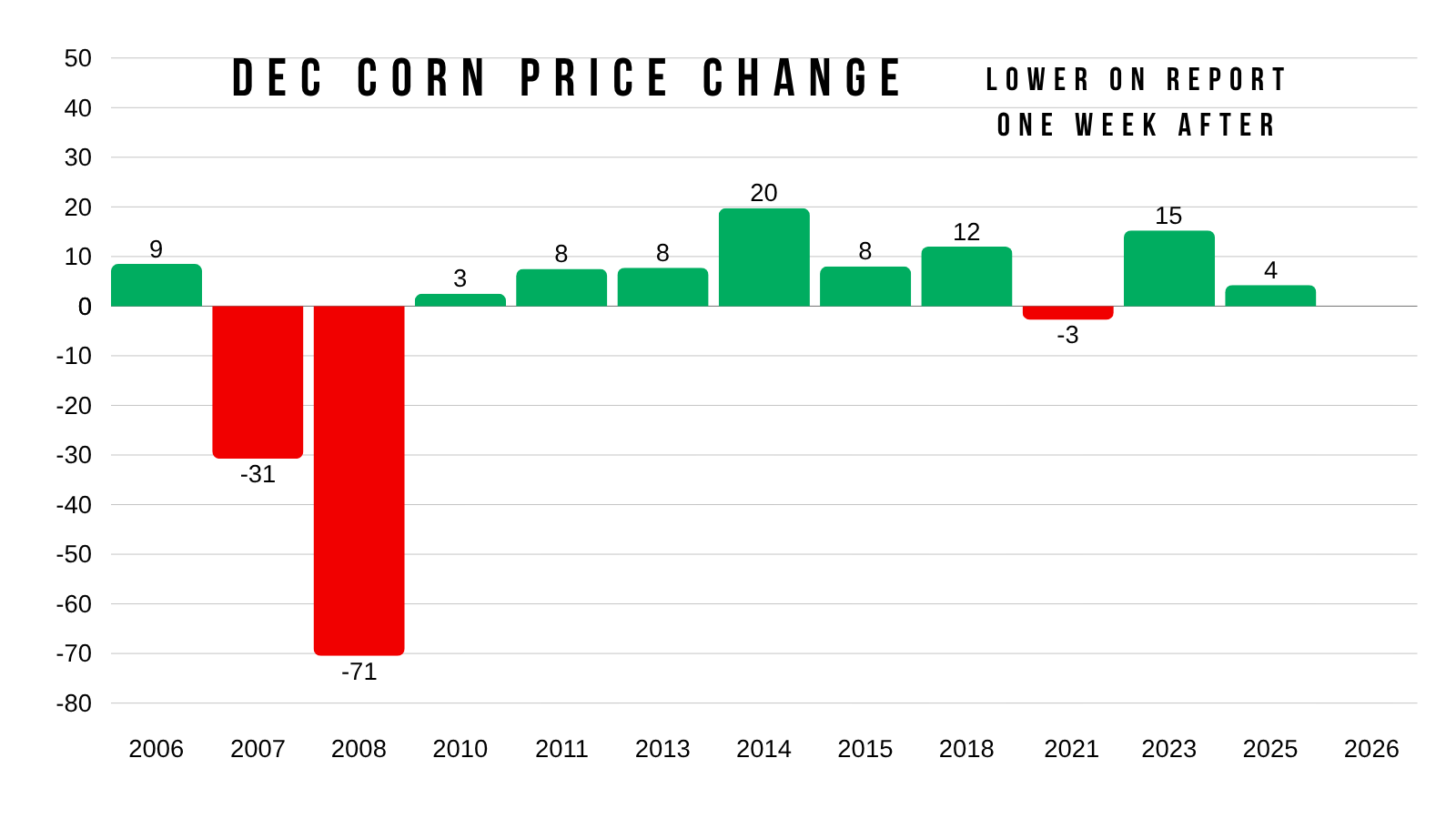
This one shows what happened to corn a month later following being down on the report day.
Same thing here.
A month later corn has been higher the last 9 of 12 years.
If you remove 2008 from both sets of data it's even more compelling.
As 2008 was an anomaly of a year, as the world was in the process of collapsing.
Corn Charts
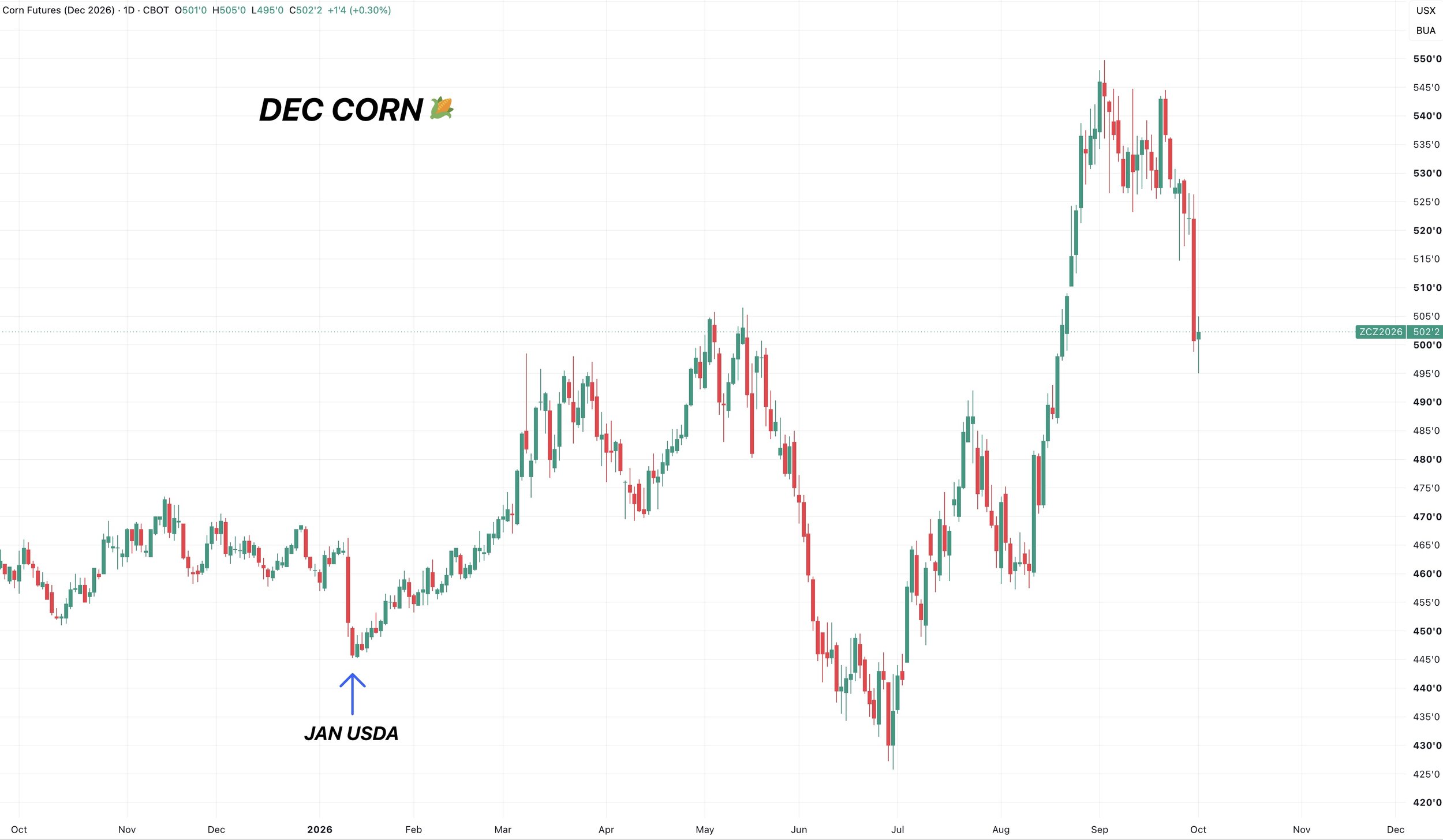
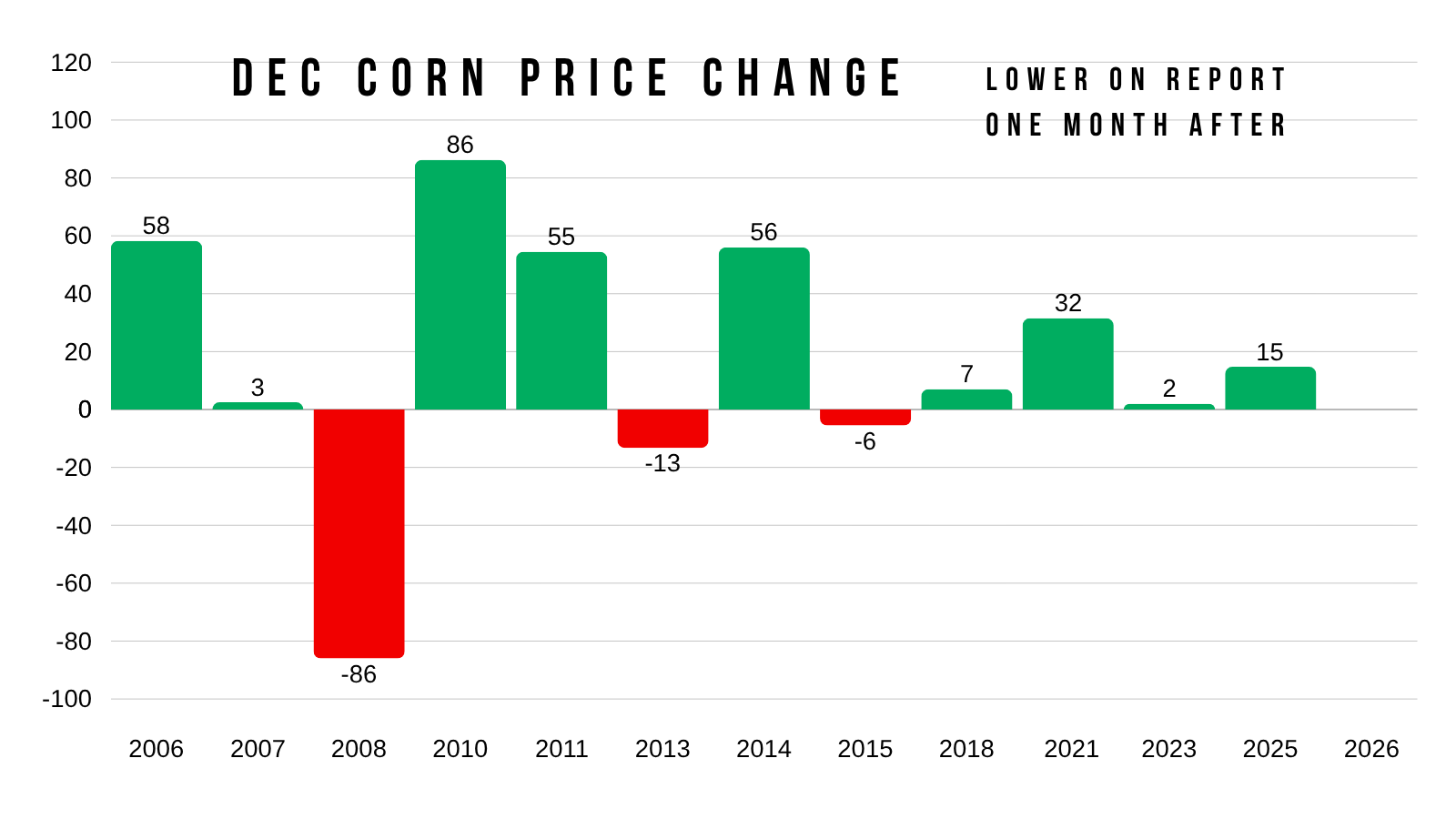
Dec Corn Daily Chart:
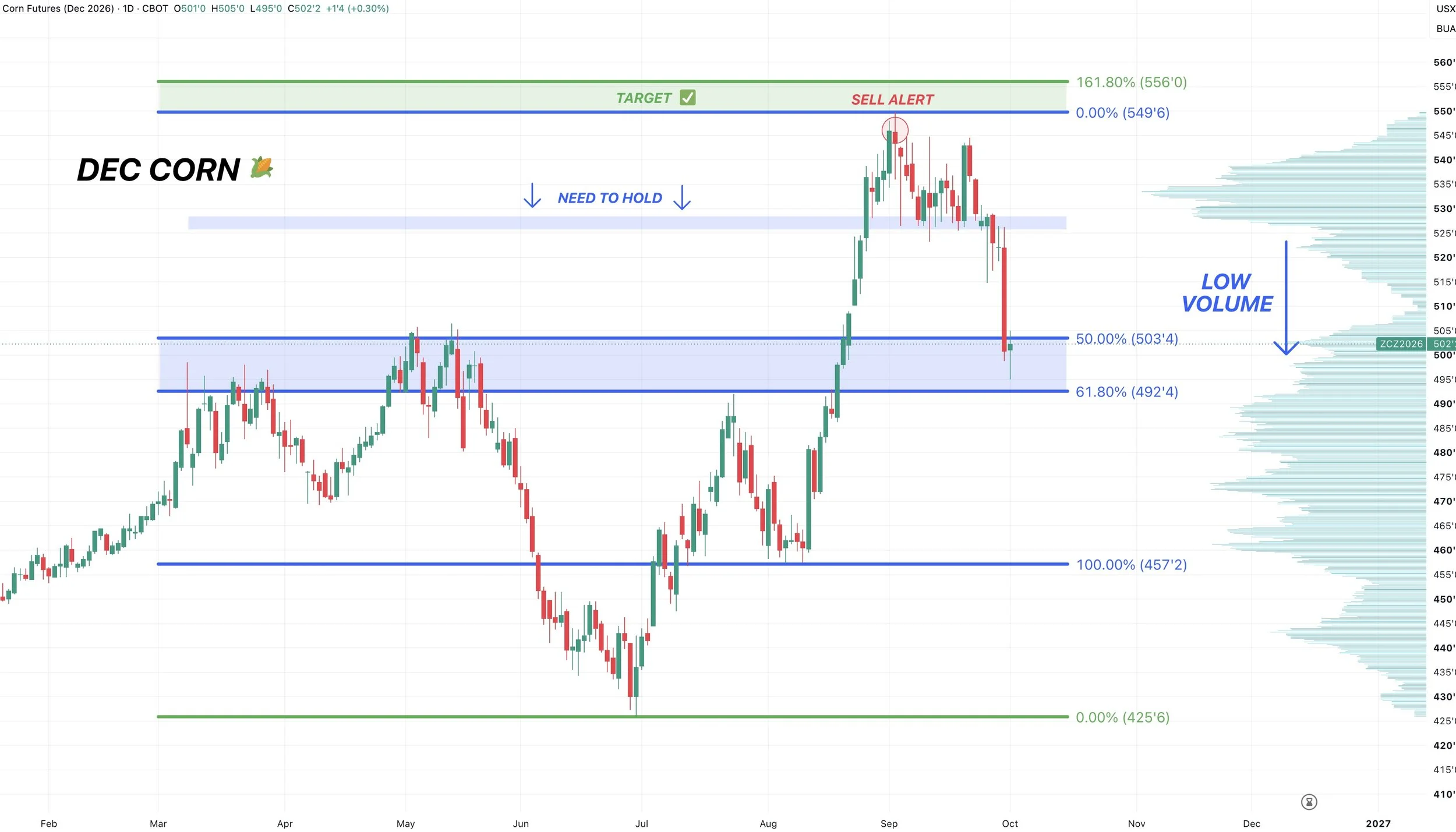
Obviously corn doesn’t have to find a bottom here, but this logically would be where I would expect us to carve out some lows.
For the last month, I have been pointing out that massive volume gap to the downside if we broke below that prior range.
Since we broke below the range, there was zero support below this market or volume to catch us. So we sliced right through the volume gap.
Now corn is sitting right in the golden zone. Having given back 50% to 61.8% of the entire rally from August.
Not only that but we are re-testing those highs from May.
We also are now back at an area of high volume, since we fell straight through the area of low volume.
So if we are going to find a bottom anytime soon, this would be the area I would expect it to happen.
If we fail to hold the 61.8% level and $4.90, then I would start getting more concerned. But for now, we're at support.
We have not yet sent out a buy signal, but if you were someone who wanted to re-own corn back near the highs, or you'll want to re-own if corn bounces higher from here, I do view this as a good re-ownership opportunity.
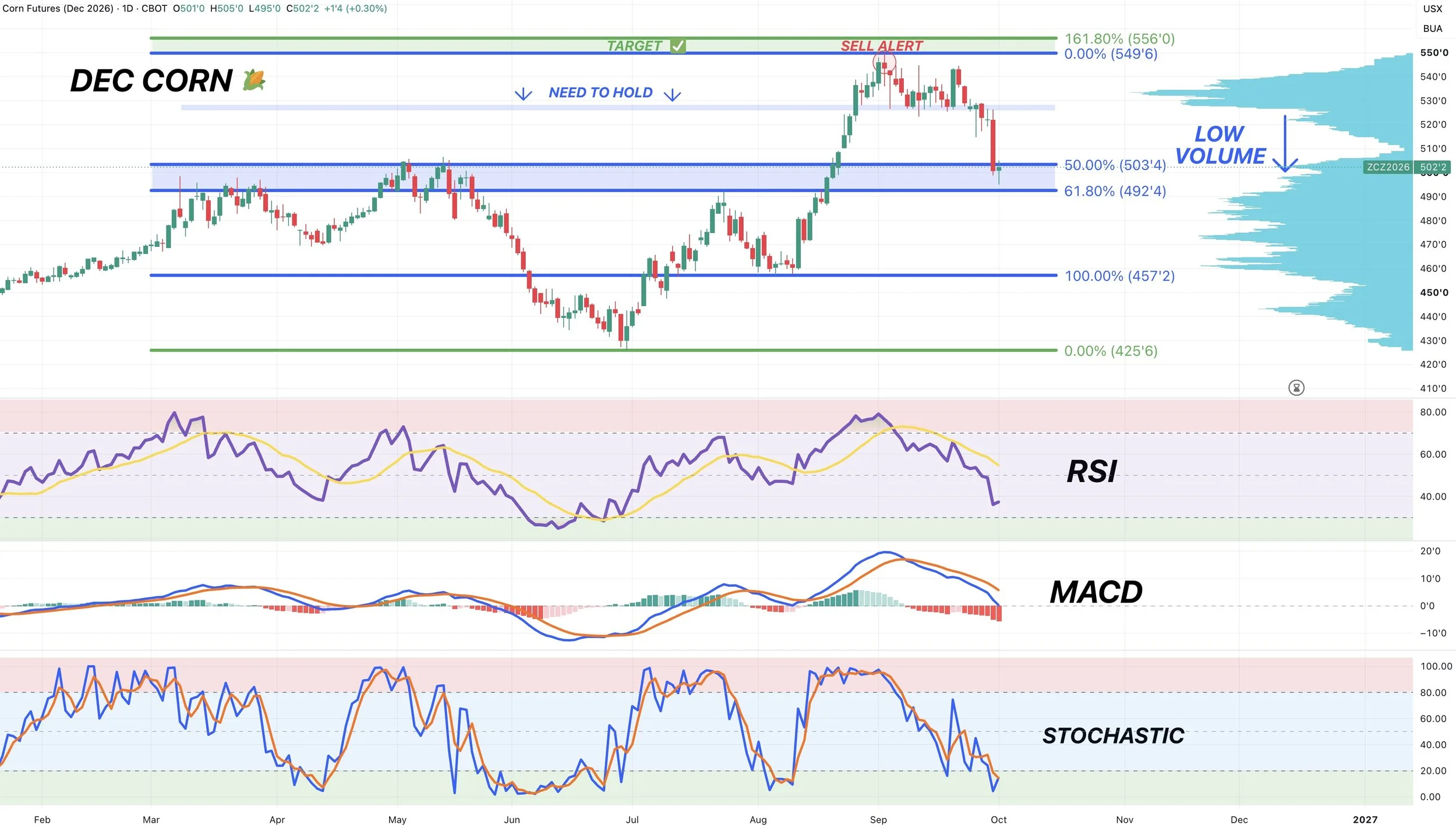
The indicators were a big reason for me being cautious the last several weeks.
As they showed no real sign or confirmation of a bottom.
However, the indicators have now cooled off.
The RSI is finally oversold. The last time we were this oversold was back when corn traded at $4.25
The stochastics have finally hit oversold status. Which is often needed when hunting for a major bottom.
Weekly Chart:
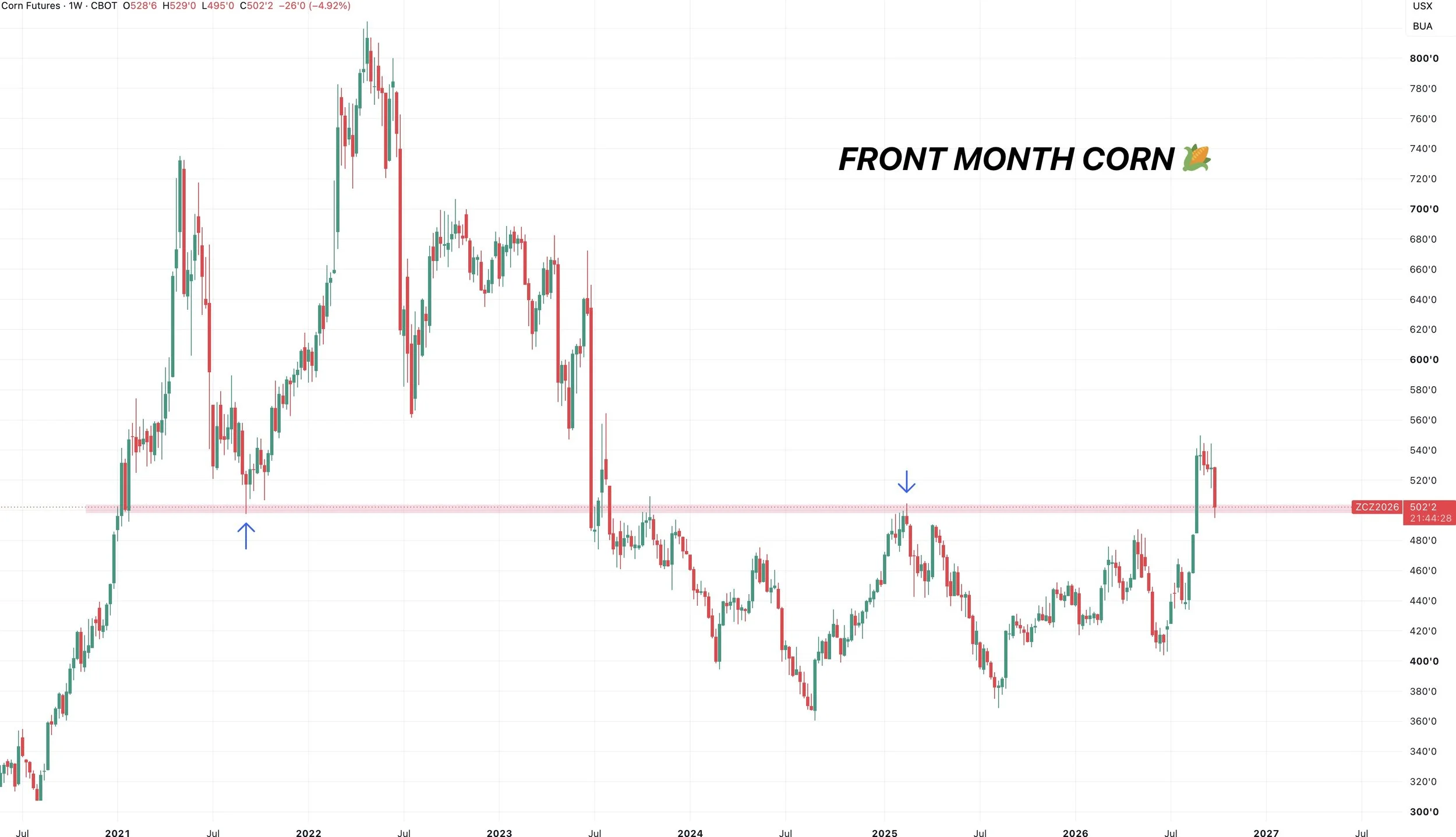
Let's zoom out.
Could this be a simple re-test on the weekly chart?
We were trapped in a massive 3 year range.
We broke out.
This was a major level. It was the highs from 2025 and lows from 2021. It marked us posting our first higher high of the entire bear market.
All we have done is now dropped back down to test that point of breakout.
Breaking out of a multi-year range is not bearish and the big picture structure is still perfectly in tact.
Soybeans
Fundamentals:
Long term I see plenty of potential as I do in corn.
However, something I have been talking about the last few weeks is the bearish seasonality for soybeans.
We tend to be weak at the end of September and early October.
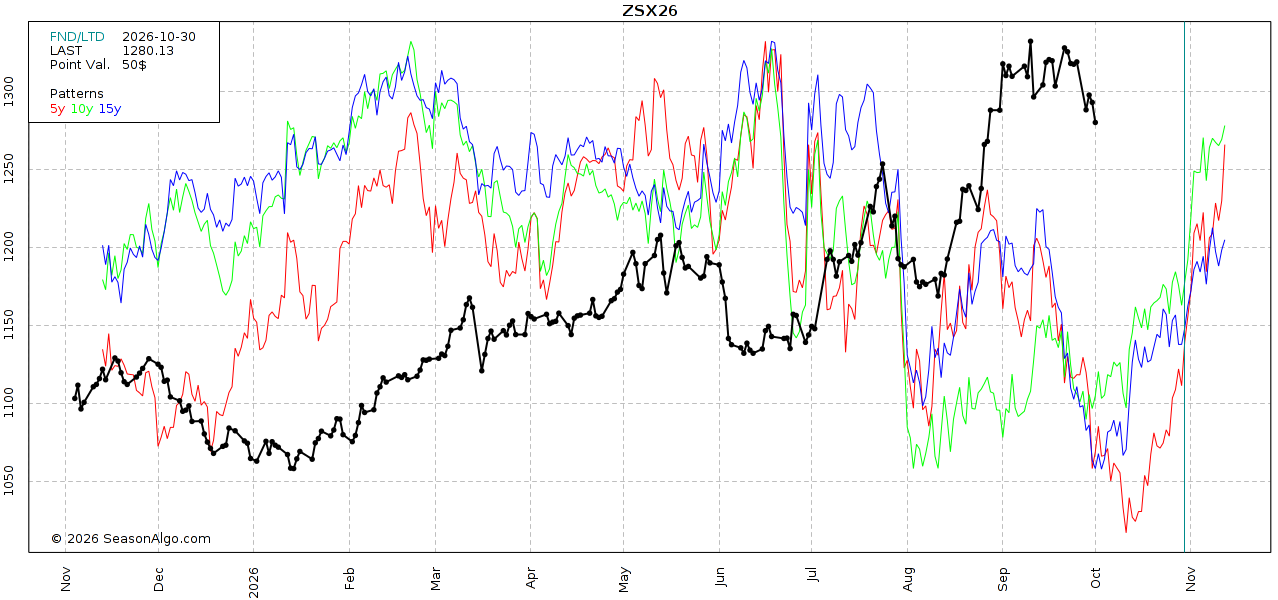
However, once we post this seasonal low here soon, soybeans have a strong tendency to run higher going into November.
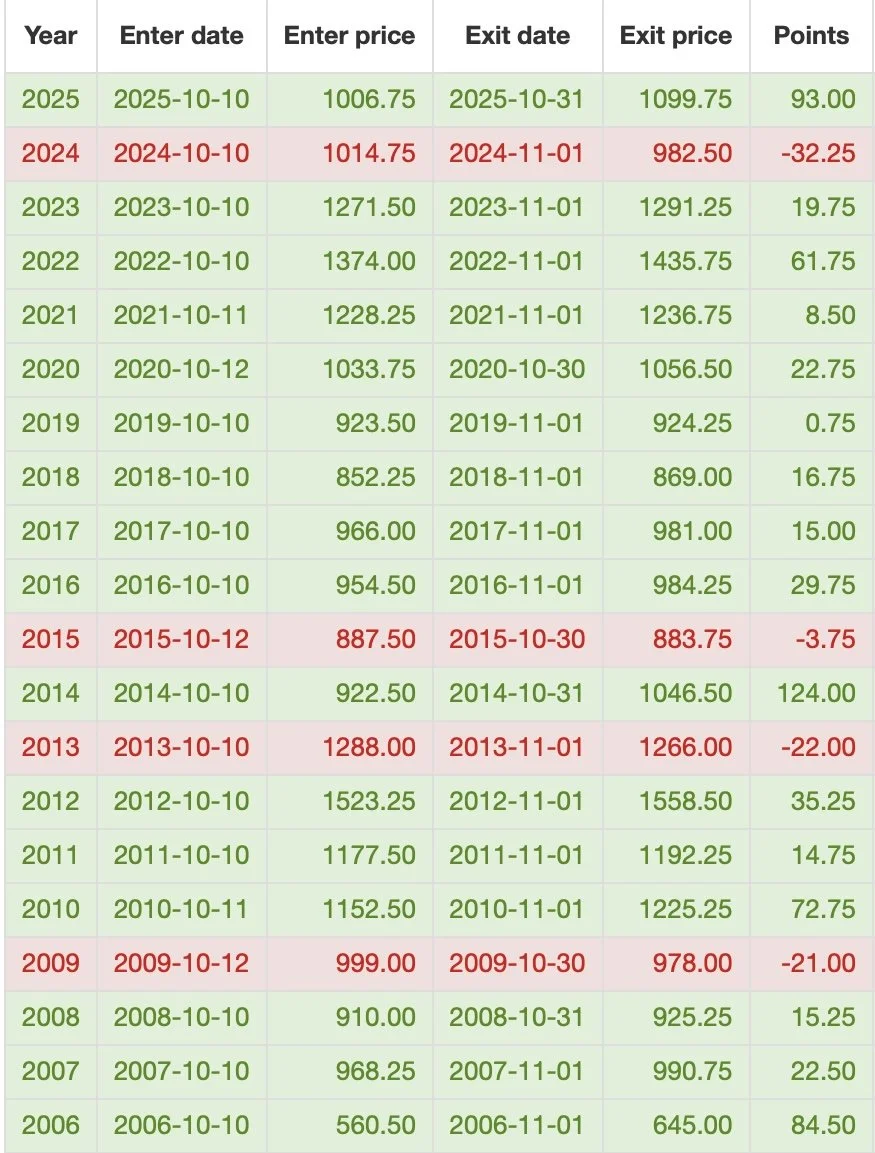
From October 10th to November 1st, soybeans have traded higher in 9 of the last 10 years.
Higher in 16 of 20 years.
That's a pretty strong set of data.
Once we get through this harvest pressure and seasonally weak time frame, there are still plenty of friendly things going for soybeans.
I'm not getting into all the fundamentals today as they haven’t changed from our last several updates.
You've got a dramatic improvement with exports this year. China is going to continue to buy, so we might have to ration business to non-China destinations as we don’t have enoughs soybeans to export the same amount as we did last year to non-China.
Crush is still a record. You still have the Super El Niño coming up which I can’t imagine will be making the world situation more bearish from here.
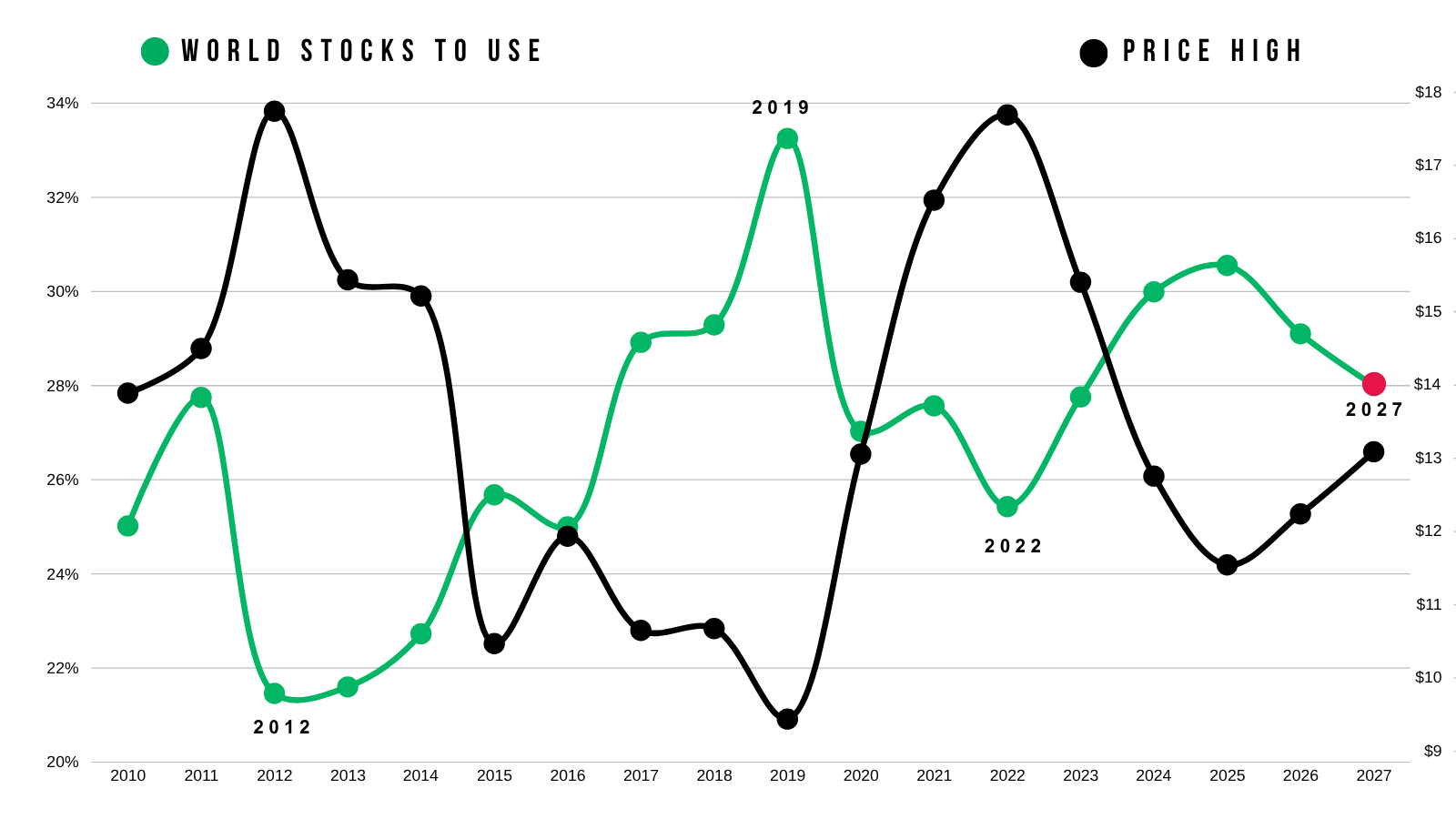
A tight world situation leads to higher prices historically.
It's at multi-year even with record Brazil and US crops. As I've went over countless times before.
Soybean Charts
Nov Beans Chart:
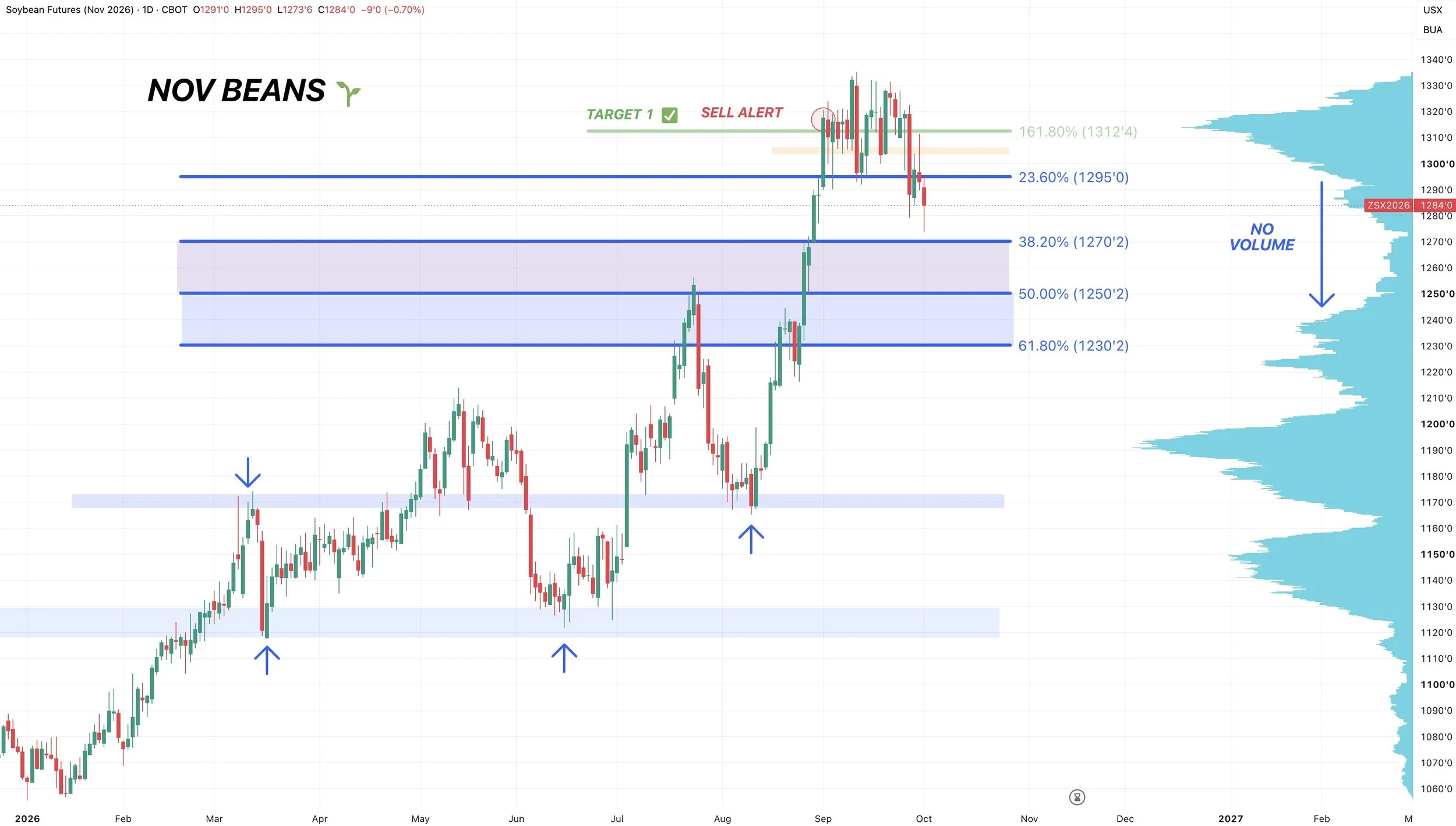
Soybeans posted new lows today, but closed well off the lows.
For me to be confident we've found a bottom, I need to see us close back up into that range above $13.00
If we are not able to do that, finding a bottom between $12.50 to $12.70 would make sense.
It gives back 38.2% to 50% of the rally from August.
If we got down to the 50% level we would also re-test the highs from July.
We need to see us get back into that prior range fast as there is still very low volume below that support.
Here is a 4 hour chart for a better visual.
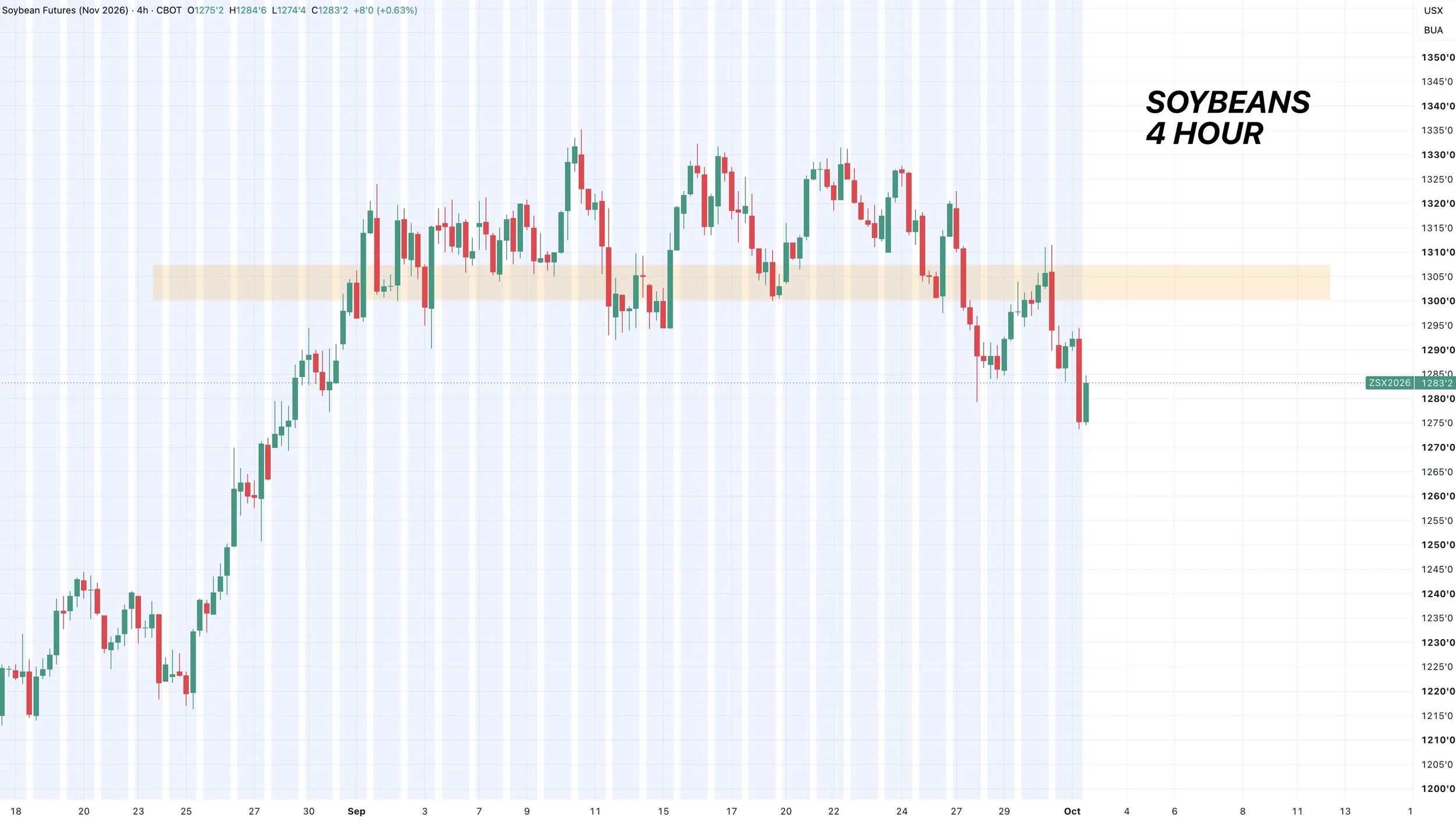
We had that clear support.
We broke it.
We came up and re-tested it. We then rejected it.
So we need to break above to be more confident the bottom is in.
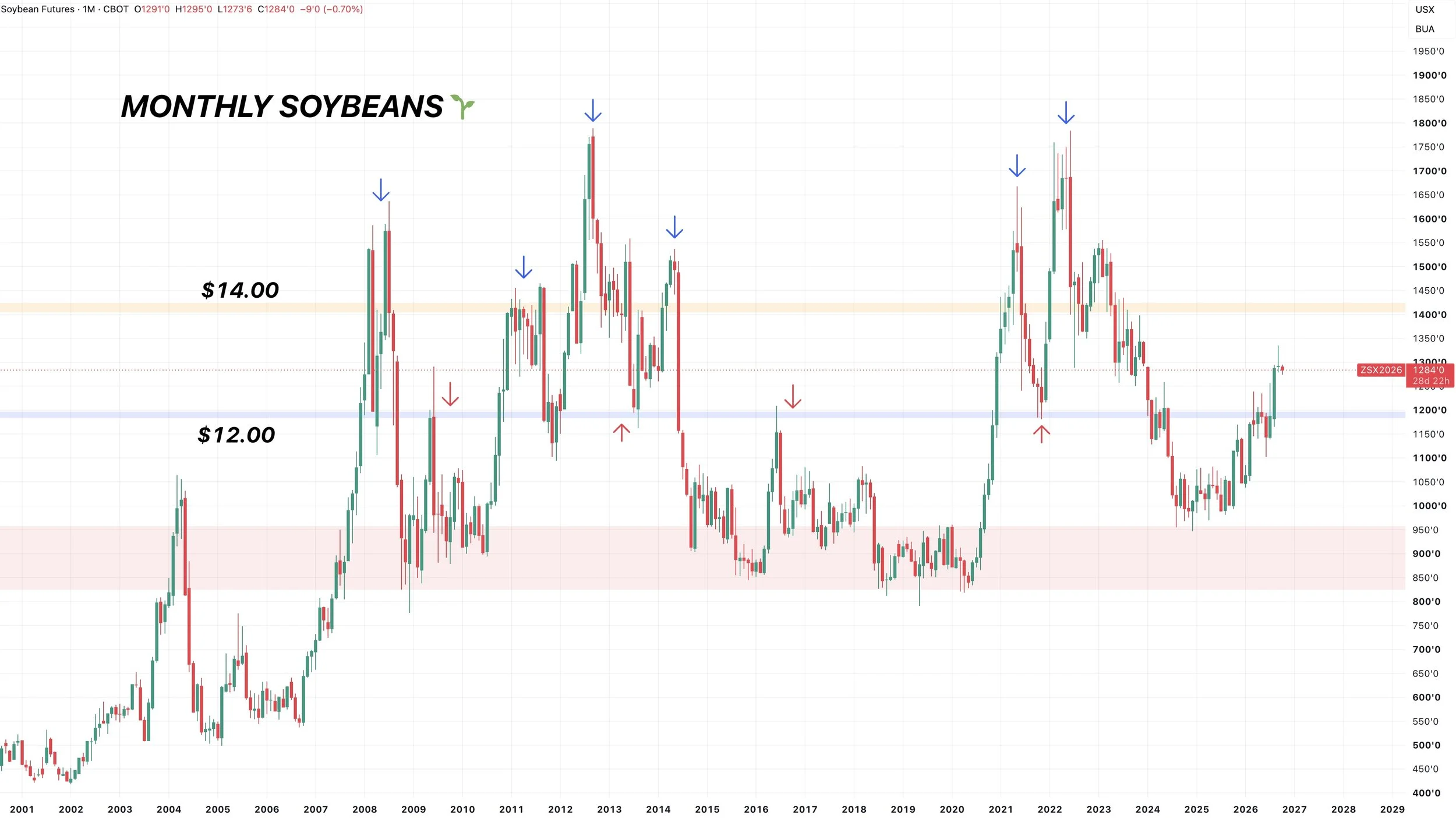
I still think beans will ultimately see $14.00 at some point in time even if takes a while or perhaps even not until next year.
Every monthly close above $12.00 has led to at least $14.00
Wheat
Dec KC Chart:
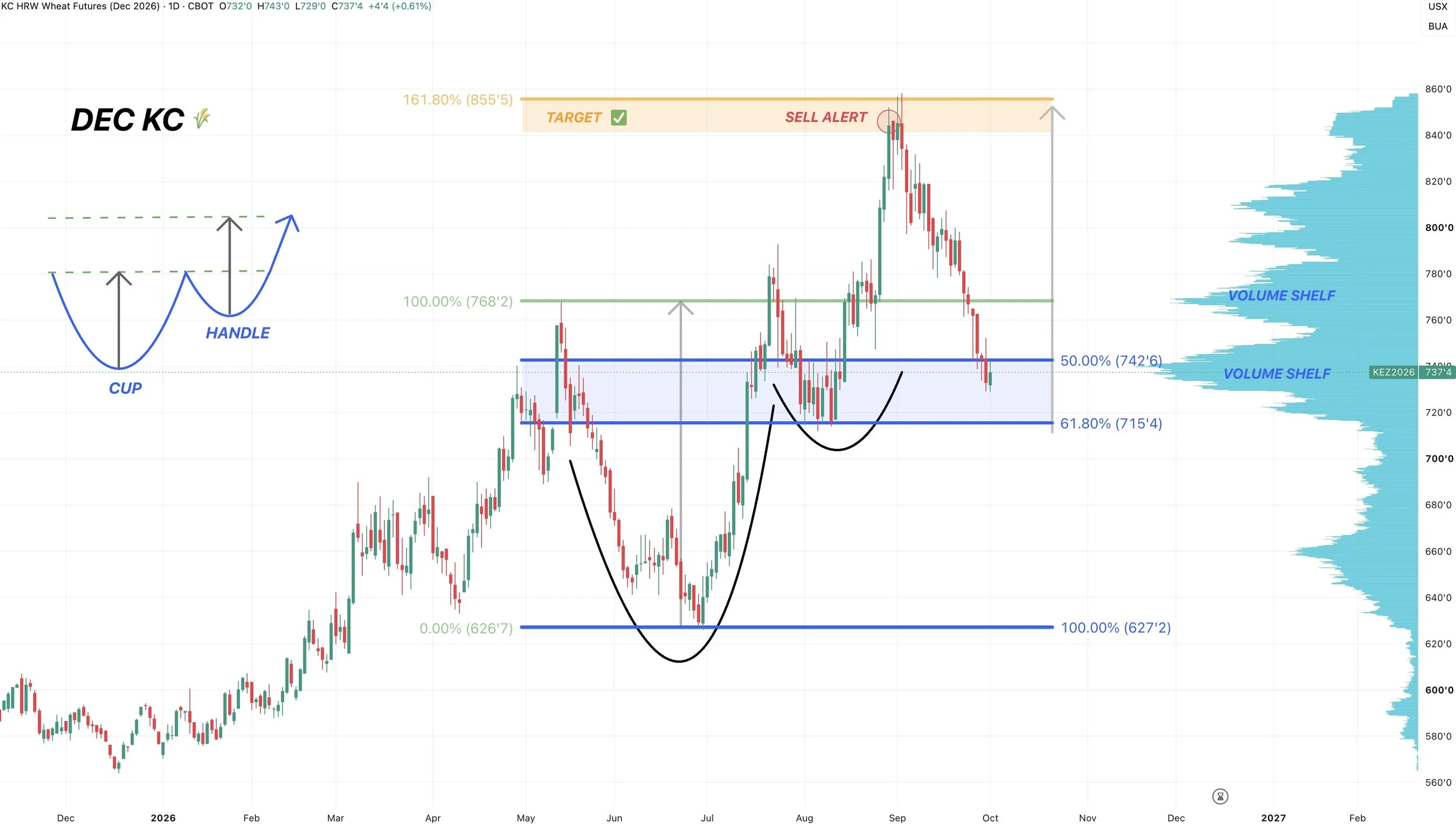
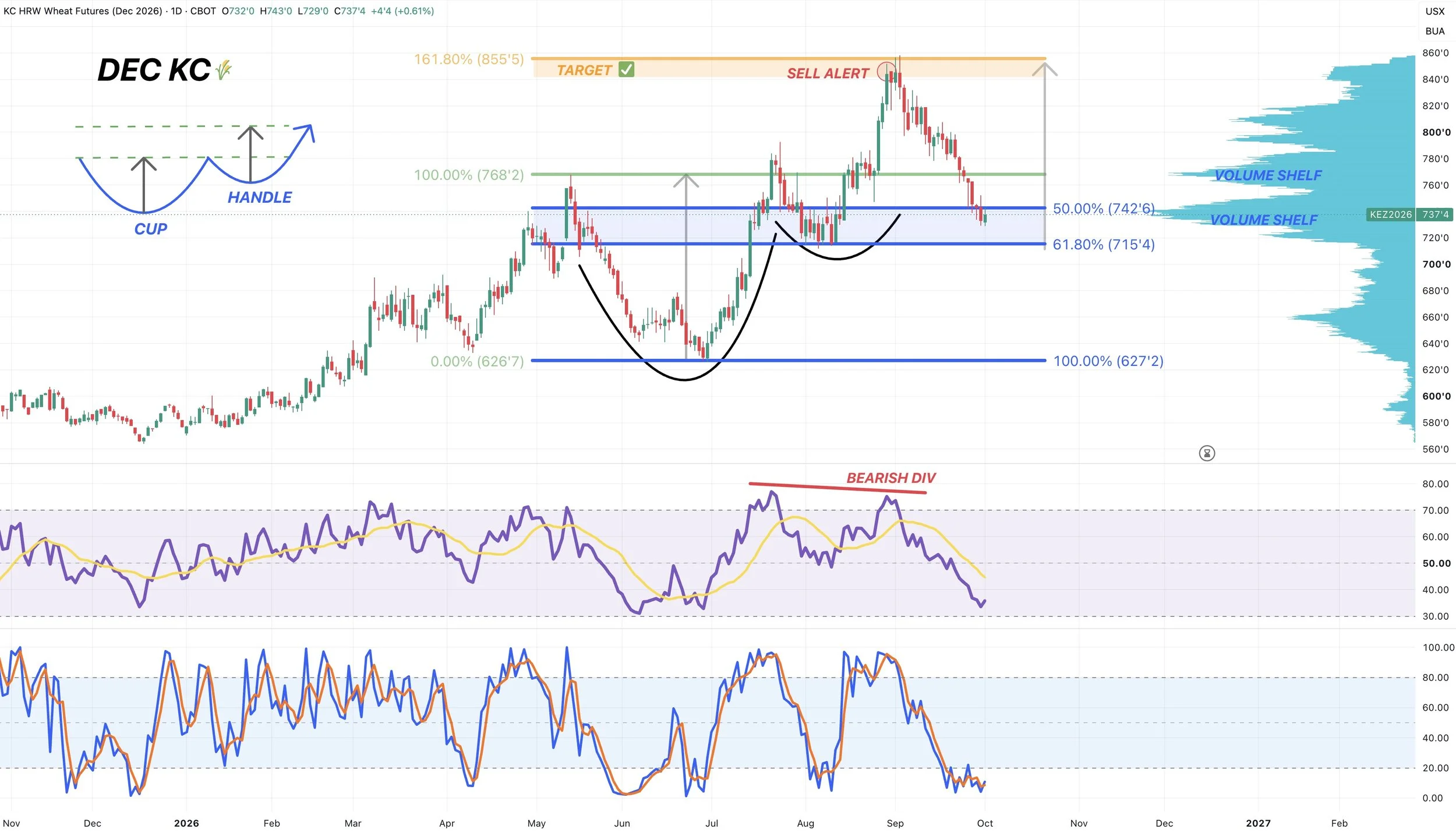
Wheat is sitting right in the golden zone down to the June lows.
This is where bulls need to step up to prevent the chart from falling apart.
If we are going to bottom, this is where we would expect us to carve out some lows.
Not only is this the golden zone, we are re-testing those highs from May.
We're also sitting at a massive shelf of volume which can act as a magnet and support.
If we start to break below this golden zone, then there would be a reason to be concerned as there would be zero volume or support below.
But for now, sitting right at support down here.
The last time we were this oversold wheat was trading over $1.00 lower than it is today.
Weekly KC Chart:
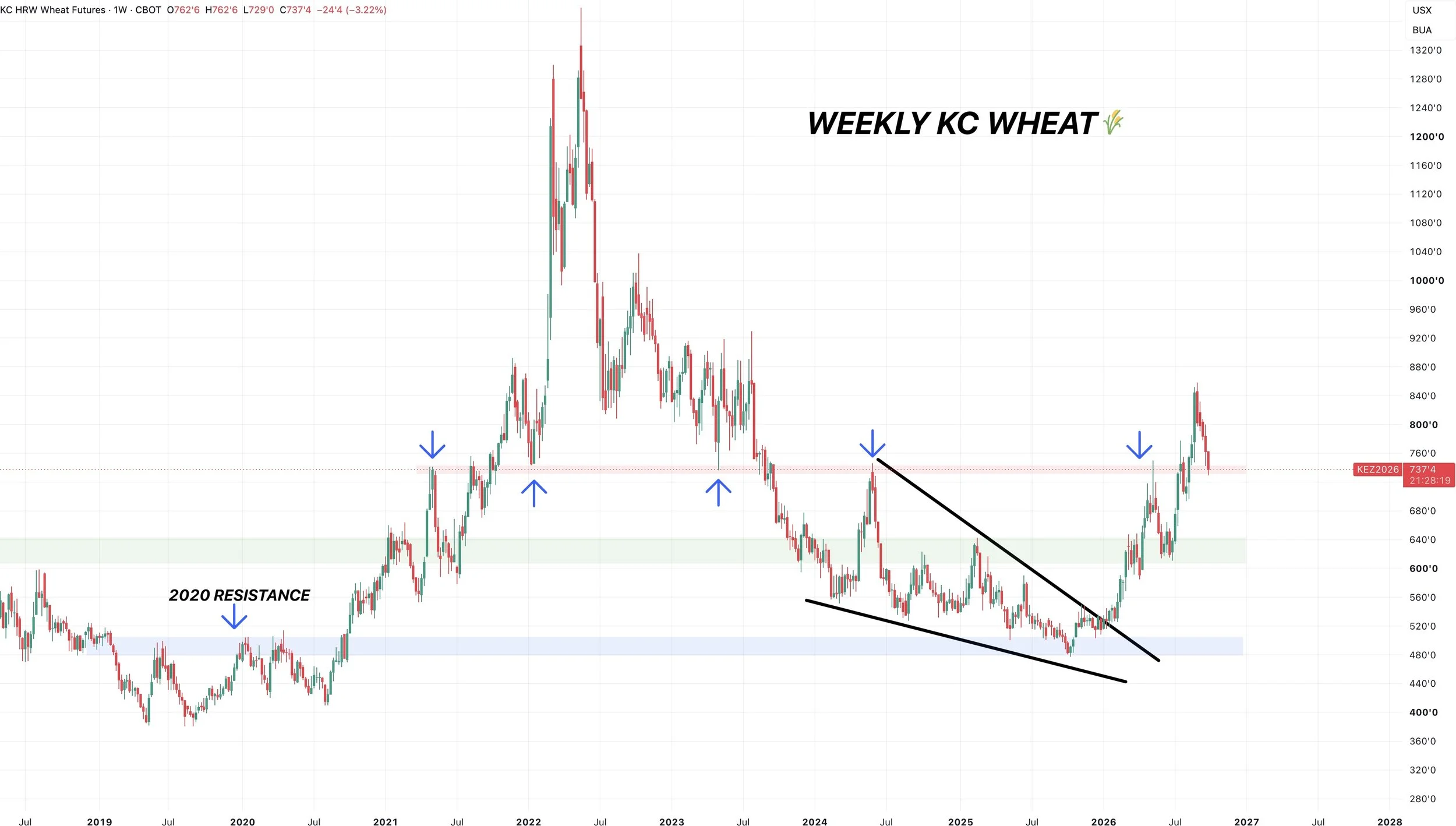
If you zoom out, this still looks like a simple high time frame re-test.
We broke through some major resistance earlier this year.
We're now coming down and trying to turn it into support.
$1.00 to $1.50 sell offs in wheat are actually very normal even in a bull market. The last bull market had multiple.
The big picture structure still looks perfectly fine as of now.
Cattle
Nov Feeders Chart:
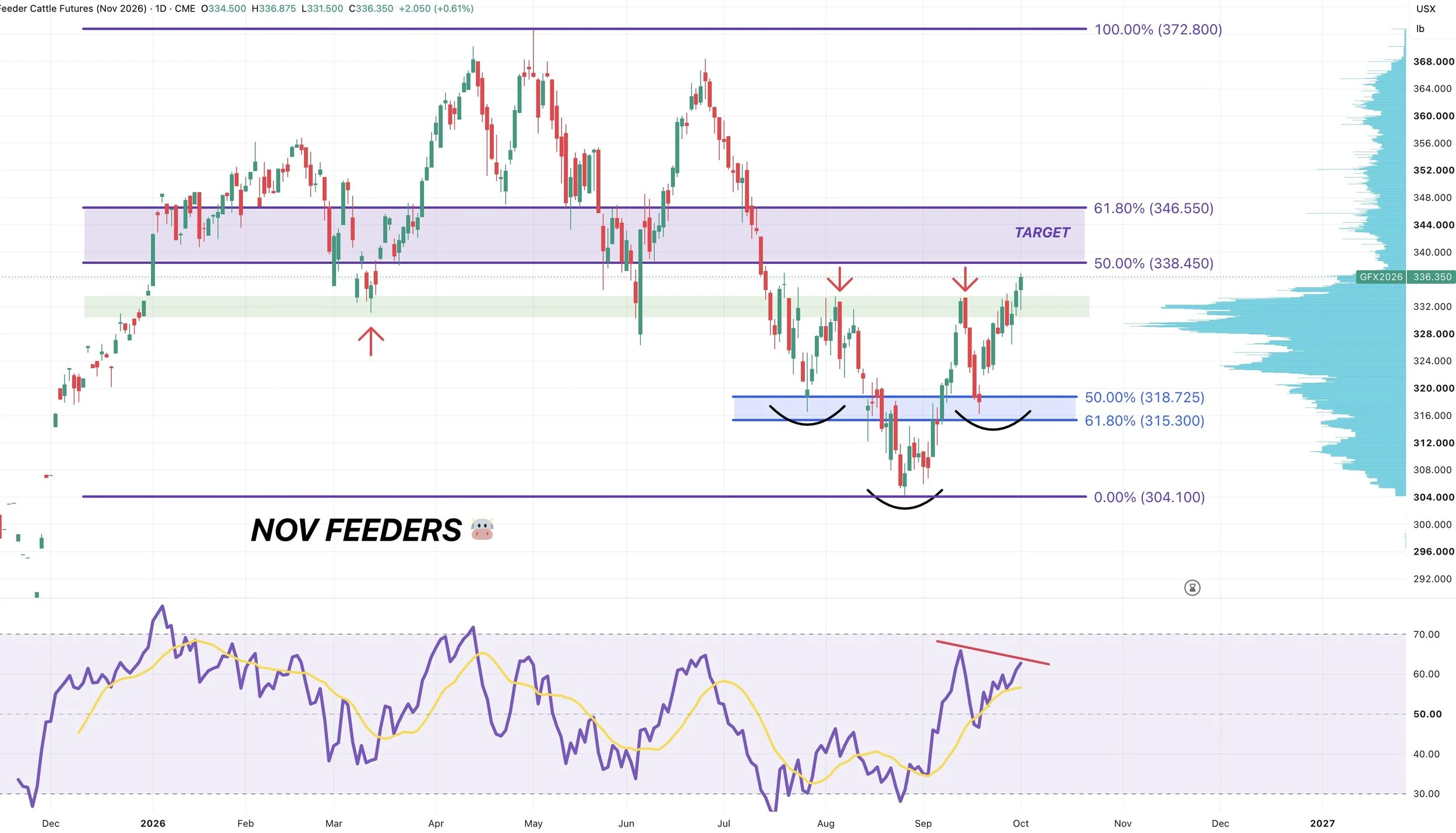
Feeders are breaking out above resistance, breaking out of this inverse head and shoulders pattern we've been talking about the last few weeks.
I would be looking to do some risk management soon up in this golden zone, which claws back 50% to 61.8% of the May highs.
We are starting to show some bearish divergence on the RSI. Prices are making new highs but the RSI is not.
This doesn’t mean we cannot keep going higher from here, but this is going to be something we want to keep our eyes on and another potential reason to de-risk in that target box.
Dec Live Chart:
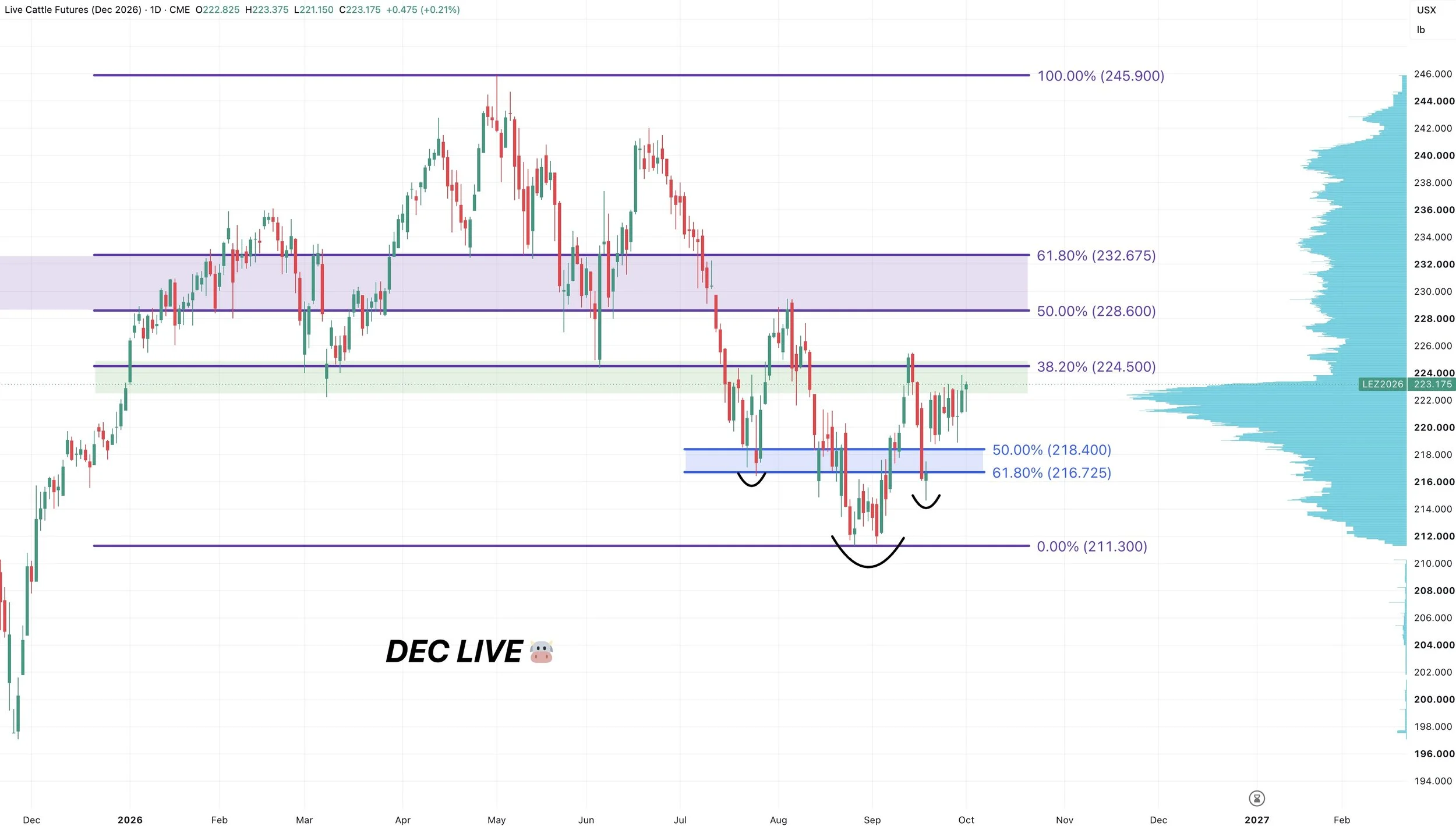
Not nearly as strong as feeders.
Feeders have broken out, live cattle has not.
Live cattle is still stuck at this big level of resistance. The lows from March and June, along with the recent highs.
So a clear level of resistance here.
We do still have that inverse head and shoulders pattern like in feeders, but need to break above those recent highs.
As I could see a scenario where feeders reach their target box but live cattle does not and fails at this resistance. So I'll be watching both closely.
Want to Talk?
Our phones are open 24/7 for you guys if you ever need anything or want to discuss your operation.
Jeremey & Office: (806)484-1214
Sebastian: (605)280-1186
Email: sfrost@dailymarketminute.com
Hedge Account
Interested in a hedge account? Use the link below to set up an account or give us a call.
WHAT THIS USDA MEANS FOR CORN
AUDIO COMMENTARY
Grains hammered with USDA
Feeders posting new highs for the move
Corn stocks came in 173 million above est
What does this report mean for corn?
We saw something similar in 2010
How similar is this story to 2010?
What exactly happened in 2010?
Does USDA know yield is dropping?
Increase in carryout was off farm
Dramatically more in elevators vs farmers hands
This report added a 2 bpa buffer
Yield doesn’t seem like it’s actually there
This is why those short on time need to be proactive
The volatility is here to stay
Avoid making emotional sales
Corn dropped right down to next support
This report doesn’t always go the same way as Oct USDA report
These are days to consider re-owning
Will corn carryout continue to shrink?
Where is the bottom for corn? (chart below)*
Corn chart breakdown below audio*
Listen to today’s audio below
Want to talk?
Office: (806)484-1214
DEC CORN CHART BREAKDOWN
By Sebastian:
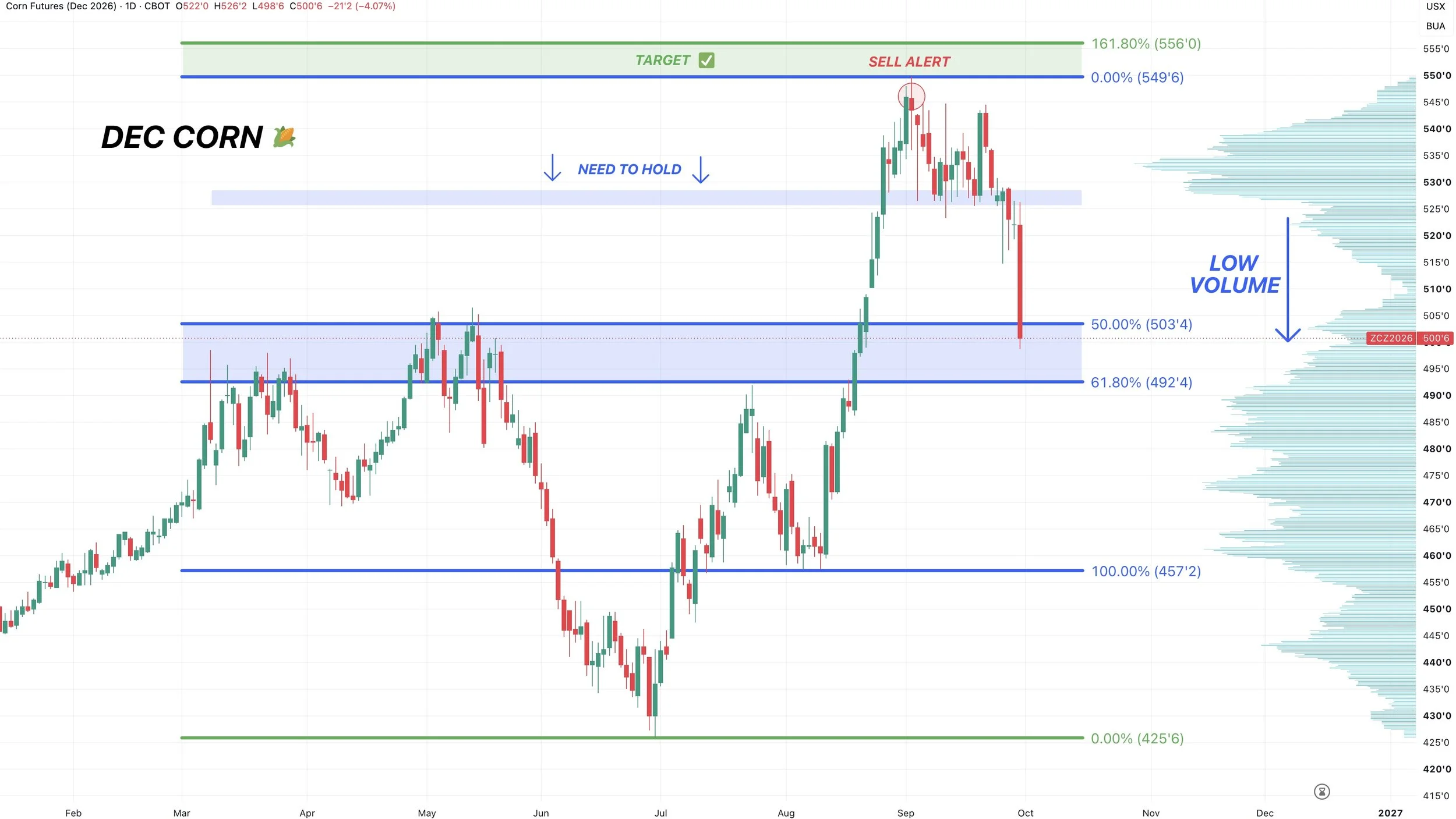
Dec Corn 🌽
We’re 50 cents off the highs and from that Sep 2nd sell/hedge alert.
For the last several weeks, I have been talking about the downside risks if we failed to hold that support and range from earlier this month. (Although no, I wasn’t expecting that downside to all come in one day).
I’ve been saying I am cautious because there was a massive volume gap and zero support holding up this market below that prior support.
We broke massively today, but should we be worried?
I would say no. Corn has simply came down to that support we’ve been talking about. This area has been my downside target if we got a real pullback. Which we’ve now received.
We’re sitting right at the 50% retracement down to the August lows.
This re-tests those highs from May.
We are now back at an area of high volume after slicing through that volume gap.
I would expect us to find a floor between here and the 61.8% level at $4.93. If we break below that level it would not look great.
But the time to be bearish was at $5.50. Not down here at support.
If you watched or read my past videos. The indicators were a large reason as to why I have been short term cautious.
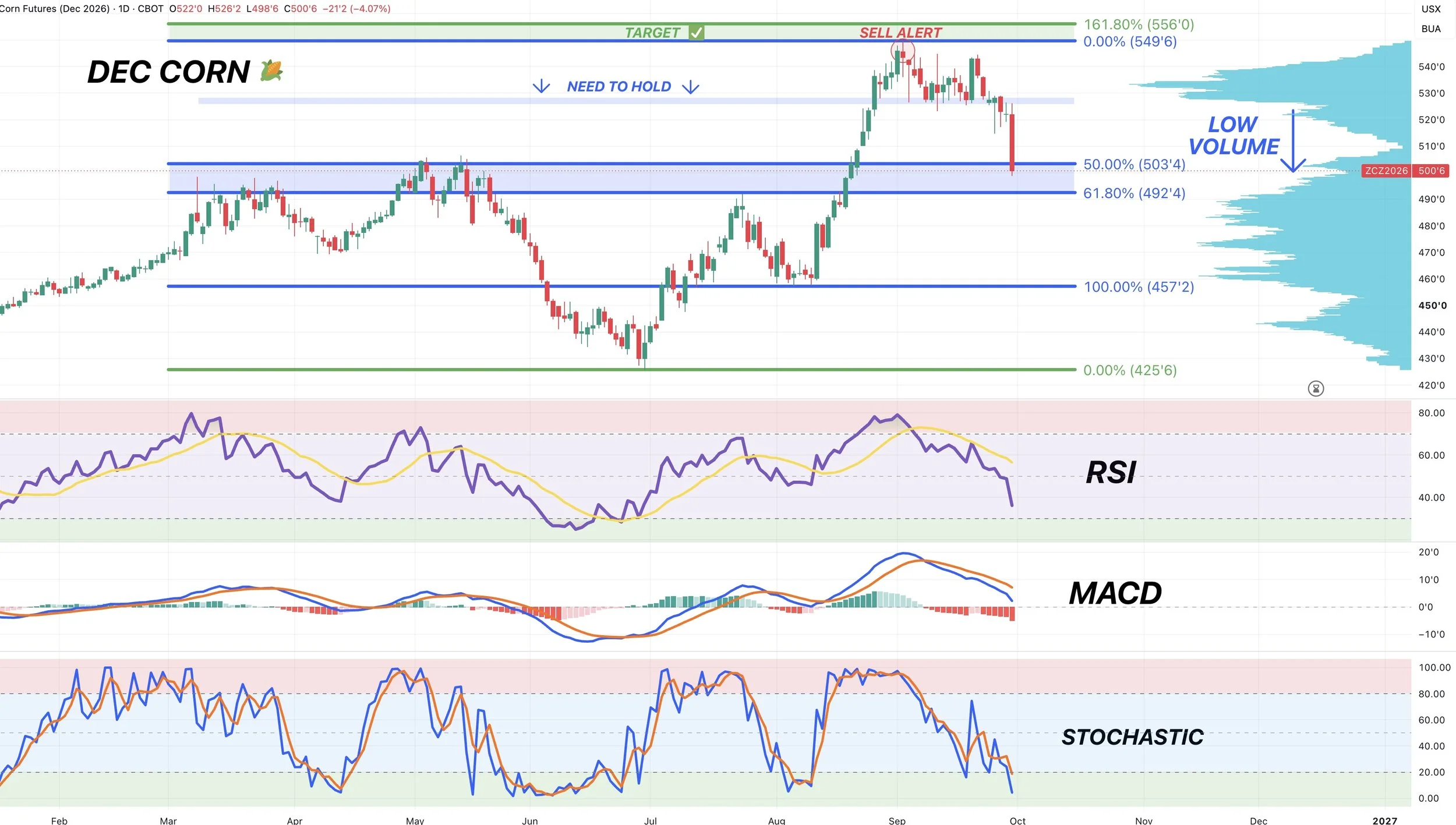
Now that the market has pulled back, the indicators have received a healthy reset.
The RSI is now finally getting oversold. Corn was trading at $4.30 the last time we were this oversold.
The stochastics have now finally came down into oversold territory. Which is something I’ve been looking for when searching for a bottom. As most of the time we don’t see a major bottom unless the stochastics bottom.
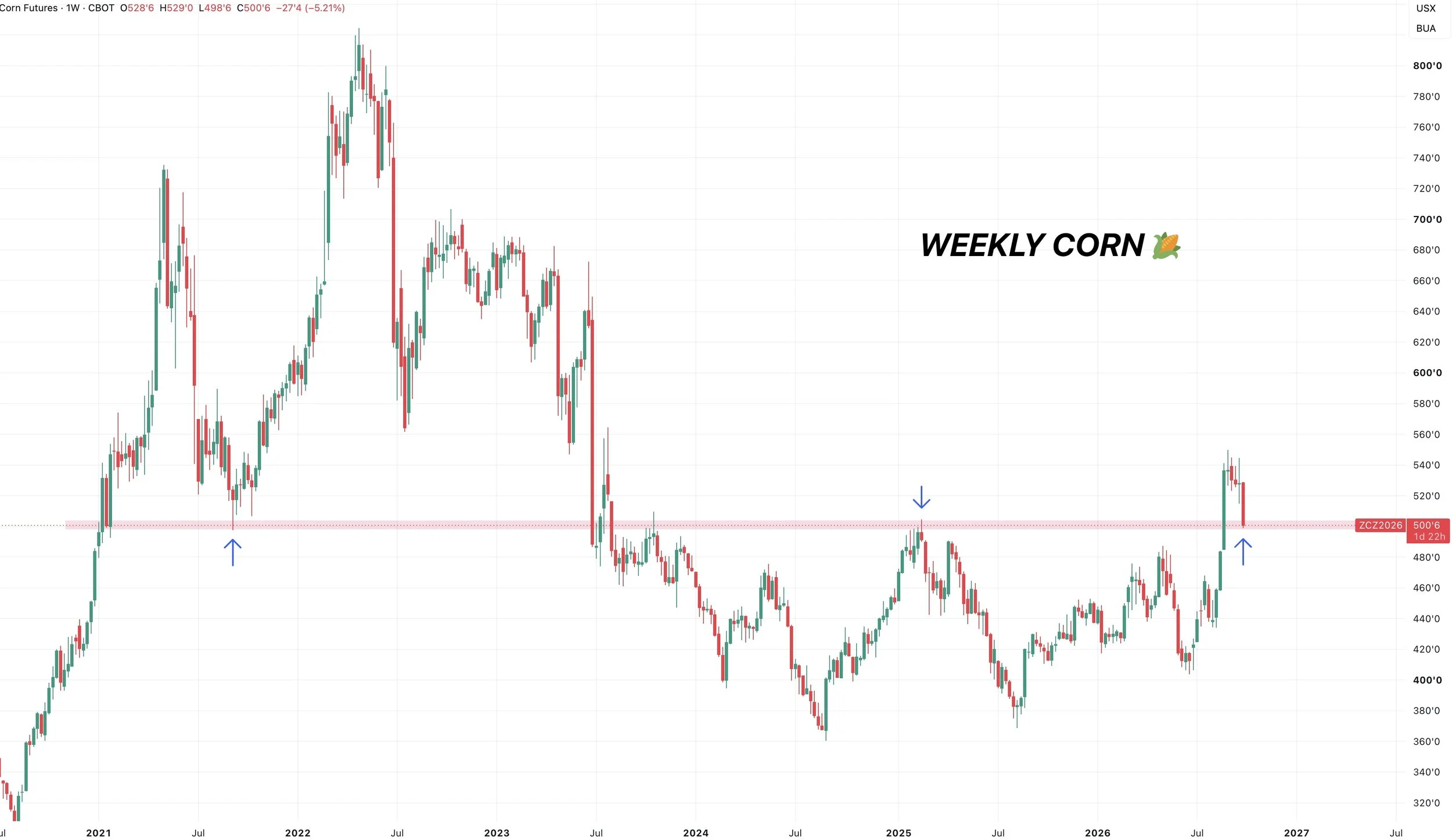
Let’s zoom out to the weekly chart.
Corn was trapped in a massive sideways range the last 3 years.
We broke out in August.
Now what does it look like we are doing?
For now this looks like a simple re-test of that old point of breakout. As we are right down at those highs from 2024 and the top of the range.
Old resistance often acts as new support.
Want to Talk?
Our phones are open 24/7 for you guys if you ever need anything or want to discuss your operation.
Jeremey & Office: (806)484-1214
Sebastian: (605)280-1186
Email: sfrost@dailymarketminute.com
Hedge Account
Interested in a hedge account? Use the link below to set up an account or give us a call.
WHAT’LL HAPPEN WITH CHINA?
AUDIO COMMENTARY
Cattle claws back yesterdays losses
Haven’t broke support or resistance
Corn & beans still completely sideways
More details on today’s wheat buy alert
Why we like this certain re-ownership strategy
Taking profits from Aug 28th wheat sell signal
What could happen in the China meeting?
China buying wheat is a sleeper
Is China buying for political reasons or because they see supply risks and upside?
So many questions & variables in this meeting
Our balance sheets are already pretty tight
The crops don’t look like they are getting bigger
We don’t have room to increase demand without prices being rationed
History doesn’t repeat. But it often rhymes
The price potential is absolutely there
High diesel isn’t a bearish item
Option prices have come down if you’re uncomfortable
Strategies based on your needs
This China meeting offers downside risk
Long term our bias is a lot higher
The Super El Niño is already making impacts
The funds are record long. What does it mean?
Until demand slows down the picture is friendly
Chart breakdowns below audio*
Listen to today’s audio below
Want to talk?
Office: (806)484-1214
Today’s wheat alert: Click Here to View
CHART BREAKDOWNS
Dec Corn 🌽
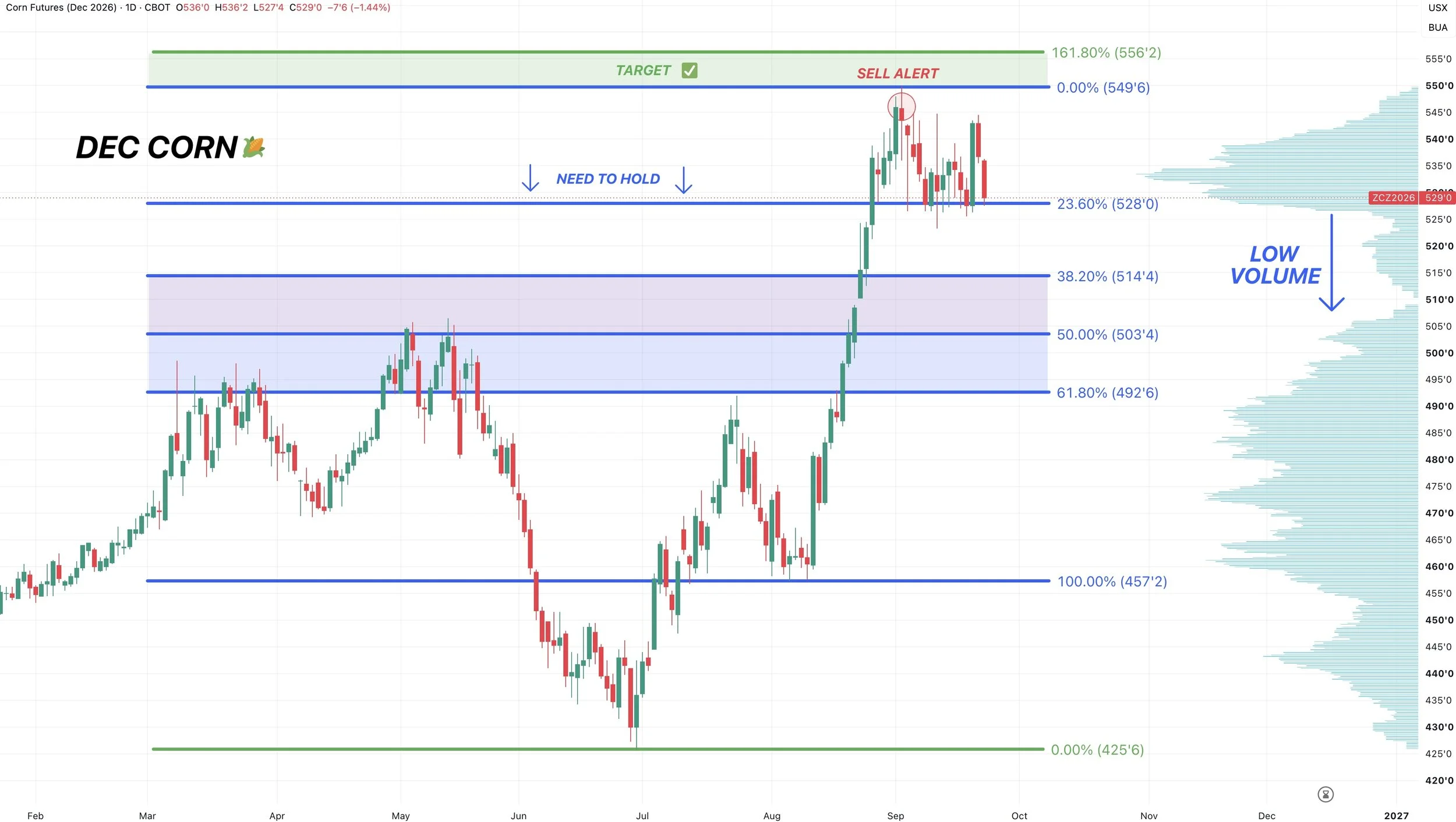
Corn sitting at a major spot ahead of the China meeting.
We have continued to hold this key support. Bouncing here countless times the last few weeks.
We are still somehow trapped inside the USDA report day range.
If we break below this support, it potentially opens the flood gates lower.
As there is zero volume or support beneath here. So it could trigger some heavy downside.
If that happened, I would be looking for a bottom in the $5.04 to $5.14 area. Which gives back 38.2% to 50% of the August rally. That is also where volume picks back up and would give us a re-test of those May highs.
Dec KC Wheat 🌾
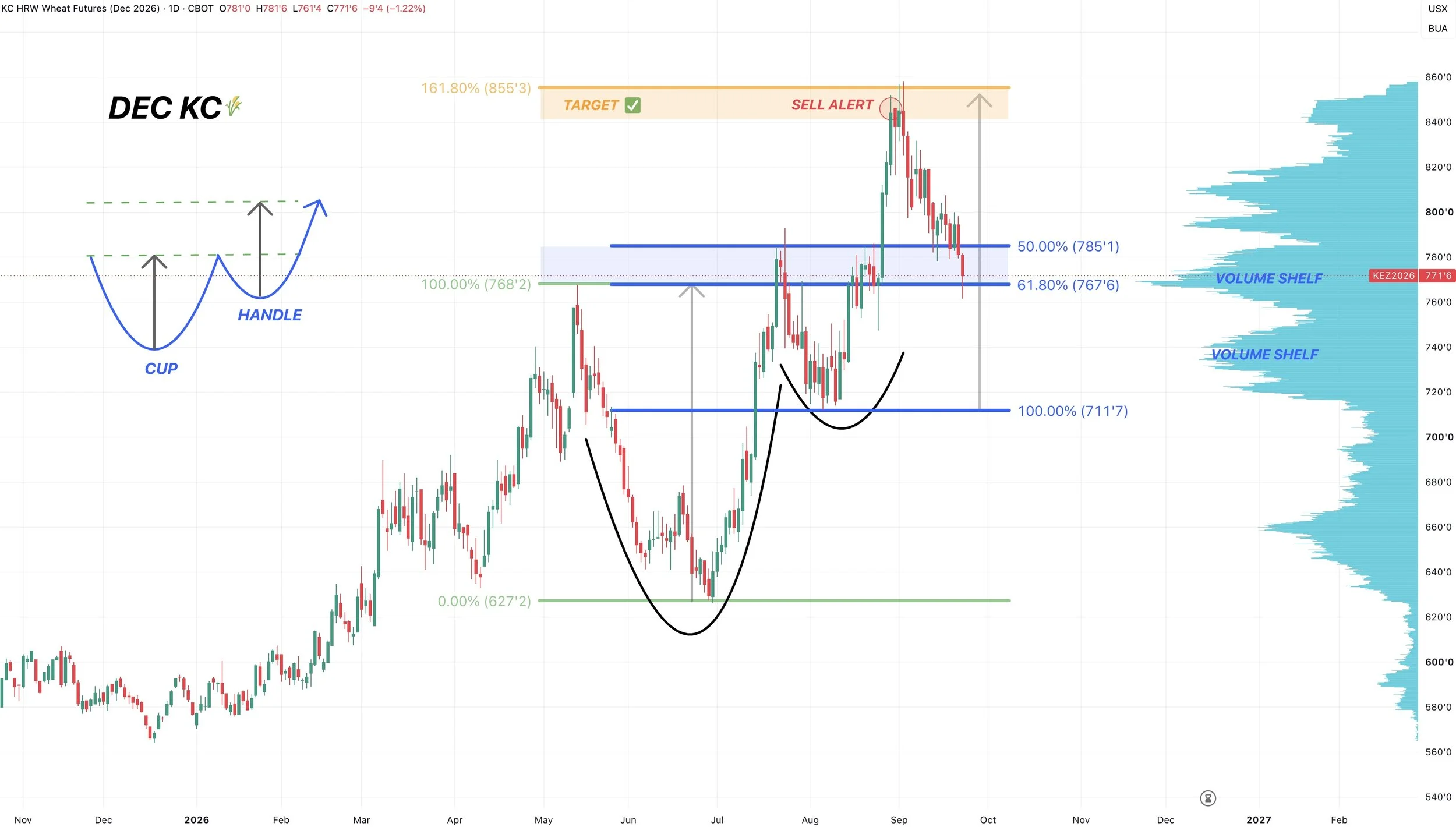
Dec KC has given back 61.8% of the entire rally from the August lows.
Not only is this the most common retracement. But we are re-testing those prior highs from May as well as July.
We also have a shelf of volume that sits right here which can act as a magnet for prices.
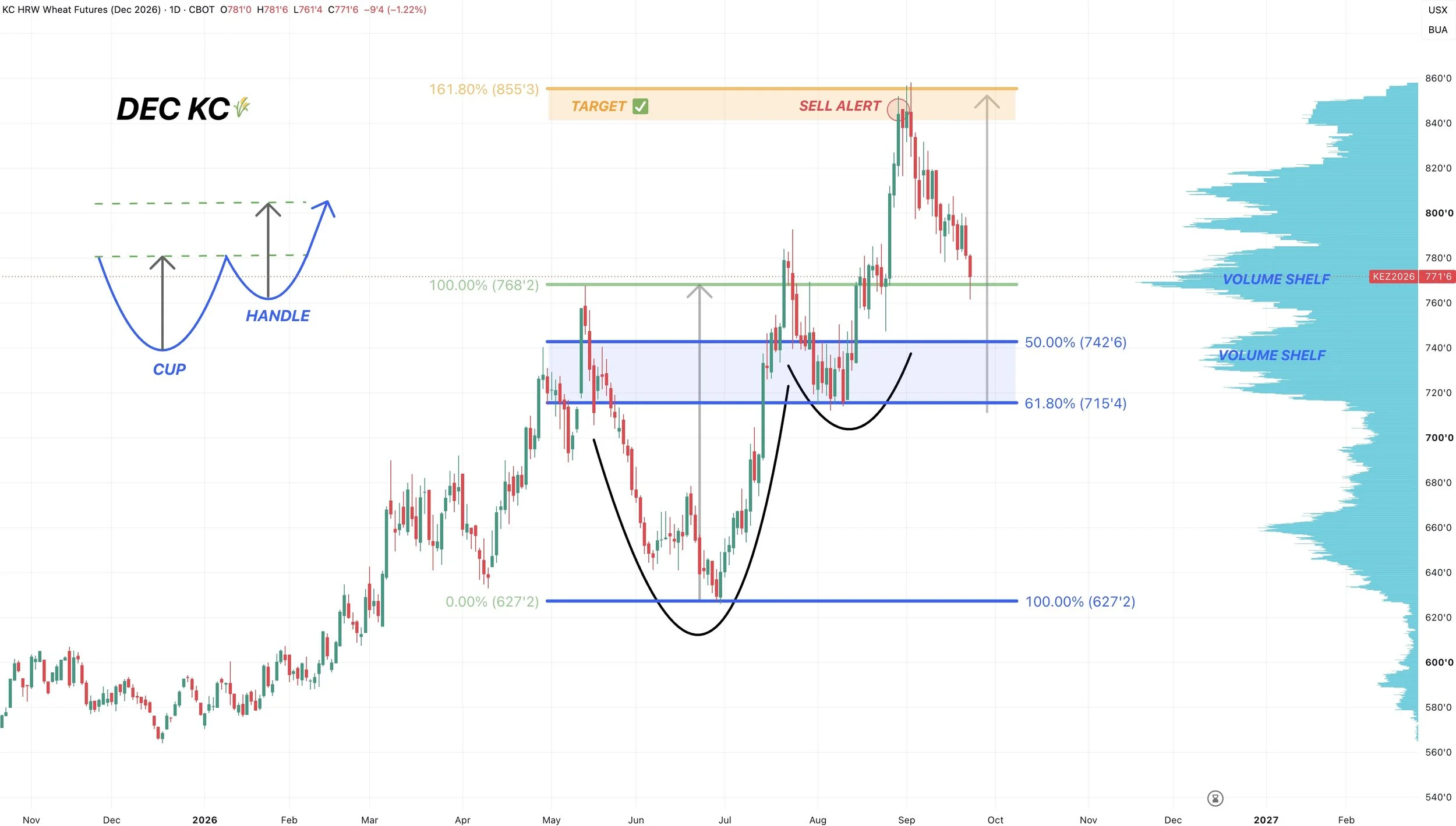
What if we fail to hold this level?
Then we could drop towards the next level of support.
Which is going to be the golden zone (50% to 61.8%) all the way down to the June lows instead.
Which aligns with the next volume shelf.
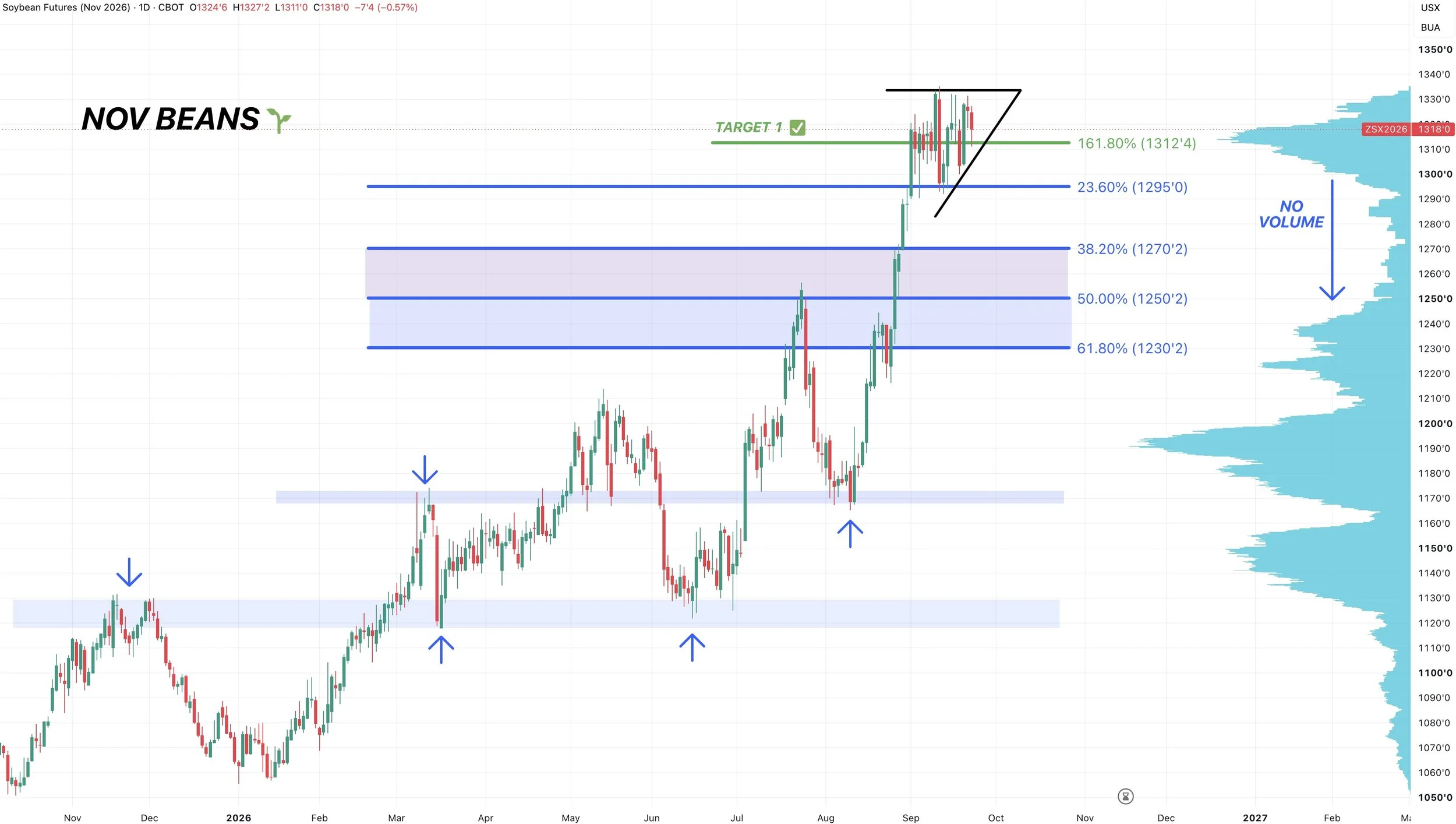
Nov Beans 🌱
Still completely sideways. Waiting for a direction to be made.
We have not yet broken the USDA report day’s range.
Whichever side the range breaks first likely gives us our next leg as simple as it sounds.
If we break the bottom of the range, there is plenty of downside risk. Given we have a massive volume gap lower and zero support below.
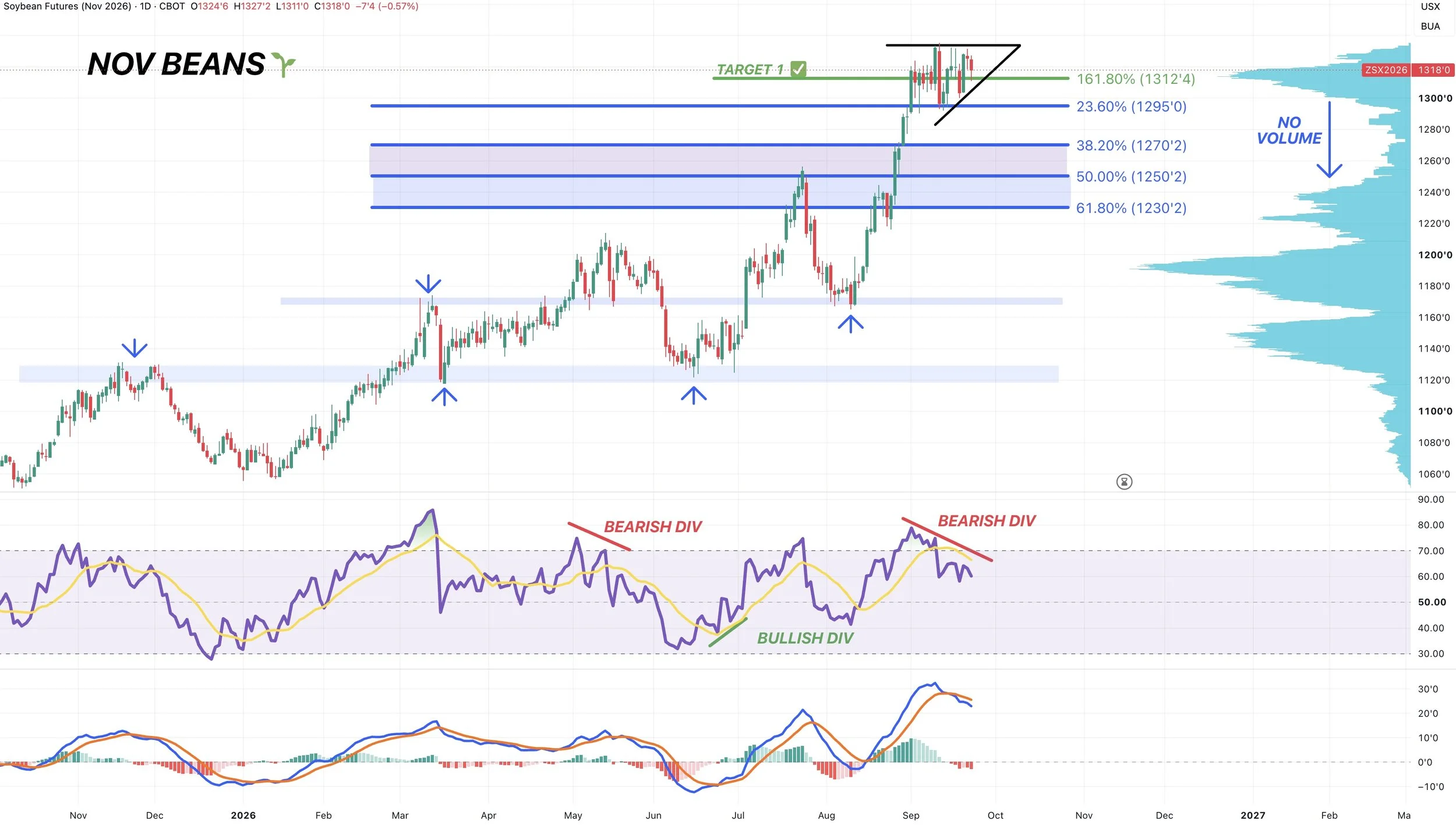
One reason I am cautious up here is that we do have bearish divergence on the RSI. Prices made new highs while the RSI is struggling to keep moving higher. A sign of possible fading upside momentum.
We also had the MACD cross bearish for the first time since July.
Want to Talk?
Our phones are open 24/7 for you guys if you ever need anything or want to discuss your operation.
Jeremey & Office: (806)484-1214
Sebastian: (605)280-1186
Email: sfrost@dailymarketminute.com
Hedge Account
Interested in a hedge account? Use the link below to set up an account or give us a call.
DOES THIS USDA MEAN ANYTHING?
MARKET UPDATE
You can scroll to read the usual update as well. As the written version is the exact same as the video.
Timestamps for video:
Overview: 0:00min
USDA: 0:45min
Corn: 3:25min
Corn Charts: 8:40min
Beans: 12:00min
Bean Charts: 14:30min
Wheat Charts: 16:35min
Cattle Charts: 18:40min
Want to talk?
Office: (806)484-1214
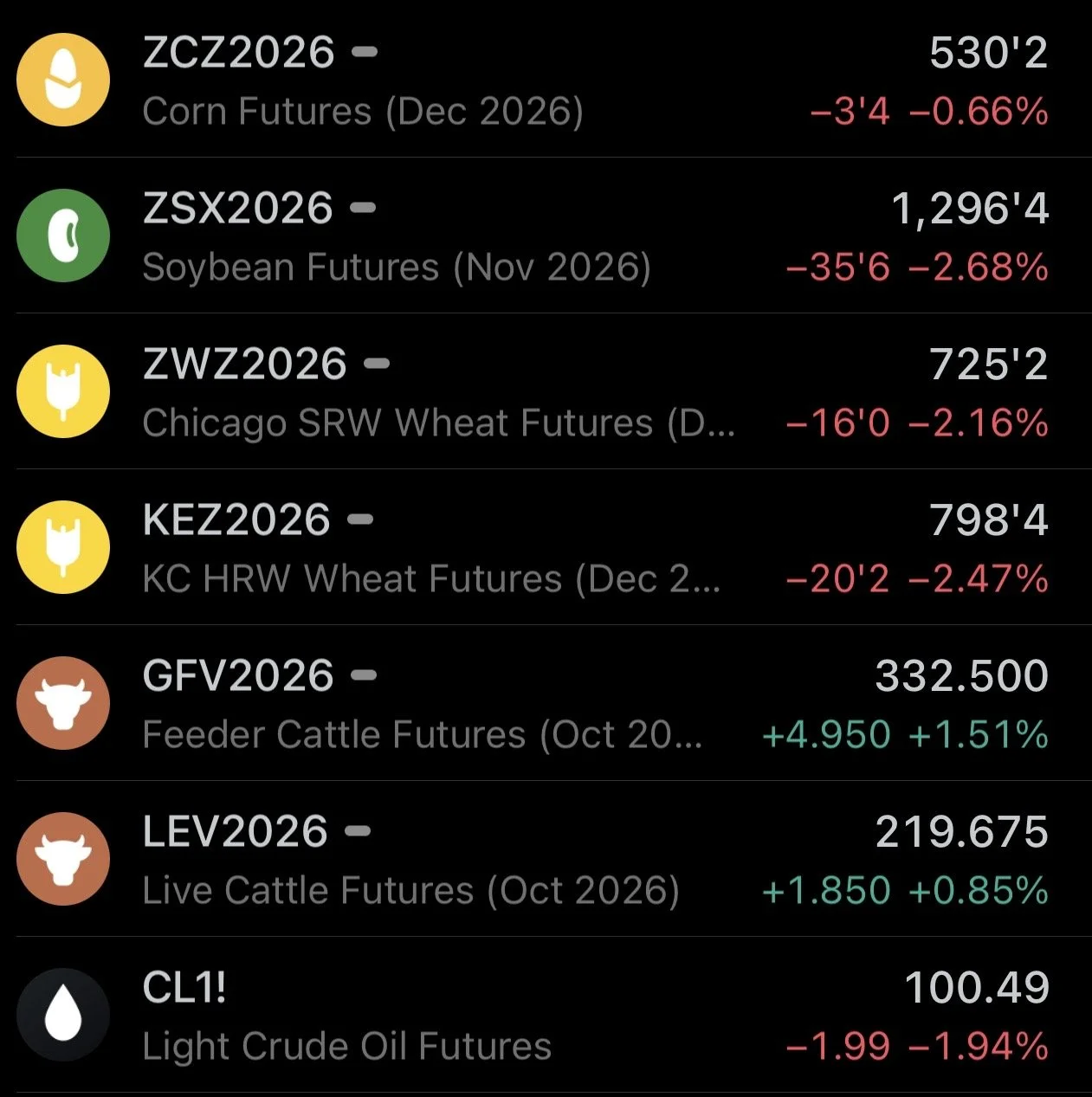
Futures Prices Close
Overview
First off I did want to take a second to remember 9/11, honor those fallen, and thank those who served.
As for the markets, grains got hit hard today following the USDA report. While the cattle market continues to put together a nice bounce.
Before the report, the market was actually already weak.
Before the report:
Corn was down -8 cents
Beans were down -25 cents
Wheat was down -20 cents
Today's all about the USDA report.
We'll be going over what changes they made, how it impacts things, and going over things we are watching on the charts. As I do still think we could be in for a little more weakness short term as we've been discussing the last week or two.
Let's dive right into the report..
USDA Recap
Numbers vs Estimates
Corn
Yield came in slightly higher than expected. At 178.5 vs the estimates of 178.2 bpa. However, this was still a sizeable cut from last month's 180.7.
Harvested acres actually came in below the estimates. At 88.5 million vs the estimates of 88.58 million.
Carryout came in at 1.567 billion bu. Which was higher than the trade estimate of 1.528 but still well below last month's 1.653.
So pretty much everything for corn came in a tad higher than the trade was expecting, but still well below last month's numbers.
Maybe the trade was expecting a more bearish outcome, given that we sold off heading into the report.

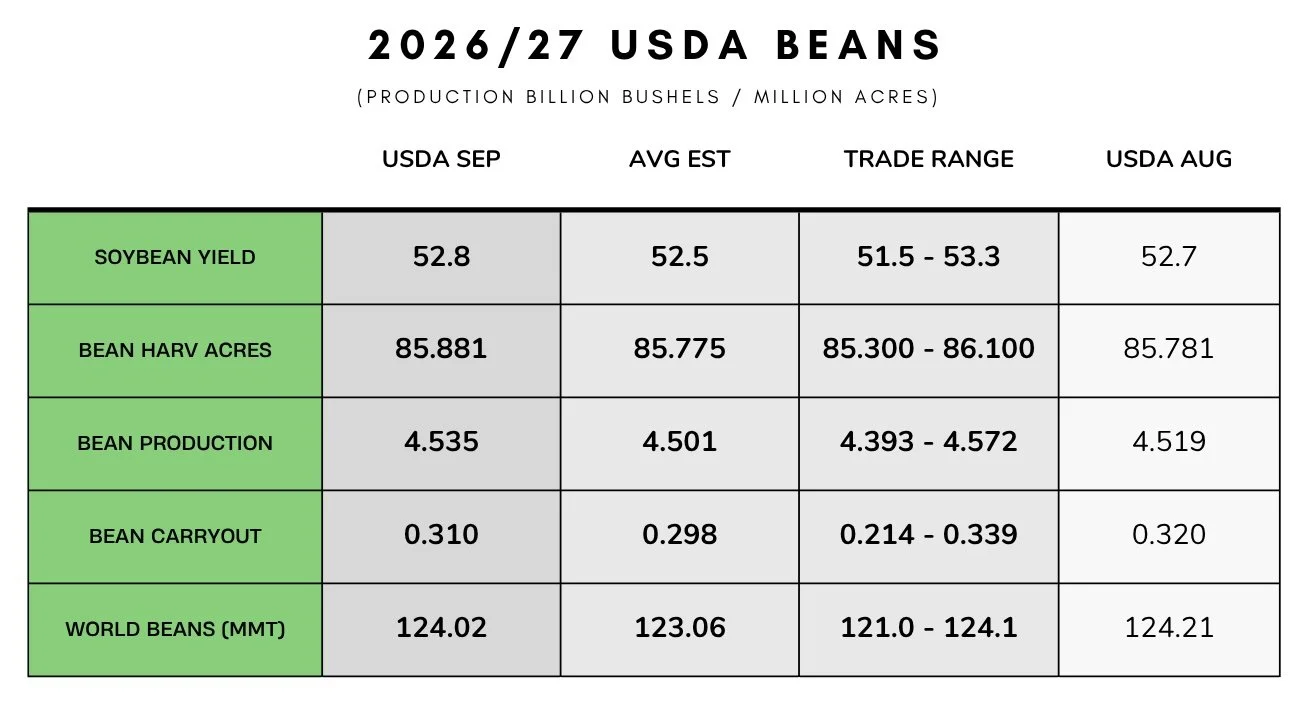
Soybeans
Yield actually increased from 52.7 to 52.8 bpa. Despite the trade expecting a cut down to 52.5.
Harvested acres came up slightly from last month.
With the disappointment in yield, our carryout came in at 310 million bu. Which was higher than the trade's estimate of 298 million but still lower than last month's 320 million.
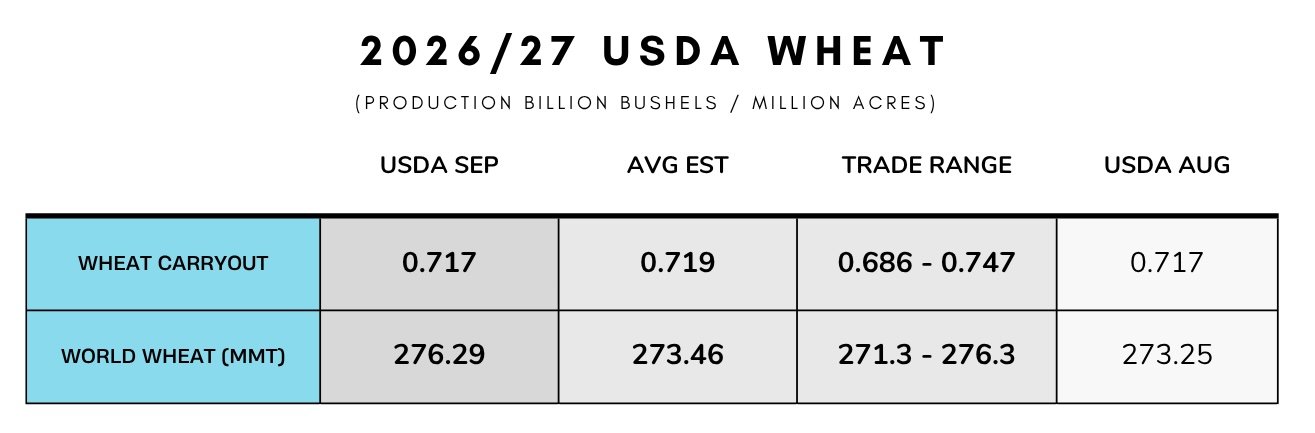
Wheat
The US balance sheet waas left completely unchanged, so nothing to see there.
The world number saw a pretty sizeable increase on the other hand.
The trade was expecting it to be unchanged, but it jumped from 273.25 MMT up to 276.29 MMT.
This was due to larger crops in Argy, Australia, and Canada.
What did the USDA actually do?
Let's jump into the full balance sheet changes to see exactly what the USDA did.
On all of these balance sheets:
Green = Bullish Change
Red = Bearish Change
Yellow = No Change
First for corn.
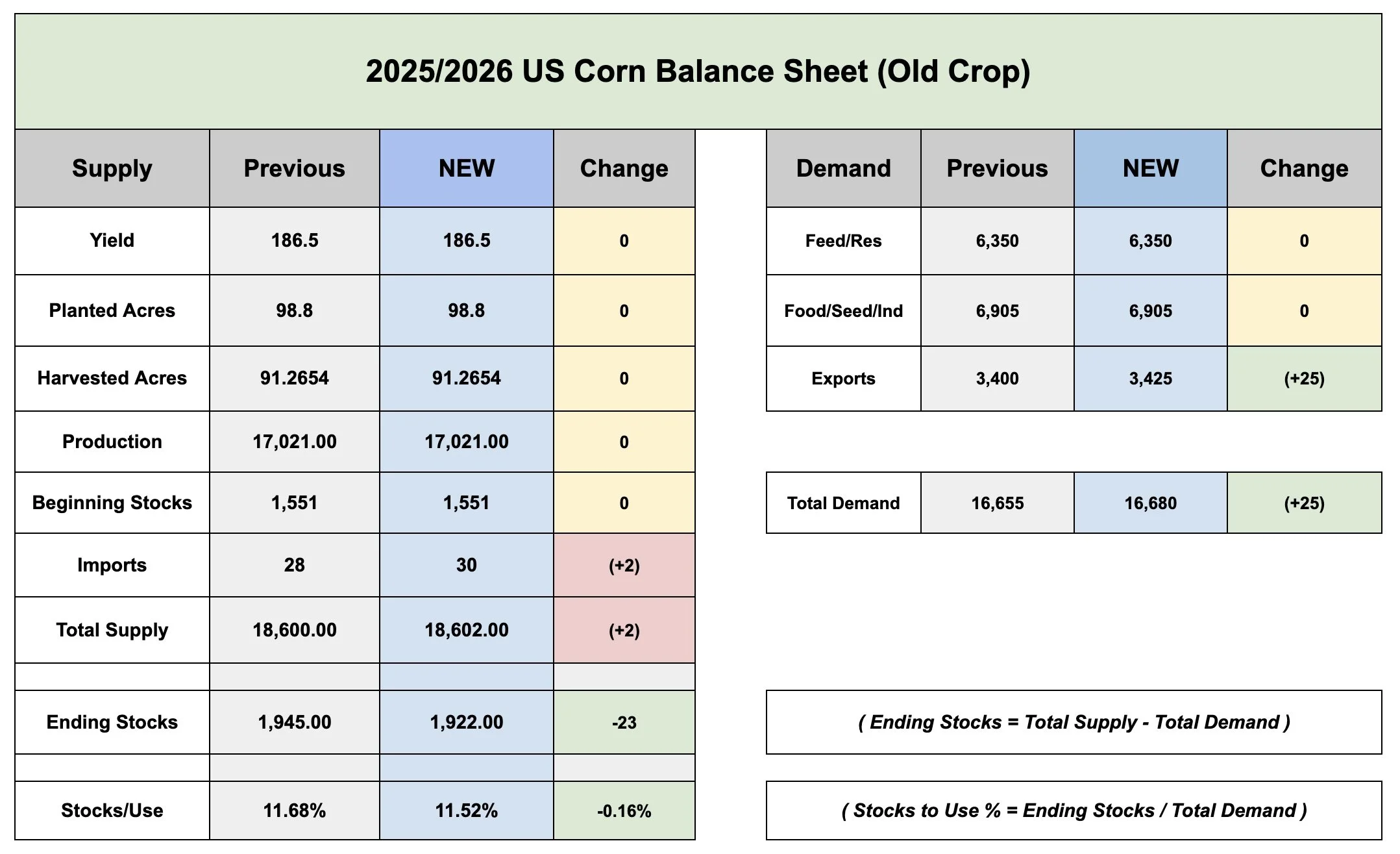
Old Crop Corn:
All they did here was bump exports by another +25 million.
Which in turn results in the new crop carryout dropping -25 million via beginning stocks.
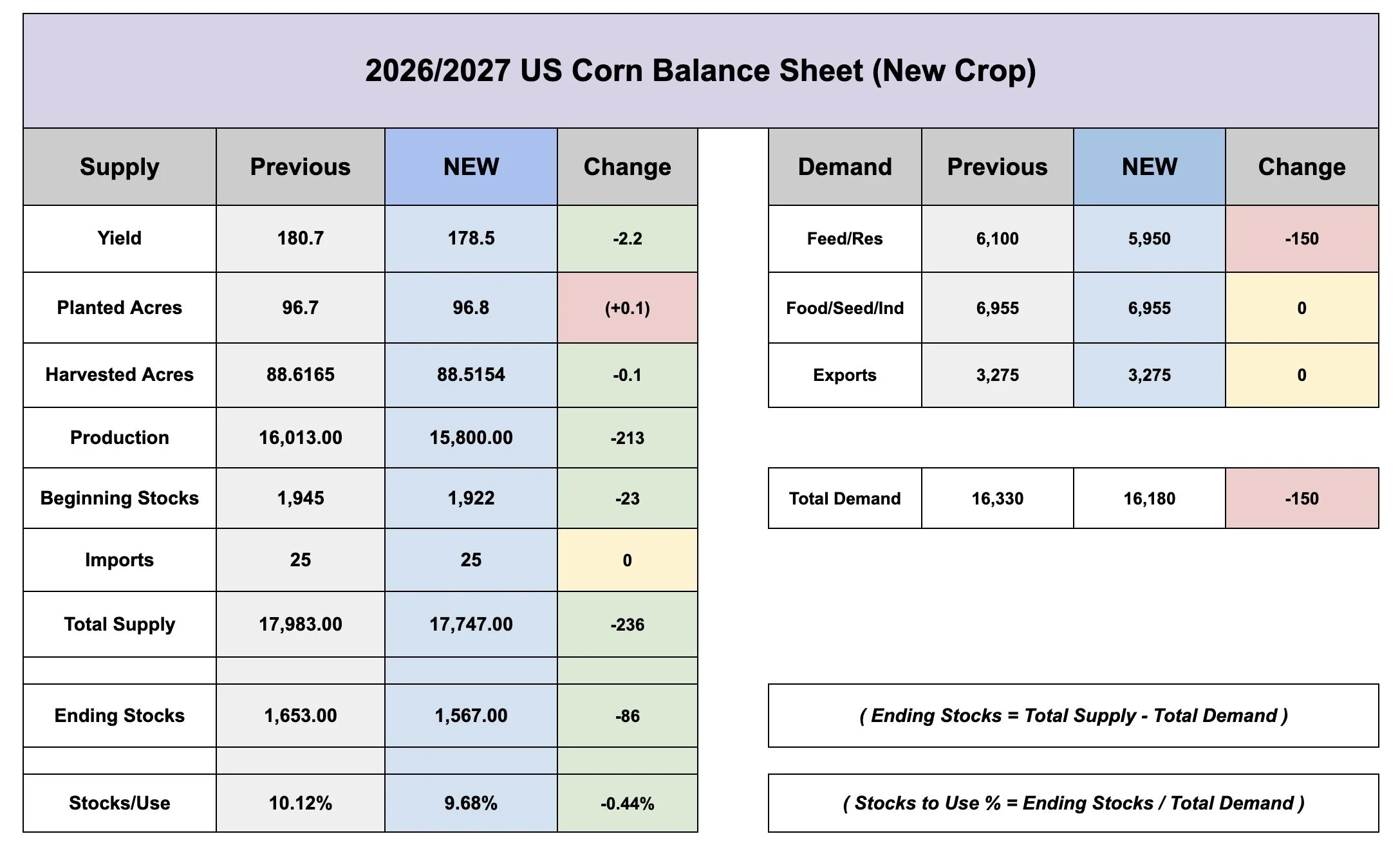
New Crop Corn:
So we got that -25 million cut to beginning stocks.
With the cut to yield, we saw supply drop -235 million bu.
However.. the USDA then offset more than half of this with a cut to the feed and residual demand. As they cut it by -150 million.
As a result, our carryout dropped -86 million bu.
One other thing to note is that our stocks to use is now offically below 10%. Coming in at 9.68%. We will get into this more later.
Next for soybeans.
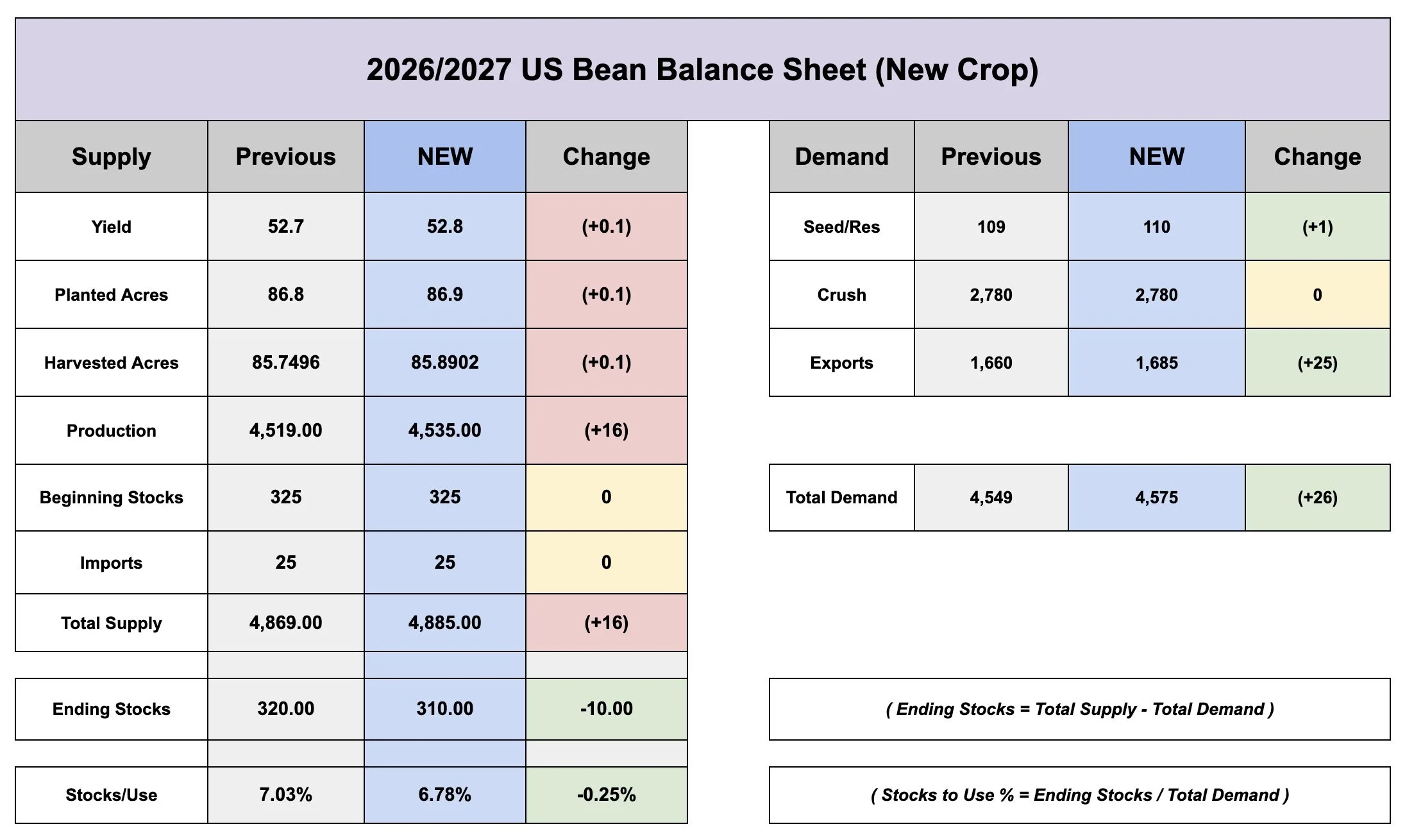
New Crop Soybeans:
They left the old crop balance sheet completely unchanged. So here is the changes to new crop.
We saw supply increase +16 million bushels with the bump in yield and acres.
However, the USDA then raised exports by +25 million.
So the net result was the carryout dropping -10 million down to 310 million.
Today's Main Takeaways
Corn
Did this report change anything?
On the surface, this wasn’t a "bullish" report.
If anything I would simply call it neutral.
We saw yield drop as the market was expecting, but it wasn’t a large enough drop to get the bulls super excited here.
The market was expecting less supply and that's what we got. There is a reason the market has ran the way it has the last month. The cut to yield was priced in.
Although the report wasn’t overly bullish, it does open the door for more yield cuts.
Typically, small crops get smaller. We've seen cuts in back to back reports, so the trend of this crop is smaller.
If the USDA would have printed a 180 yield we would have seen an absolute blood bath. But they cut like the market thought they would. Just not more than was already priced in.
The USDA not magically finding more acres was nice too. As all of those magic acres were what really butchered things last year.
The most interesting part about this report?
We officially have a new crop balance sheet with a sub 10% stocks to use ratio.
It came in at 9.68% as we mentioned.
This would be the first time we've been below 10% since 2022/23's 9.92%.
And it would be the tightest since 2021/22's 9.24%.
So the report itself wasn’t necessarily bullish given the market was already pricing in a smaller crop, but the balance sheet for corn is still the most bullish it's been in years.
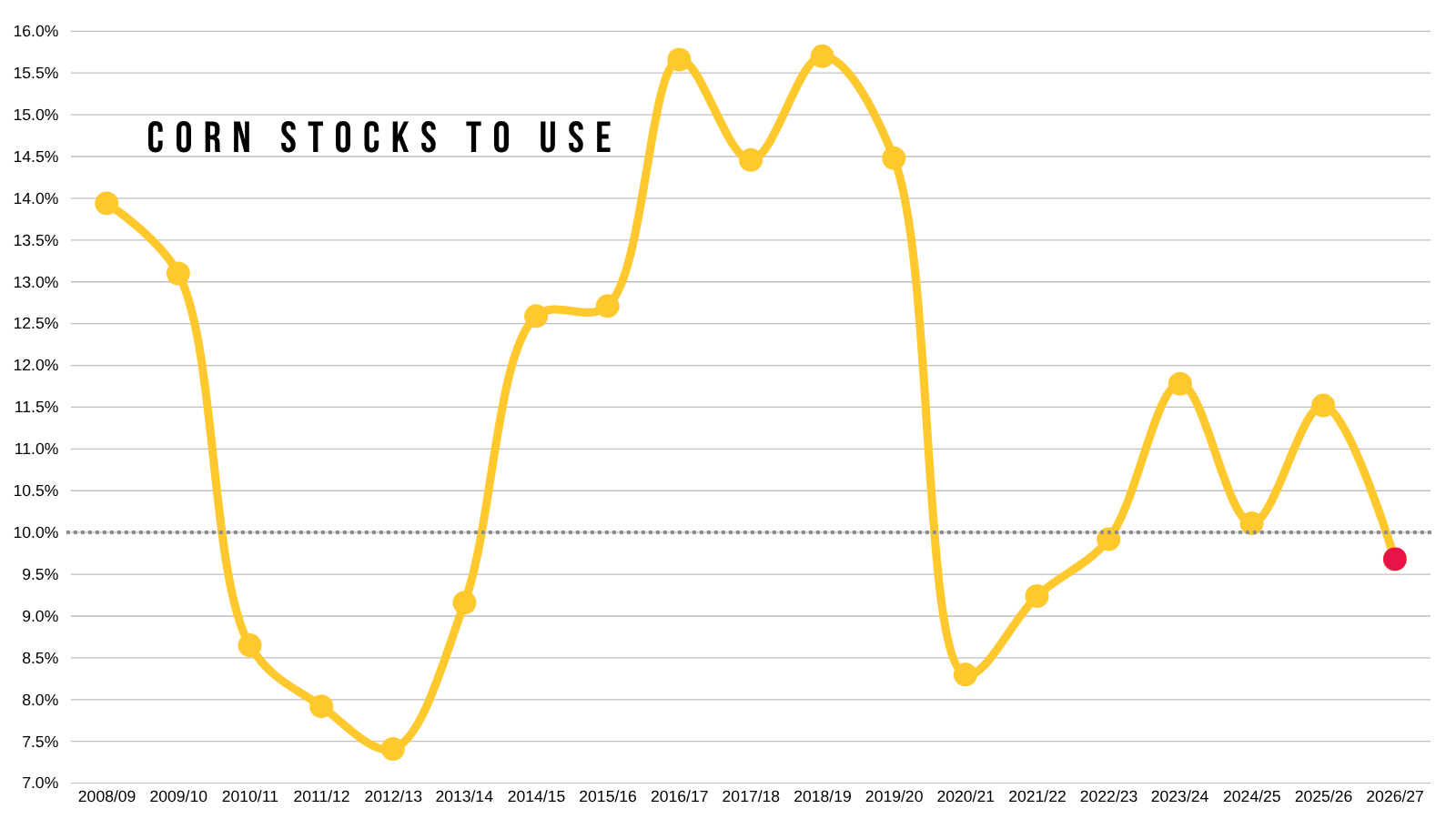
If you look at it based on where we were during the Sep USDA report.
This number would be one of the tightest in recent memory.
Almost on par with 2021 and 2022.
We are starting in a much tighter spot than we have the last several years.
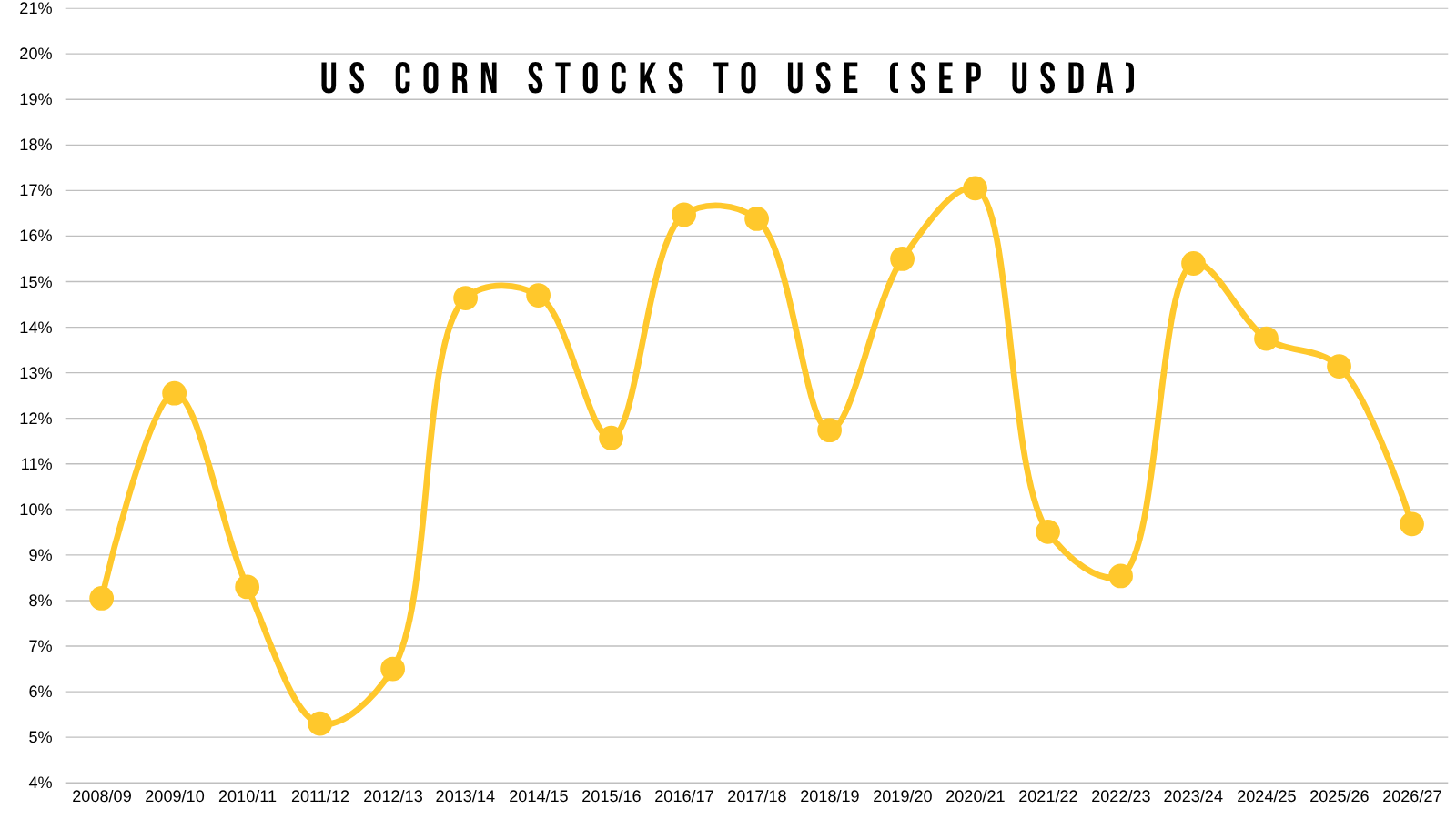
The stocks to use has a very high correlation to prices.
It's probably the best way to gauge the outlook for corn.
Here is an update on the stocks to use vs corn prices.
Right now, we are entering into that bullish territory.
Bear markets happen above 12.5%.
Bull markets happen below 10%.
We are no longer in a bear market.
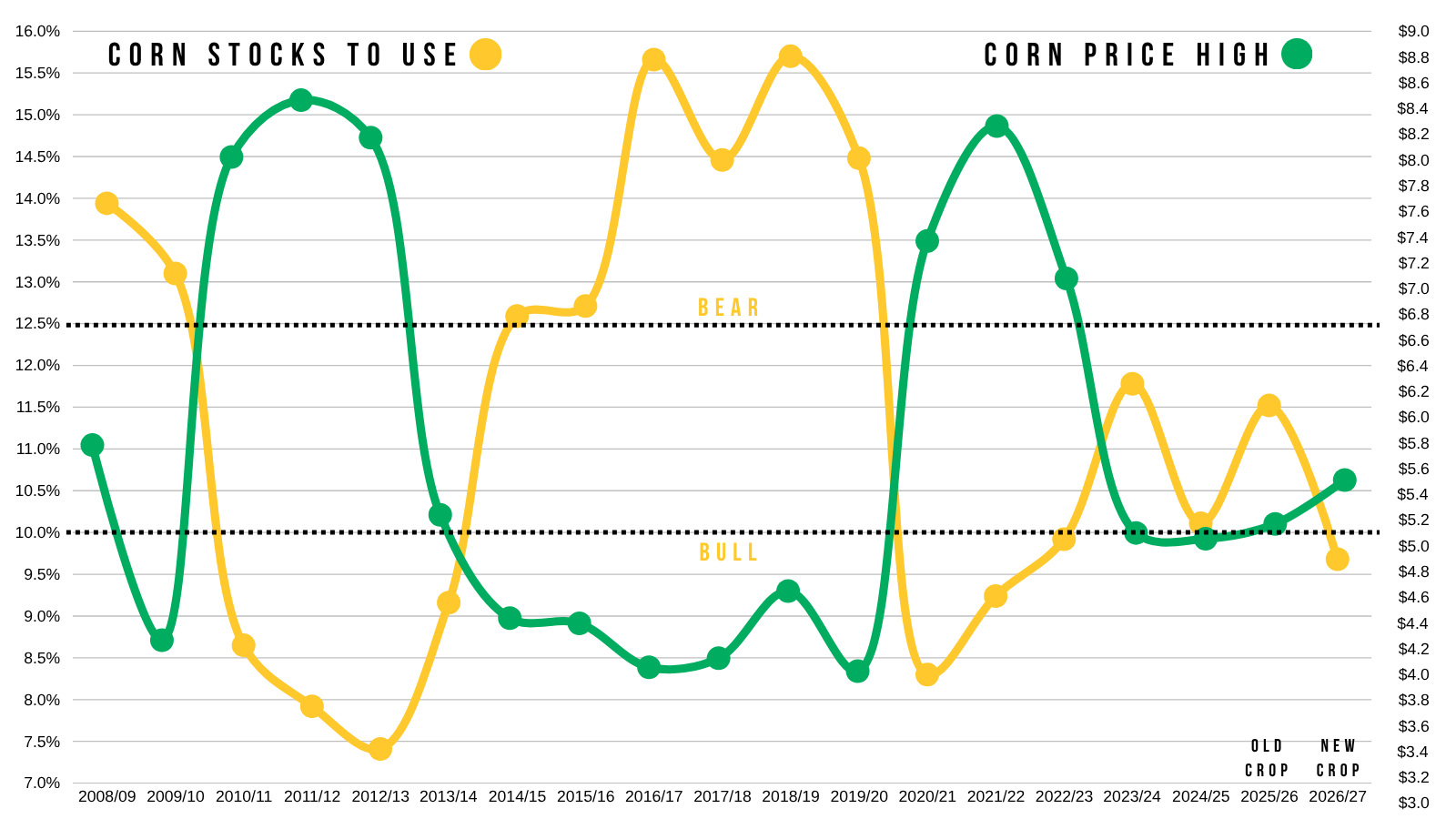
As we have talked about countless times, that 10% level is traditionally the threshold you need to see to get higher priced corn.
The 12.5% to 15% range is associated with bear markets.
The 10% to 12% range is somewhat in no man's land. Not mega bearish but not really bullish. Which is where we've been the last few years.
Below 10% is typically where you get bull market prices. When that stocks to use starts to crawl into the 8% to 9% range.
The chart above gives a pretty good visual of this. As it outlines bull market and bear market territory, along with the middle.
We are now below 10%, so this is no longer a bear market, but we likely need to see this get closer to 8% or 9% if we want to see $7 to $8 corn.
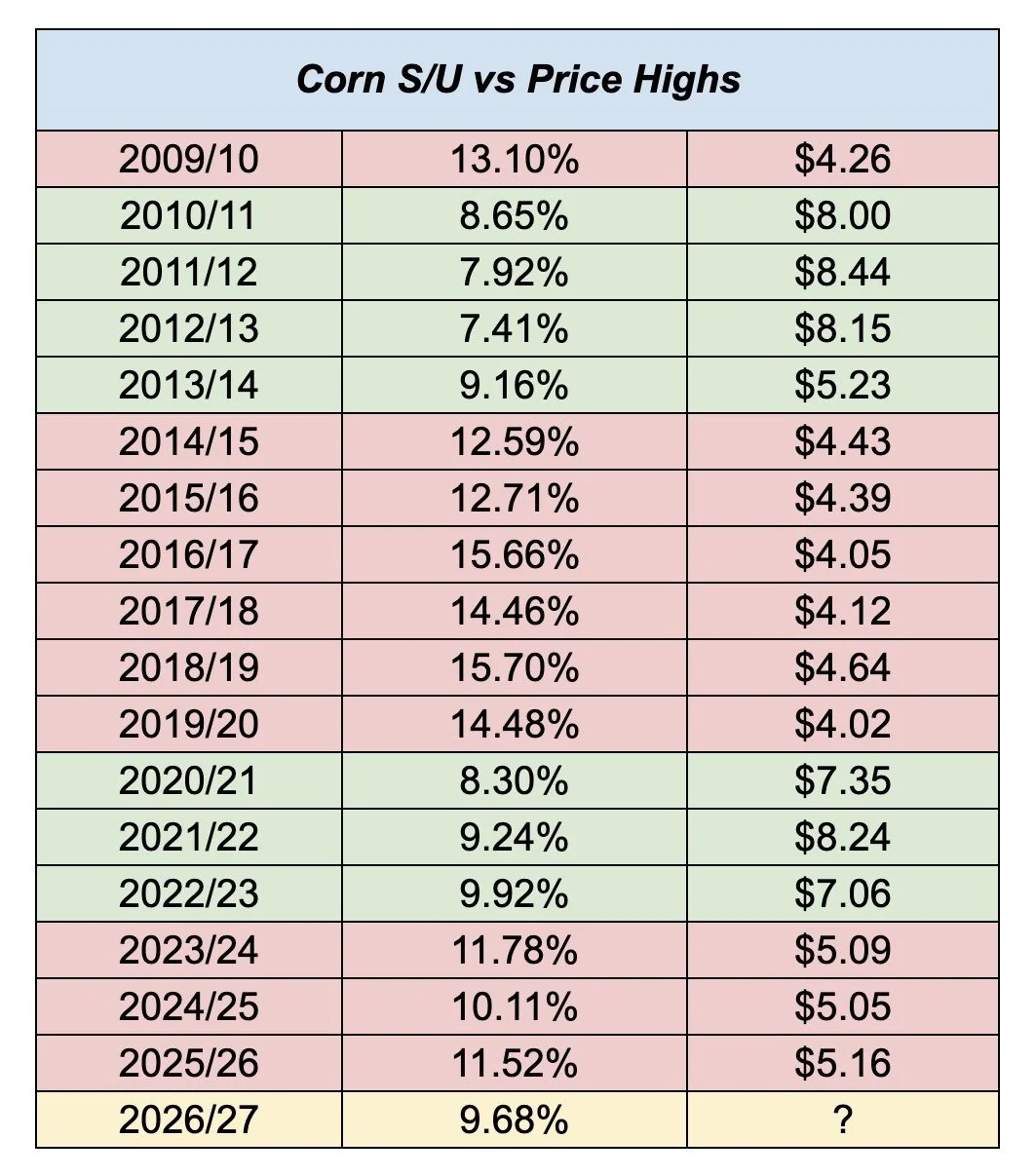
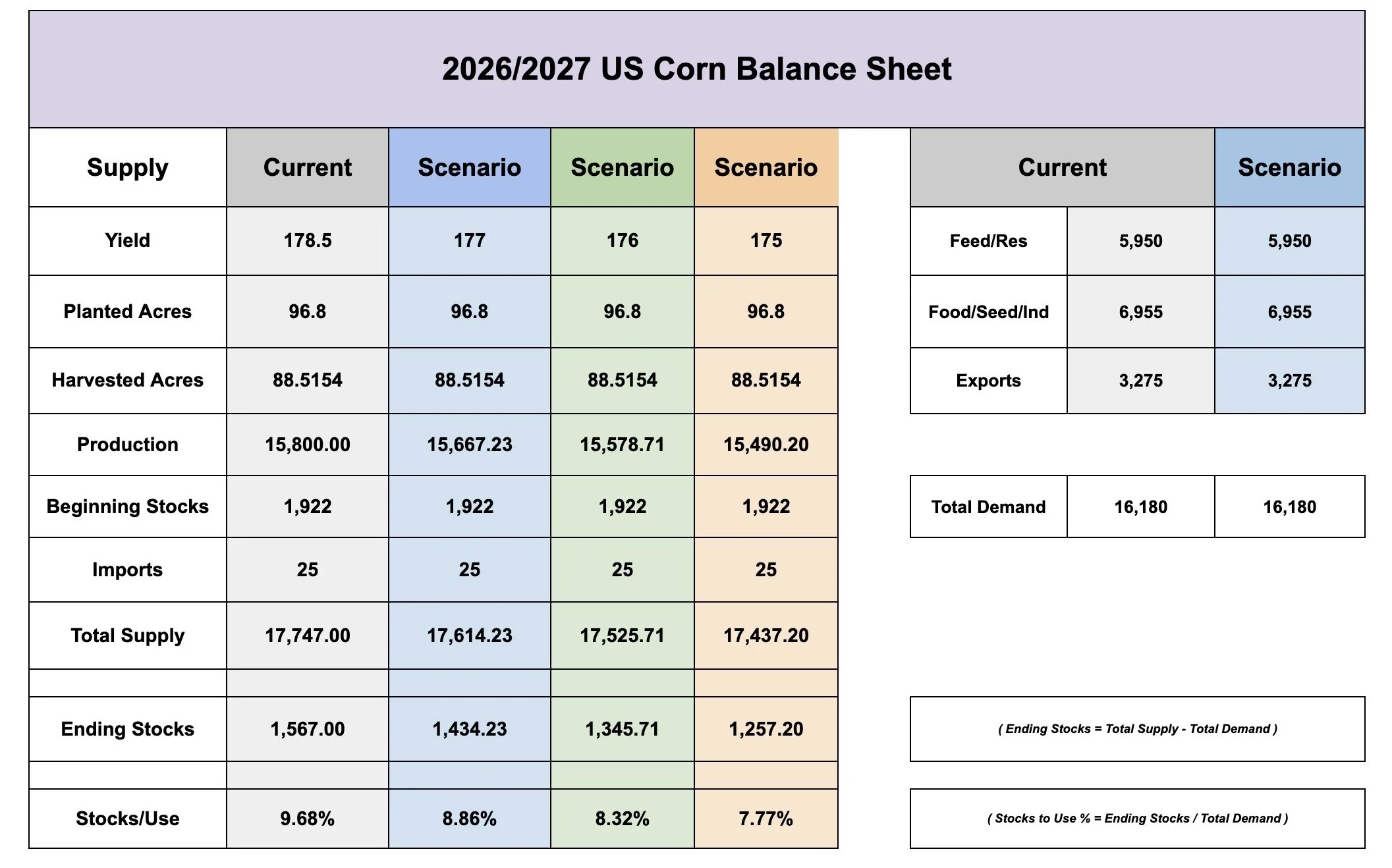
Here are some updated balance sheet scenarios based on yield changes.
All of these are before any adjustments to demand.
But purely by lowering yield, there is a real chance that this stocks to use gets pretty dang tight into that 8% to 9% range.
A 177 yield before changing demand gives you an 8.9% stocks to use.
I do also think that the USDA should eventually raise the old crop exports even further. They bumped them by 25 million today, but I think they should be at least 75 to 100 million higher or possibly even more.
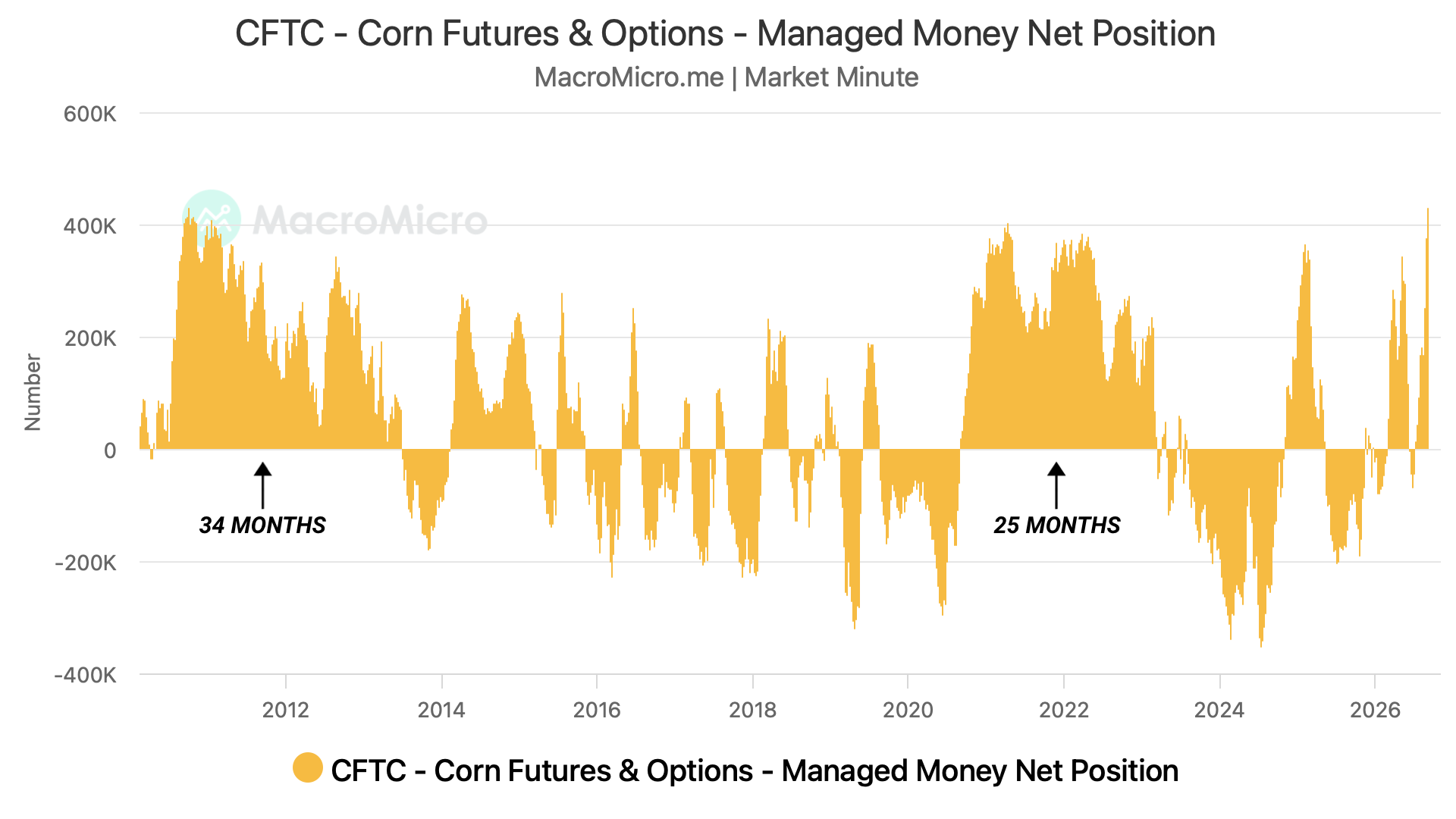
The Funds: Record Long
We went into this on Tuesday.
But the funds are record long both corn and soybeans right now.
Does this mean the rally has to be over? No.
It could mean that the funds might look to take some profits, but doesn’t mean they have to full on puke out.
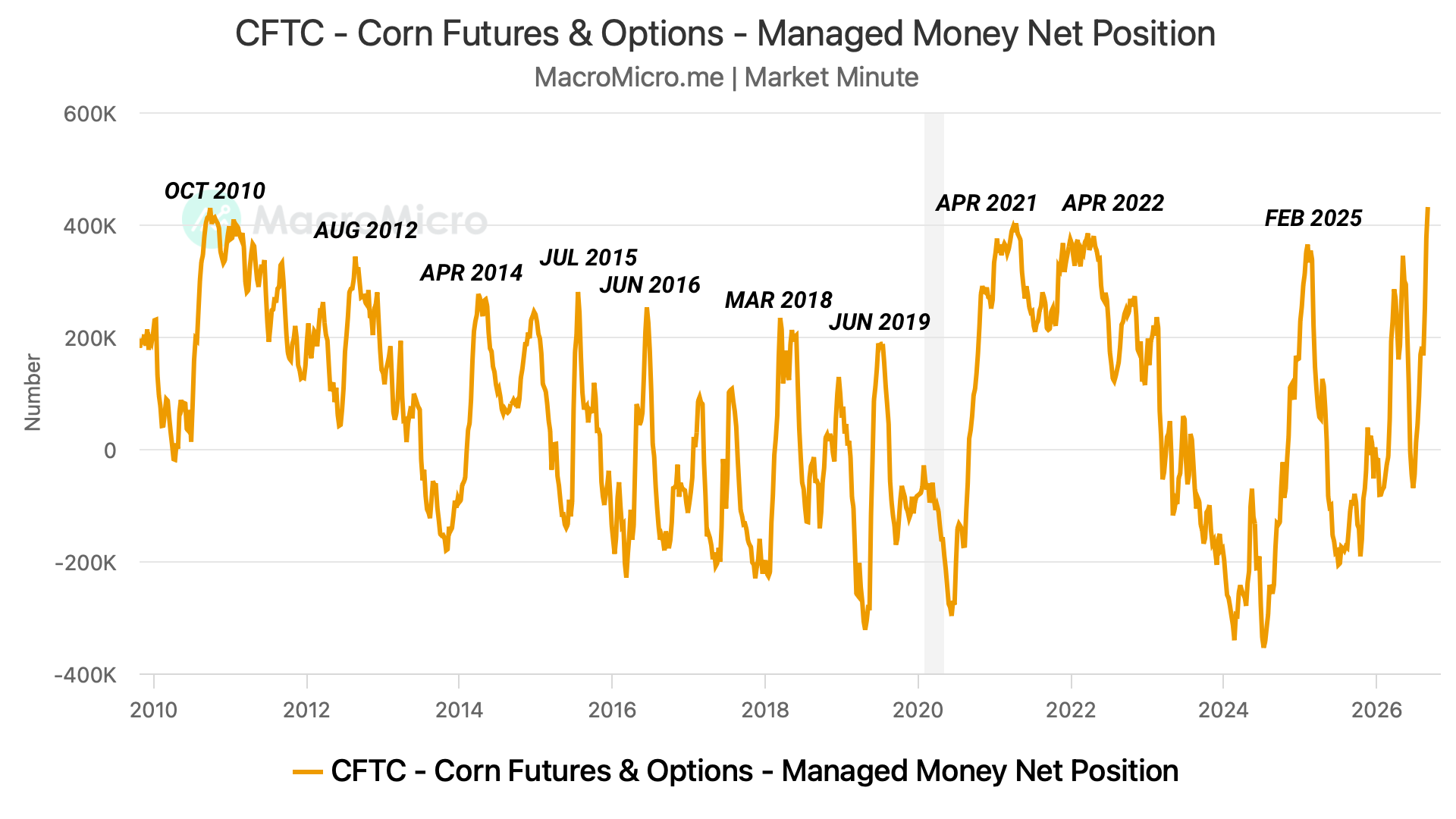
There are only 3 times the funds have been long +400k contracts.
2010, 2021, and today.
How long did they stay long the last two times?
In the 2010 run, they were long for 34 months.
In the 2021 run, they were long for 25 months.
So both were 2-3 years.
Could you they full on exit? It's always possible. But I don’t see them giving up that long without a reason. I think they'll defend it for the most part, as I don’t see a reason for them to.
It doesn’t mean they can’t sell some. They don’t have to add here, but they don’t have to get short either.
Most of the times where they get super long then randomlly puke out does tend to happen during the spring to summer time rather than towards the end of the year.
Aka summer supply scares and weather rallies.
This is more than just a traditional supply scare in June.
Corn Charts
Still Long Term Bullish, Still Short Term Cautious
Long term I am bullish on corn and the rest of the grains, as I see plenty of ways for higher prices down the road.
Short term, I am pretty cautious. As I have been for the last week if you watched my previous updates.
This pull back across all of the grains isn’t surprising, and actually viewed as healthy in my opinion.
Which is the reason we sent out that sell signal and hedge alert on September 2nd at the highs.
The alert was geared towards those who lack storage or are short on time. If you've got plenty of time, by all means stay patient. I want to keep as much dry powder as possible. The corn situation is not bearish.
If you missed the alert: Click Here to View
Short term, we could be in for a correction like we've talked about the last week or so. As we've been talking about this possible pull back.
We just had a massive rally. The funds are record long. I wouldn’t be surprised to see them take a little bit of profit while the farmer is going to be forced to sell off the combine.
We could get some harvest pressure. Then once the farmers are forced to sell, the market runs it back higher. But not before forcing people out.
That's my thought process here.
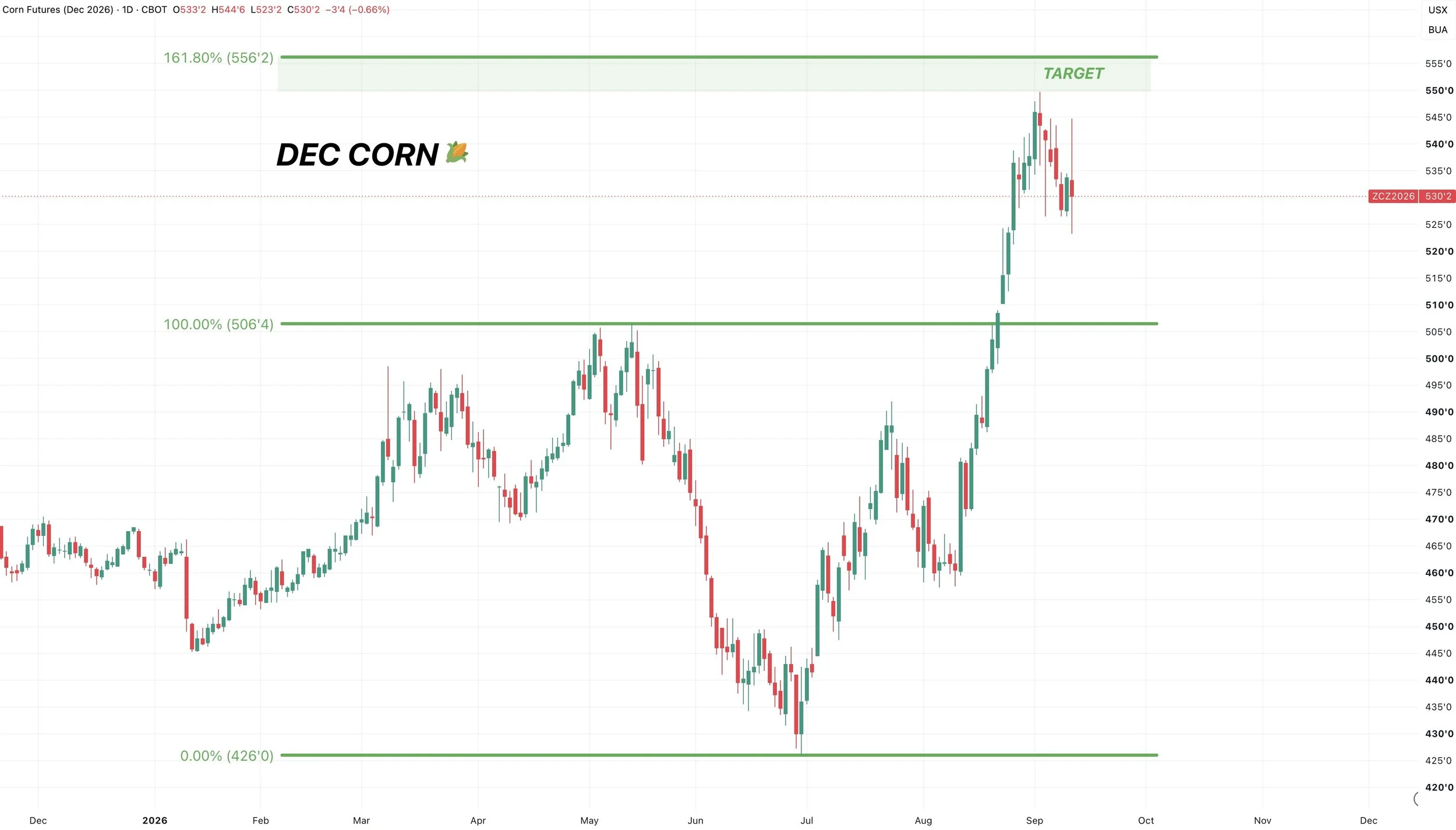
Dec Corn Daily Chart:
We hit that $4.50 target.
Today's price action was disappointing.
Right after the report, we went from down -8 cent to up +11 cents.
The market then digested the report, and we finished the day down -3 1/2 cents.
We had a huge range today. So today's highs and lows will be important. Whichever direction we break first probably decides the next leg and if it's higher or lower.
Indicators: Suggest Pullback?
The indicators are something we talked about in last few updates as well.
The MACD crossed bearish. Suggesting mometum may be lower for now.
The market tends to make big bottoms when the stochastics are bottomed out. Right now they are not bottomed out, currently about half way there.
So that's something I will be watching when trying to hunt for a bottom.
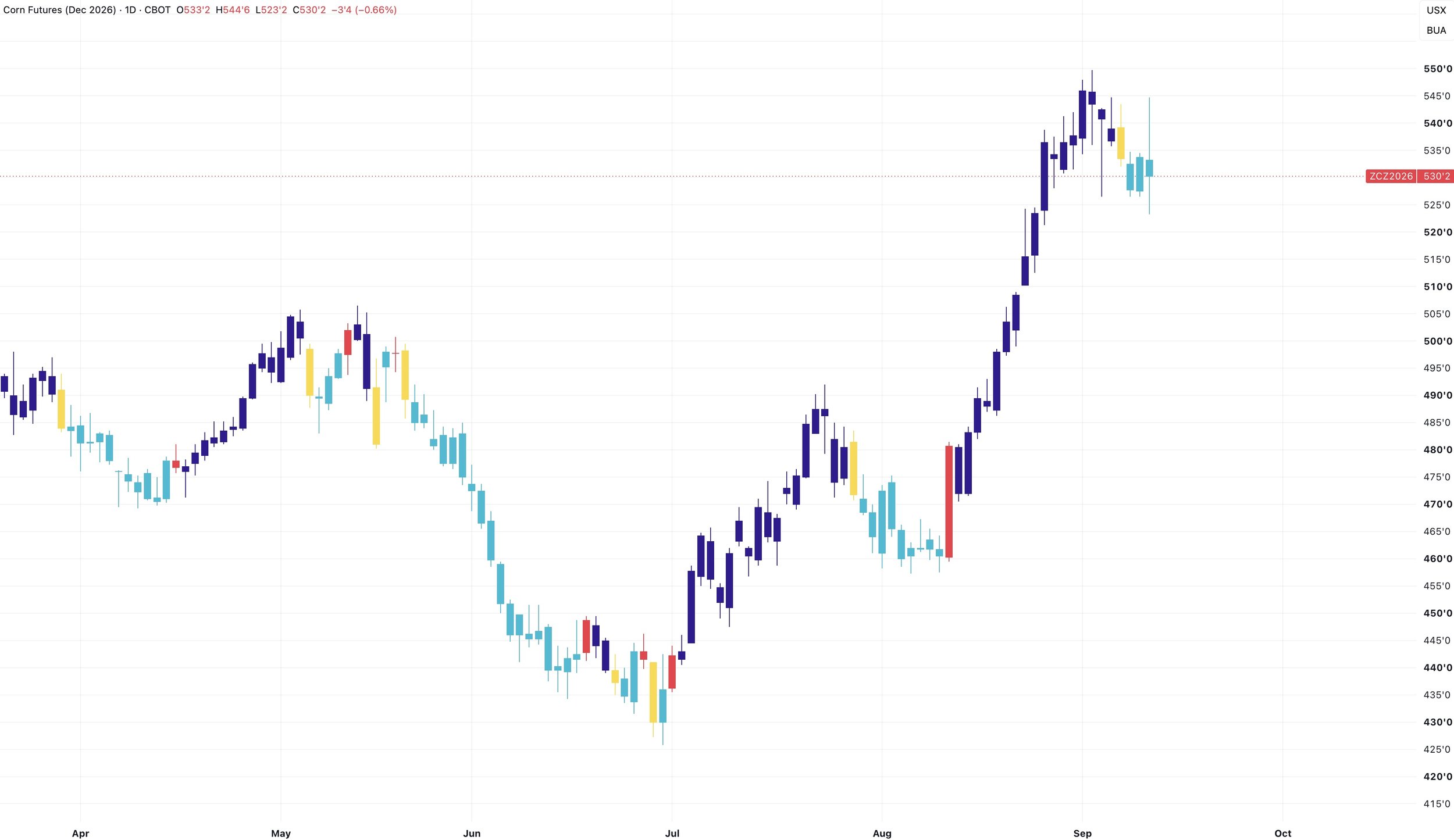
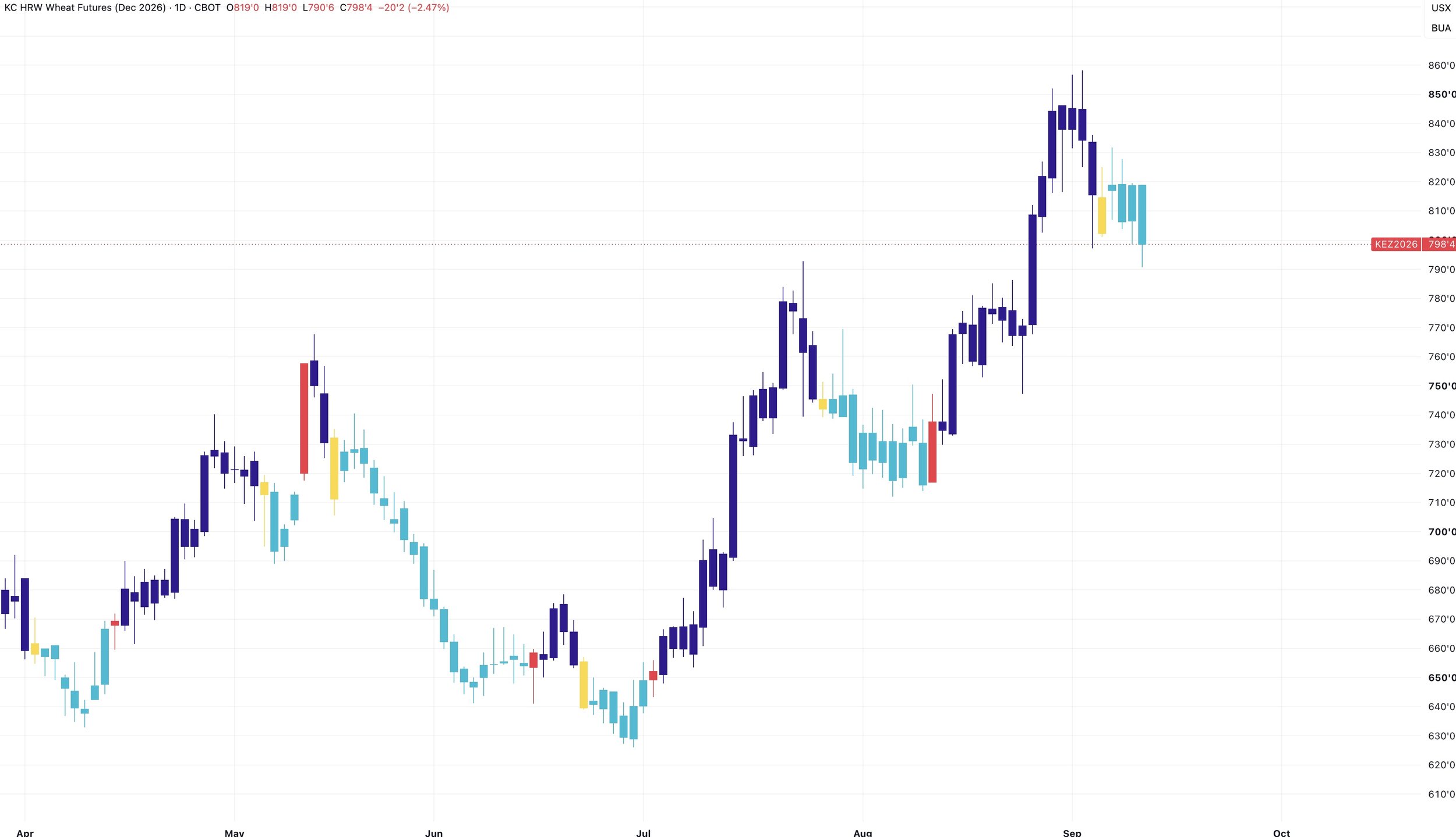
Here is an update on the bearish and bullish candle indicator I showed you guys earlier this week.
Again:
Red Candle = Bullish Trend
Dark Blue Candle = Bullish Trend Continuation
Yellow Candle = Bearish Trend
Light Blue Candle = Bearish Continuation
Of course this is not a perfect indicator by any means, but currently we still have a bearish trend following that yellow candle earlier this week.
Which was the first yellow candle since before the August pullback.
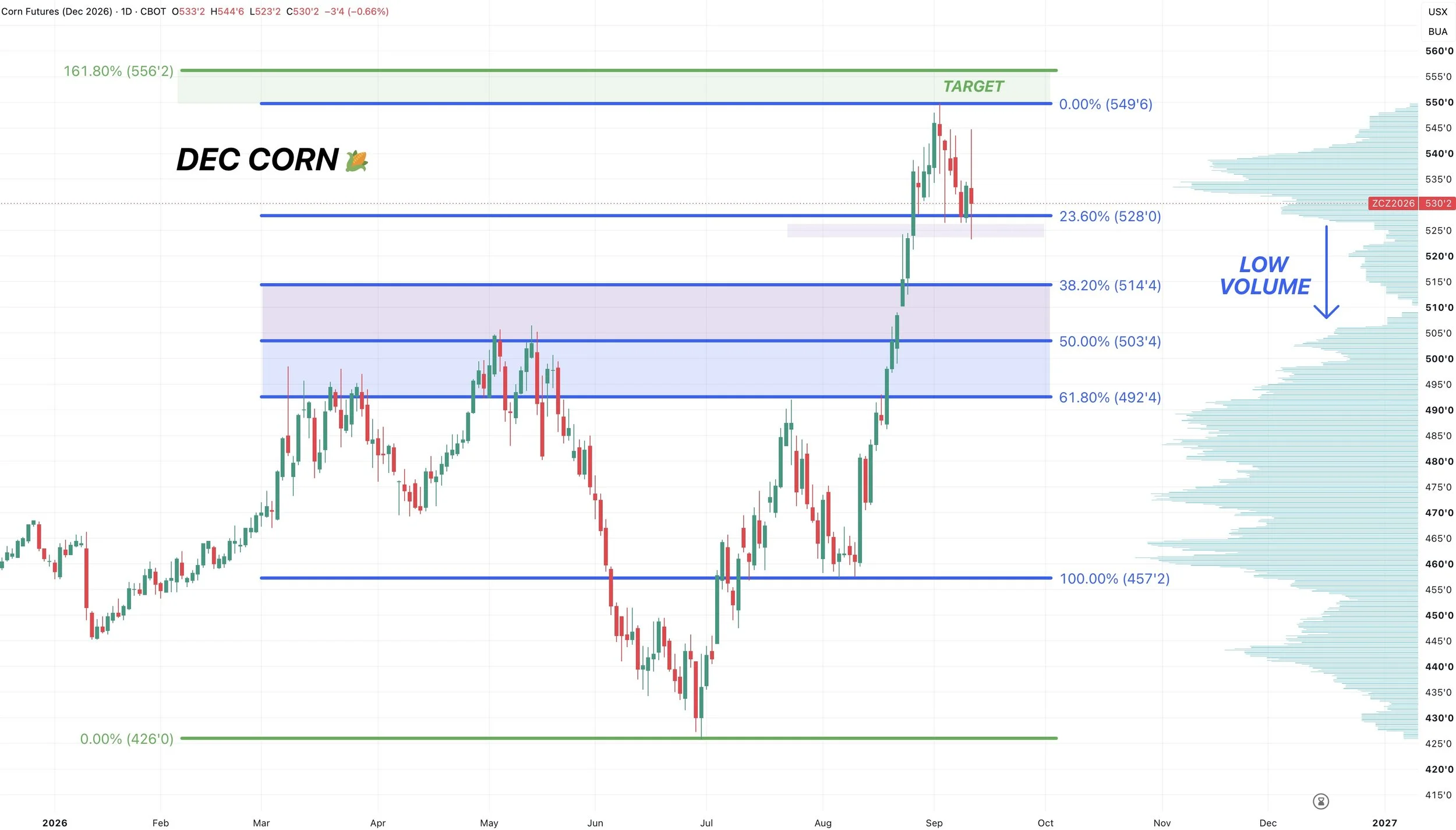
Where could we pullback to?
Of course we do not have to pullback further, but I am just saying I would not be surprised if we do.
Today's lows are going to be a key level to watch.
If we break them, I am looking for a bottom around $5.04 to $5.14
Which is the 38.2% to 50% retracements down to the August lows.
I lean more towards the 50% level, as that level would align with a perfect re-test of those highs from May.
I think that would present a great opportunity to look at some re-ownership if it comes.
There is also pretty low volume if we break below this current level. So bulls would like to hold here or it could spark further downside.
If you look at the weekly chart.
We got a clear breakout.
The highs from May also just happened to be at $5.04
So a re-test of the point of breakout would perfectly line up with that level here as well.
Making it another point of interest and another reason why it'd make sense to bounce there if we get there.
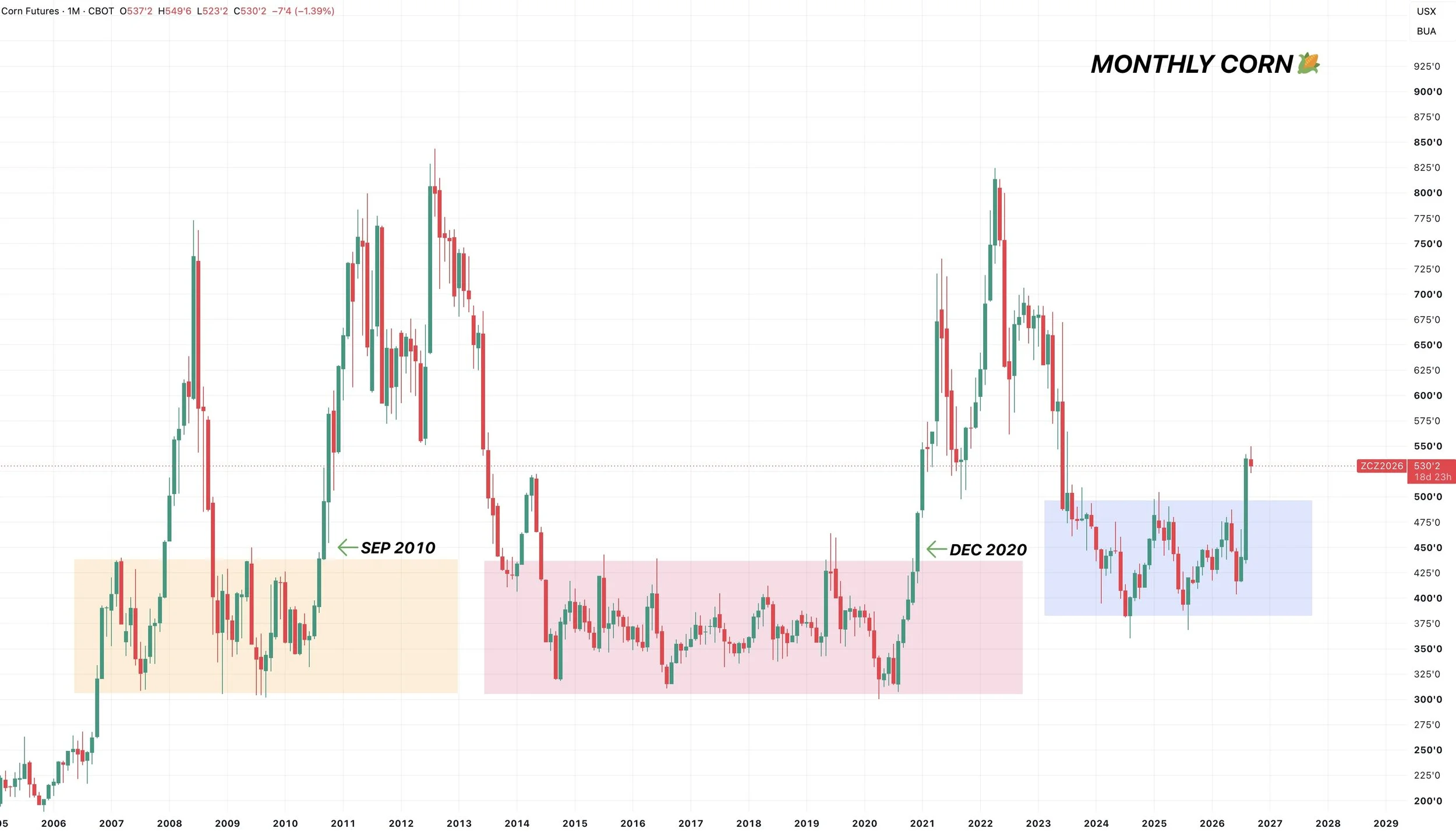
Monthly Chart: Breakout
Big picture the corn chart looks phenomenal.
I think this thing has plenty of upside long term.
We just had a monthly breakout from a multi-year range.
The last two times we saw that happen was 2010 and 2020.
Seems like a big deal.
Weekly Chart: $6.50 Corn?
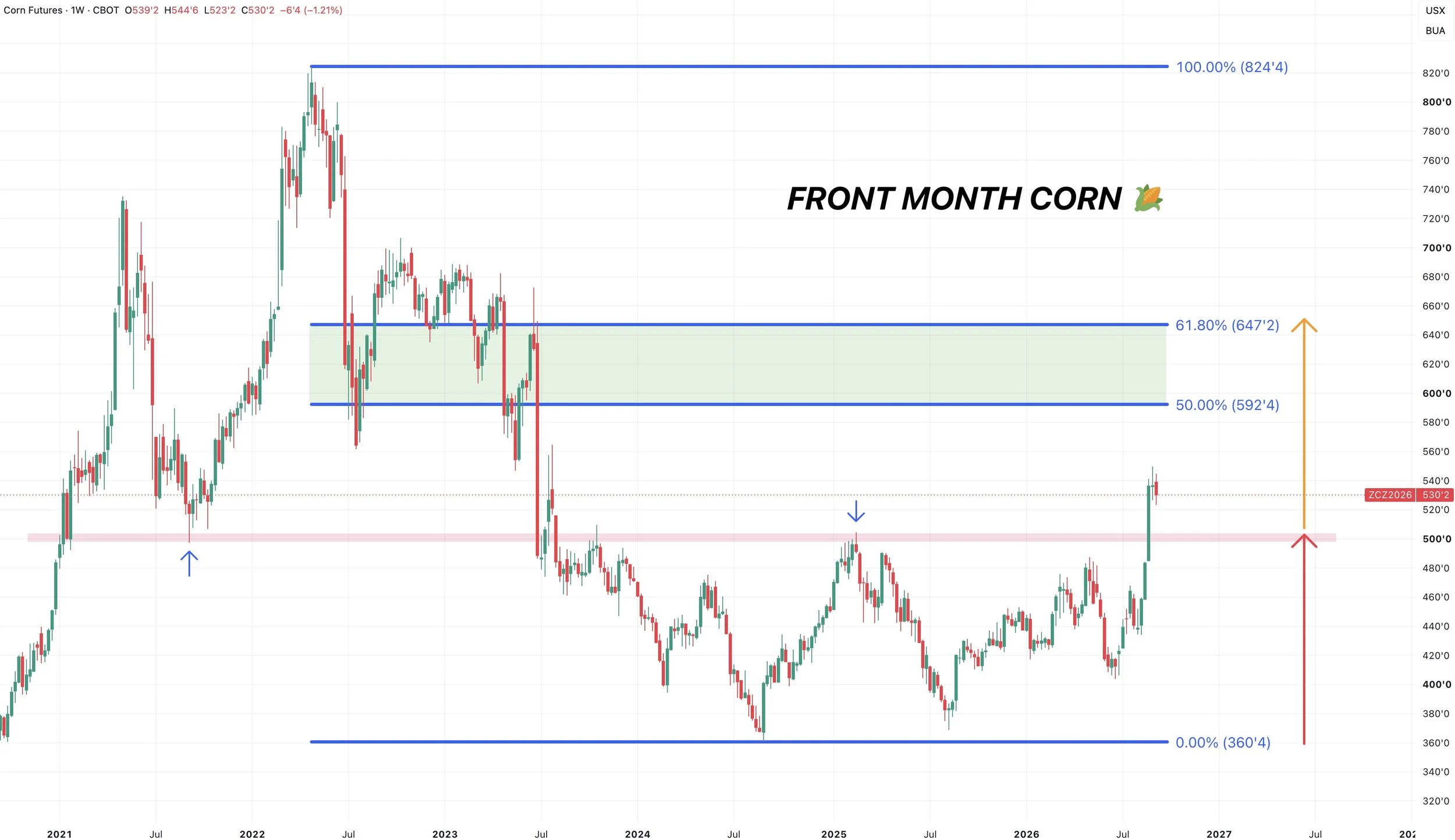
I think corn has a shot at $6.50 longer term.
But that doesn’t mean it's going to be a straight shot higher. And it doesn’t mean we have to get there at all. But I think it's realistically possible eventually.
If you take the range we've been trapped in for 3 years, and add it on top of the range, you get $6.50
$6.50 is also 61.8% of the 2022 highs.
Soybeans
USDA mean anything?
The report didn’t provide any big changes.
The crop was bigger than the market was expecting.
Corn and beans had the same weather. Yet corn yields are way down, meanwhile bean yield are up. Makes you scratch your head a little. So I think the yield could ultimately come down a little.
The USDA did bump our exports.
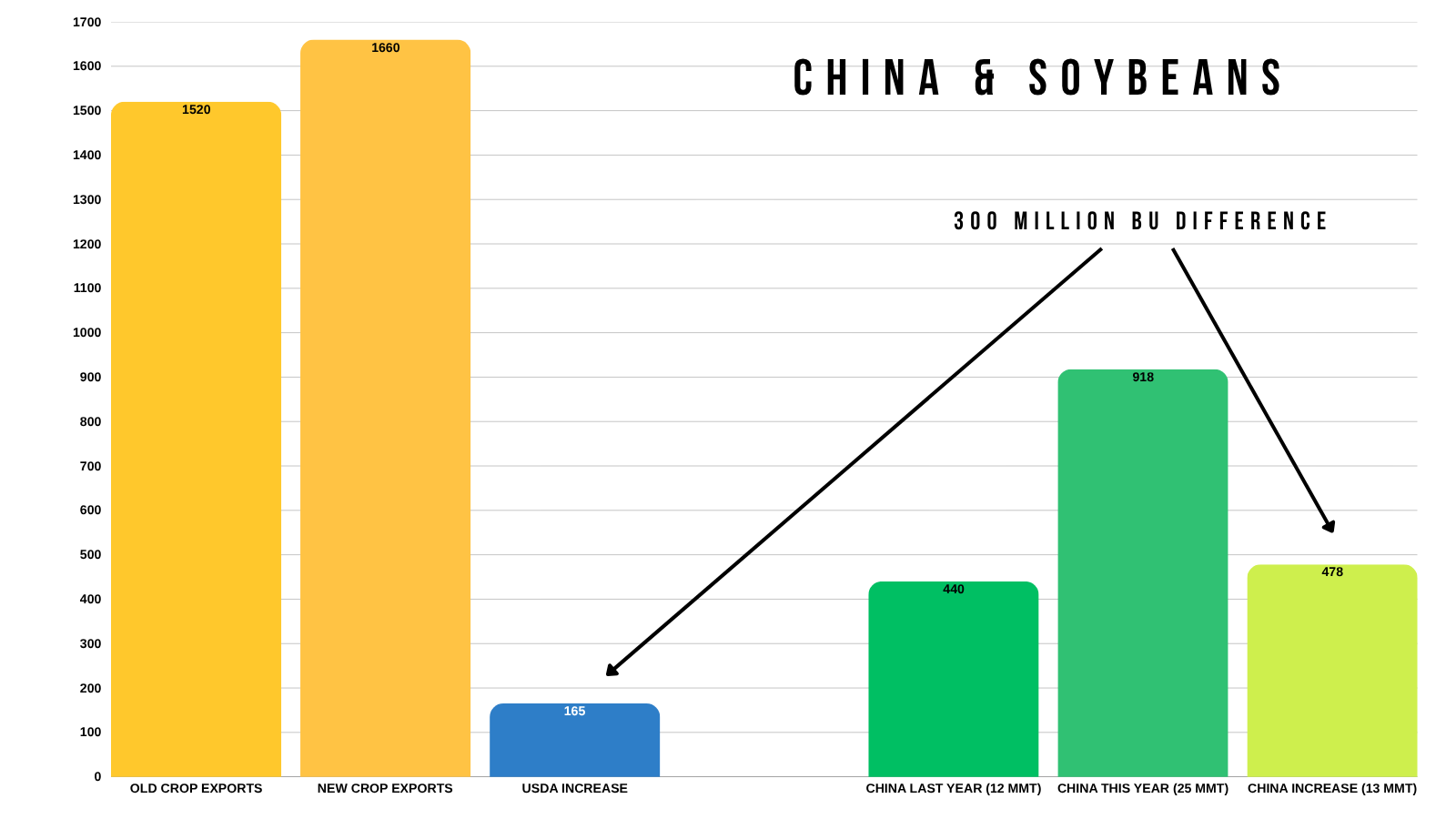
China has already bought half of their 25 MMT goal.
If you've seen my past updates, you probably know that the USDA is not accounting for all of the business to China that they agreed to buy.
The USDA now has exports up +165 million vs last year.
But wait.. China says they are going to be buying +480 million more than they did last year. So why the disparity?
The USDA seems to think that we are going to be losing non-China demand. But for us to lose that business, we might need to ration demand with higher prices.
Sorry if I sound like I'm beating a dead horse on this topic. But this is one of the most important factors.
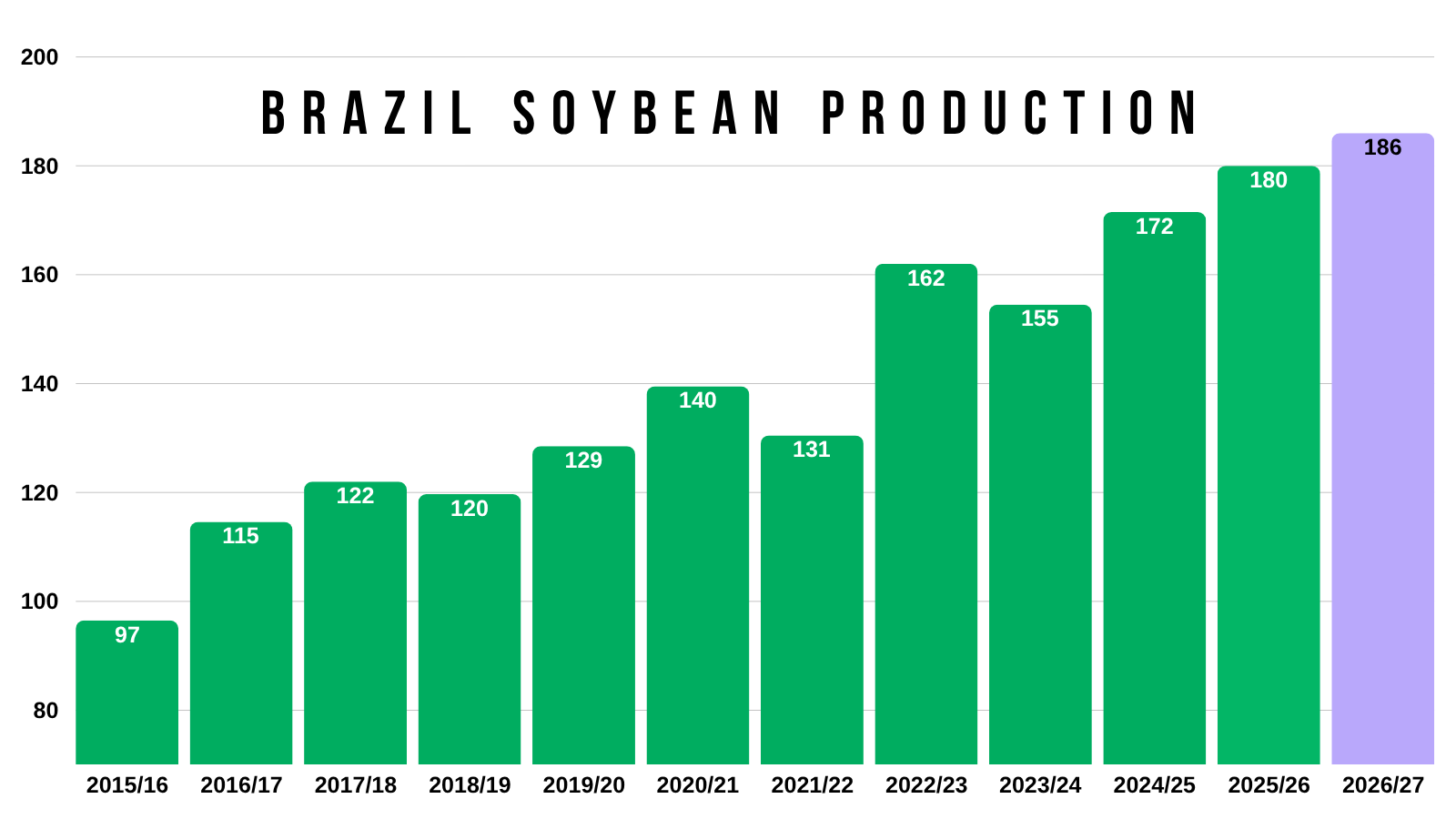
Then you have Brazil.
Their weather season is coming up fast. And we have a Super El Nino that historically leads to some dryness that could cause some problems.
Brazil has continued to pump out record crop after record crop.
Yet the world situation isn’t getting any bigger.
It's at multi-year lows.
So what happens if Brazil actually has a hiccup?
The USDA thinks we are going to lose non-China demand. But what happens if the other player Brazil has an issue? Where is the world going to get all of their soybeans from? Well that business might have to come from the US.
So we have China demand that could very well be being under estimated.
The US crop is up for debate. Maybe it's smaller, maybe it's not.
Then we have the Super El Nino and Brazil, while the world situation is the tightest it's been in years.
If Brazil's crop is smaller, that world situation will undoubtably get even tighter.
I think there is a very good chance that the soybean market is going to have to ration demand at some point.
How do you ration demand? Via higher prices.
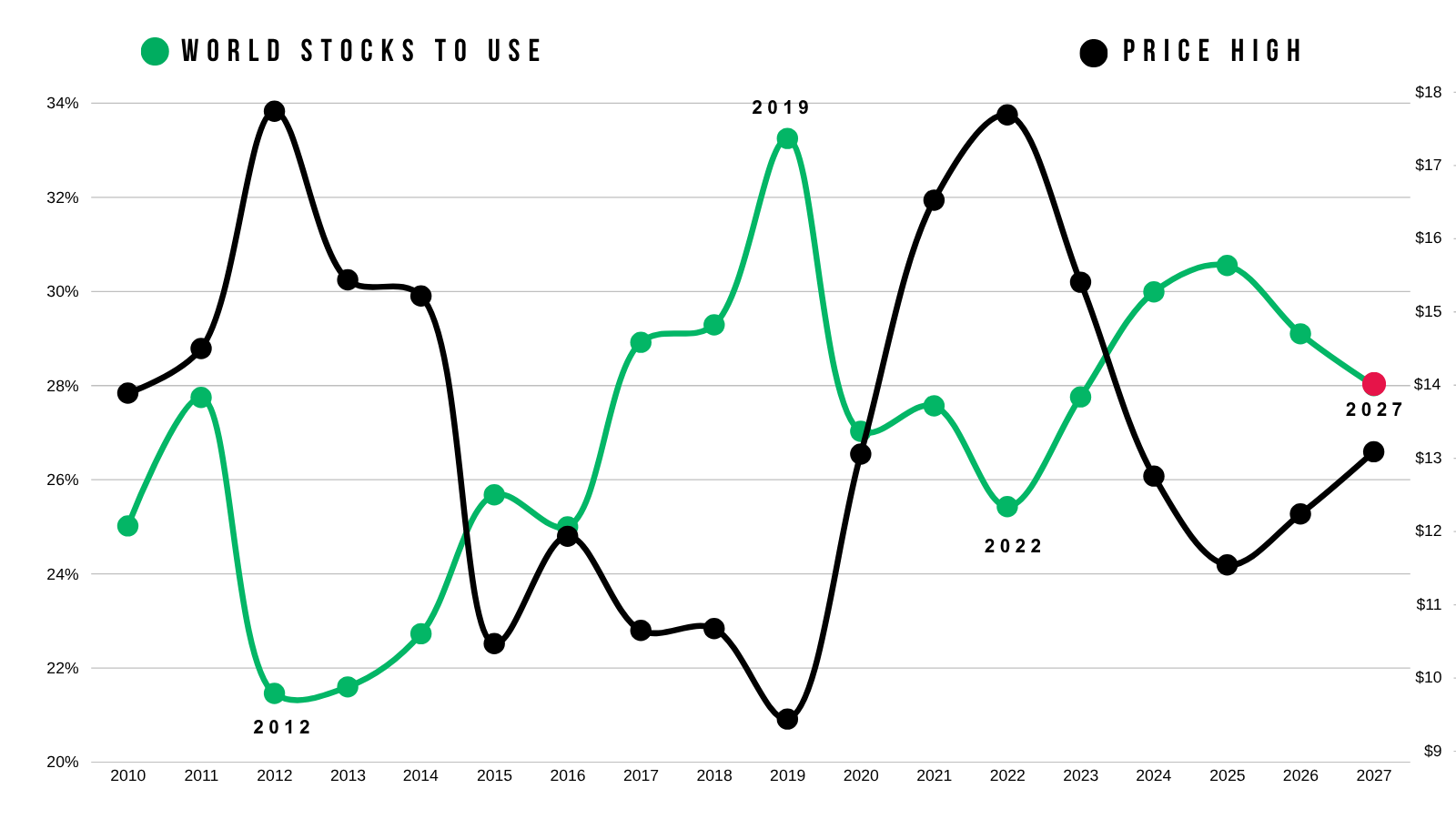
Here is the US situation vs soybeans highest prices.
Not as clear of a correlation here as there is with the world one.
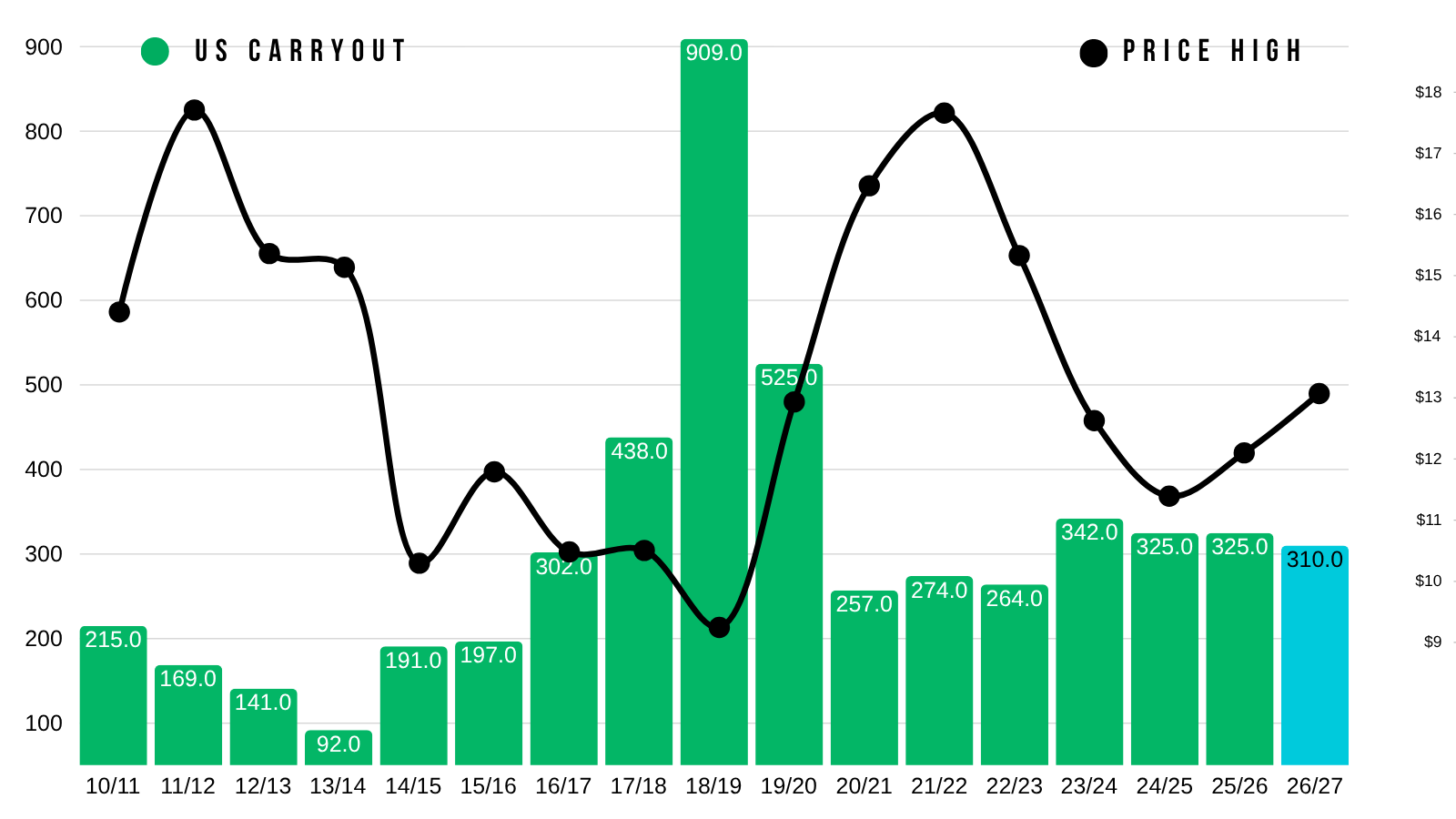
We have a 310 carryout. The last bull market saw a US carryout below 300 million.
I do think the carryout could ultimately end up below 300 million due to demand.
Soybean Charts
Having said that.. just like in corn I think this market could be due for a breather and correction. As I have been talking about the last week or two.
Which is why we sent out that sell signal and hedge alert on September 1st.
Again, like in corn, this was mostly for those who need to be proactive. Those who simply lack storage or time.
If you missed the alert: Click Here to View Alert
Nov Beans Chart:
The reason behind the alert was that we hit the golden fib from the August lows up to the July highs. 161.8% of that move. A common spot for continuation rallies to stall in bullish markets.
We had been trapped in a completely sideways pattern the last 10 days.
Yesterday we broke out of the top of that range.
Today we gave it all back and broke through the bottom of the range.
So that looks like a possible failed breakout, but Monday's action might be telling. As it could likely tell us if this is just a head fake or if the correction is starting.
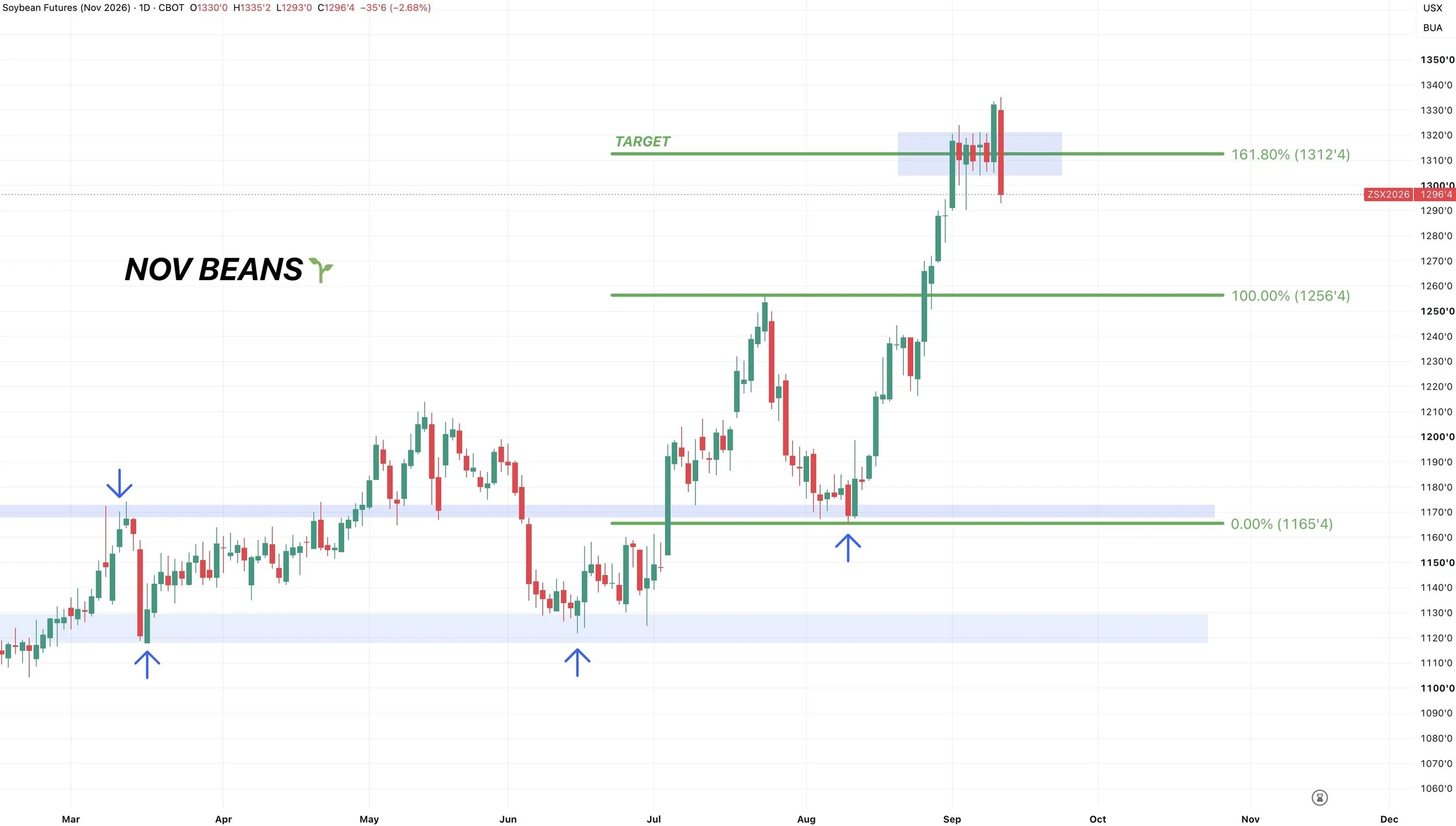
How far could we pull back?
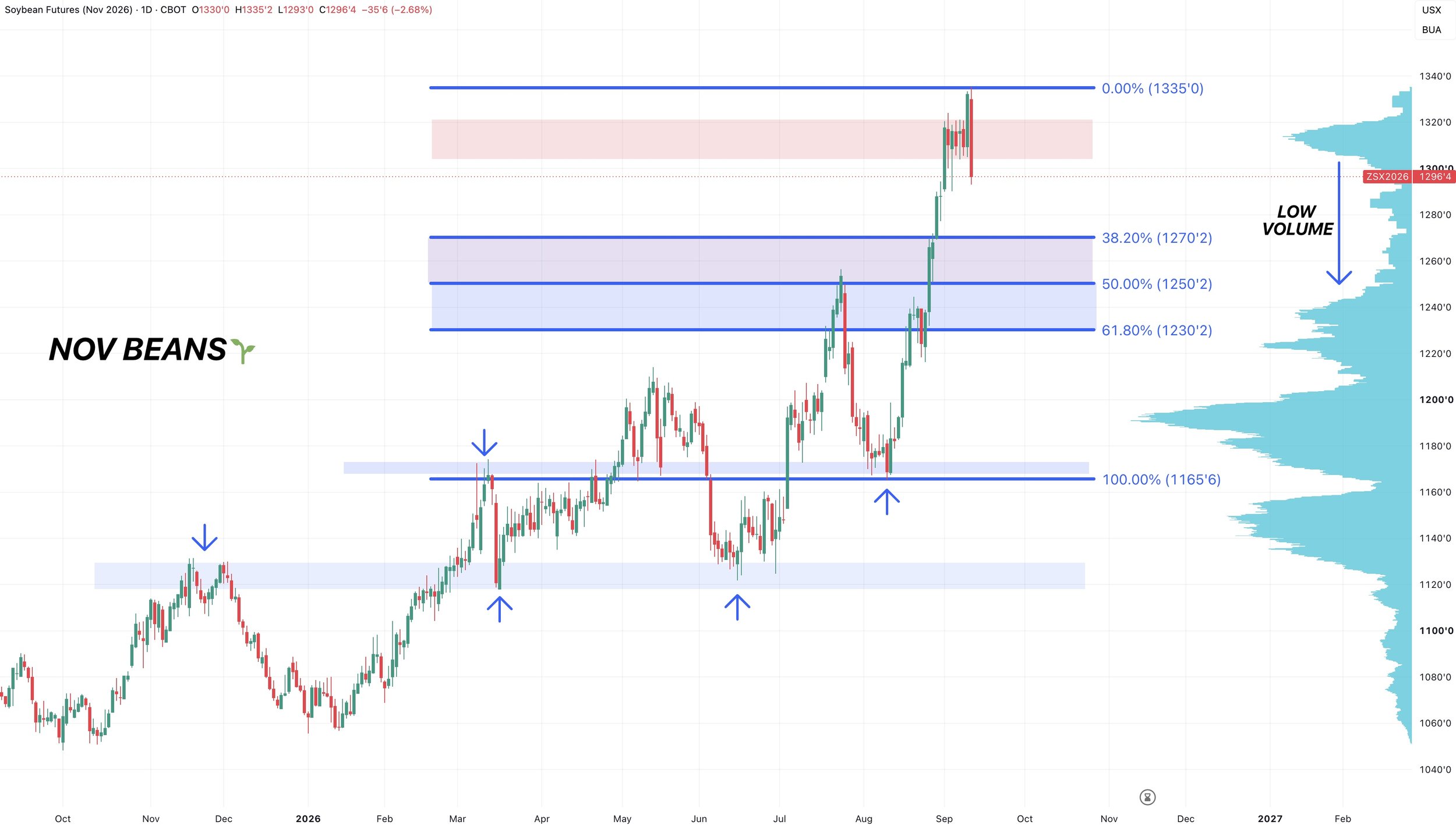
If this is the start of that correction we've been discussing, I am looking for a possible bottom around $12.50 to $12.70
That would give back 38.2% to 50% of the rally from August.
That 50% level lines up with a re-test of those highs from July.
The soybean market has a pretty solid history of breaking out, then coming back to turn the old highs into support.
If you notice there is not very much volume and support below this level if we decide to pull back. Because we ran straight up, leaving little support.
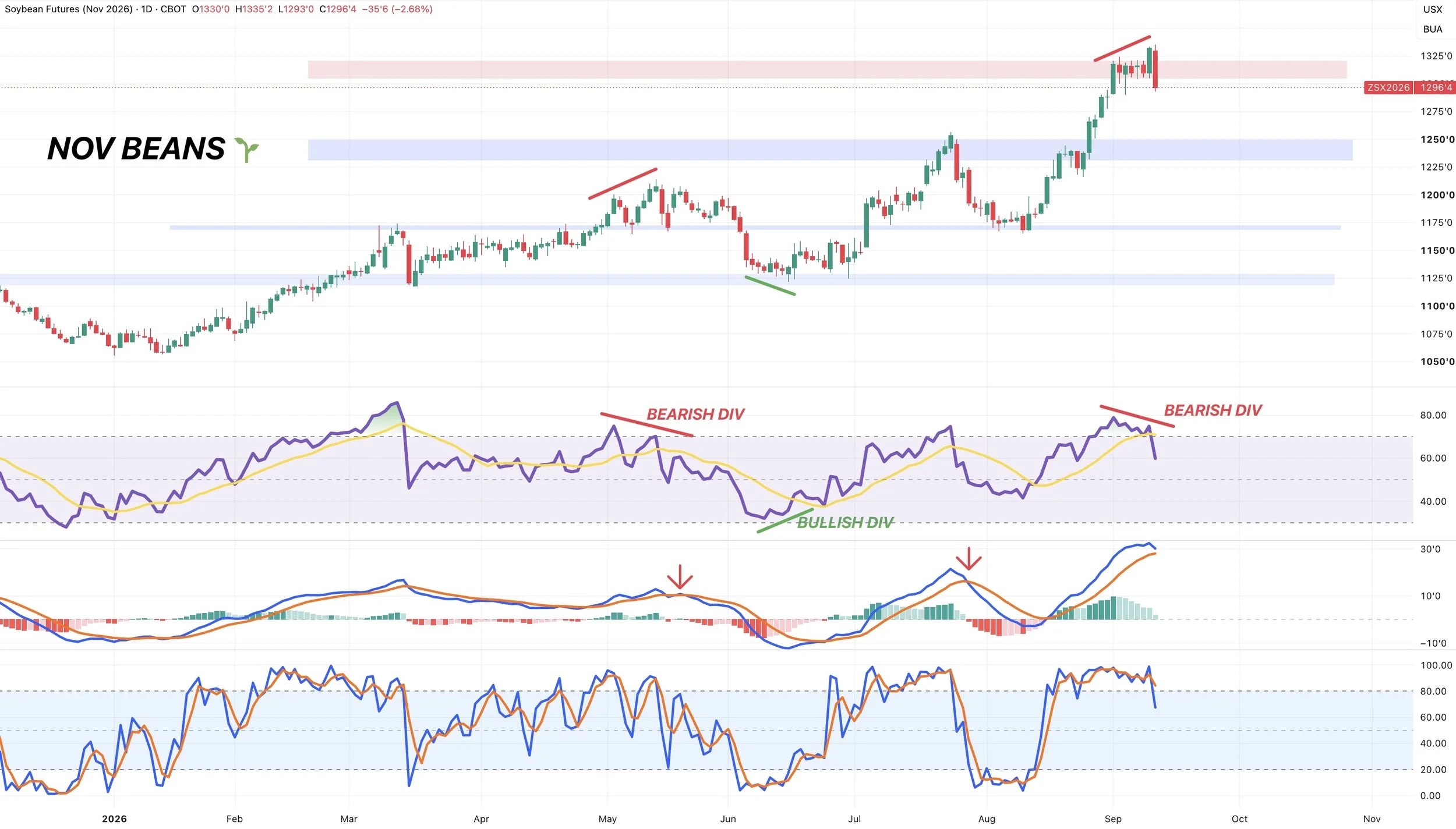
Indicators suggest pullback?
The indicators also suggest we could be in for some further weakness short term.
We had bearish divergence on the RSI yesterday which is playing out today.
Prices made new highs. The RSI did not.
The MACD is curling lower, looking like it may want to cross bearish from here.
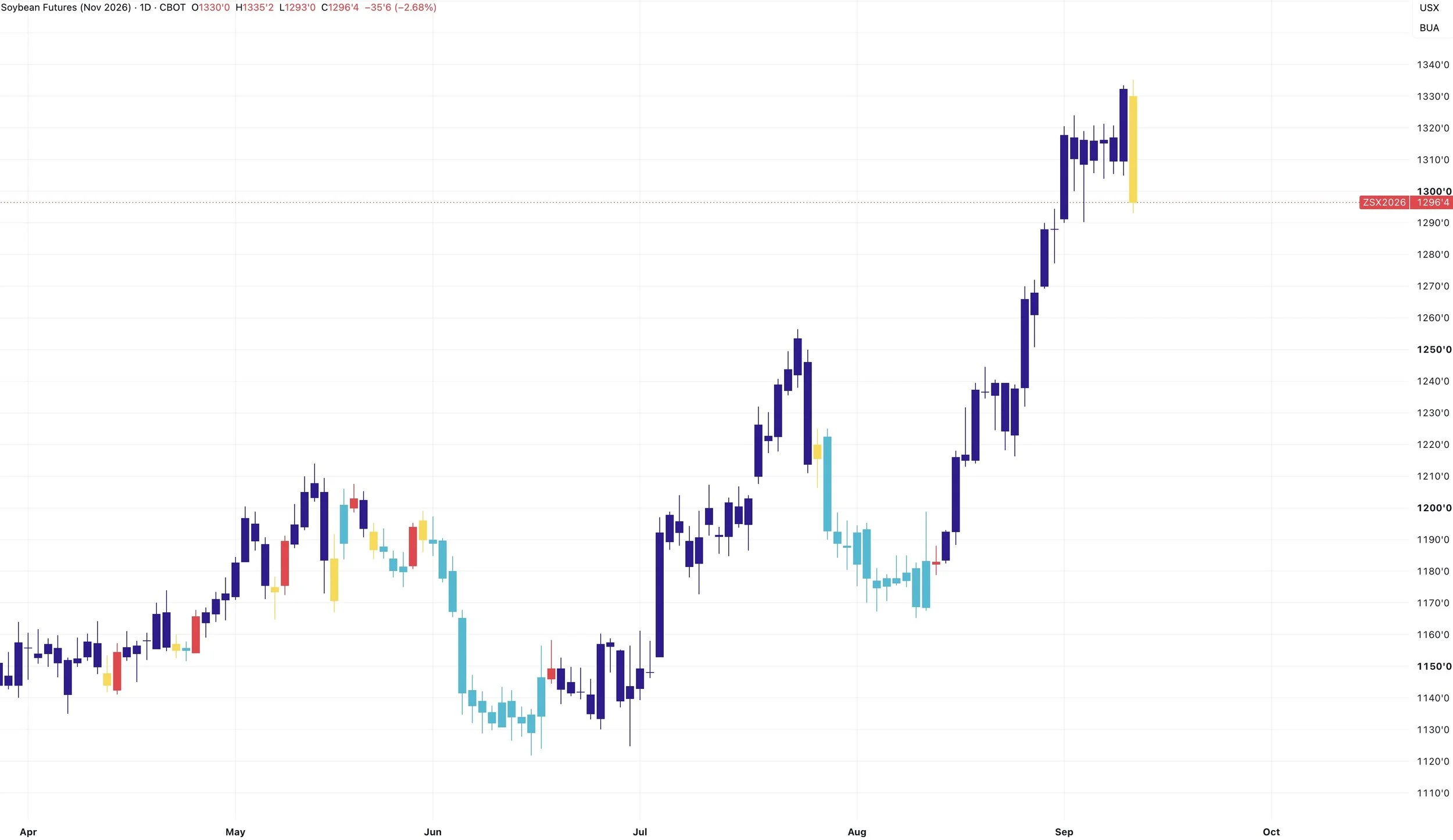
Here is the bullish and bearish candle indicator.
We just got our first yellow bearish candle since right before that August pull back.
Obviously doesn’t mean we "have" to continue lower. Simply another reason why some further downside would not be a surprise.
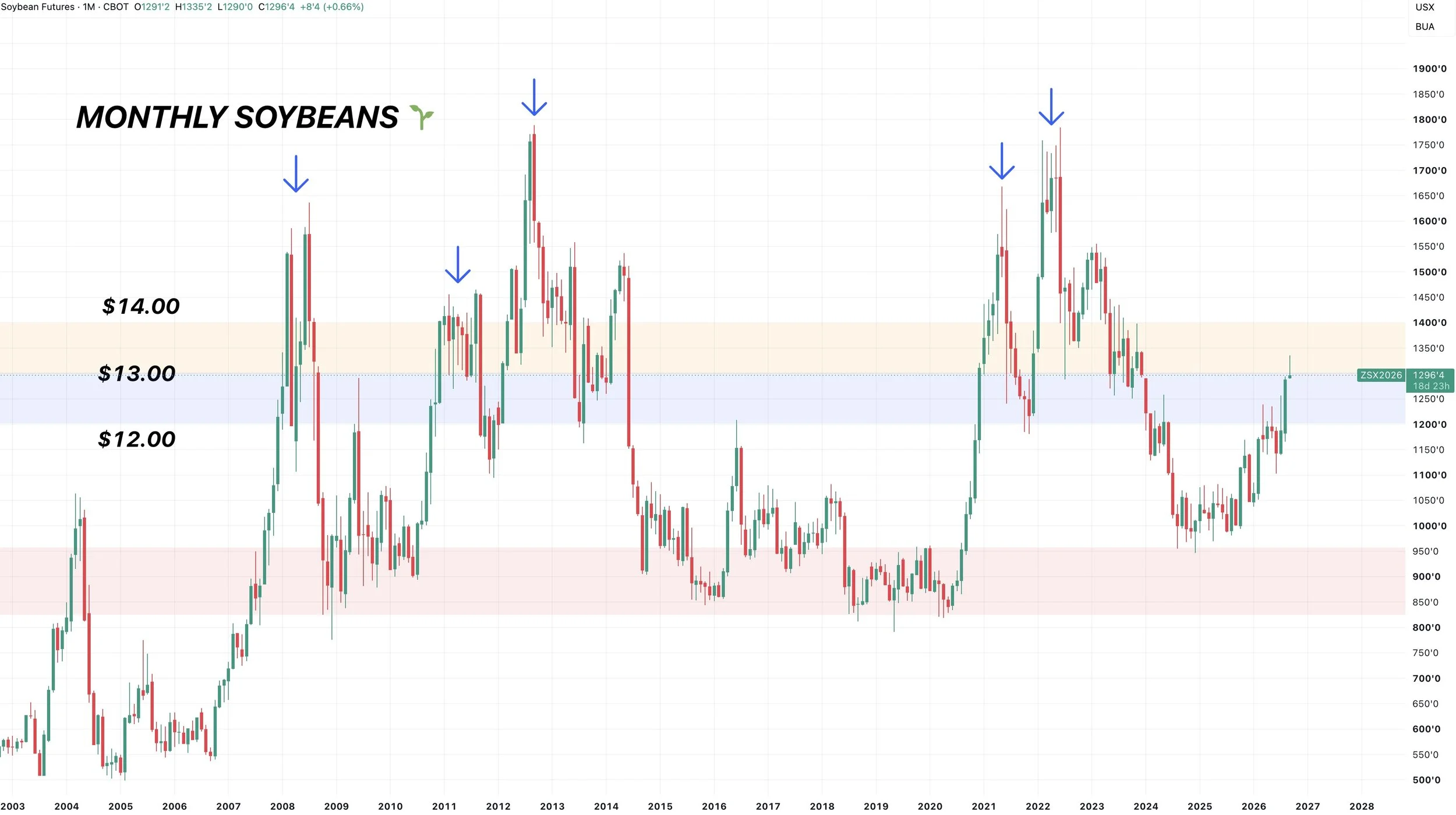
Eventual $14 Beans?
Every single time soybeans have seen a monthly close above $12.00, we have eventually ran to $14.00
We could go lower first, but I think there is a chance we see $14.00 at some point.
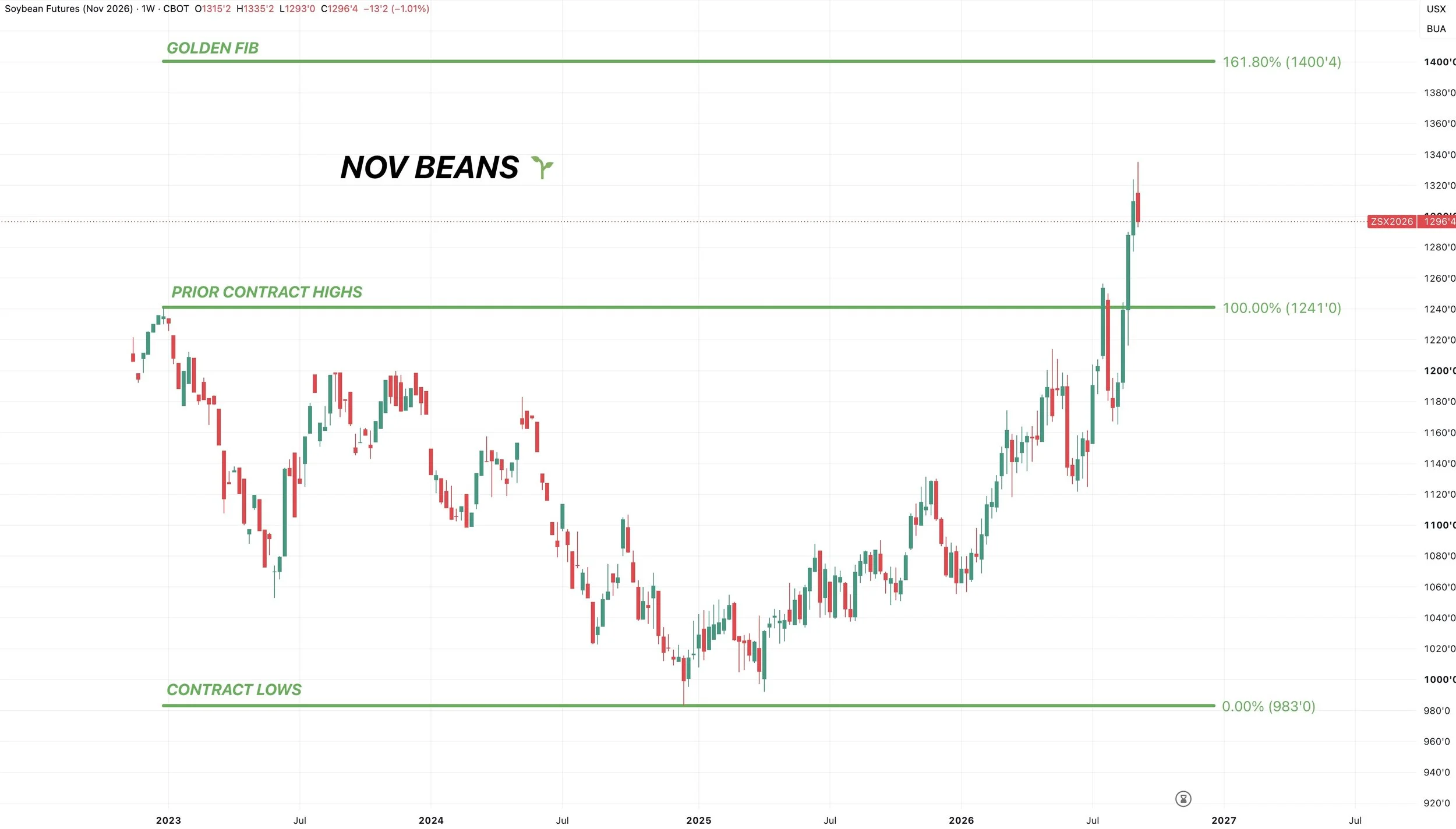
If you look at the weekly chart for Nov beans.
The golden fib from the contract lows up to the previous contract highs also sits right at $14.00
Meaning $14.00 is 161.8% of those contract lows, up to the prior contract highs.
So that is going to be why this is a possible long term target.
Wheat
The report didn’t change much. The US situation as unchanged.
The world situation was a bearish surprise. We have the Black Sea issues, but that's not actually a supply issue. It's more of an issue of getting the supply to move. If that continues, it could still definitely cause some issues.
Dec KC Chart:
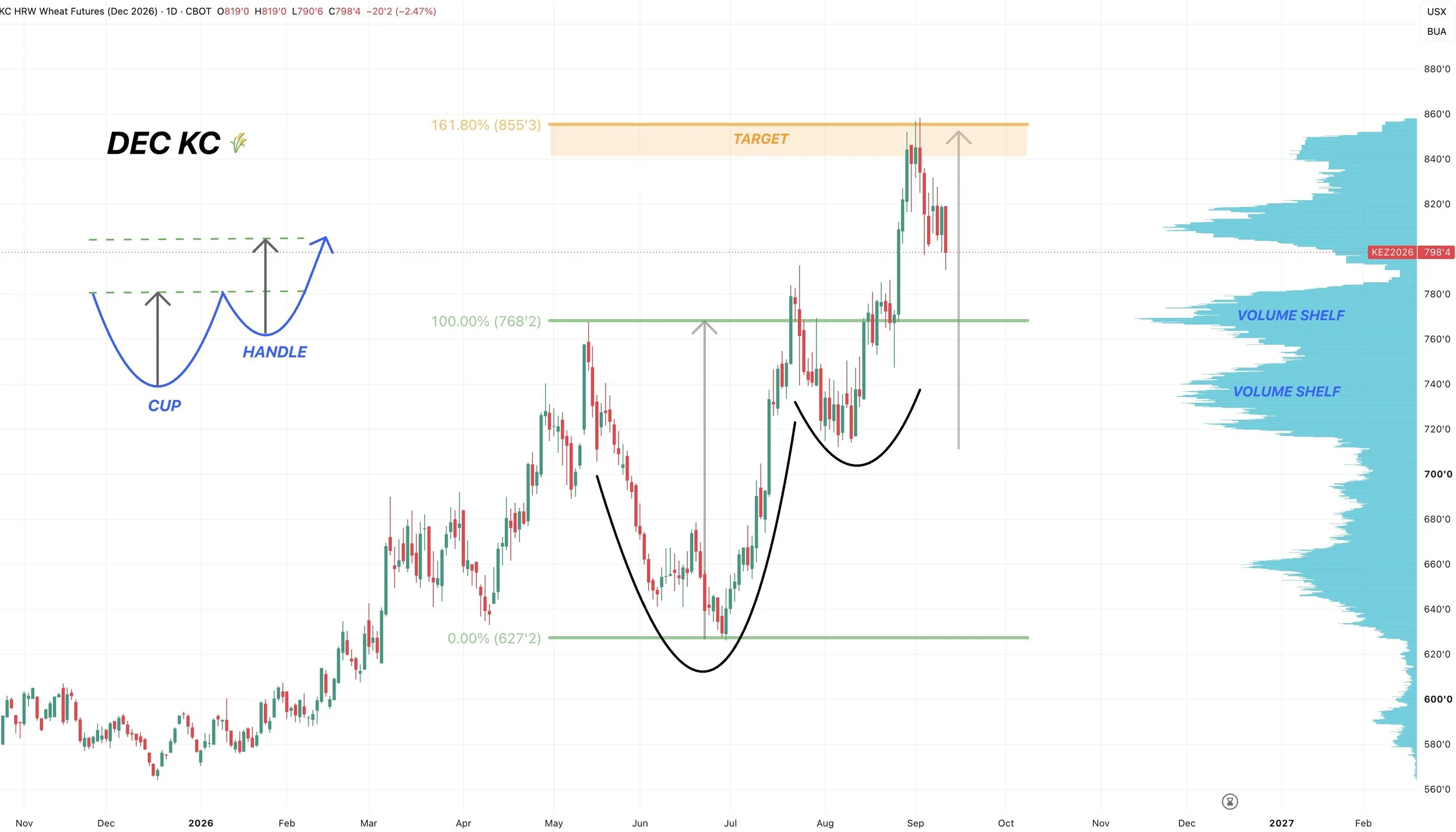
We rejected right off that target and where we issued that sell signal and hedge alert.
If you missed the alert: Click Here
That target was the golden fib. 161.8% of the June lows up to the May highs. A very common continuation target in a bullish market.
That same level was the exact implied move from the cup and handle pattern we broke out of.
We are now seeing that expected pull back.
Where could we bottom?
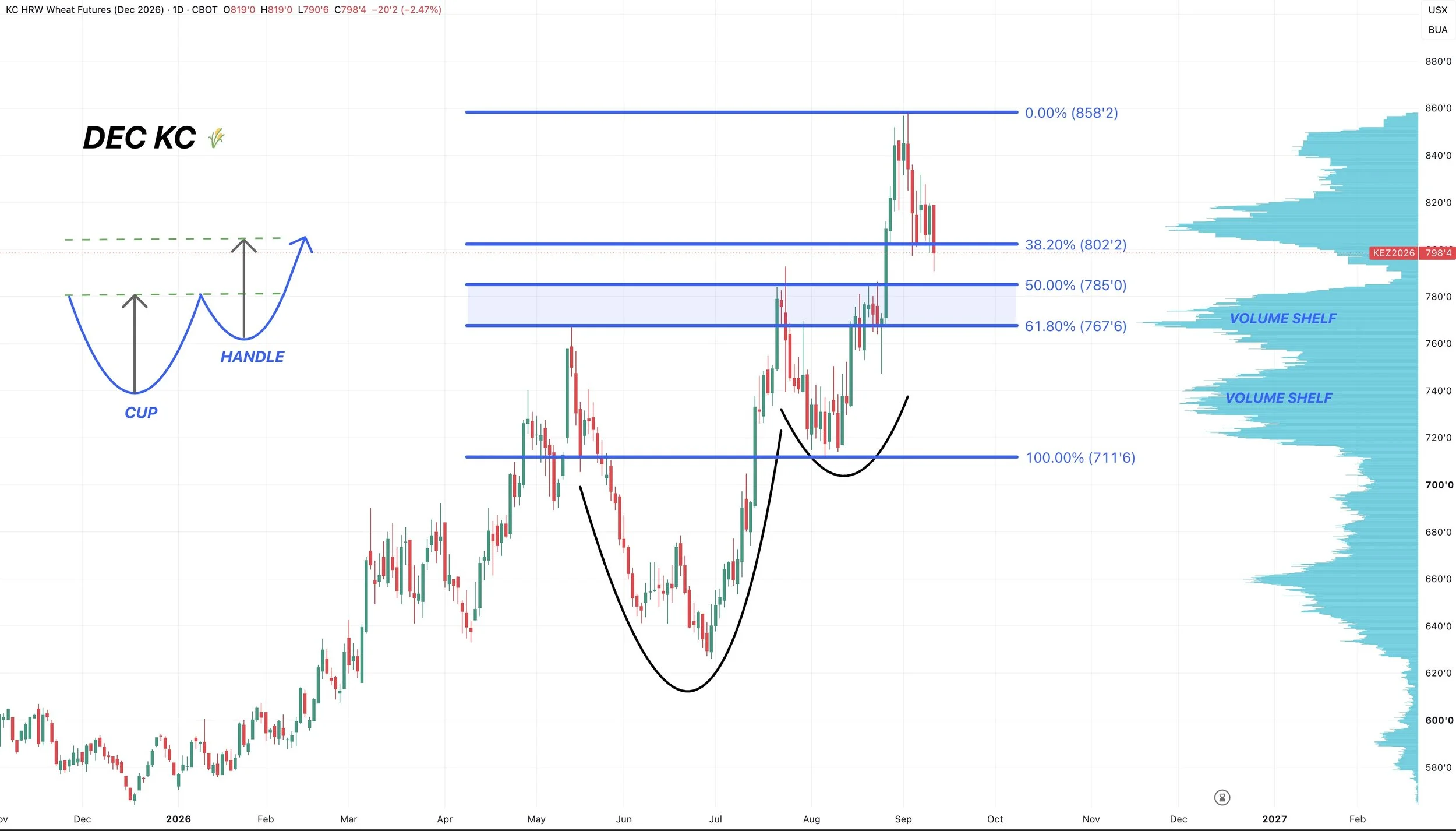
I am still watching that golden zone.
$7.68 to $7.85 gives back 50% to 61.8% of the rally from August.
That would also be a perfect re-test of the prior highs. Turning that old resistance into new support.
Not only that, but there is a massive shelf of volume sitting right in that zone.
Areas of high can volume are often magnets for prices.
Here is an update on the candle indicator.
We had that yellow candle. Now still seeing bearish continuation.
$9 Wheat?
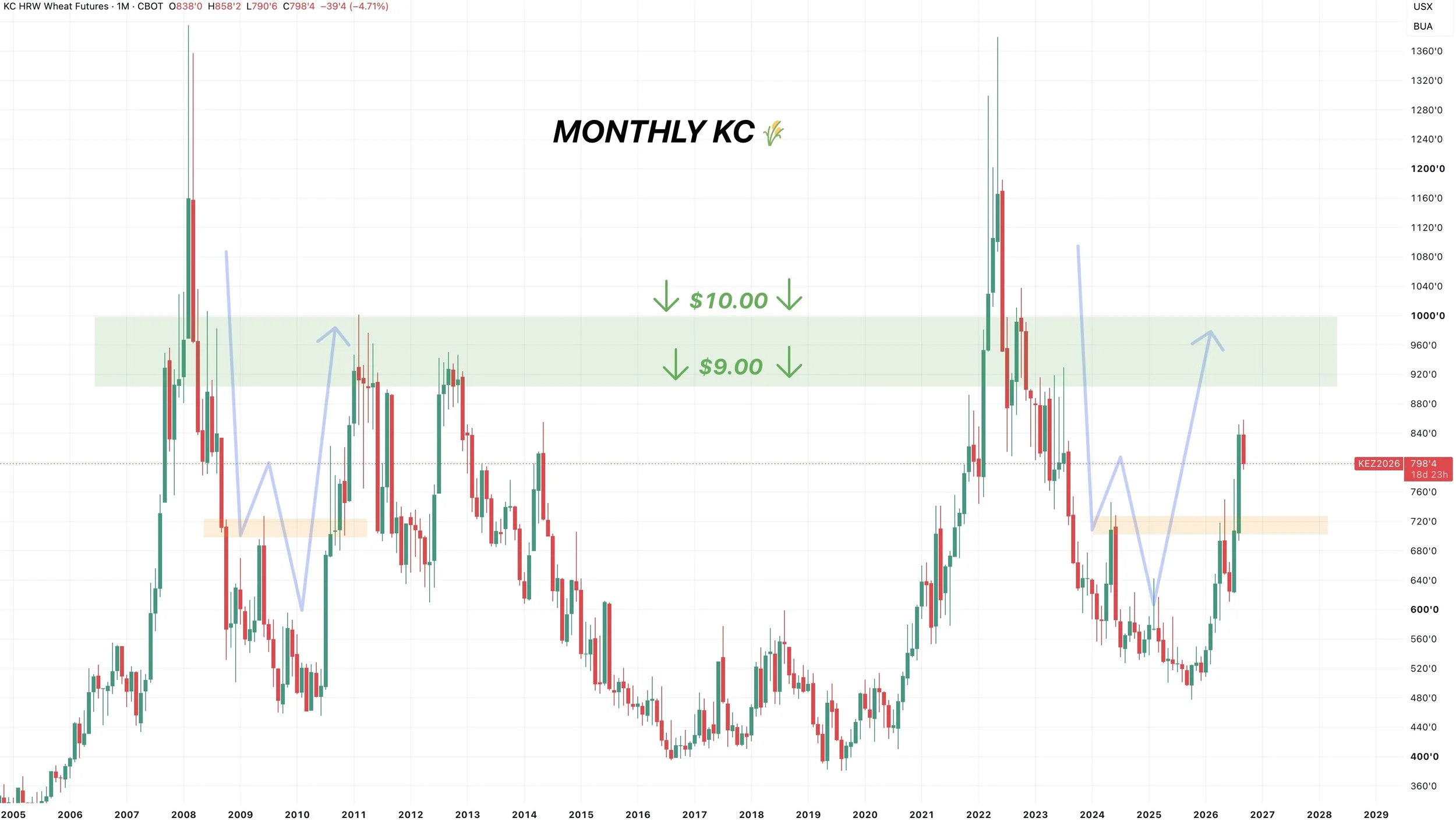
I did want to point out that every single major rally in the wheat market has at least led to $9 to $10.
So I'd say it's absolutely possible we get there long term.
However, if it happens, I would probably be extremely aggresive.
Do you know how many months the wheat market has closed above that green box?
4 months in the entire history of the wheat market.
This rally does still look extremely similar to that one we saw in 2011.
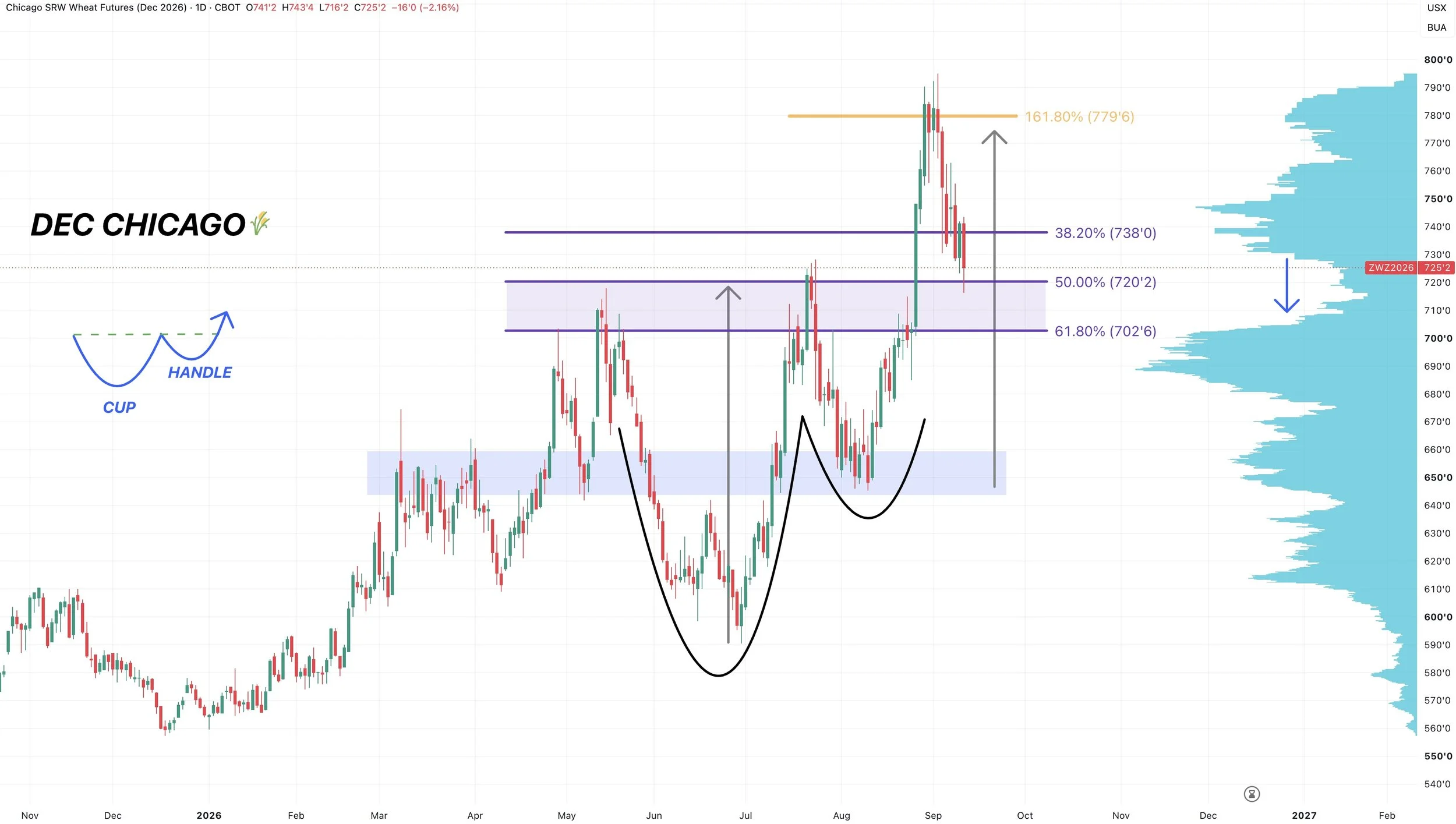
Dec Chicago Wheat:
Nothing to update here.
We rejected off the golden fib and cup and handle pattern target.
We are now entering the golden zone.
We want to hold that 61.8% retracement at just about $7.00
This zone is also a re-test of the old highs. We do also have a volume gap down to the 61.8% level to be aware of.
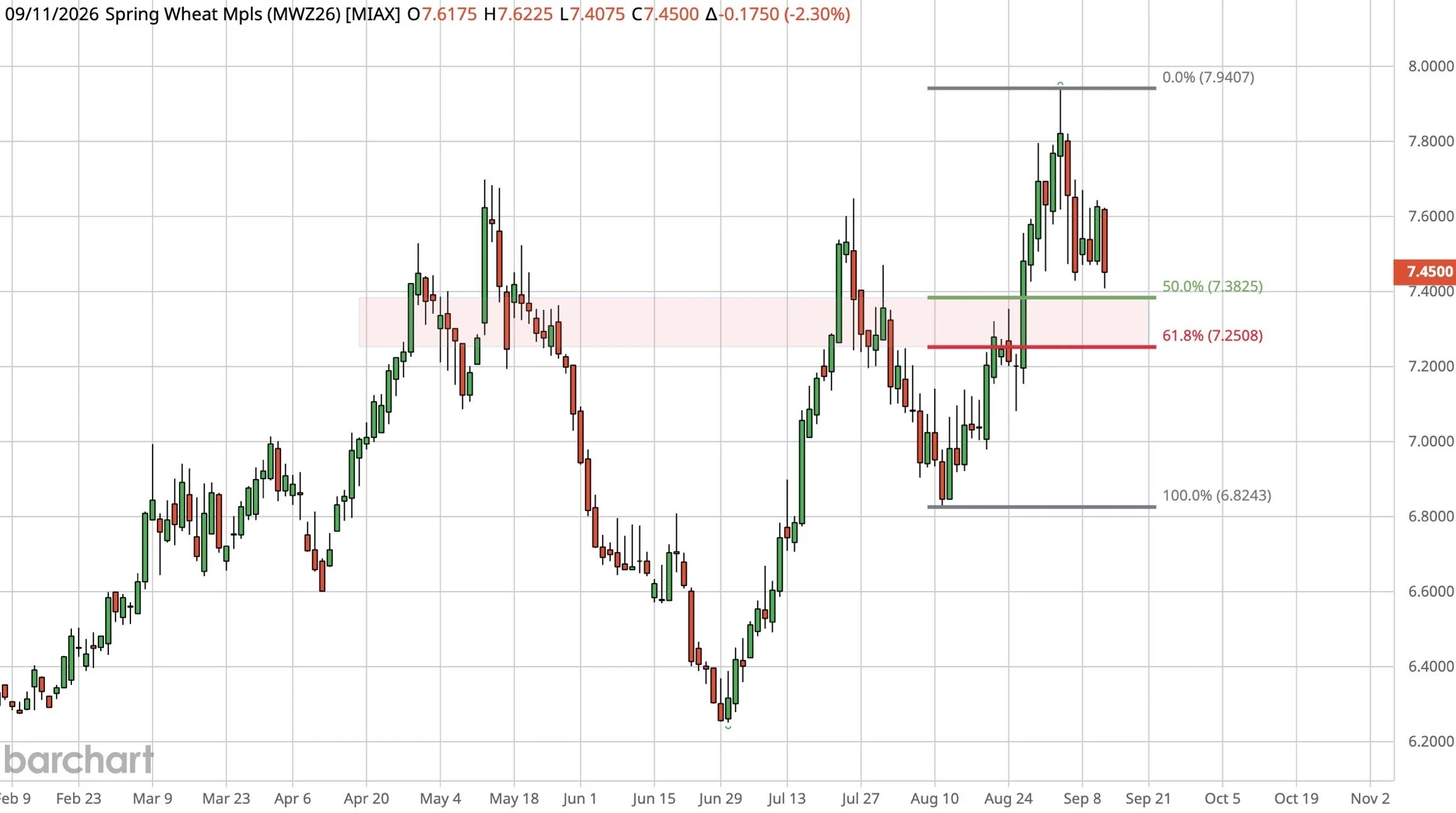
MPLS Wheat:
Nothing to update here either.
We want to see us hold that 61.8% retracement at $7.25
That would be a level where we'd look for a bounce.
Cattle
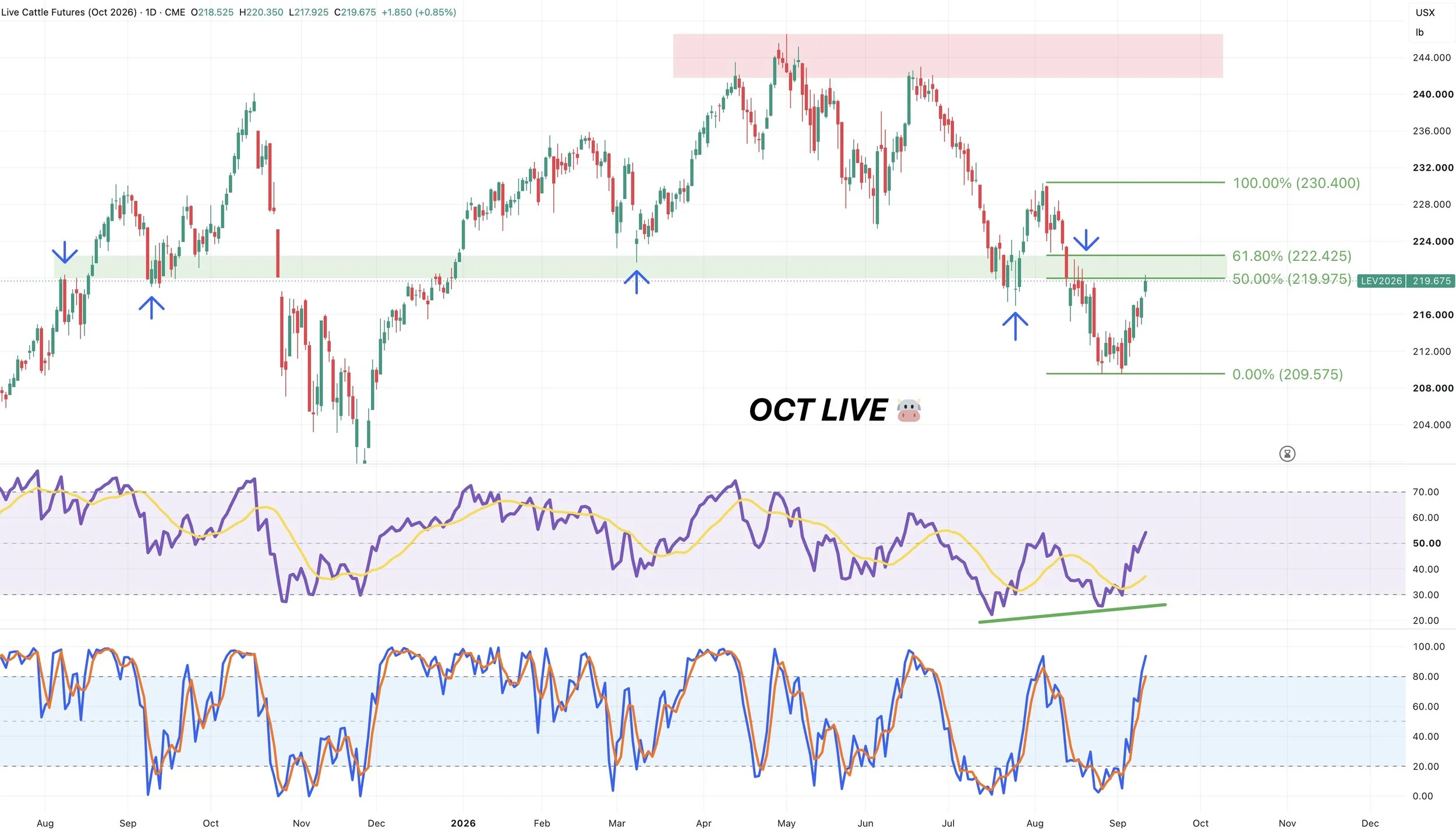
Oct Live Chart:
We had that bullish divergence we had been talking about.
Now putting together a nice bounce.
However, we are entering into an area where we could find resistance.
We've clawed back 50% of the August highs.
Between 220 and 222 would be a good area to get some hedges on in my opinion.
This golden zone is also prior support, so could act as resistance.
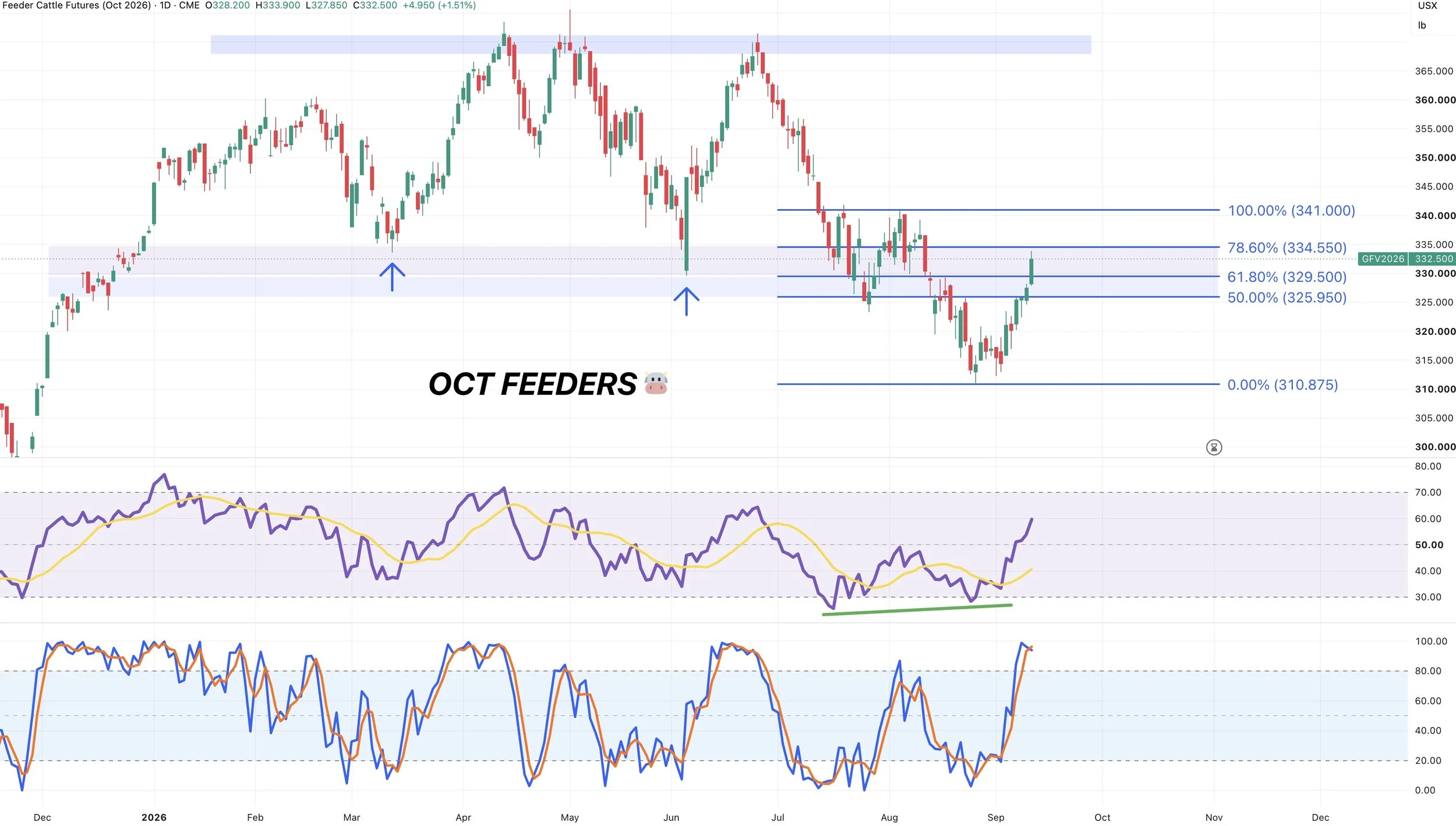
Oct Feeders Chart:
Feeders also seeing a nice run after that bullish divergence. As prices made new lows but the RSI did not.
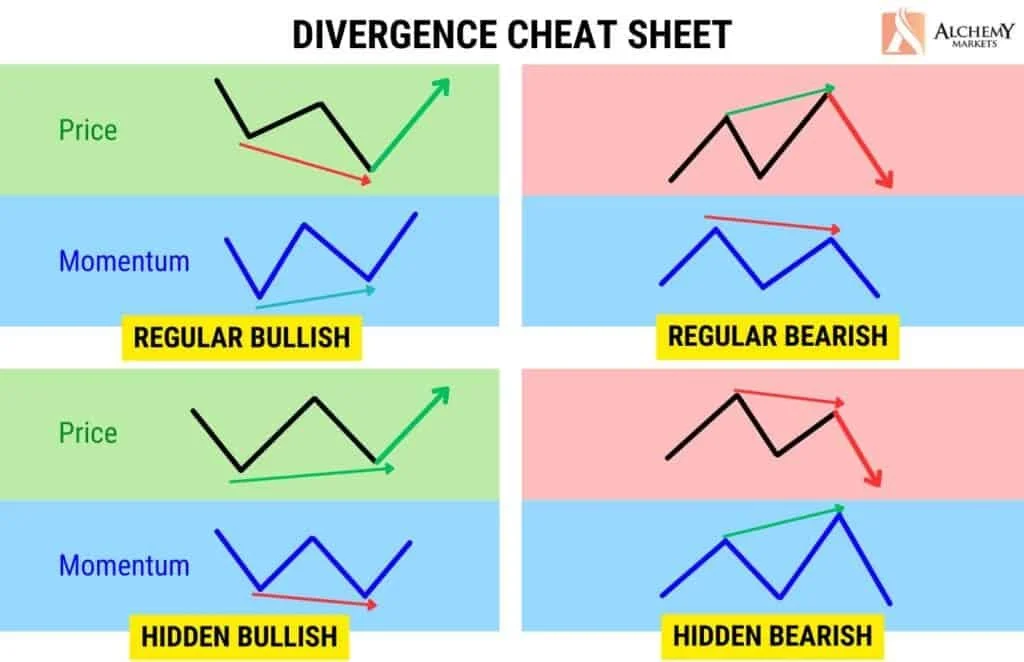
Now something to be aware of is that we are showing hidden bearish divergence.
This happens when the RSI makes new highs, but prices do not.
I attached an RSI divergence cheat sheet below this chart.
This would be an area where I would not be surprised to see some resistance.
We clawed back 78.6% of the August highs. Running right up into that old support which is now possible resistance.
So like in live cattle, I think this is a good area to be managing some risk.
If break above those August highs then this chart opens up further. But for now, we want to treat this as just a relief bounce.
Want to Talk?
Our phones are open 24/7 for you guys if you ever need anything or want to discuss your operation.
Jeremey & Office: (806)484-1214
Sebastian: (605)280-1186
Email: sfrost@dailymarketminute.com
Hedge Account
Interested in a hedge account? Use the link below to set up an account or give us a call.
WHAT’LL USDA DO TOMORROW?
AUDIO COMMENTARY
Cattle bouncing but nearing resistance
Crude is back above $100
Talk of inflation and war
Upside breakout in soybeans
China buying massive amount of beans
Funds have reasons to stay long
What does USDA do tomorrow?
The USDA estimates haven’t been super bullish which is not a bad thing
Potential for yield to be lower than expected
If you are in a “have to” situation
Every time we have seen $13 beans, we usually see $14 beans
Having a solid marketing game plan
How to balance yourself when it feels like we are going to go up or down forever
Funds can get long and stay long
Estimates: 178.2 corn & 52.5 soybeans
Demand is not slowing down. What happens if our supply drops further?
Do the positives outweigh the negativity?
If you are a cash only marketer. What to do?
Markets can top when everyone is too bullish
Tomorrow’s price action will be key
USDA estimates below audio*
Listen to today’s audio
Want to talk?
Office: (806)484-1214
Your free trial recently ended
Don’t miss our future updates or our next sell signal.
Last chance for our Labor Day sale, which ended last week.
USDA ESTIMATES
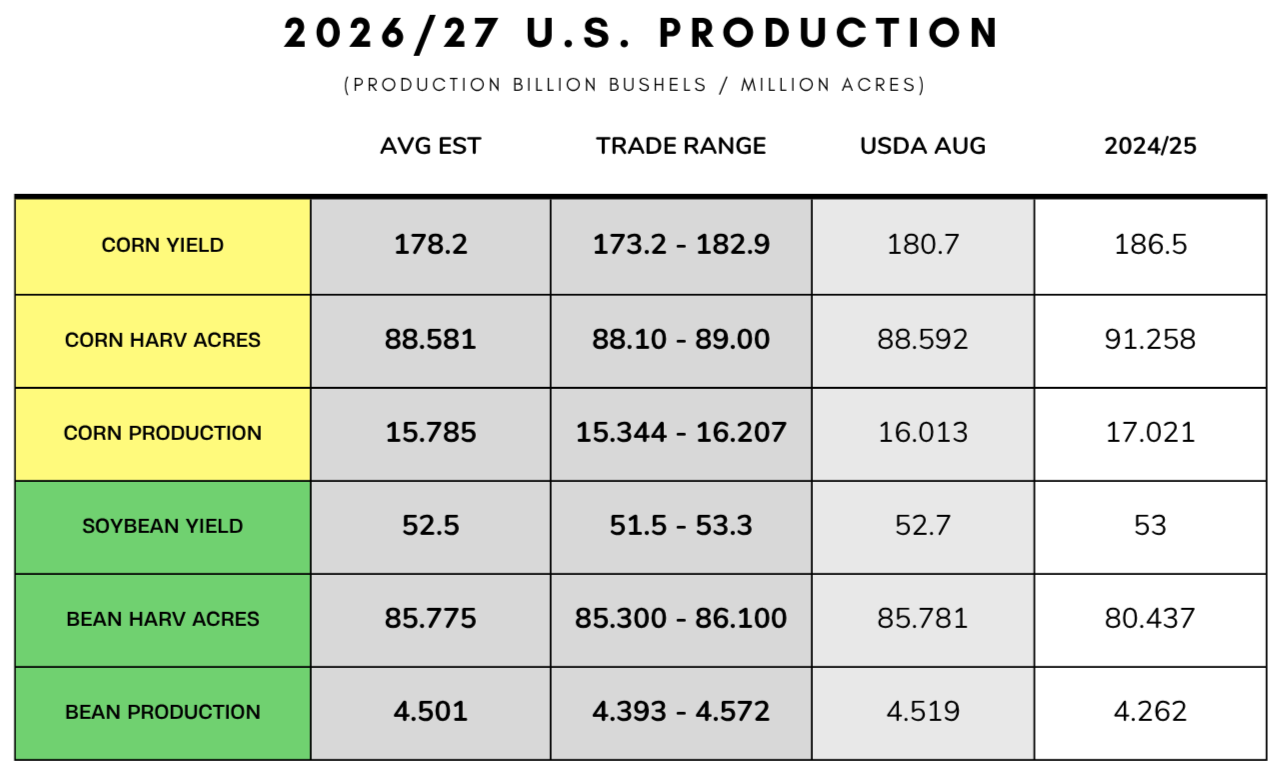
The trade is expecting lower yields in both corn and soybeans.
The trade range in corn is pretty massive. With the high guess being 182.9 and the low guess being 173.2 bpa. Nearly a 10 bpa swing.
Want to Talk?
Our phones are open 24/7 for you guys if you ever need anything or want to discuss your operation.
Jeremey & Office: (806)484-1214
Sebastian: (605)280-1186
Email: sfrost@dailymarketminute.com
Hedge Account
Interested in a hedge account? Use the link below to set up an account or give us a call.
EXTREMELY VIOLENT DAY IN GRAINS
AUDIO COMMENTARY
Nice bounce in cattle today
Extremely wild and violent day
Corn was 14 cents off its lows
Soybeans were 26 cents off their lows
Wheat was down over 40 cents early on
Putin made comments about peace
Market is very sensitive to headlines
Practice being comfortable
The unknowns move the market
A lot of things point to higher prices
Monthly breakouts & tighter situations
Everyone jumping on bull bandwagon
All the bears are becoming bulls
One thing that makes a guy nervous
USDA report next Friday
Why production feels lower to me
Market has priced in smaller yield. How small?
Someone is buying the dips in grains
How will USDA trim demand next month?
Demand doesn’t magically fall out of bed
Prices haven’t gone high enough to ration demand
What if the natural seller is oversold?
How to make sales & re-own them
Best opportunities we’ve had in years
Why this volatility is your friend & an advantage
Strategies that might make sense for you
2012 topped on a bullish report after it was all priced in. Something we have to be aware of
Listen to today’s audio below
Want to talk?
Office: (806)484-1214
Your free trial recently ended
Our Labor Day sale ends Monday
Keep our daily updates & alerts
This Week’s Hedge & Sell Alerts
Corn: Yesterday
Soybeans: Tuesday
Wheat: Last Friday
Want to Talk?
Our phones are open 24/7 for you guys if you ever need anything or want to discuss your operation.
Jeremey & Office: (806)484-1214
Sebastian: (605)280-1186
Email: sfrost@dailymarketminute.com
Hedge Account
Interested in a hedge account? Use the link below to set up an account or give us a call.
IS THIS A BULL MARKET?
AUDIO COMMENTARY
Very volatile day in grains
Big 30 cent range in wheat today
Which class of wheat will lead?
Using volatility to add to your bottom line
This volatility is a gift and opportunity
What are the risks?
Week away from big USDA
Market has lot baked into it. But how much?
Are we in a bull market now?
We could have markets we haven’t seen in a long time
If demand doesn’t slow and supply doesn’t grow
Why having hedge accounts is important
Don’t let elevators get you in a sticky situation
Demand is not going anywhere
Practice good risk management if short on time
Just because there is upside doesn’t mean there cannot be a set back short term
Ways you can protect yourself
Re-owning without chasing it
Strategy that works for most of you guys
Do small crops get smaller?
Heat could be taking the top off the crop
It’s all about turning the odds in your favor
The chance for +$6-7 corn are only increasing
Funds are getting record long in a hurry
Listen to today’s audio below
Want to talk?
Office: (806)484-1214
This Week’s Sell & Hedge Alerts
Corn: Today
Soybeans: Yesterday
Wheat: Last Friday
Want to Talk?
Our phones are open 24/7 for you guys if you ever need anything or want to discuss your operation.
Jeremey & Office: (806)484-1214
Sebastian: (605)280-1186
Email: sfrost@dailymarketminute.com
Hedge Account
Interested in a hedge account? Use the link below to set up an account or give us a call.
CORN HEDGE & SELL ALERT
Disclaimer: there is risk of loss trading futures and options. Past performance does not necessarily indicate future results. This is our opinion and should be treated as such.
This alert is not for everyone. So make sure you scroll to see if this is for you as well as some possible strategies you could consider.
Why the alert?
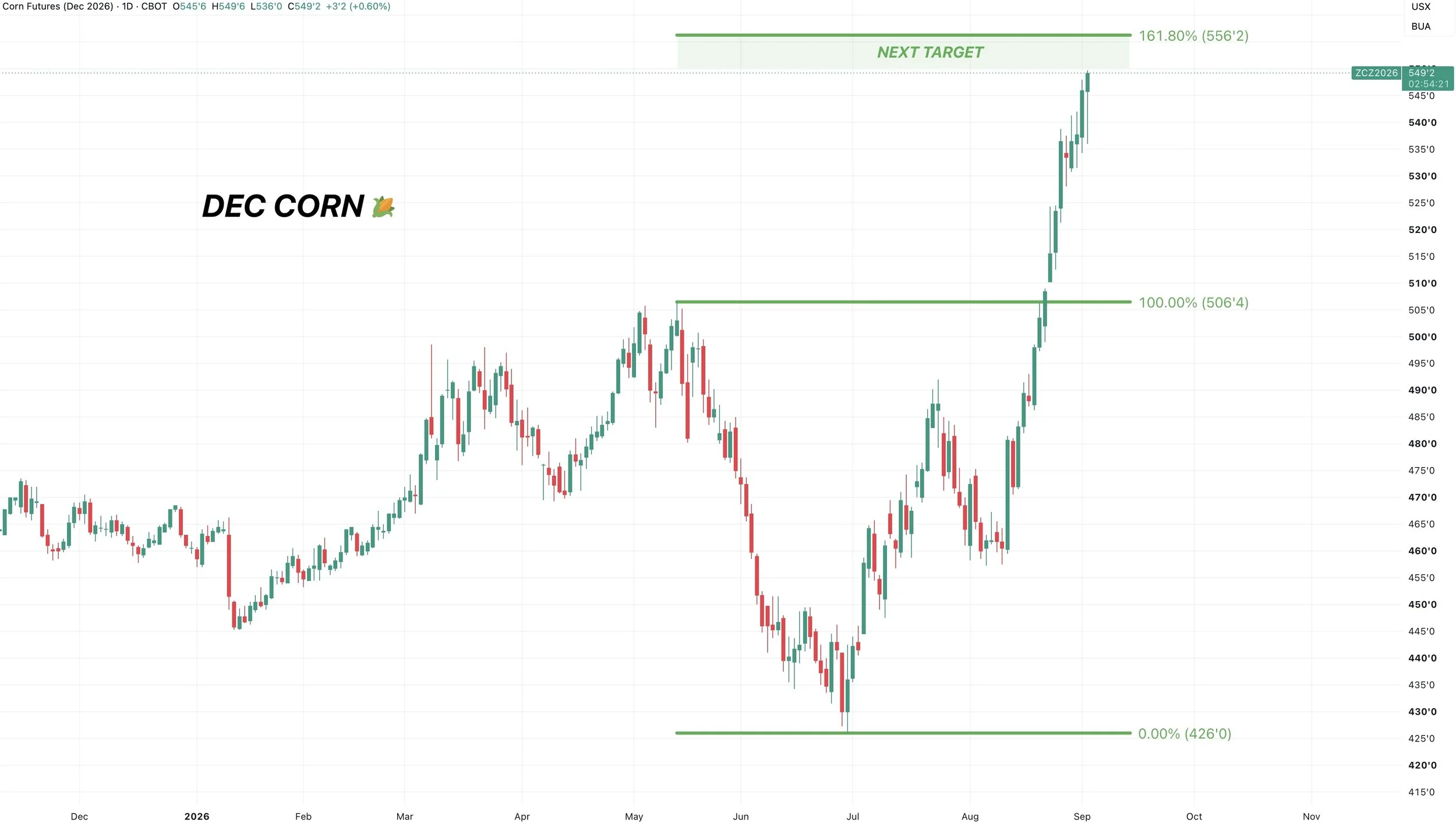
Dec corn is approaching our next target of $5.50 to $5.56
$5.56 is the golden fib. 161.8% from the contract lows up to the May highs.
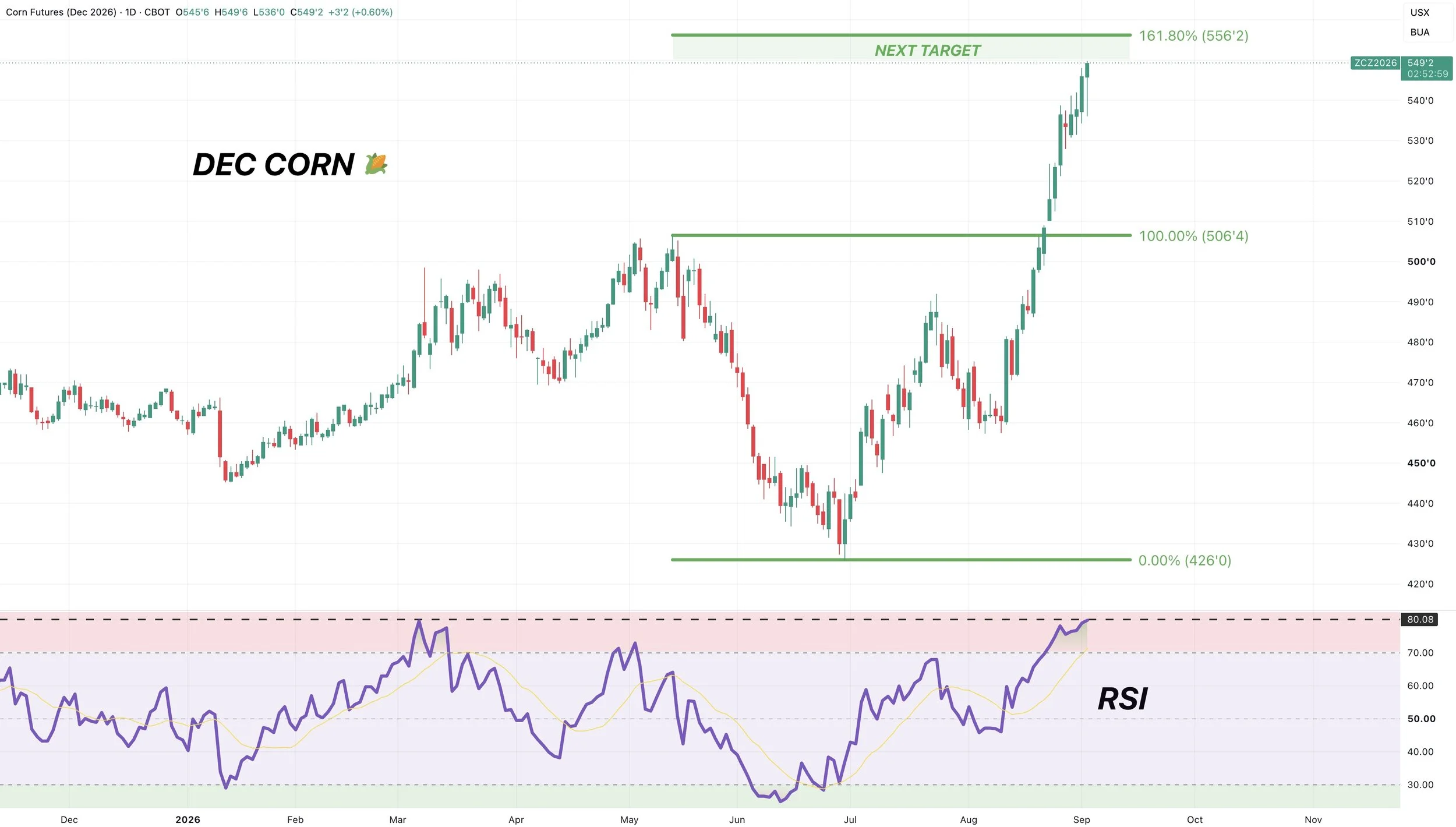
We are also getting pretty over bought on the RSI. As it’s reaching the highest levels it’s been at.
Obviously this doesn’t mean the market cannot keep pushing higher from here.
But for those short on time, it warrants doing something.
Who is this alert for?
To be clear this alert is not us calling a top or even a pullback in corn. We think corn will ultimately be higher down the road. As we believe there is plenty of potential, especially long term over the next several months.
If you don’t have to move anything soon or are comfortable where you are, we like staying plenty patient. We do NOT want to be oversold in these markets. At all. We want to leave ourselves with a lot of potential upside.
However, for those who lack storage, have to move stuff off the combine, or are behind in their marketing. It makes sense for you to be managing your risk up here in some sort of manner.
It’s not about perfectly timing every high or low, it’s about managing risk where it makes sense.
If you are short on time in your marketing, you don’t have the luxury that someone with time has. It would not be all that hard for corn to see a sizeable short-term correction at all. Given that we’ve ran +90 cents without stopping the last few weeks.
As always, we prefer to use options to give us flexibility in your marketing.
If you don’t like using options, you could consider a small incremental cash sale.
If you have a hedge account, here are some strategies we like:
1) Cash Sale & Re-Own
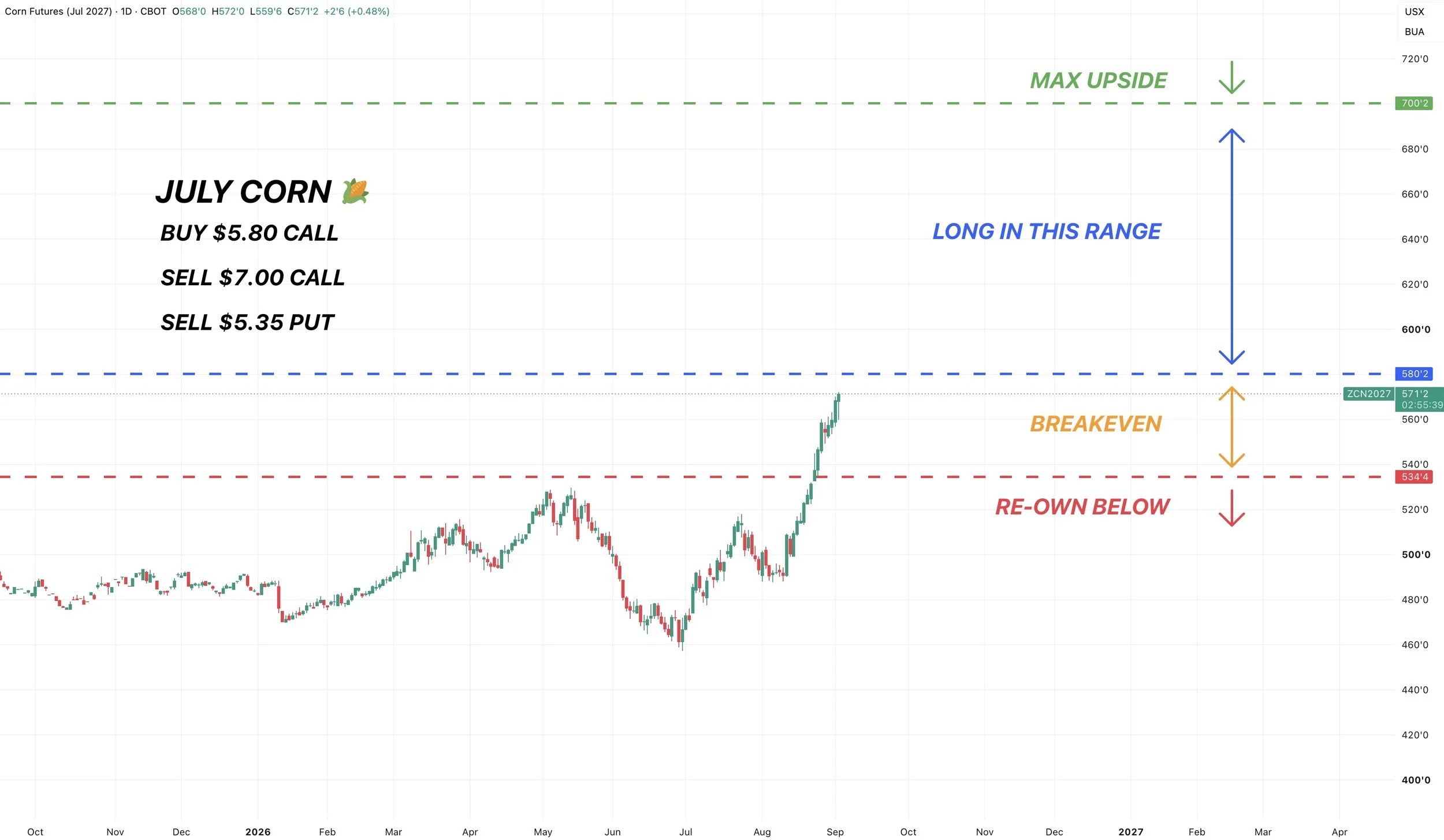
If you make a sale and want to keep your upside exposure, or if you are oversold and want some more upside exposure, here is one strategy you could consider:
Buy July $5.80 call
Sell July $7.00 call
Sell July $5.35 put
This would give you upside until $7.00. In exchange you could re-own corn 35 cents below today’s price. This would be roughly a zero cost trade but selling options does require margin.
There are several other ways you could go about it, so feel free to reach out if you want to talk. This is just one example of the type of trades we like.
Office: (806)484-1214
Here is a visual of that trade.
2) Downside Protection
Here is another option if you are someone who needs some short term downside protection.
We do not want long term protection until next July for example. As that’s too far out and too expensive.
We want to ride this market higher.
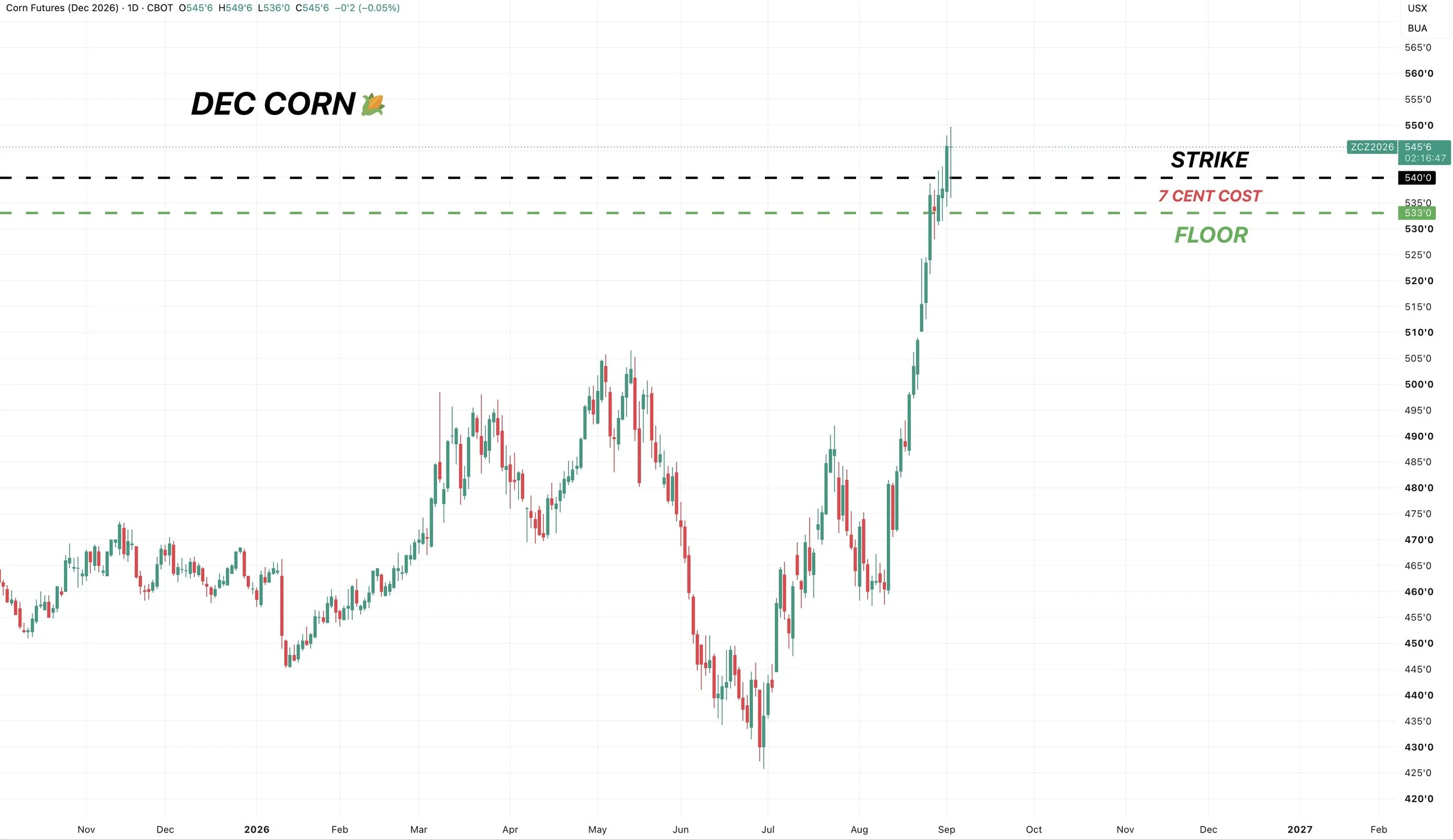
The simplest thing we like to do is grabbing some short-term puts if you can’t afford the market to fall out of bed short term.
For example, you could buy a $5.40 weekly put that expires the day of the Sep USDA report for about 7 cents. Which would give you a floor of $5.33
Again if you have questions or want to talk about what the best move for you specifically would be, feel free to reach out.
Office: (806)484-1214
Want to Talk?
Our phones are open 24/7 for you guys if you ever need anything or want to discuss your operation.
Jeremey & Office: (806)484-1214
Sebastian: (605)280-1186
Email: sfrost@dailymarketminute.com
Hedge Account
Interested in a hedge account? Use the link below to set up an account or give us a call.
BEANS IN TEENS. GRAINS EVER TOP IN SEP?
MARKET UPDATE
You can scroll to read the usual update as well. As the written version is the exact same as the video.
Timestamps for video:
Overview: 0:00min
Ever Top in Sep?: 3:00min
Corn Charts: 7:10min
Bean Charts: 11:20min
Wheat Charts: 15:55min
Cattle Charts: 17:20min
Want to talk?
Office: (806)484-1214
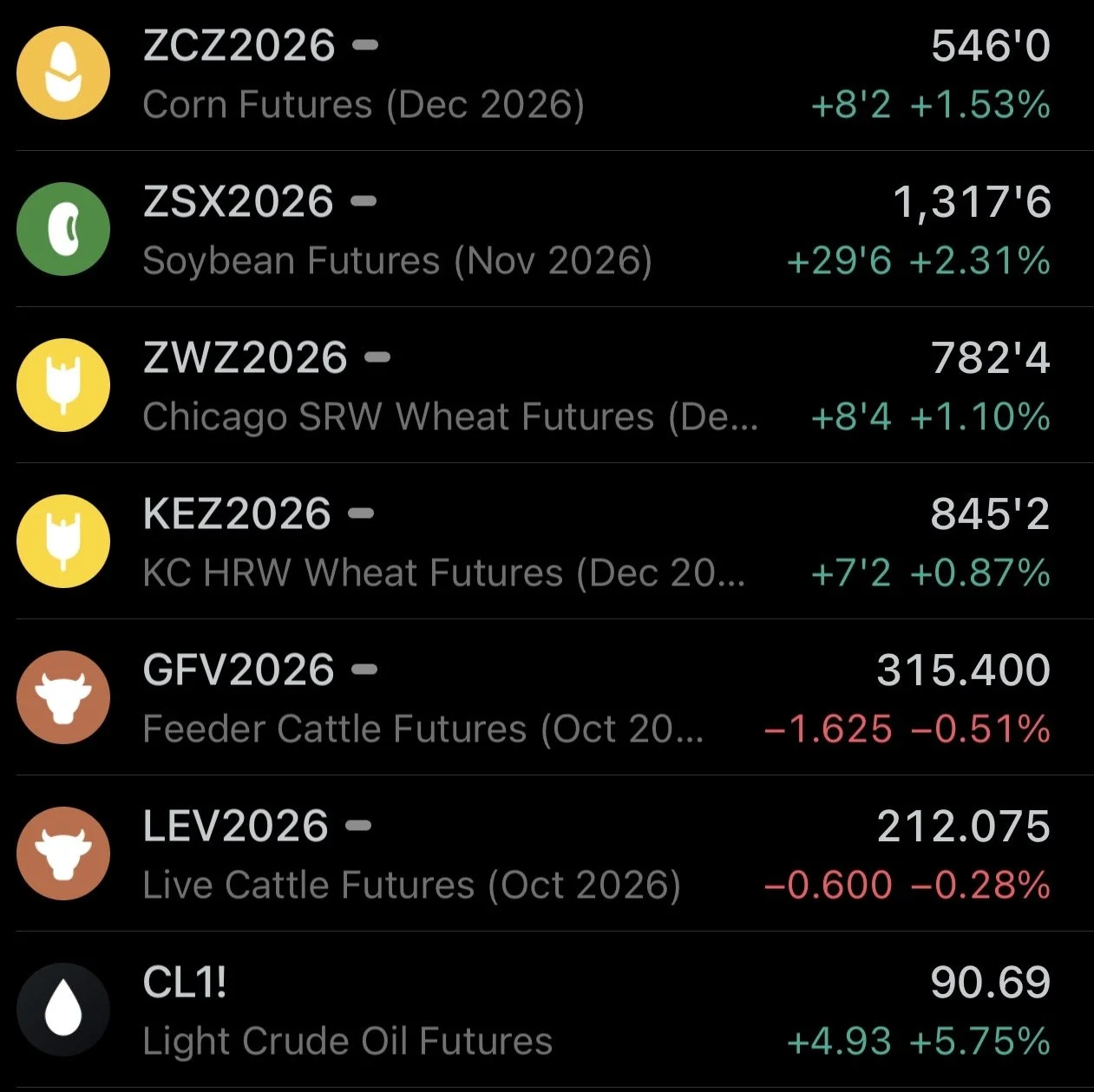
Futures Prices Close
Overview
Great day across the grains today, with soybeans leading the way higher this time.
Crude oil is back above $90 with escalations in the Middle East.
Wheat got a boost from further headlines over in the Black Sea, as the situation continues to be sporadic and all over the board.
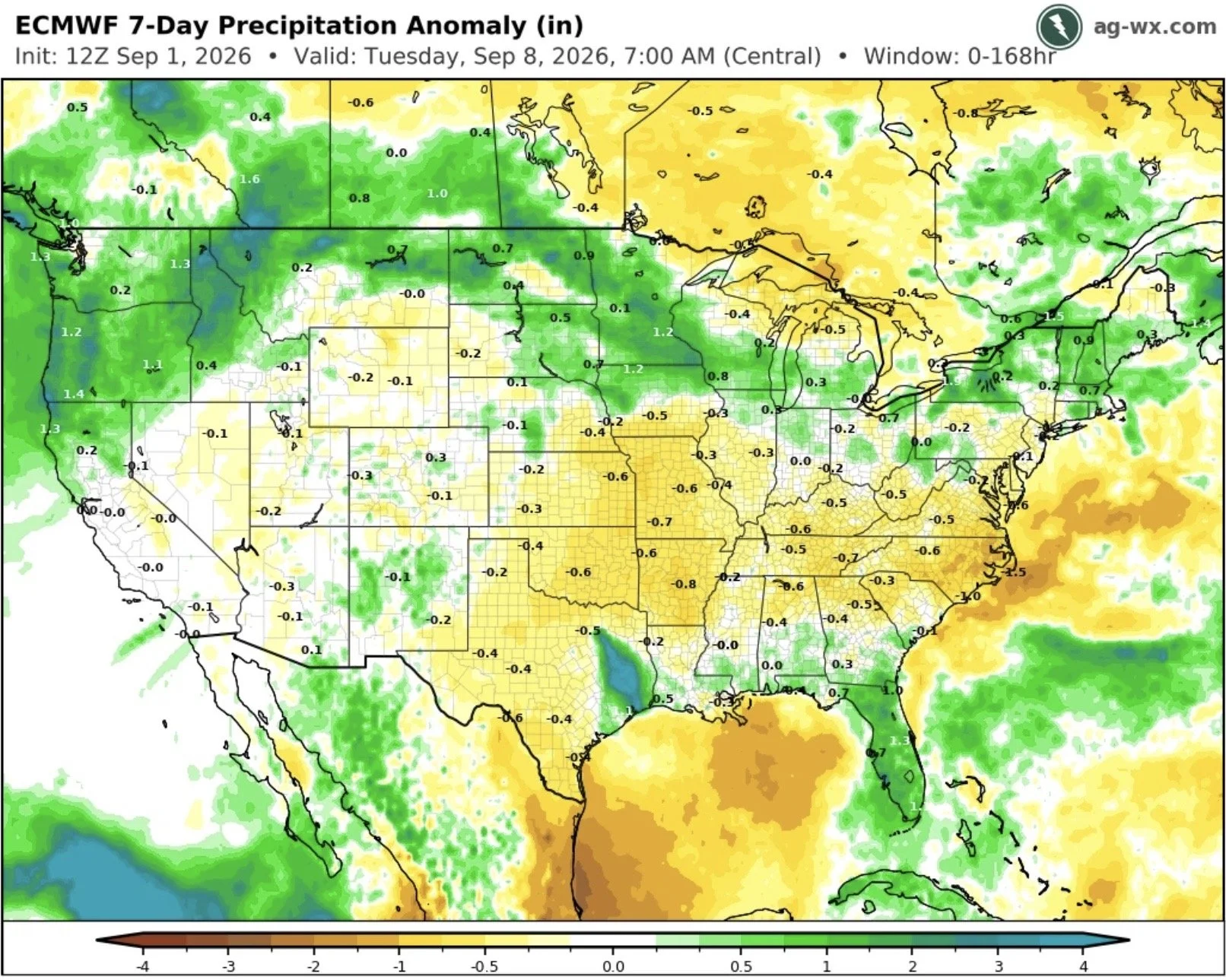
Soybeans are rallying following the surprise drop in crop ratings yesterday, along with some somewhat dry and very hot forecasts ahead.
Soybeans hit $13.00 for the first time since 2023 today.
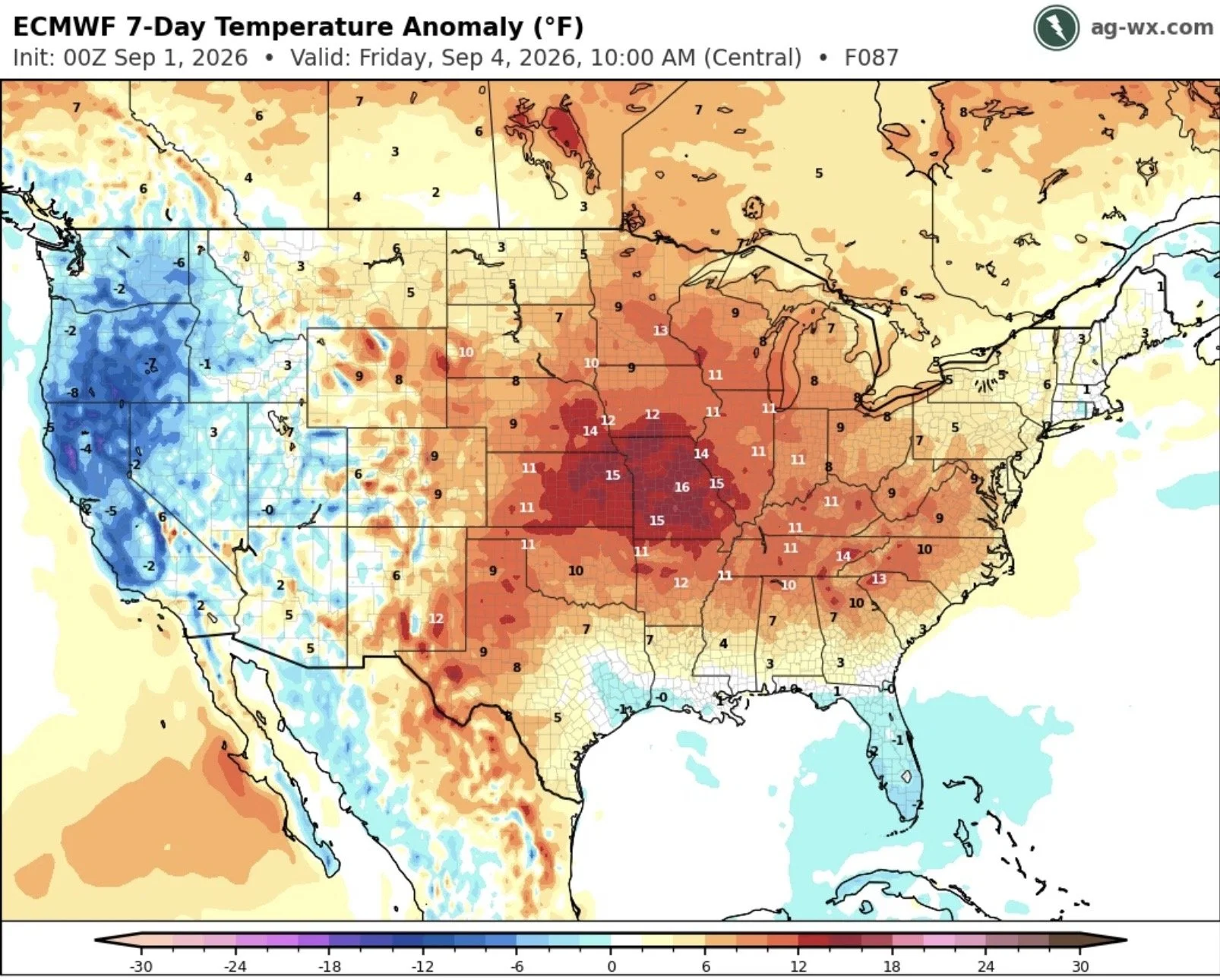
Here are the forecasts for the next week.
Crop Ratings: How Poor?
The trade was expecting both corn and soybean ratings to be down -1% this week.
Corn came in unchanged at 57%.
Soybeans came in down -2% at 58%.
The market was well aware that the corn crop isn’t great, but now they are starting to question how the bean crop looks as well.
How do these ratings stack up vs history?
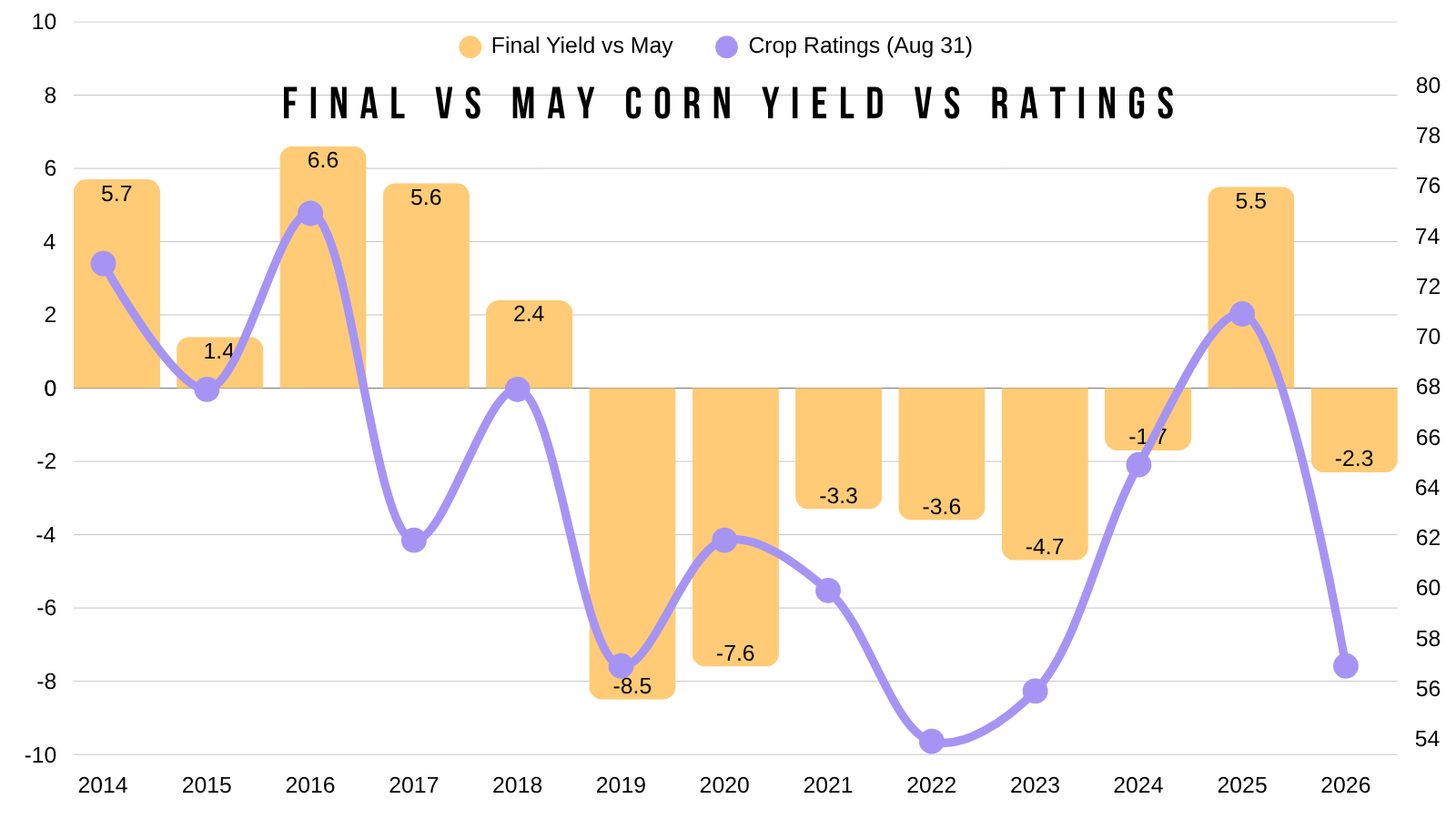
First for corn.
Since 2013, the only years that had a lower rating for today's date were 2022 and 2023.
Historically, ratings this poor have led to well below trend line yields.
The current -2.3 bpa deviation from trend the USDA currently has would be the smallest deviation we've seen when ratings were this low.
So it would favor yield coming in lower than it currently is.
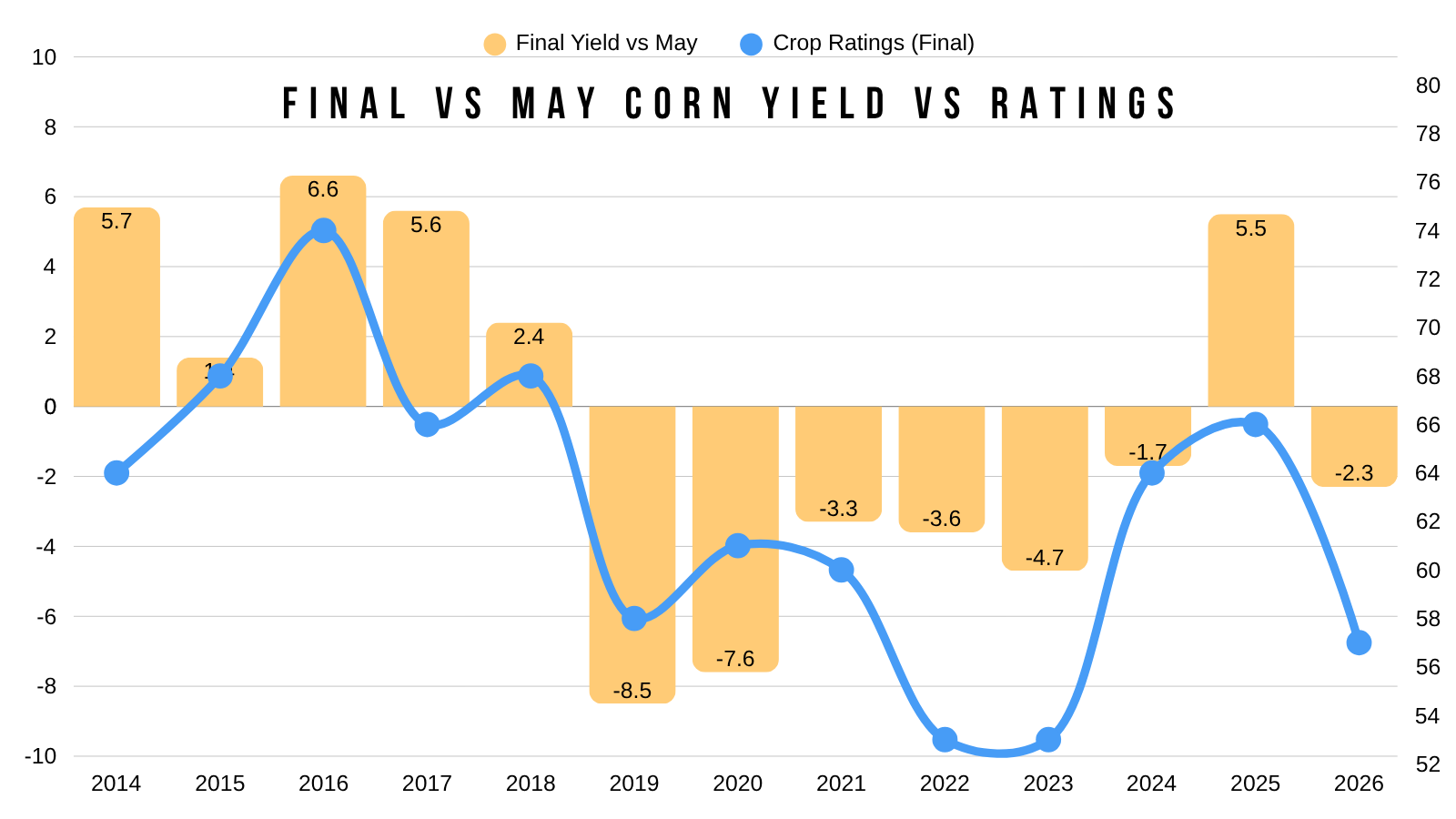
Here is that same chart but with the final ratings instead for some more reference.
Again, this would be one of the lowest ratings in at least the last decade.
Historically, it has led to some sizeable deviations below trend as we've been talking about for the last few months.
Next for soybeans.
This would be the lowest rating since 2023.
Sitting right about on par with 2021, 2022, and 2023. All within 2% of this year.
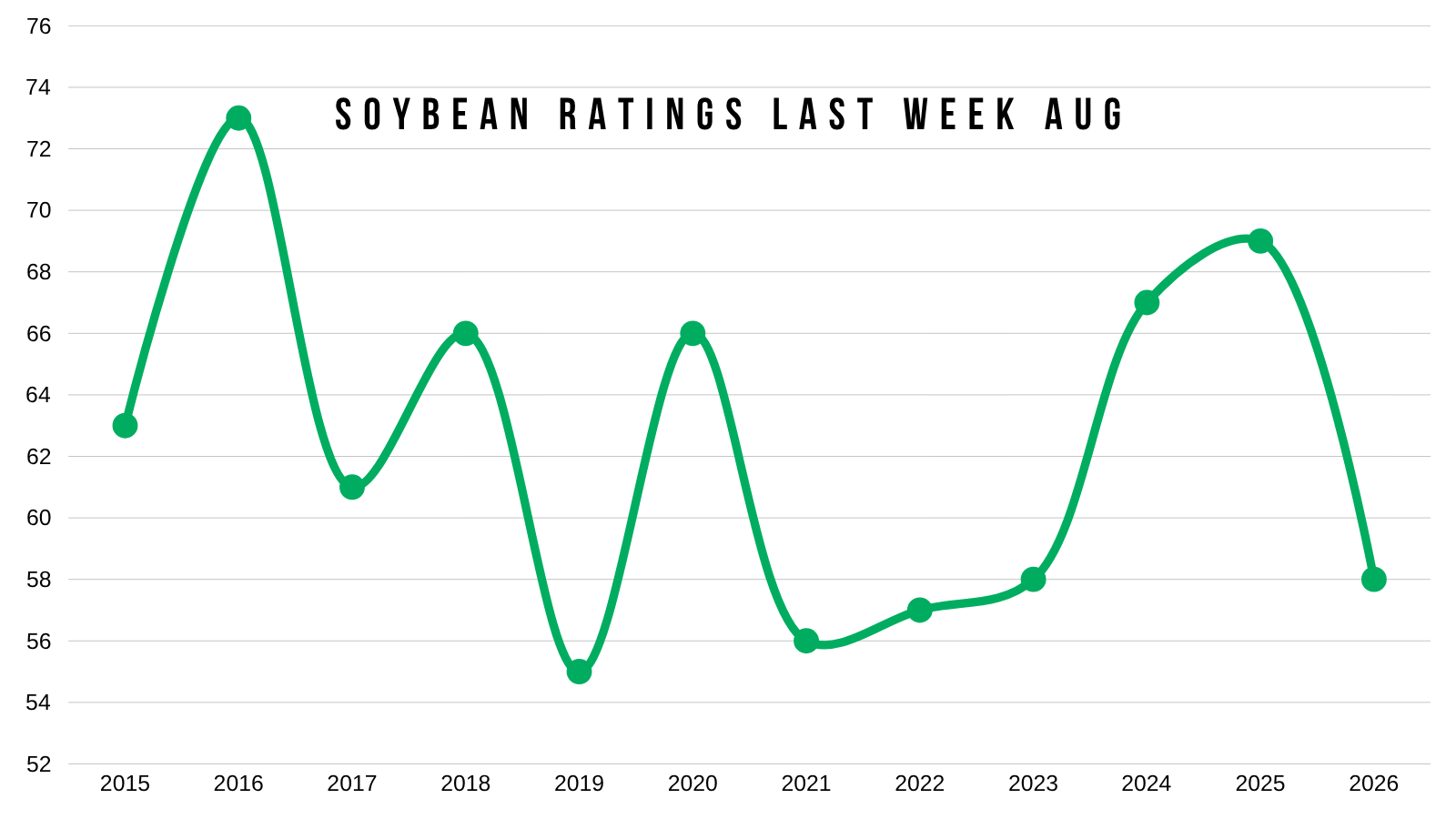
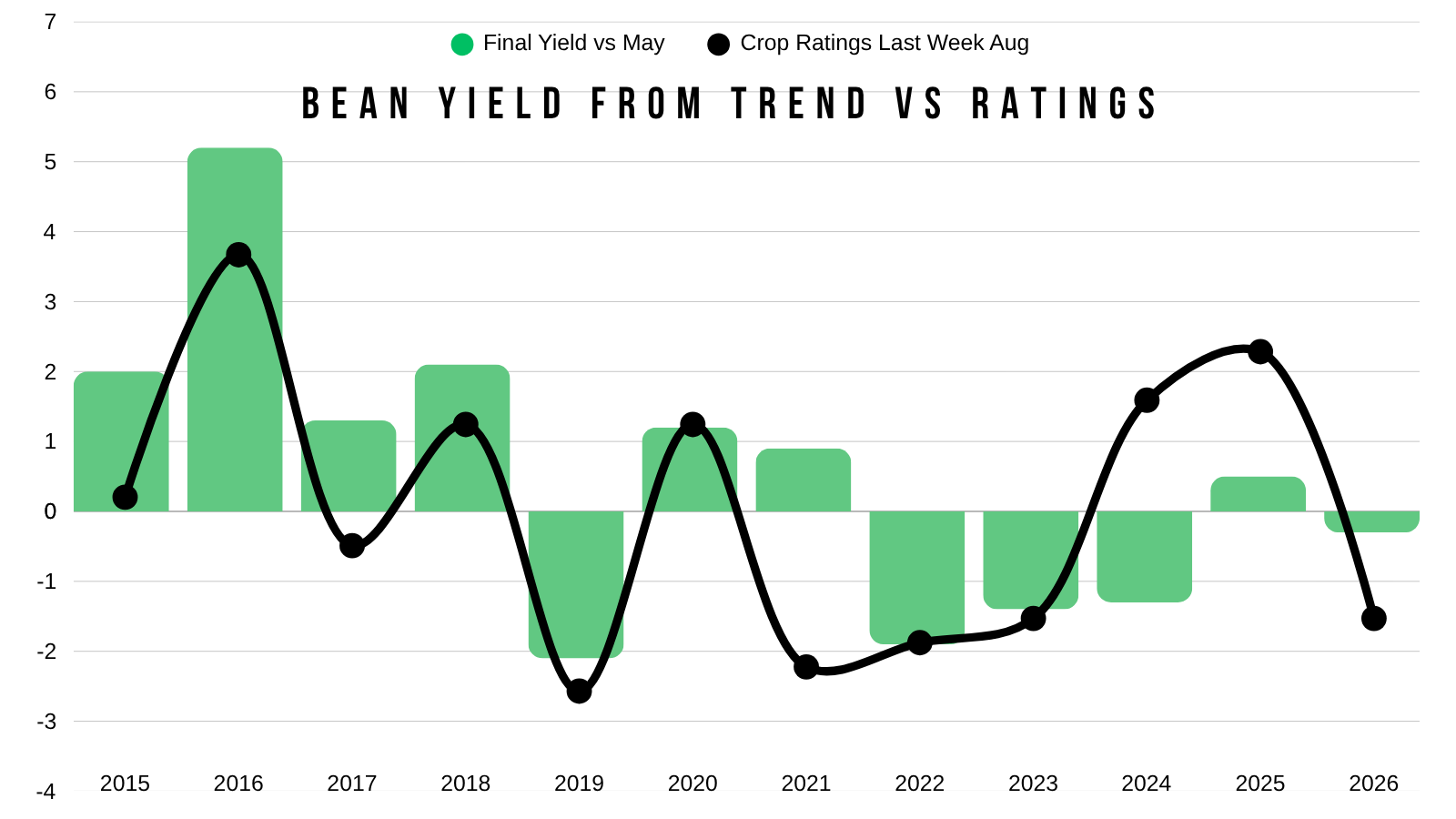
For those wondering, here is soybean ratings vs the yield deviation from trend.
No there is not a very clear correlation here like there is in corn.
However, ratings are -11% lower than last year.
58% today vs 69% last year.
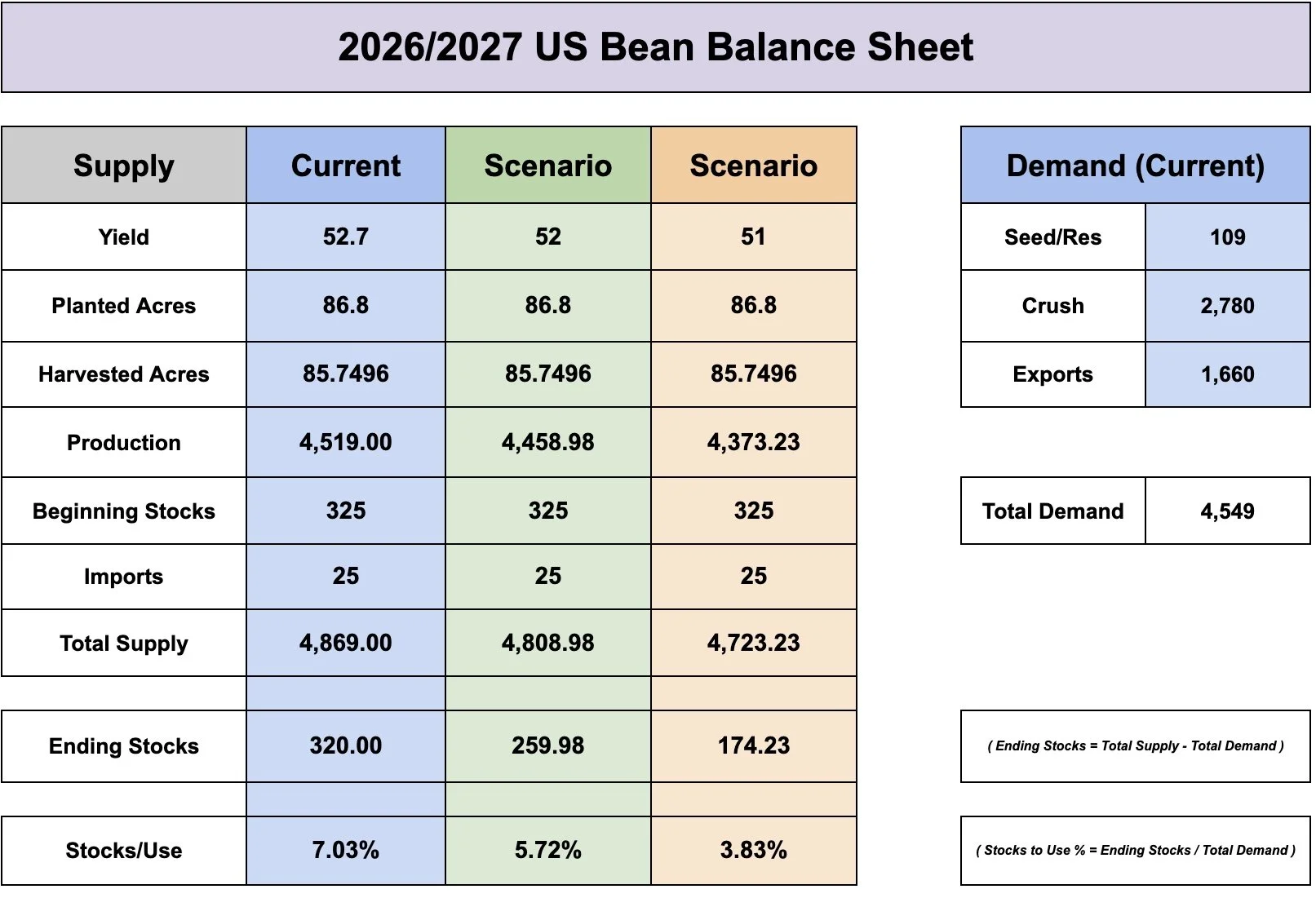
We are way below last year's ratings. So that does have to make you question if this crop really is almost on par with last year's 53 bpa yield. Given the USDA currently has a 52.7
This is important because the room for error on the soybean balance sheet is still thin as paper.
Not to mention the phenomenal crush demand or China demand which we aren’t going to get into today as we've done so plenty in the past.
Today we aren’t going to be diving too heavily into the fundamental topics we've already covered either.
If you'd like more in depth fundamentals, check out some of my past videos where we talk about the upside potential and bull cases etc.
Do We Ever Top in September?
Grains just posted new highs for the year across the board.
Now that it's offically September.. We have to ask:
Do we ever post our highs in September?
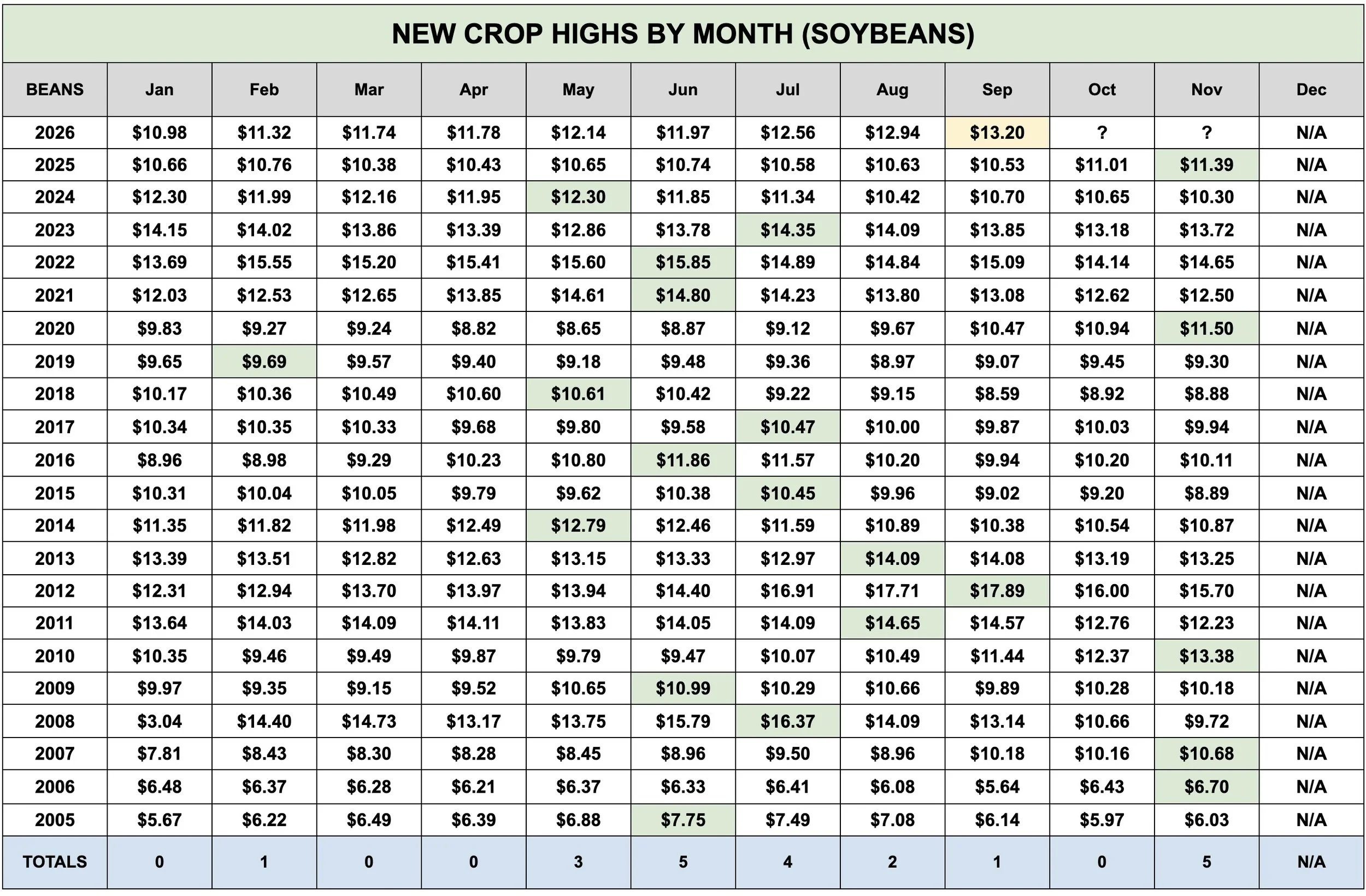
If we look at the highest prices for every month for Dec corn.
The answer would be: No
We have never once posted our highest price for the year in September.
We have also never once posted our highest price for the year in October.
The most interesting part?
The last two times we posted our highs at the end of the year were 2020 and 2010.
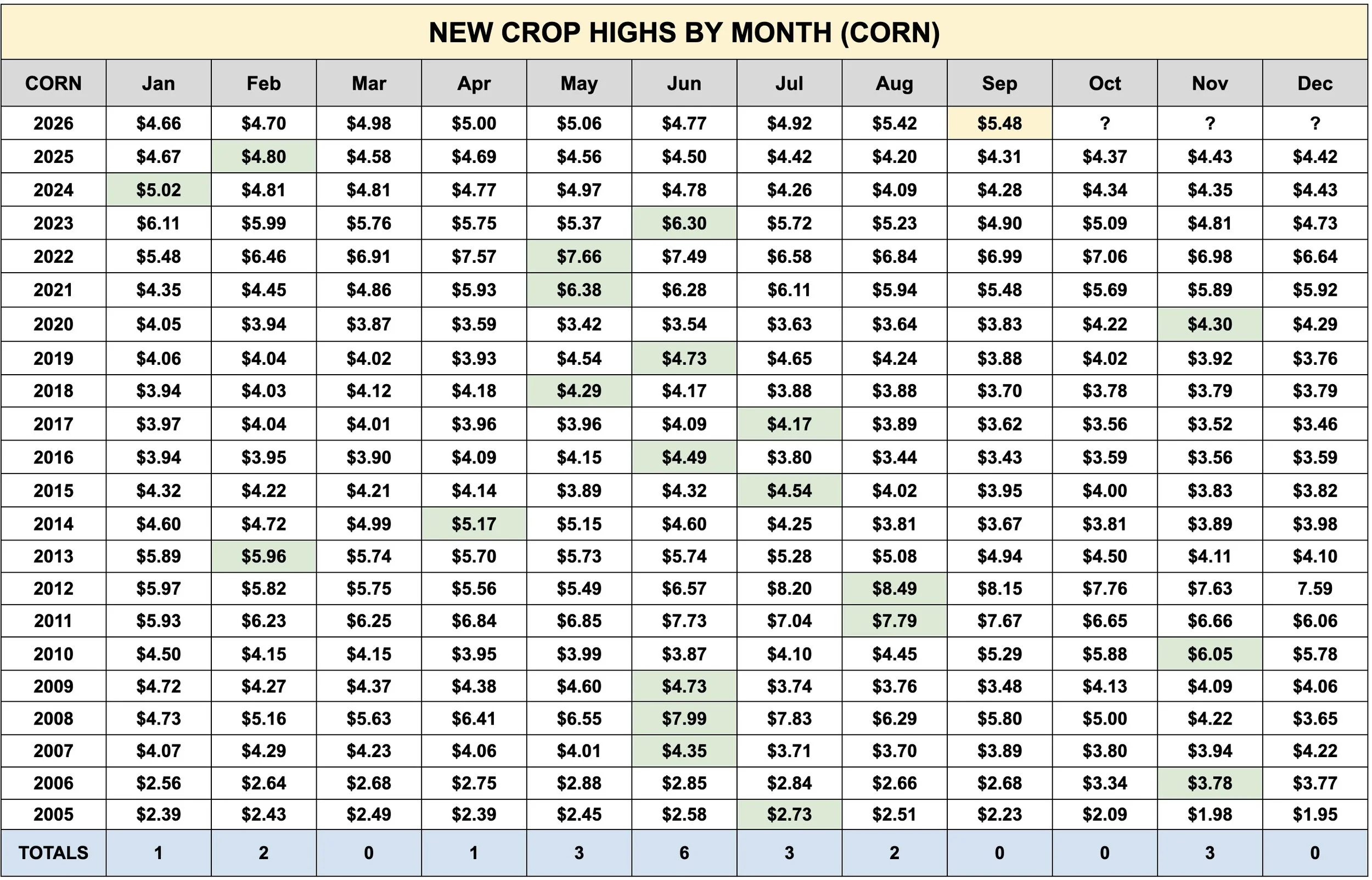
The closest we ever got to posting our highs for the year in September was back in 2011.
We posted our highest close on August 30th before falling until October.
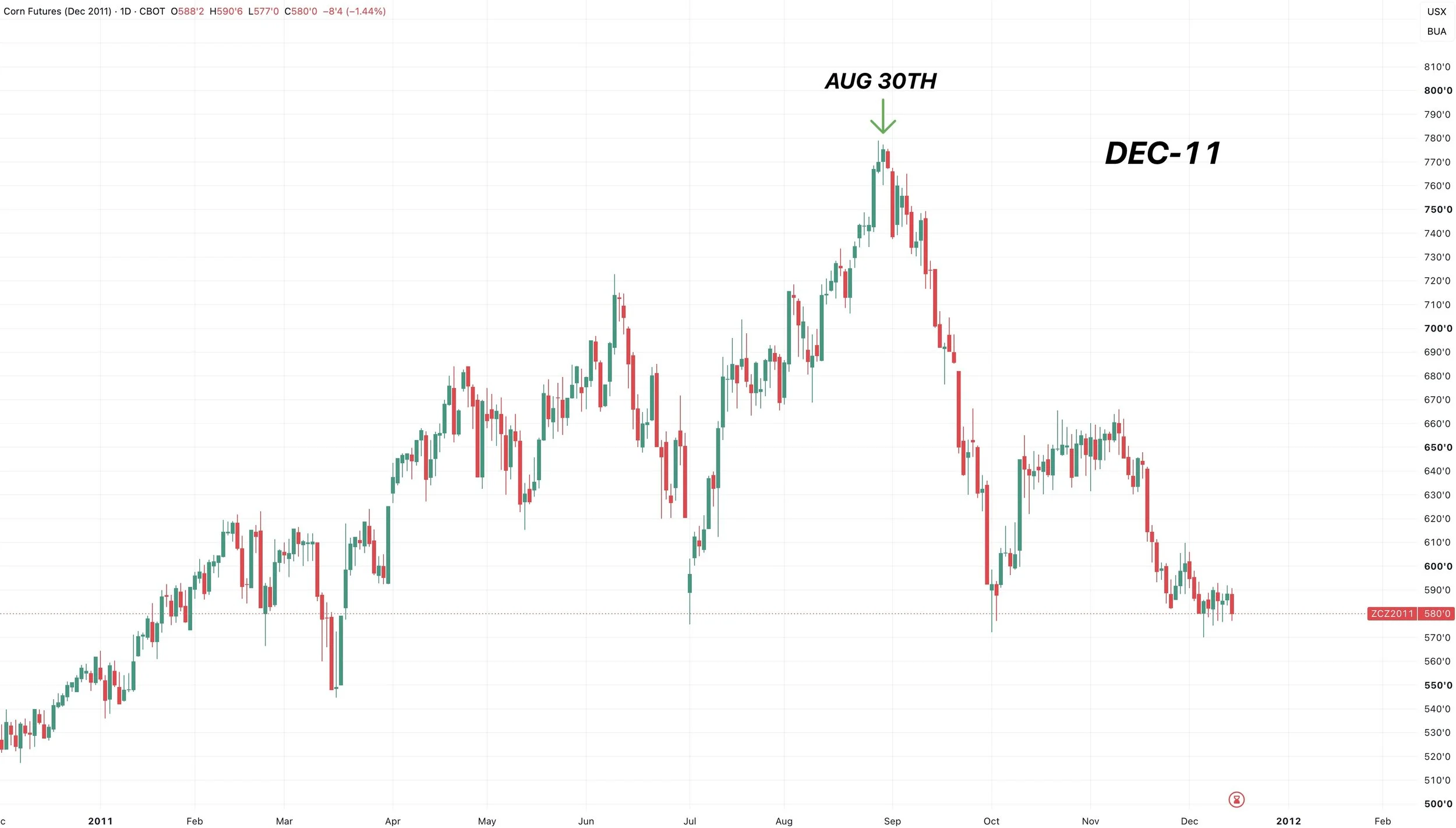
But as I talked about last week.. this feels far more similar to 2010 or 2020 than it does to 2011 or 2012.
2011 was a bull market. Corn was trading over $7.70 at the time.
We obviously aren’t in a bull market.. yet.
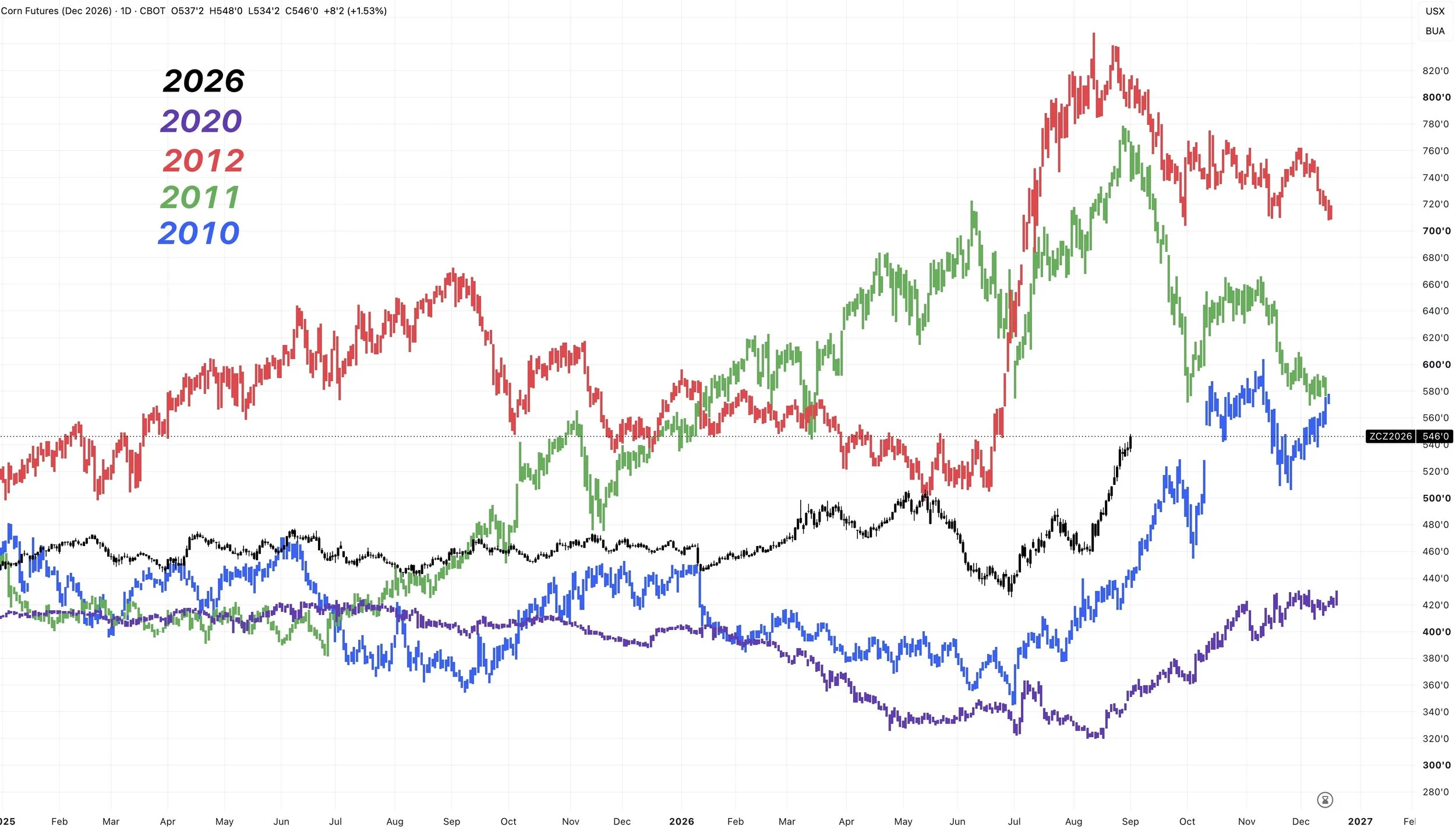
If you are comparing 2026 to 2010 and 2020..
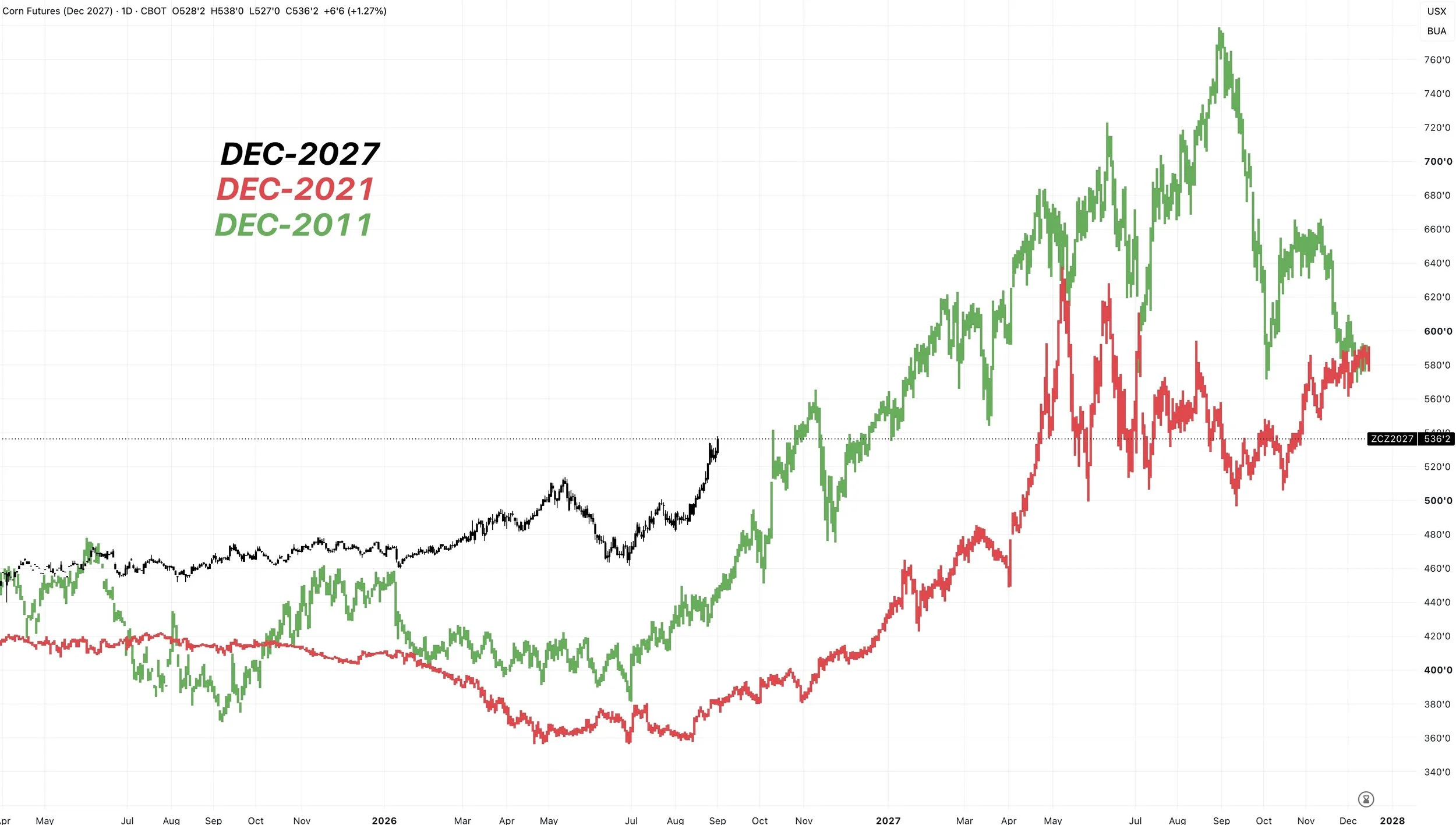
Then you of course have to compare 2027 to 2011 and 2021.
Here is what those two years looked like compared to Dec-27 corn.
Both continued higher into the following year.
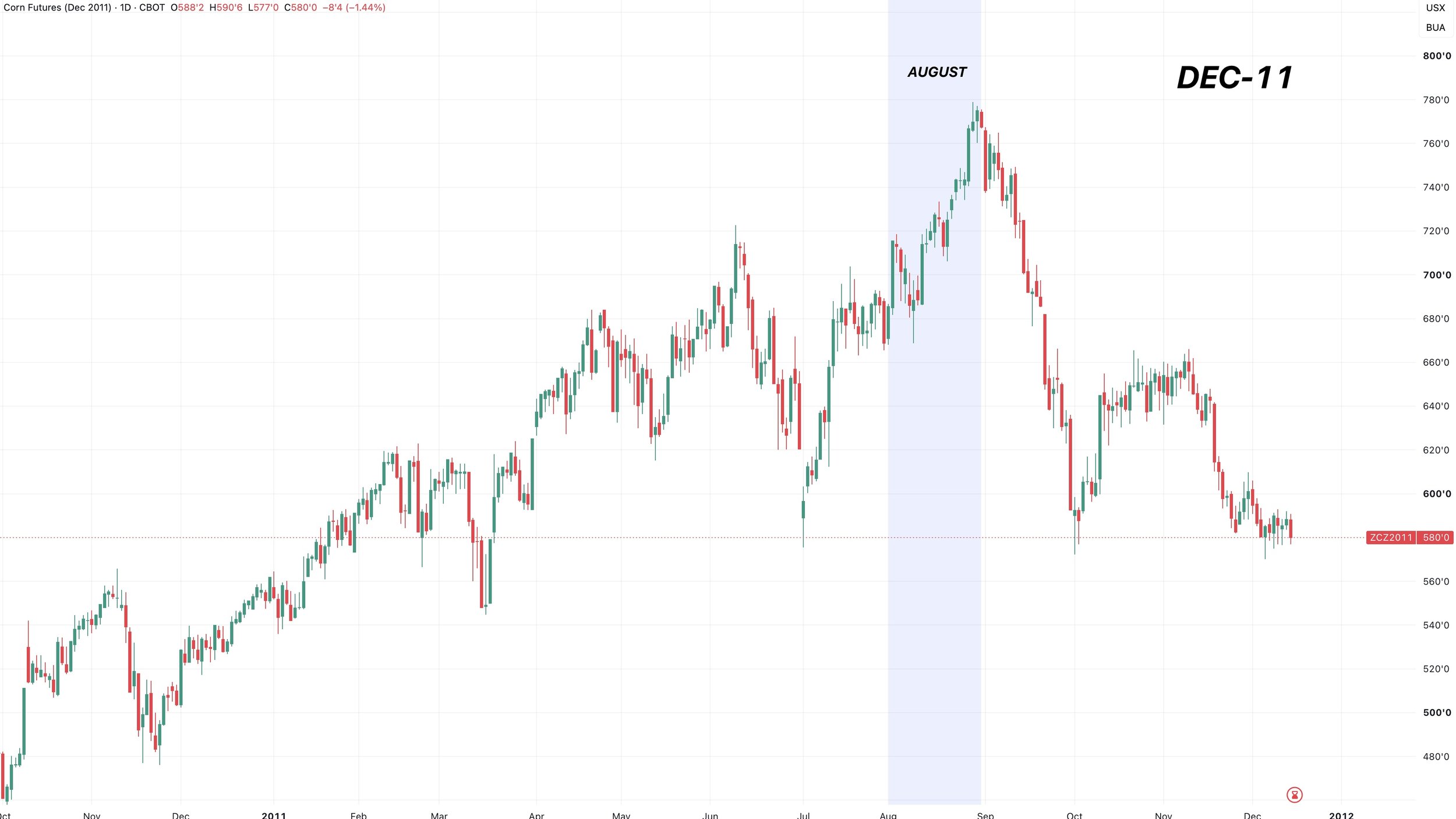
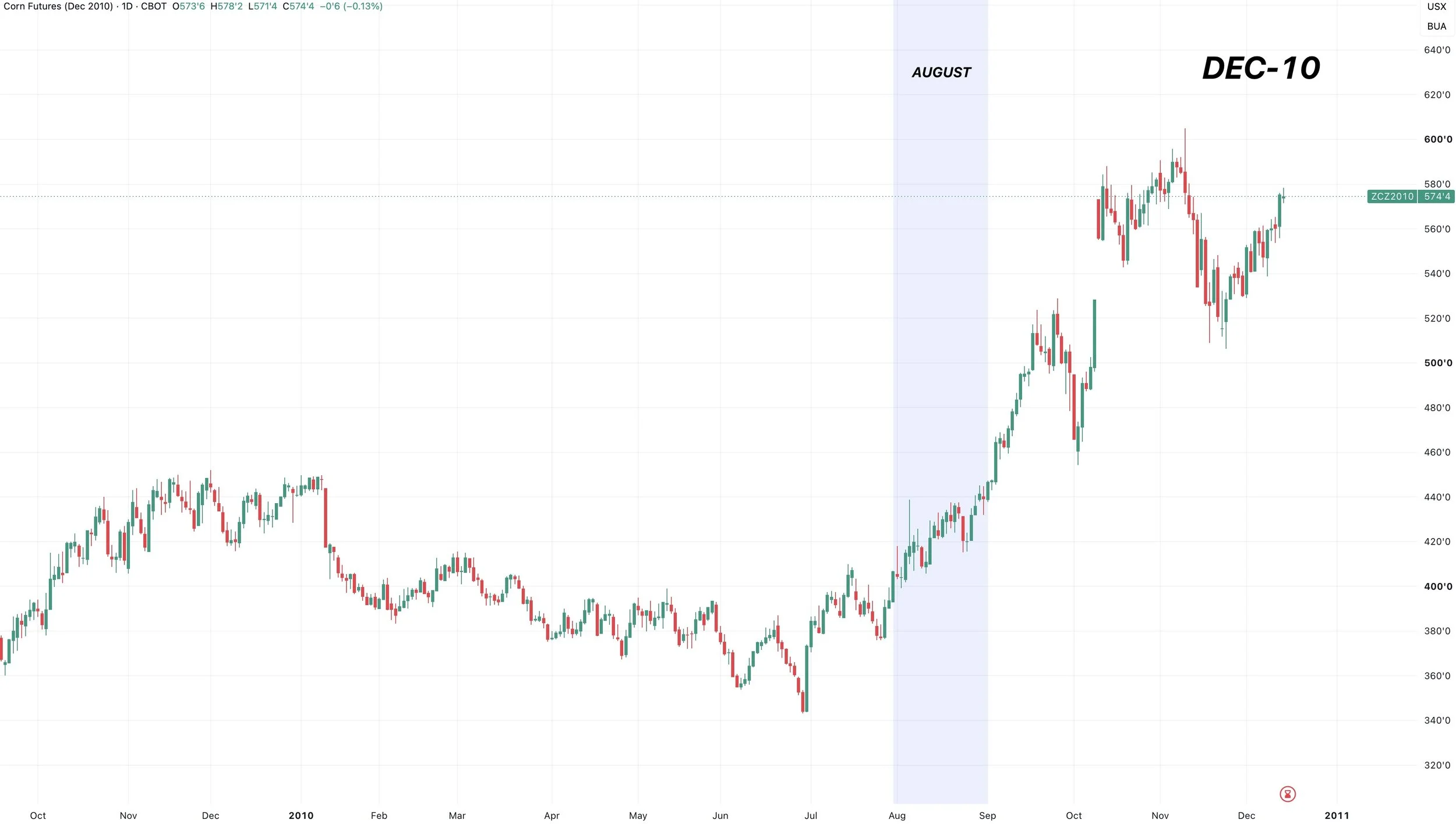
What Happens After a Strong August?
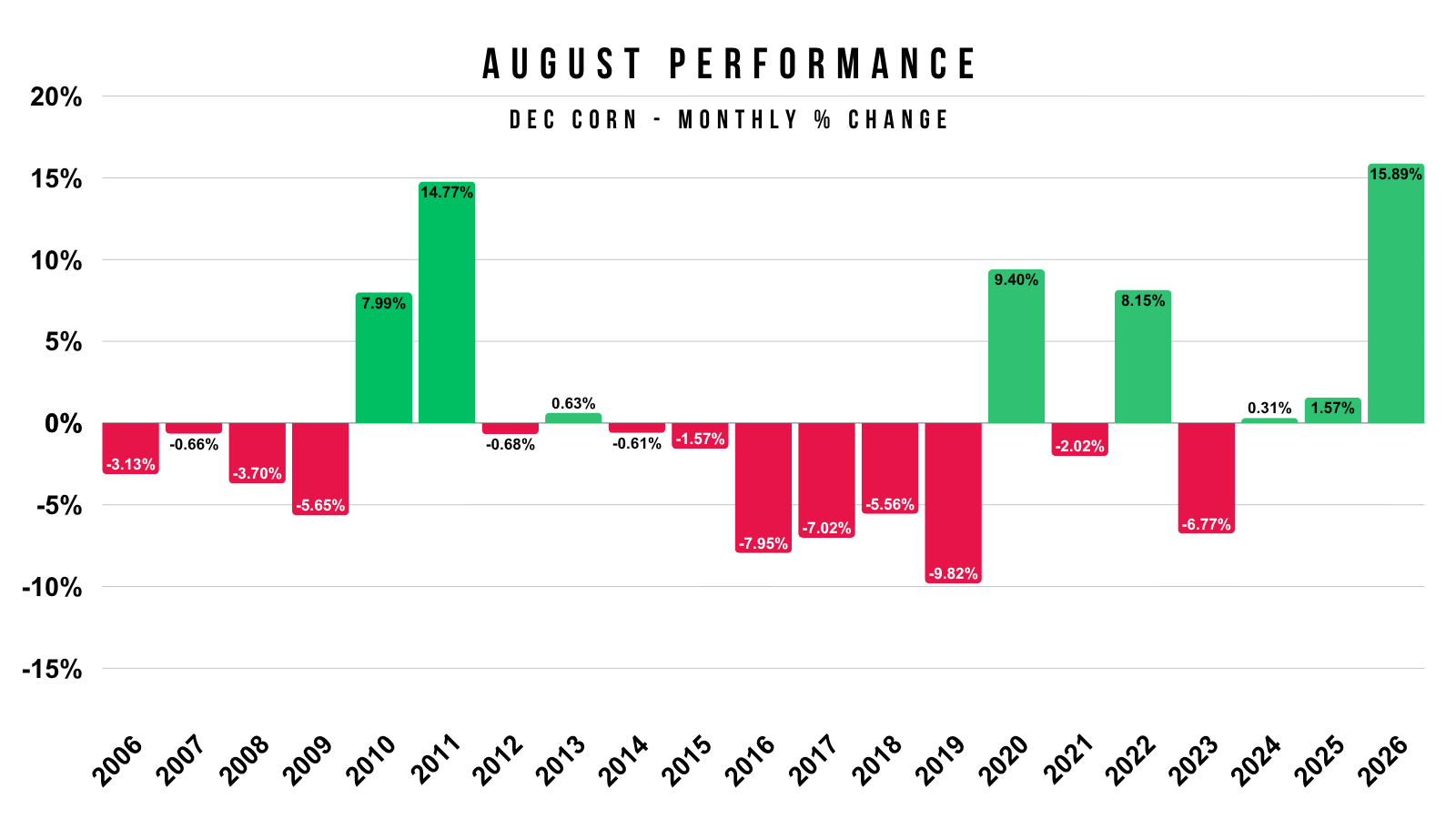
Corn just posted our strongest August ever. Of all-time.
There are only 4 other years that had a similarly strong August.
Those years were:
2022 (bull market)
2020 (started the bull market)
2011 (bull market)
2010 (started the bull market)
That's interesting..
But let's look at what actually happened in each year we had a strong August.
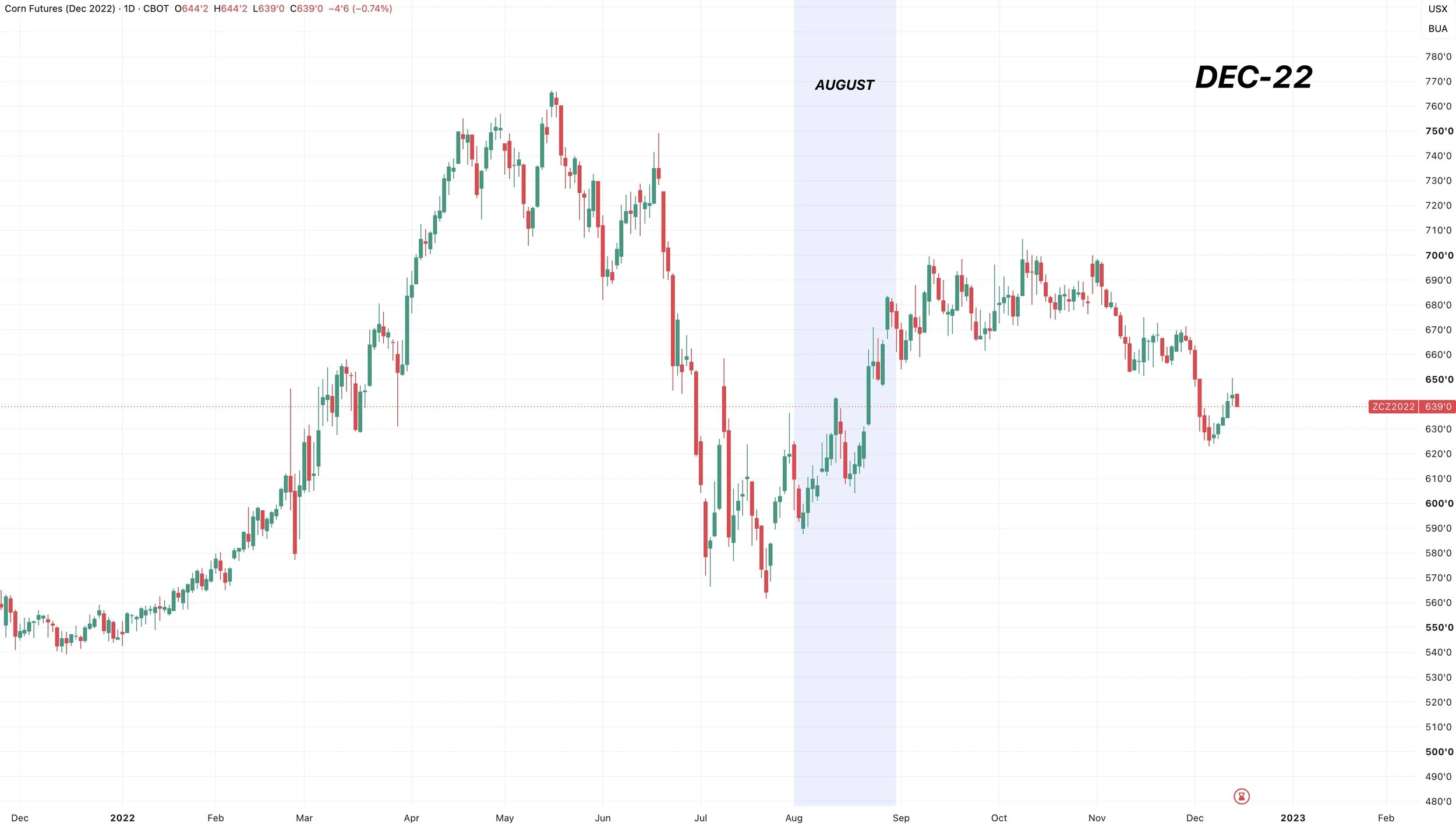
2022:
The August rally came after a brutal summer sell off. The rally did not reclaim what we lost. However, the market stayed strong until November.
Corn was trading over $7.00 at the time for reference.
2020:
The rally continued the rest of the year.
Which led to a bull market the following year.
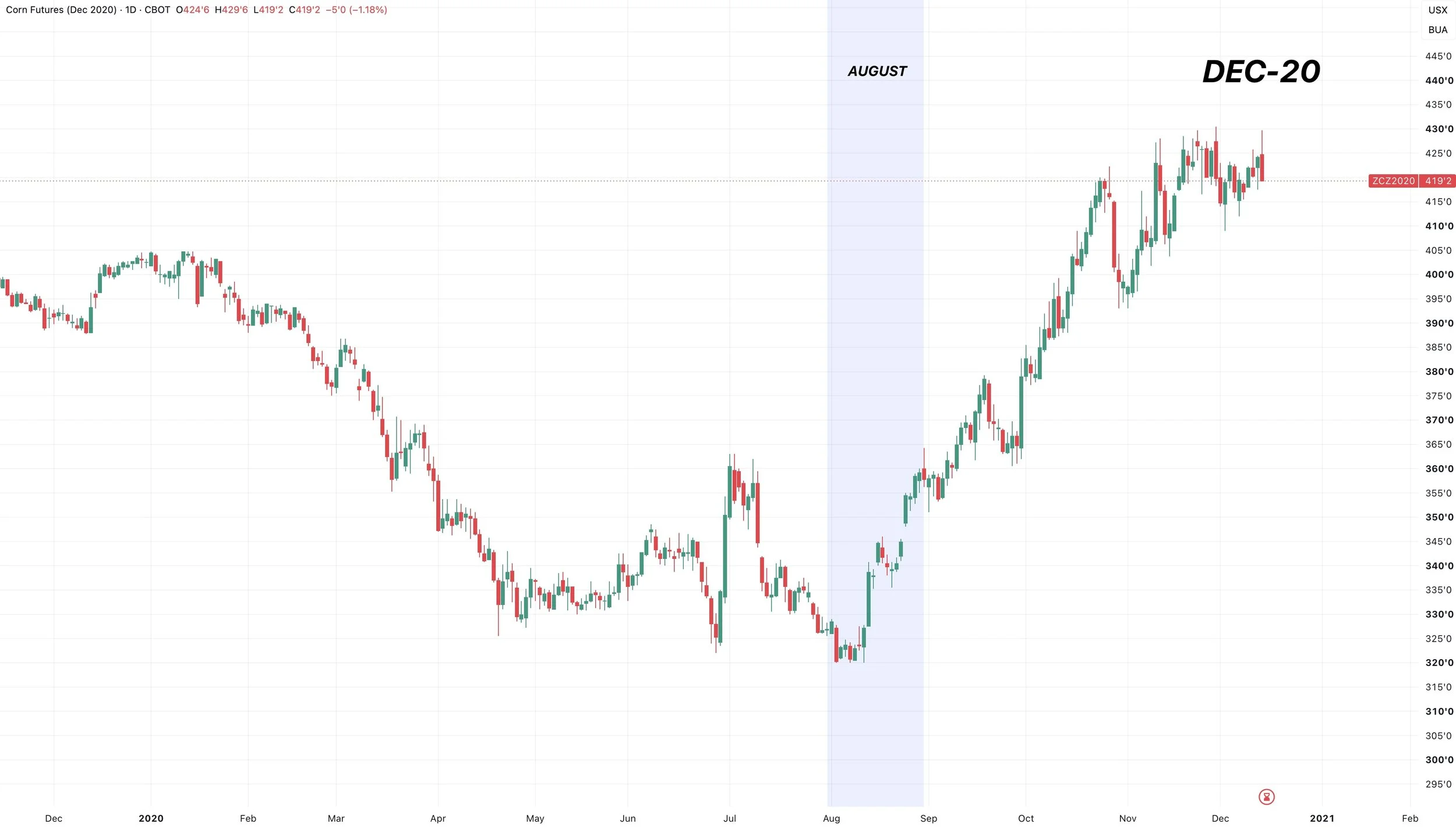
2011:
Now this would be the only year where the market did not stay strong after it's strong August performance.
The market basically went lower every day of September.
2010:
Lastly you have 2010.
Once again, the market was strong the rest of the year.
Which eventually led to a bull market the following year.
First Monthly Breakout Since 2020:
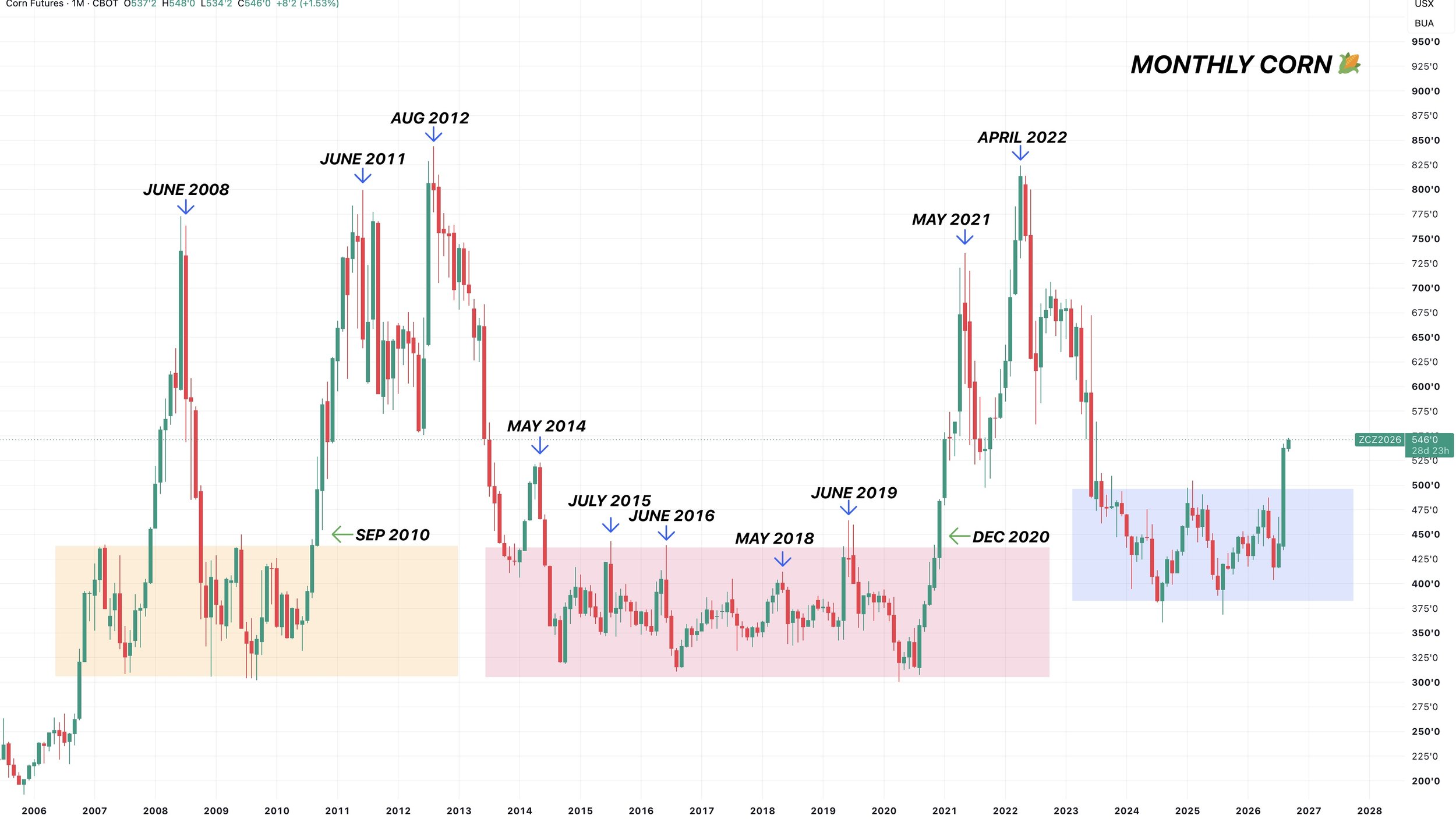
Here is another reason to believe this year is more similar to that of 2010 or 2020.
Corn tends to be trapped in a $1.00 range.
We've been trapped in a rough $1.00 range for the last 3 years since 2023.
We offically just broke out of that range.
The last two times we broke out of a multi year range were 2010 and 2020.
Interestingly enough.. both of the breakouts happened at the end of the year.
2010 happened in September.
2020 happened in December.
Where as most of those rallies that fade and do not last, occured during the spring to summer time.
End of year rallies have had a tendency to continue into the following year.
So I'd argue there are absolutely some similarities here.
What about soybeans?
Soybeans have only posted their highs in September one time ever.
Which was back in 2012.
But I'd once again argue that this year isn’t all that similar to 2012.
Sure, we have some concerns surrounding supply, but this has largely been a demand led run. Where the market is questioning whether our supply can meet that demand. Rather than a weather scare.
Soybeans have never topped in October.
November is actually the most common month outside of June.
Charts
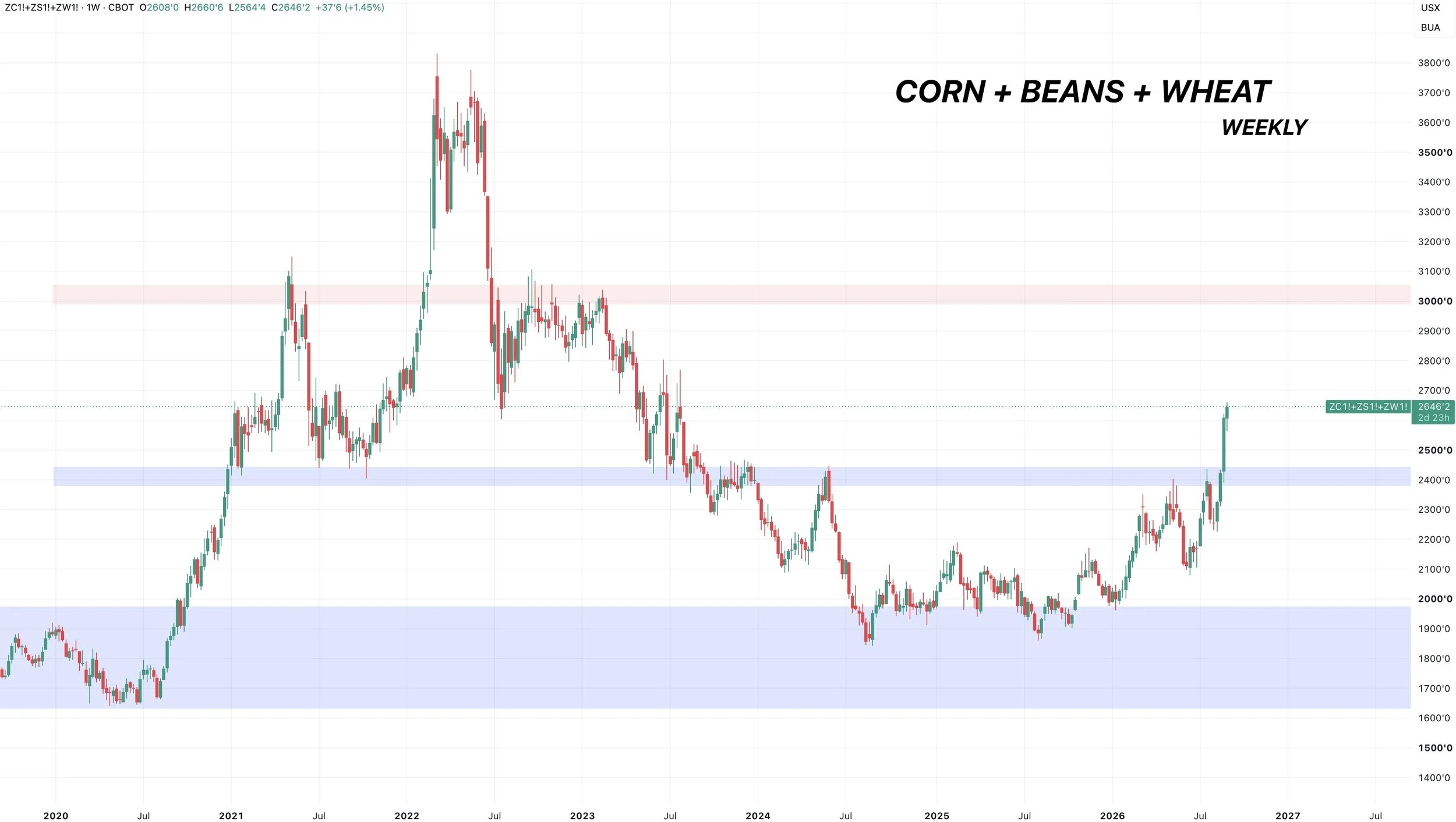
Corn + Beans + Wheat Chart
Here is a chart that combines front month corn, soybeans, and wheat prices.
This first one is the weekly chart.
This chart looks very bullish long term.
We have been sideways the last few years. We are now breaking out. Shattering some pretty significant resistance.
As we cleared those highs from 2024 and the lows from 2021.
It likely won’t be a straight line higher, but long term this chart looks very promising and I'd say it definitely has room to run further towards those 2021 highs and 2023 highs.
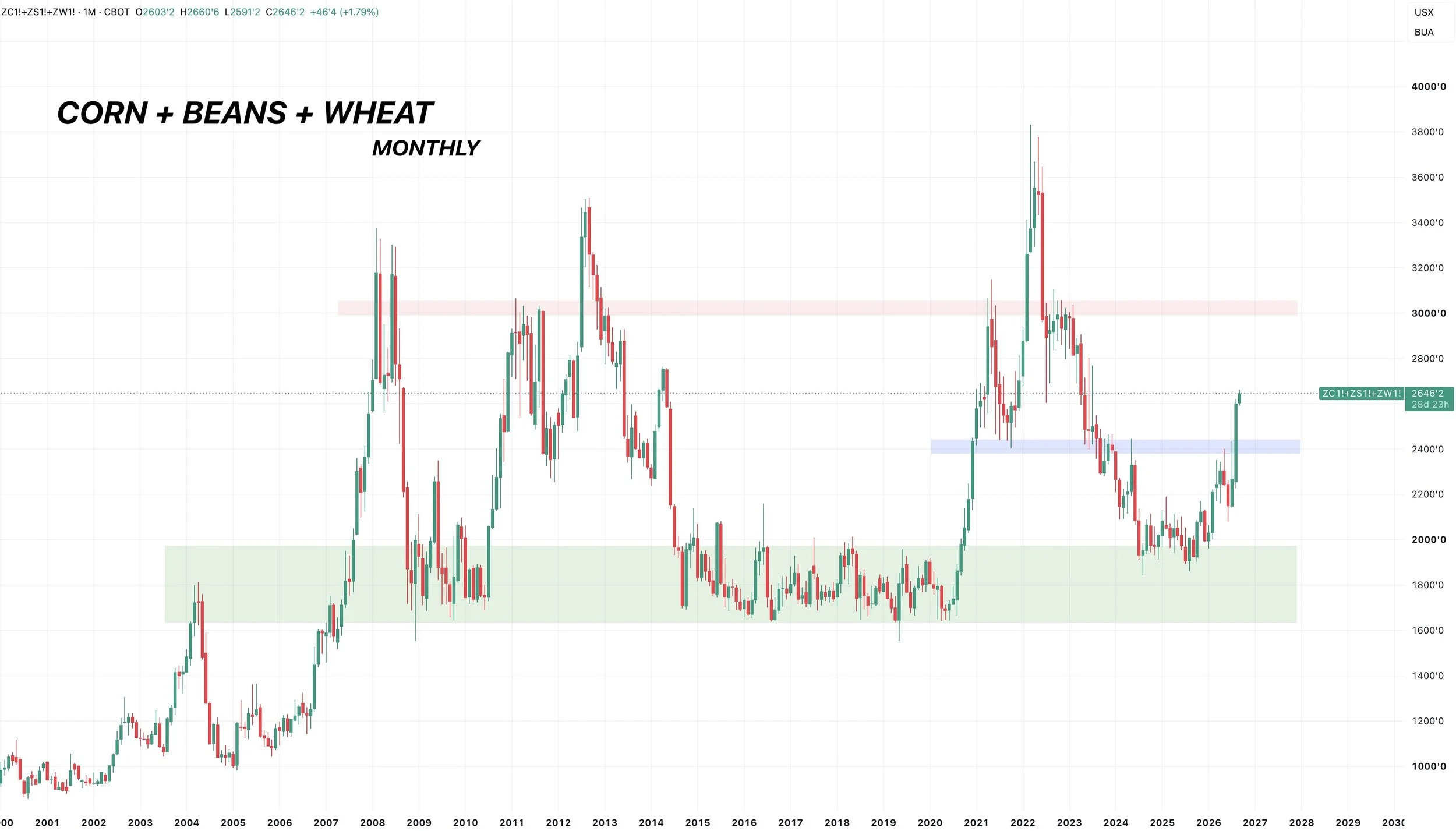
Here is the monthly chart for another perspective.
These are monthly candles, so again this doesn’t mean the grains have to go to those 2022 type of levels tomorrow, but the chart looks great long term.
We had that nice rounded bottom the last two years, which occured right at the previous highs from the last bear market. Turning that old ceiling into the new floor.
Now breaking out. The last few times it broke out, it went quiet a bit higher, towards that red box. So again, could have room to run.
Corn
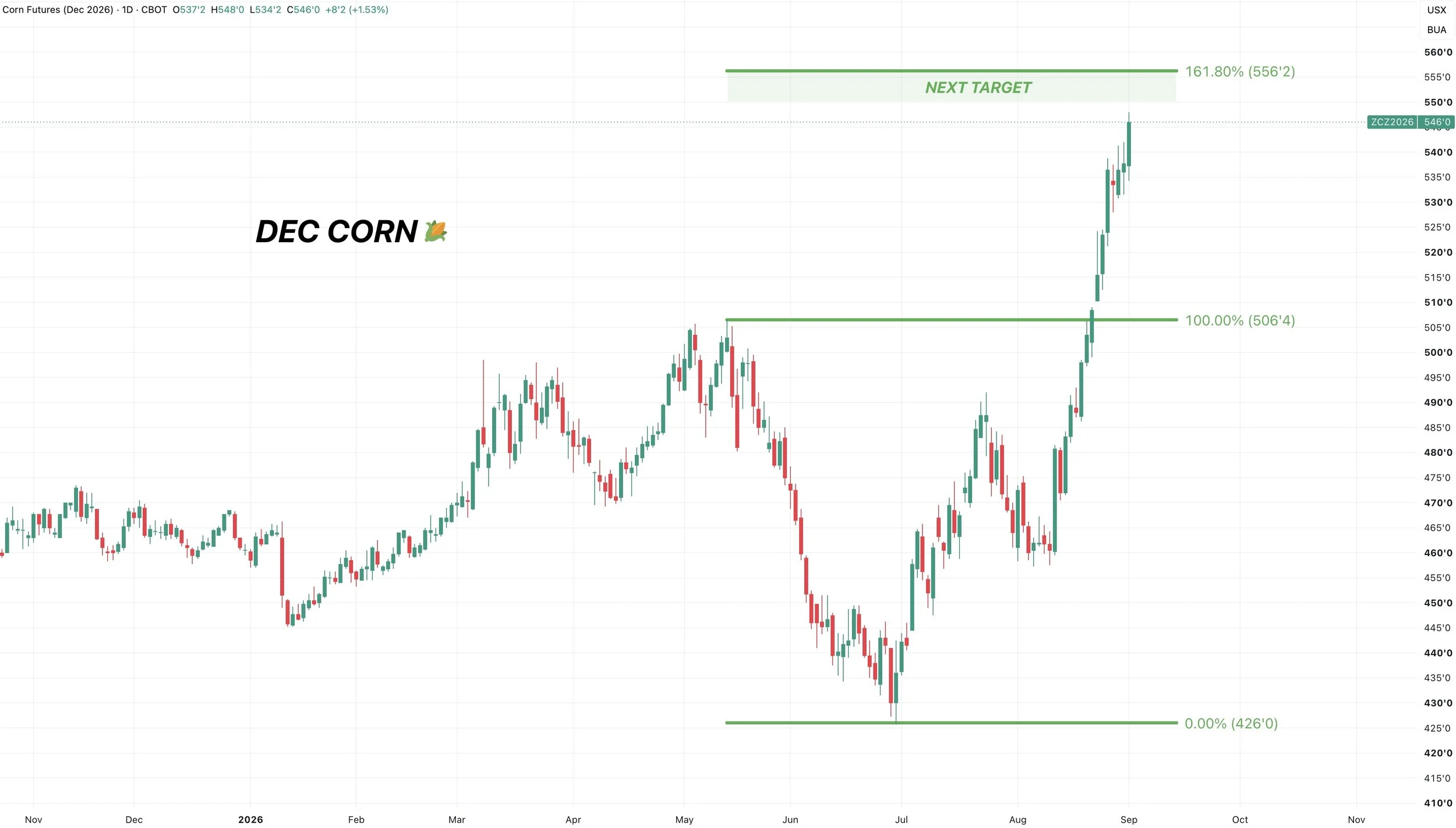
Dec Corn Chart:
Short term we are getting very close to my first target of $5.50 to $5.56
Which is the golden fib from the contract lows up to those May highs.
We were really close to issuing a corn sell/hedge alert today but did not.
However, this would be an area where we want to consider taking some risk off the table here shortly for those who need to do so.
We could potentially have an alert out tomorrow.
Hitting a target doesn’t mean the rally is over, and doesn’t mean we have to stop here at all. But this would be a common area to see the rally take a breather.
So for those who lack storage or are behind in your marketing, this is where we'd consider doing something.
If you're in a comfortable spot, we don’t mind being patient. As we still think the grains as a whole have plenty of potential long term.
Keep in mind, we do NOT want to get ourselves into an oversold situation at all.
The potential in this market is the best it's been in years. That potential does not "have" to unfold. But I'm making sure we have plenty of bullets in case it does.
We are starting to get pretty overextended here.
As the RSI is getting close to hitting the most overbought levels it's seen.
Again, doesn’t mean we can’t continue higher. But seeing a pullback and having this rally catch it's breathe would not be a surprise.
As we've gone straight up for +90 cents. We’ve only had 3 red days since the Aug USDA.
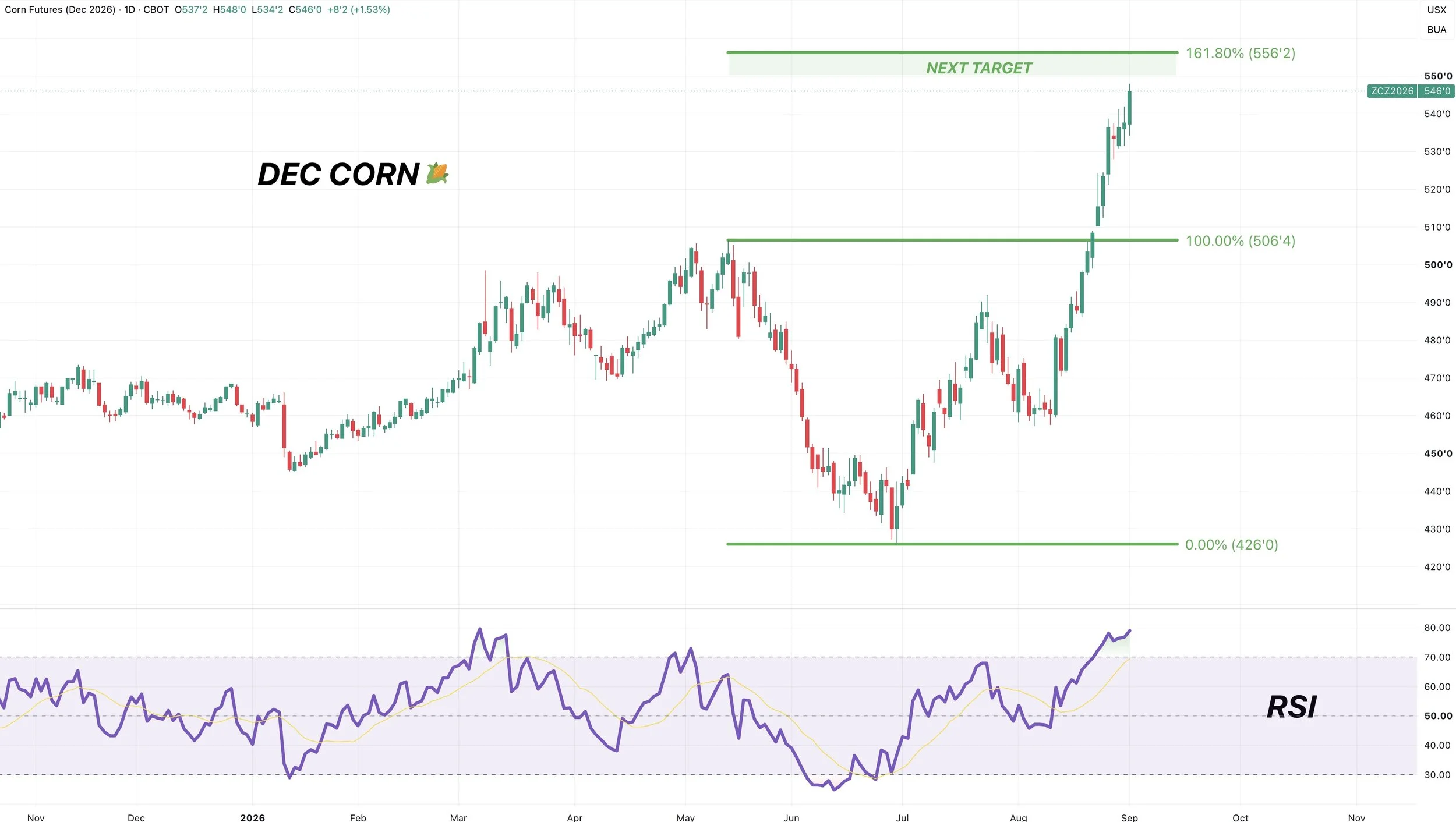
Weekly Chart: Breakout
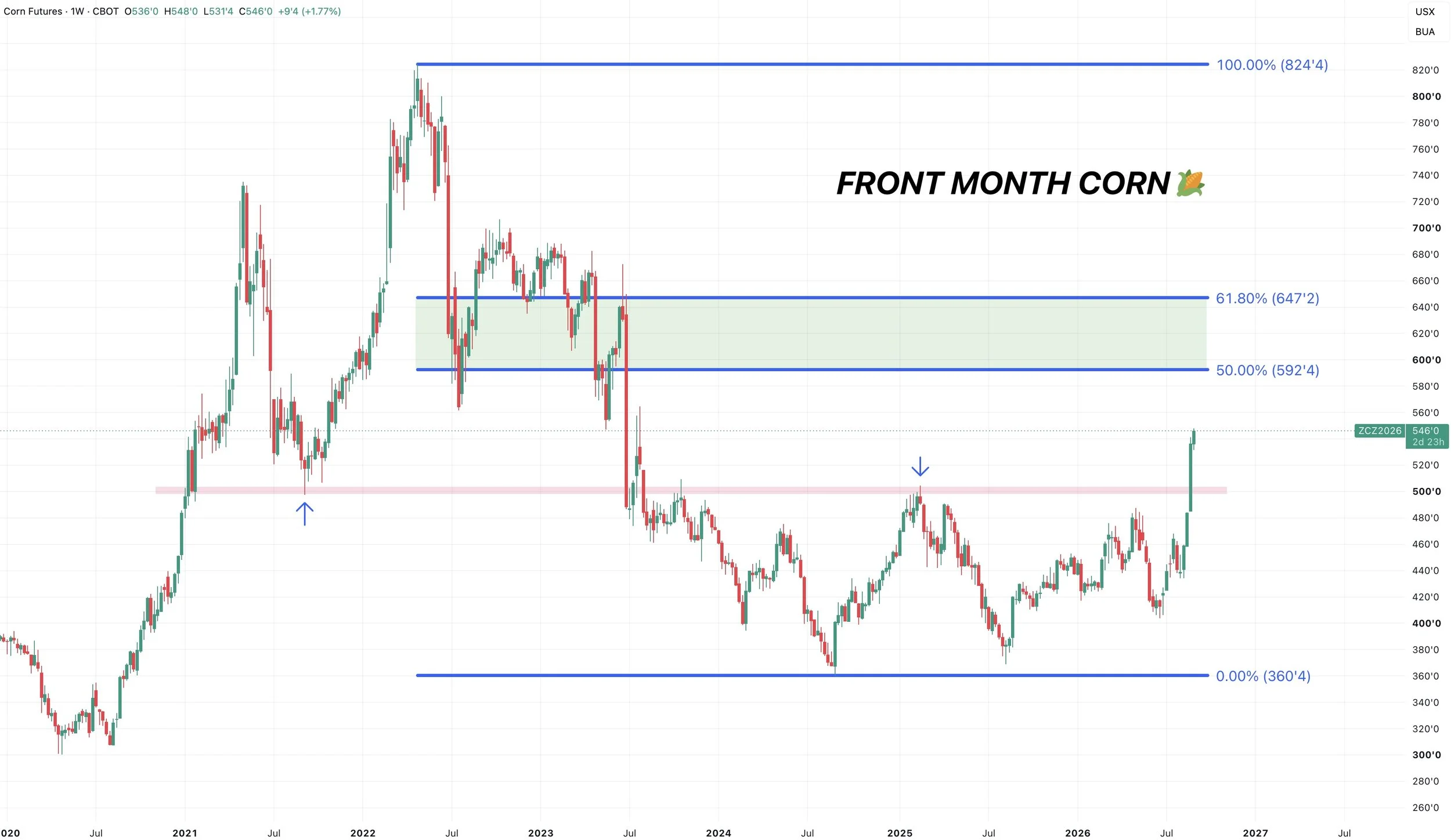
This chart looks amazing.
We broke key resistance. Those highs from 2025 and the lows from 2021.
Posting our very first higher low and higher high of the entire bear market. Finally breaking out of this sideways range we've been in for 3 years.
That seems important. So the long term structure of this chart has definitely shifted higher.
This doesn’t mean there won’t be set backs along the way, but the stucture looks promising long term.
If you took some retracements from the 2024 lows of $3.60 up to the 2022 highs of $8.24. The 50% to 61.8% levels come in at $5.92 to $6.47
Monthly Chart: Another Breakout
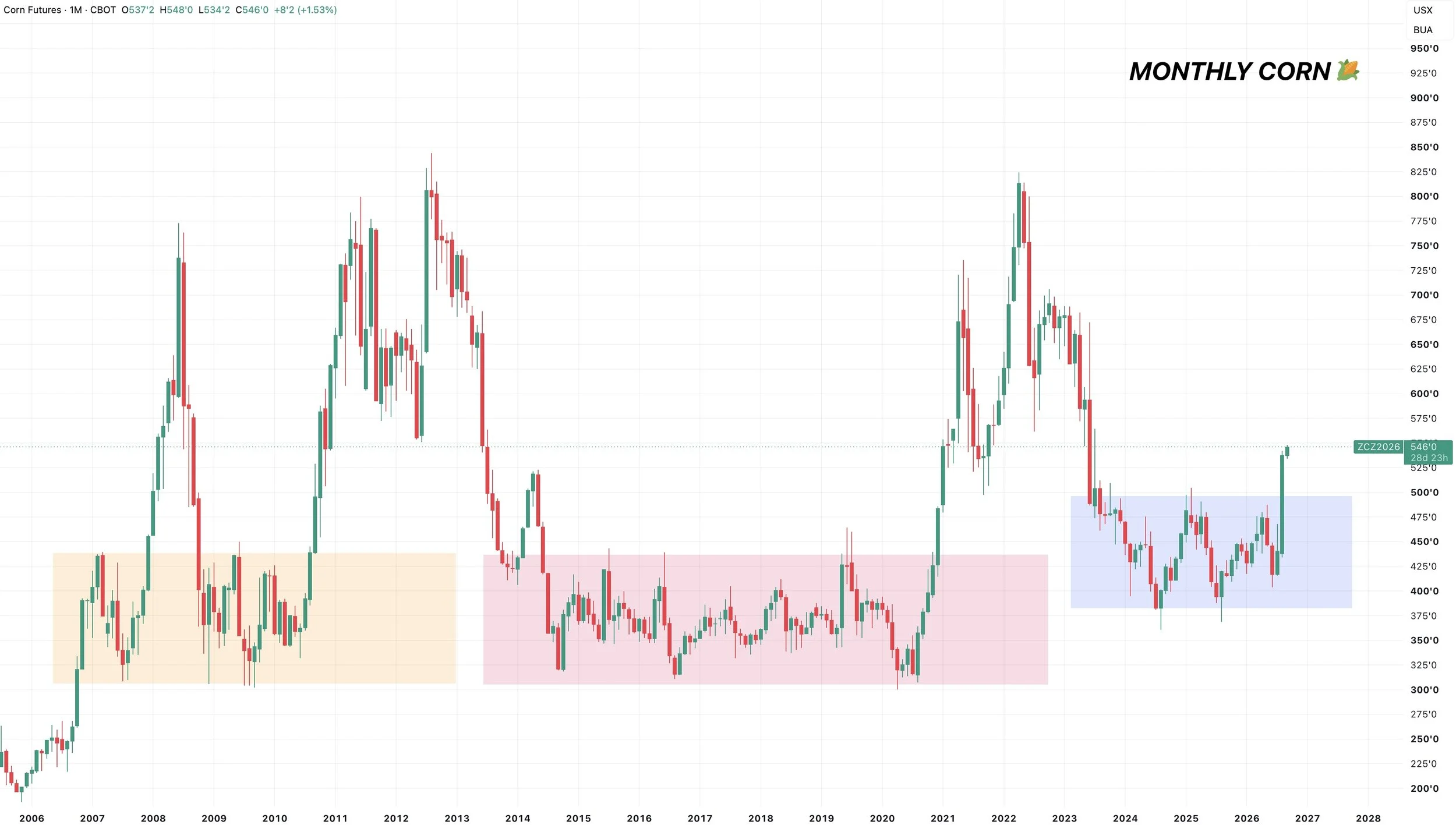
I already showed this chart. But this one is breaking out as well.
Corn likes to consolidate in roughly a $1.00 range. Which we've been doing since 2023.
We've now received our first breakout of a range since 2020.
This of course doesn’t mean corn definitively has to go to $6 to $7 but this chart is not bearish at all and offers plenty of upside potential.
Soybeans
Disclaimer: there is risk of loss trading futures and options. Past performance does not necessarily indicate future results. This is our opinion and should be treated as such.
Today's Sell & Hedge Alert:
We did issue a sell signal and hedge alert for soybeans today.
If you missed it: Click Here
As almost all of our signals have been this year, this was mostly geared towards those who: lack storage, have to move stuff off the combine, or are behind in their marketing.
This is a spot where we like to get caught up or get some protection.
If you're in a comfortable spot, we do not want to get carried away with sales or get ourselves oversold. As we see further potential.
What could you consider?
We always prefer to use options as it gives you the most flexibility in your marketing.
If you don’t like using options, then we'd just consider a small incremental sale.
If you have a hedge account, here are a few routes you could consider:
1) Cash Sale & Re-Own
If you make a sale and would like to keep your upside open, this would be one possible strategy to look at.
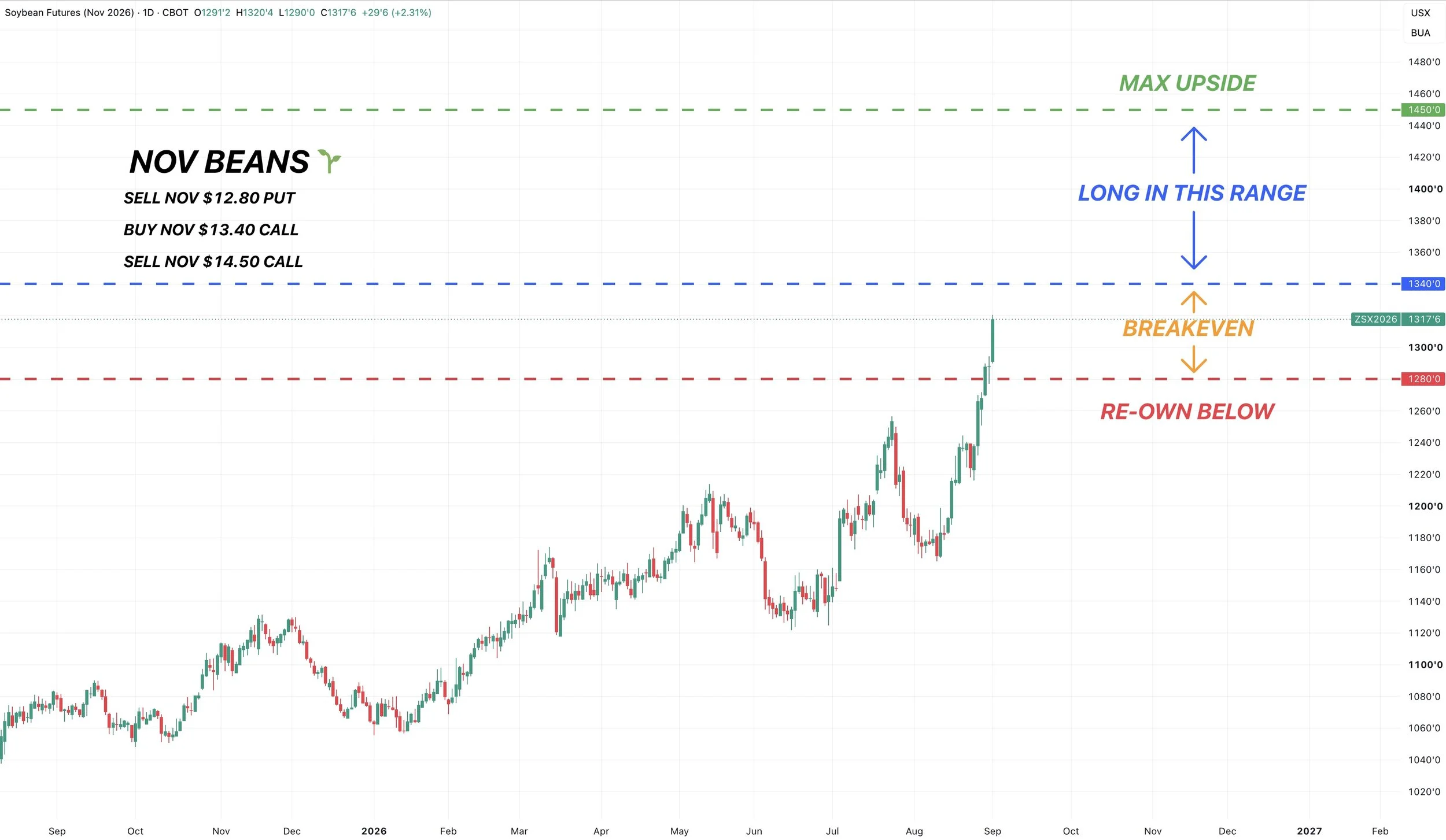
Sell Nov $12.80 put
Buy Nov $13.40 call
Sell Nov $14.50 call
This would give you a max upside of $14.50, in exchange you could re-own soybeans on the board at $12.80. This would be roughly a zero cost trade, but selling options does require margin.
Here is a visual on how the trade would work at expiration.
Another strategy you could consider is:
Sell July $12.80 put
Buy July $13.80 call
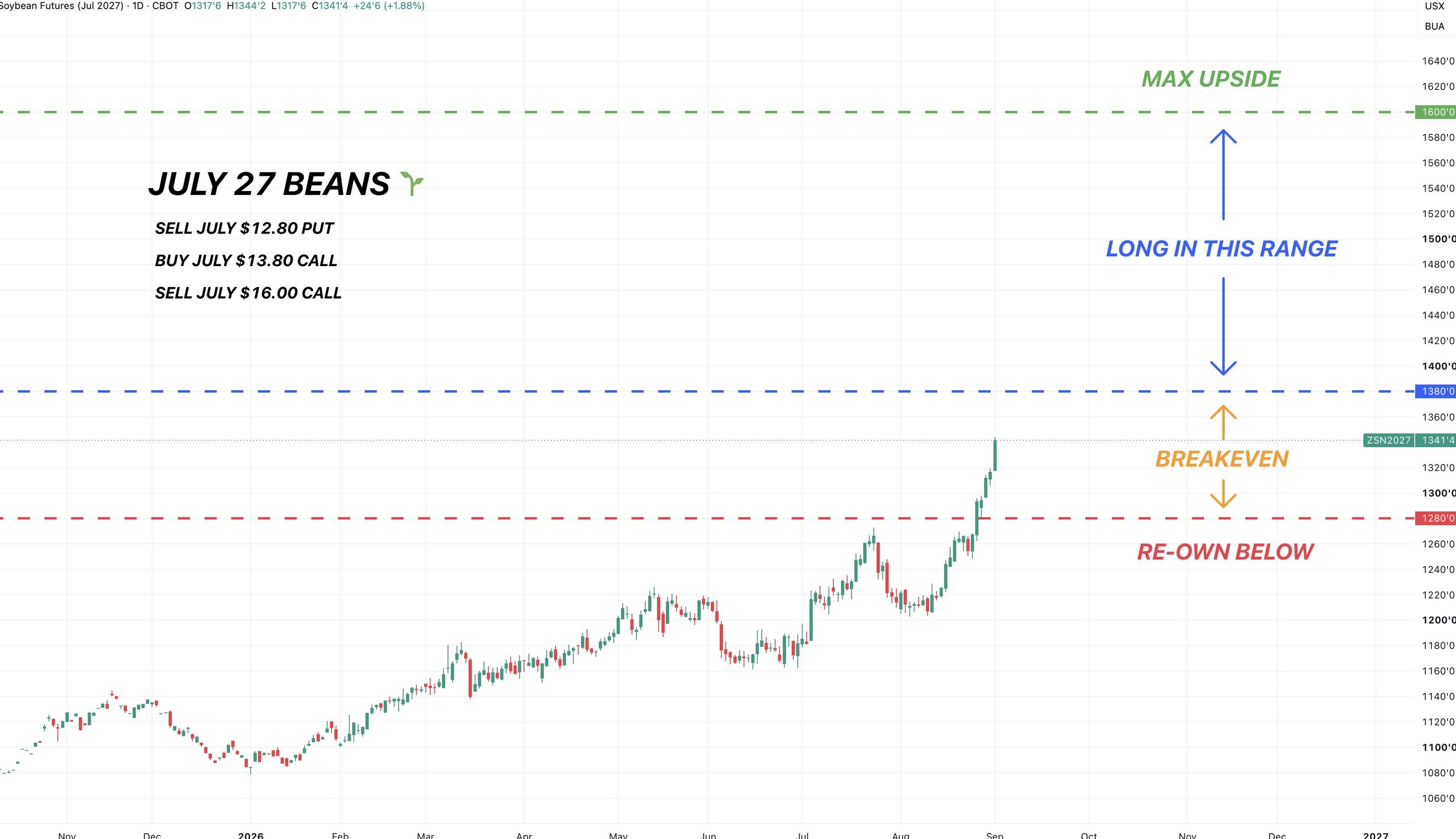
Sell July $16.00 call
This would give you upside until $16. In exchange, you could re-own July beans 60 cents lower than we are today. This would also be about a zero cost trade but would require margin.
Here is a visual of that one.
2) No Sale & Downside Protection
Instead of making a sale and re-owning, another route you could take is simply grabbing some downside protection if you prefer not to make a sale.
We want to ride this market up as much as possible. But instead of spending a bunch of money on a long term floor we would much rather have a short term floor.
For example the July $13.40 puts cost 75 cents which is a ton.
On the other hand, a $13.00 put that expires in 10 days cost around 11 cents.
Or the $13.20 puts that expire in 10 days cost around 20 cents. Which would you a floor of $13.00 until that USDA report.
There are a thousand ways to manage your risk, if you'd like to discuss what might make most sense for you please reach out anytime.
Office: (806)484-1214
Why the alert?
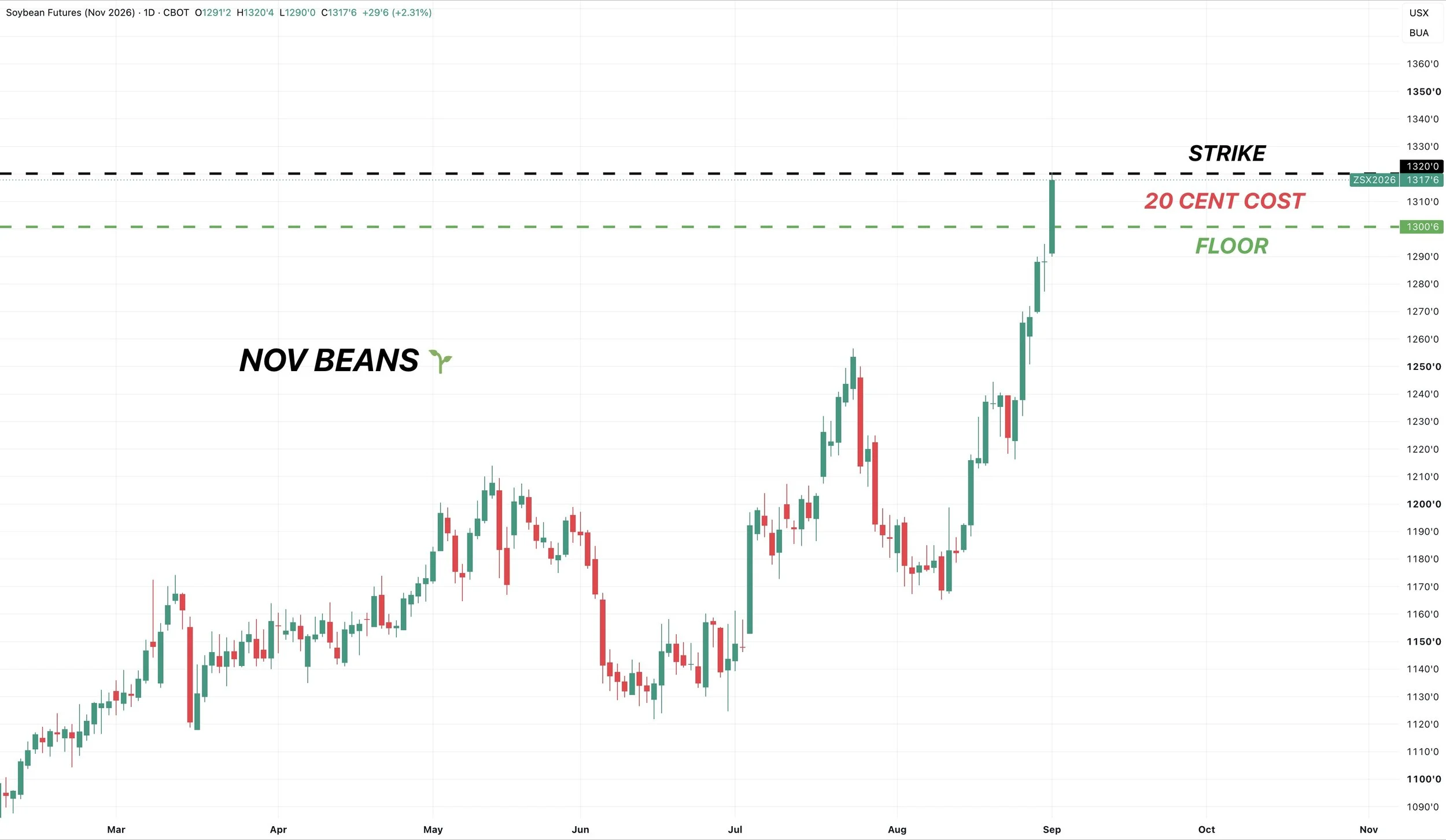
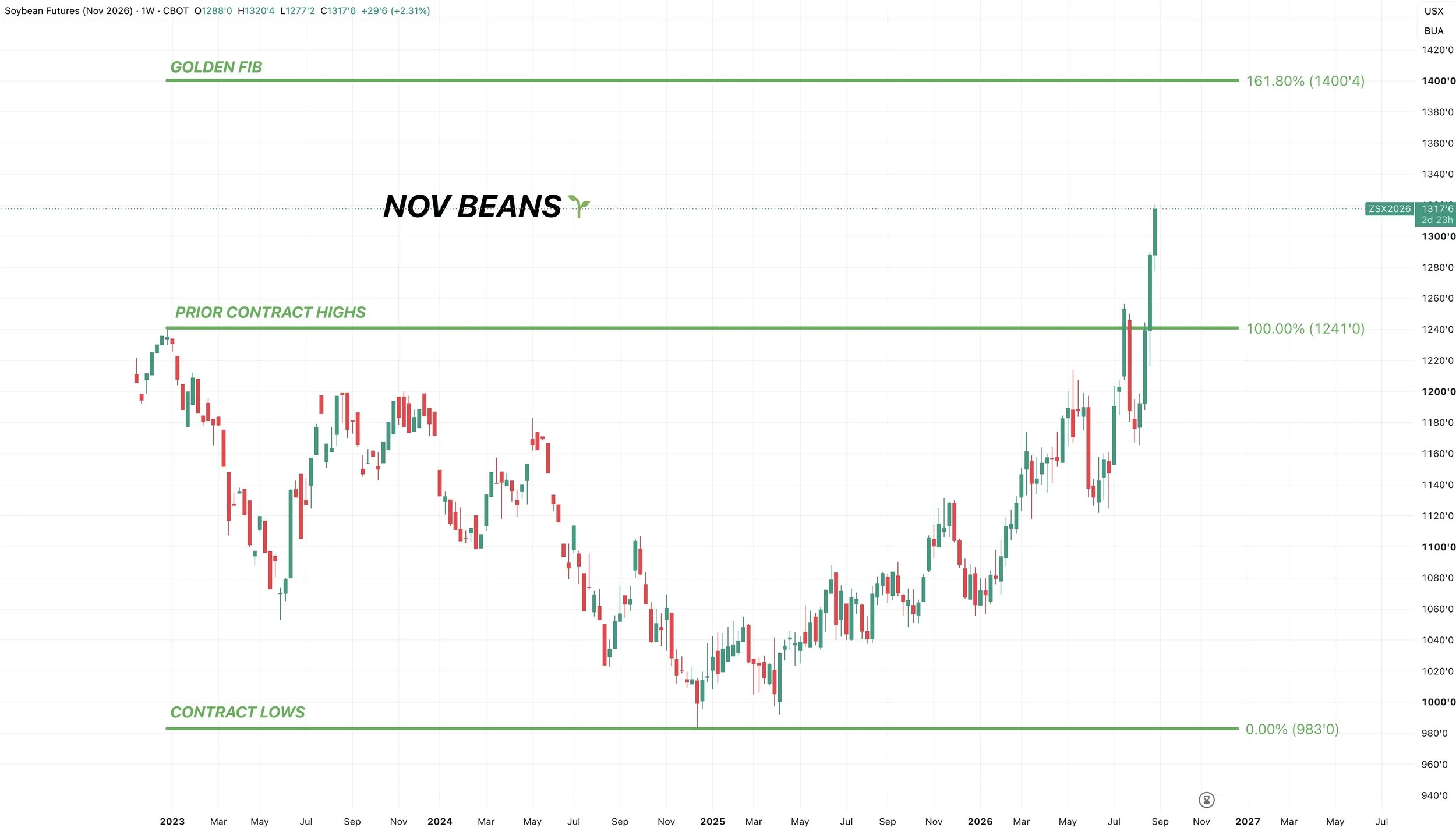
Nov Beans Chart:
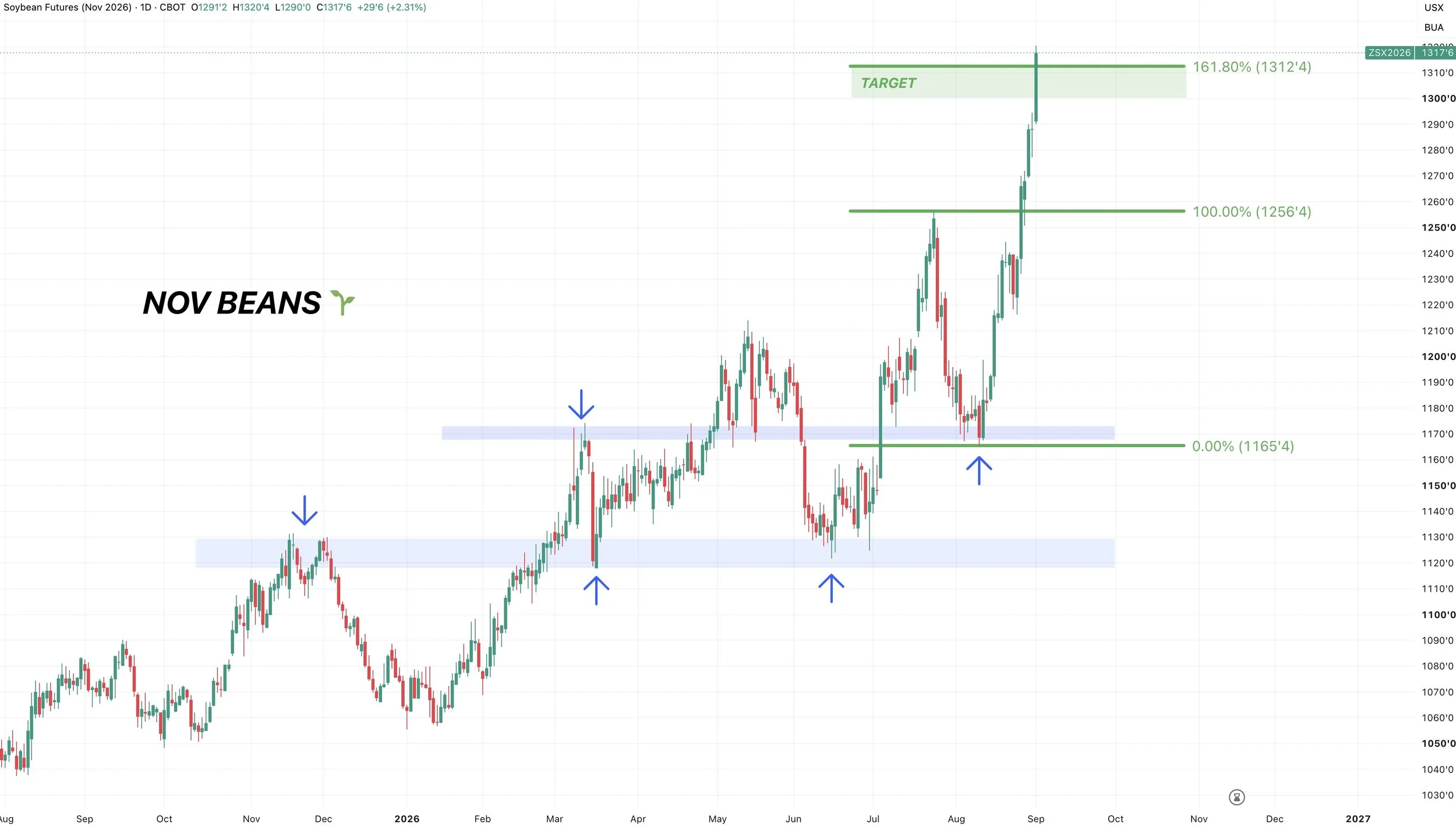
The main reason for the alert was that we hit our next target we've had for the last month or so.
The golden fib. Which is the 161.8% retracement from the August lows up to the July highs.
This is a common continuation target.
It of course doesn’t mean we can’t keep running, but short term this would be a point of interest and where a pullback wouldn’t be surprising.
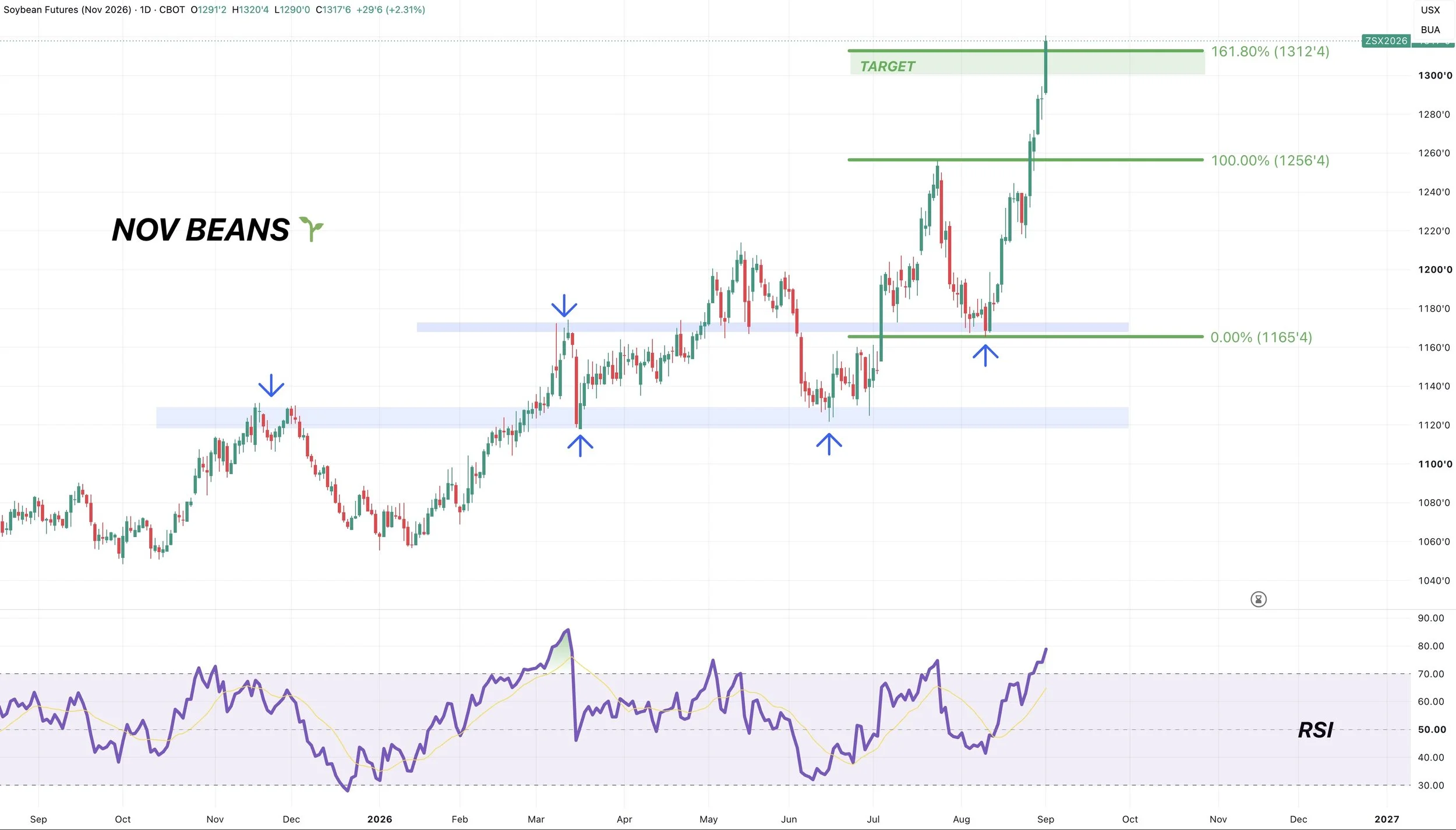
We are also starting to get pretty overbought in soybeans as well.
Next Possible Target:
My next target is always subject to change.
But for right now, beyond the target we hit today, this is one I am watching.
If you take the golden fib from the contract lows all the way up to the previous contract highs. It comes in right at $14.00
Weekly Chart:
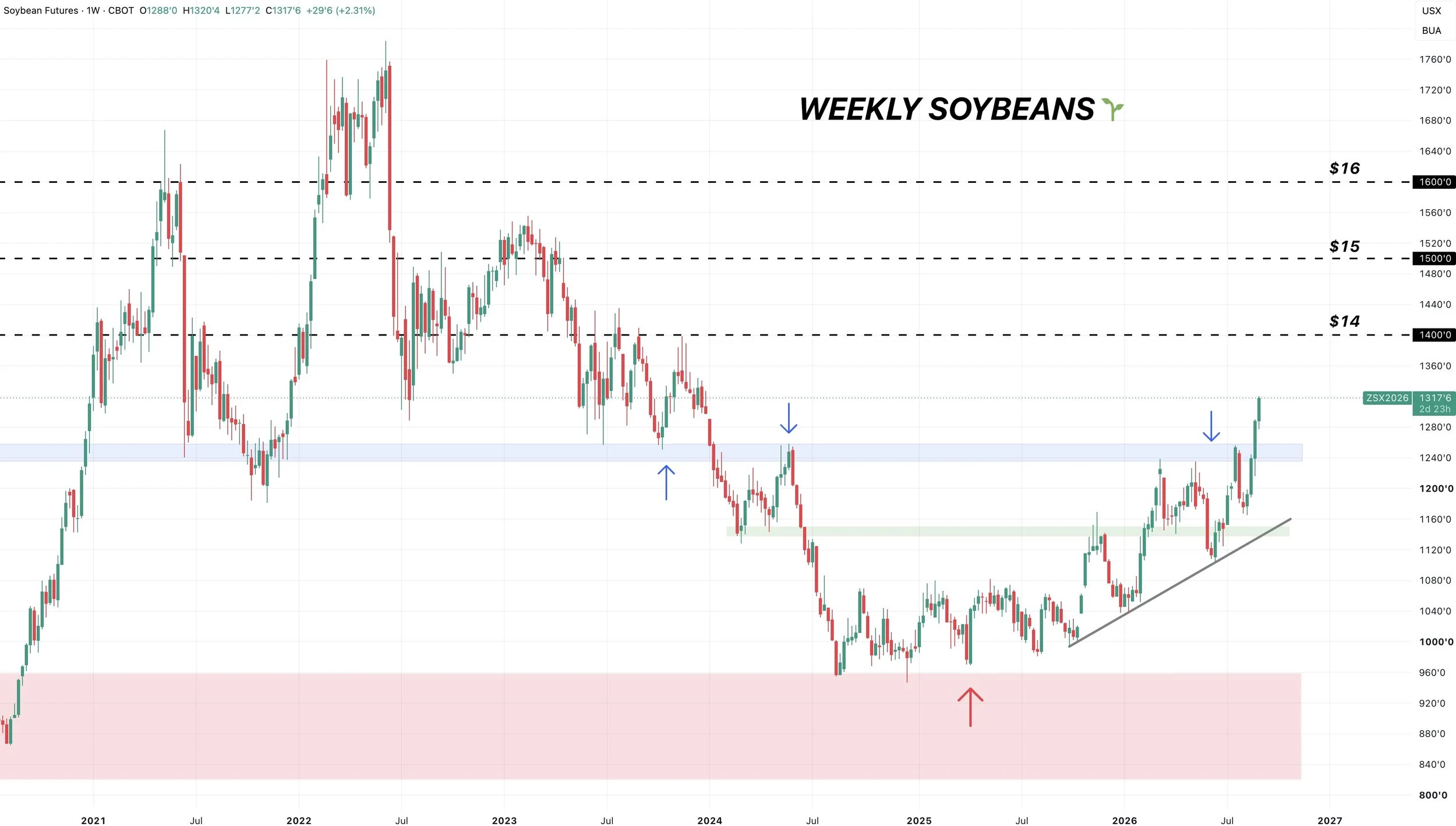
If you zoom out, the long term structure looks very bullish as we've been talking about for a very long time now the last several months.
We've got higher highs and higher lows.
We just broke big resistance, taking out those highs from 2024.
Beans are in the teens for the first time in 3 years.
I'd argue there is still room to run long term and $14 to $15 beans does not look all that far out of the realm of possibilities..
Monthly Chart:
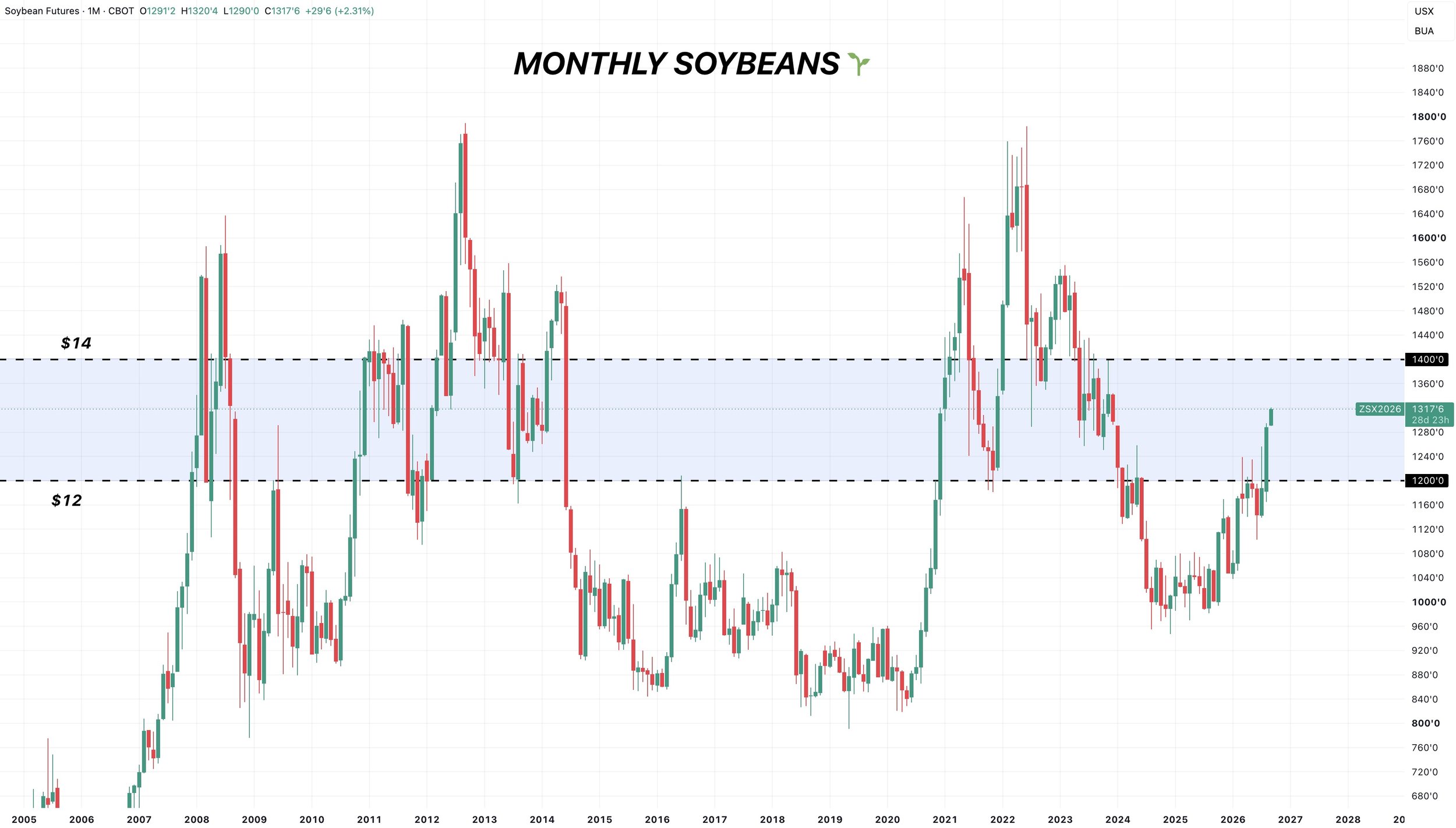
For starters this chart looks great.
Here is something interesting I found on the monthly chart.
The blue box highlights $12.00 to $14.00
Every time we have broke above $12.00 and saw a monthly close above $12.00, the market has ran to at least $14.00. In most cases higher.
Following a monthly close above $12.00, the rally has never stopped in the $13.00's. There are times we’ve traded above $12.00 and did not make it to $14.00, but those only happened when we failed to close above $12.00. (Examples: 2009, 2016, and this year)
Wheat
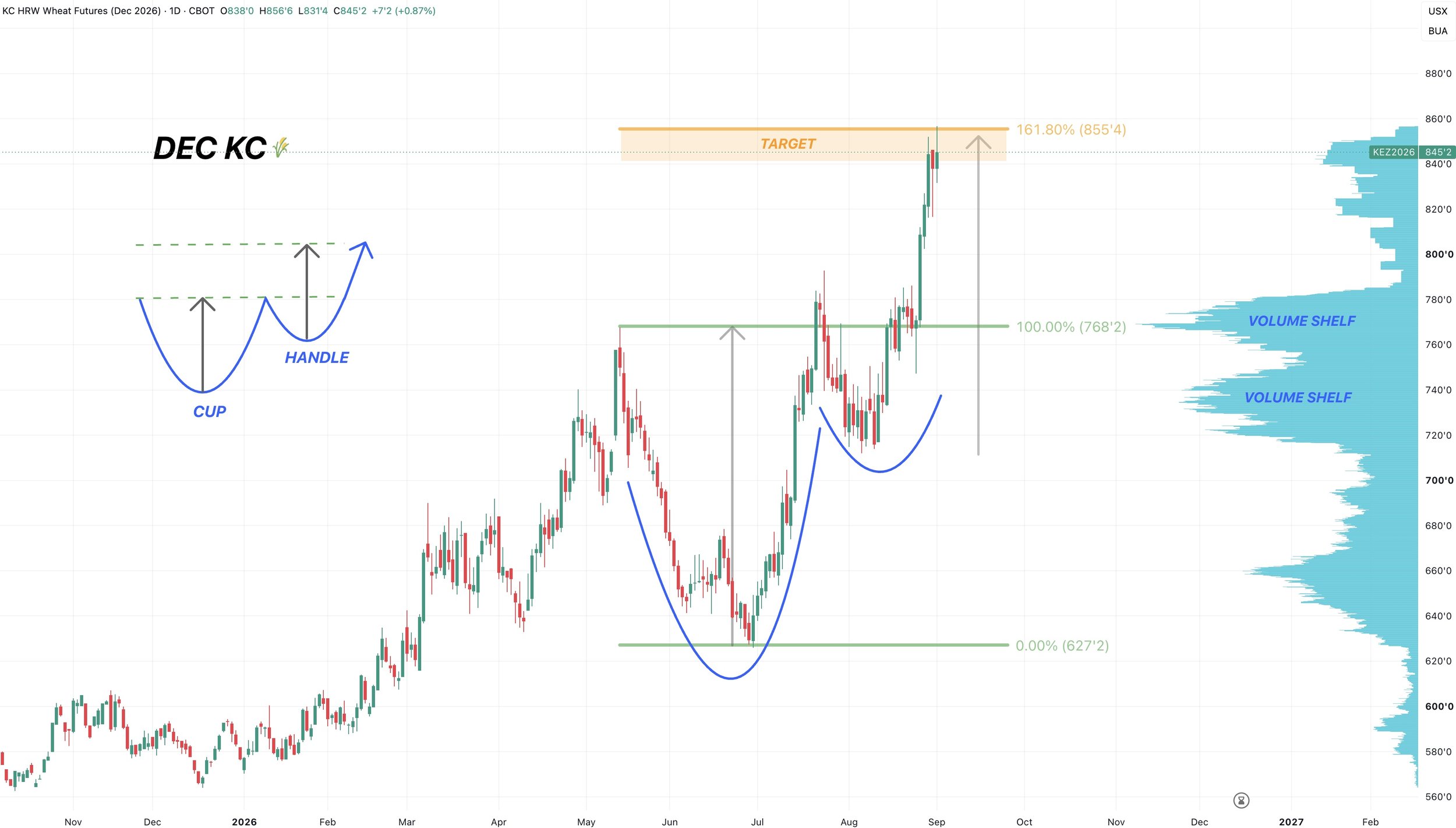
Dec KC Chart:
We had that sell signal and hedge alert for the first time in a long time on Monday.
As we hit that target we've had for the last month or so.
We hit the implied move from this cup and handle pattern.
We also hit the golden fib. The 161.8% retracement from the June lows up to the May highs.
So this is still an area where we want to managing our risk if you need to do so.
If we fail here, I'll be sharing where I think we could bottom.
If we continue higher, I'll be sharing some next possible upside objectives.
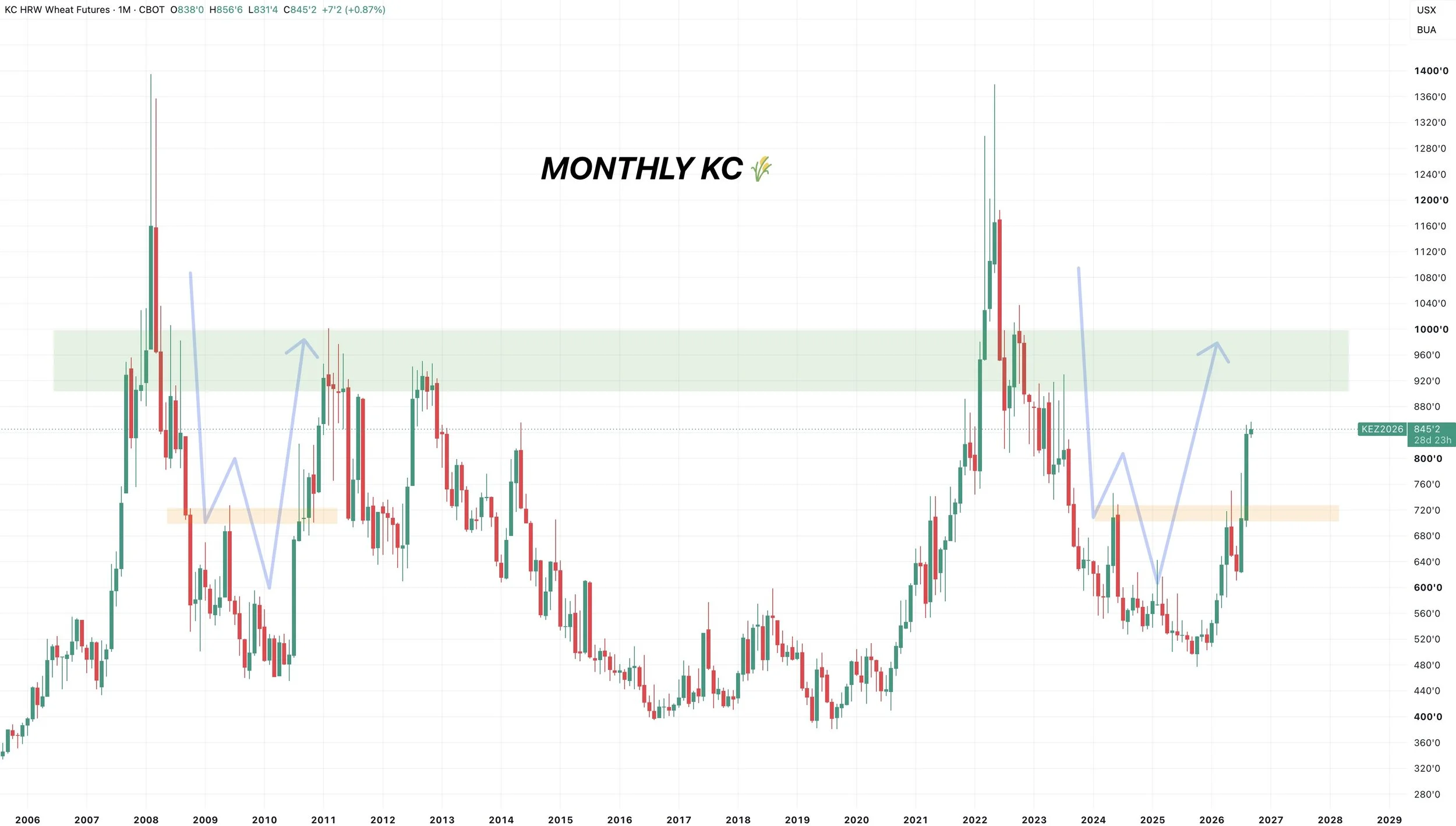
Monthly KC Chart:
If you zoom out, what could definitely still have long term upside potential.
This rally looks very similar to what we saw back in 2010-2011.
Every major rally in the wheat market has ran up to at least that $9 to even $10 range.
If we get into that $9 to $10 green box, it probably makes sense to be more aggressive.
Considering there is only a handful of months we've ever closed above that range.
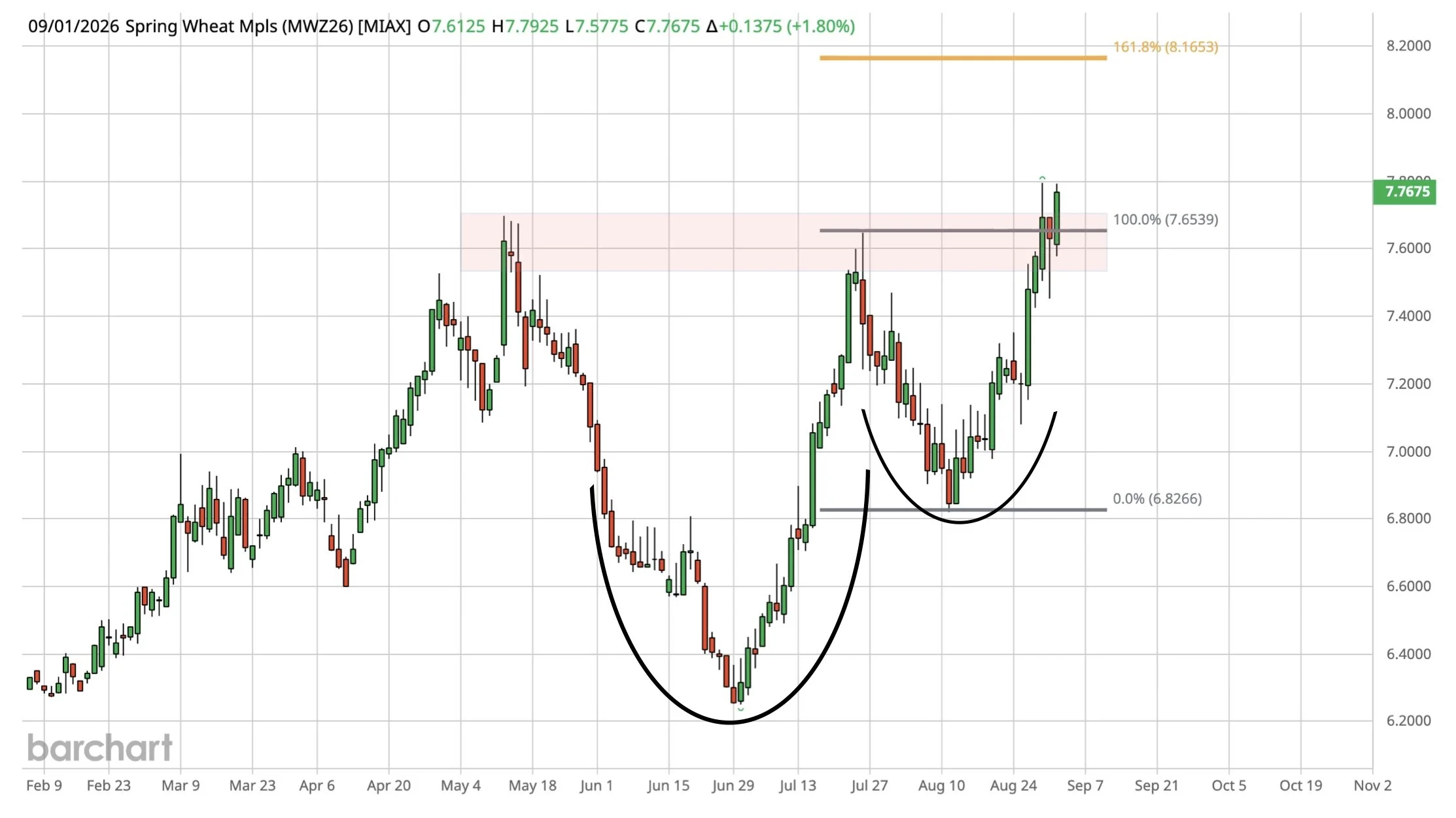
MPLS Wheat Chart:
MPLS has been lagging KC.
It does look like we are attempting to break through this resistance, but not quiet out of the woods yet.
We still have this cup and handle pattern here.
We still have the golden fib that sits around $8.15, which is going to be an area of interest if we break out and continue to rally.
Cattle
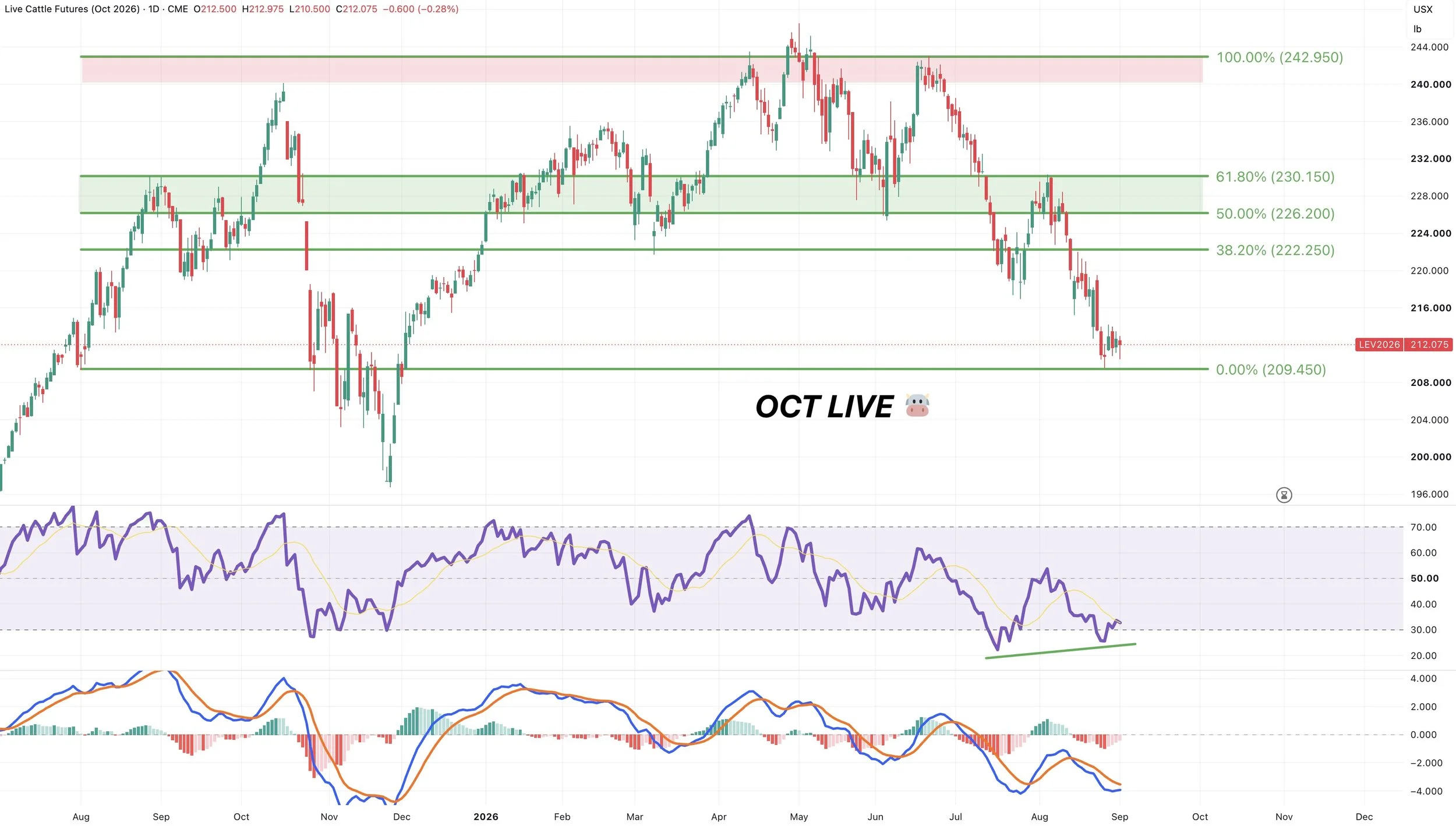
Oct Live Chart:
Cattle still doesn’t look too hot down here.
I'm still in the camp that any sizeable rally should be protected as the trend is lower.
It'd probably be beneficial for cattle if the corn market took a step back.
The indicators are still suggesting this market might want to try to at least get a dead cat bounce.
As we still have bullish divergence on the RSI and the MACD looks like it wants to cross bullish as well.
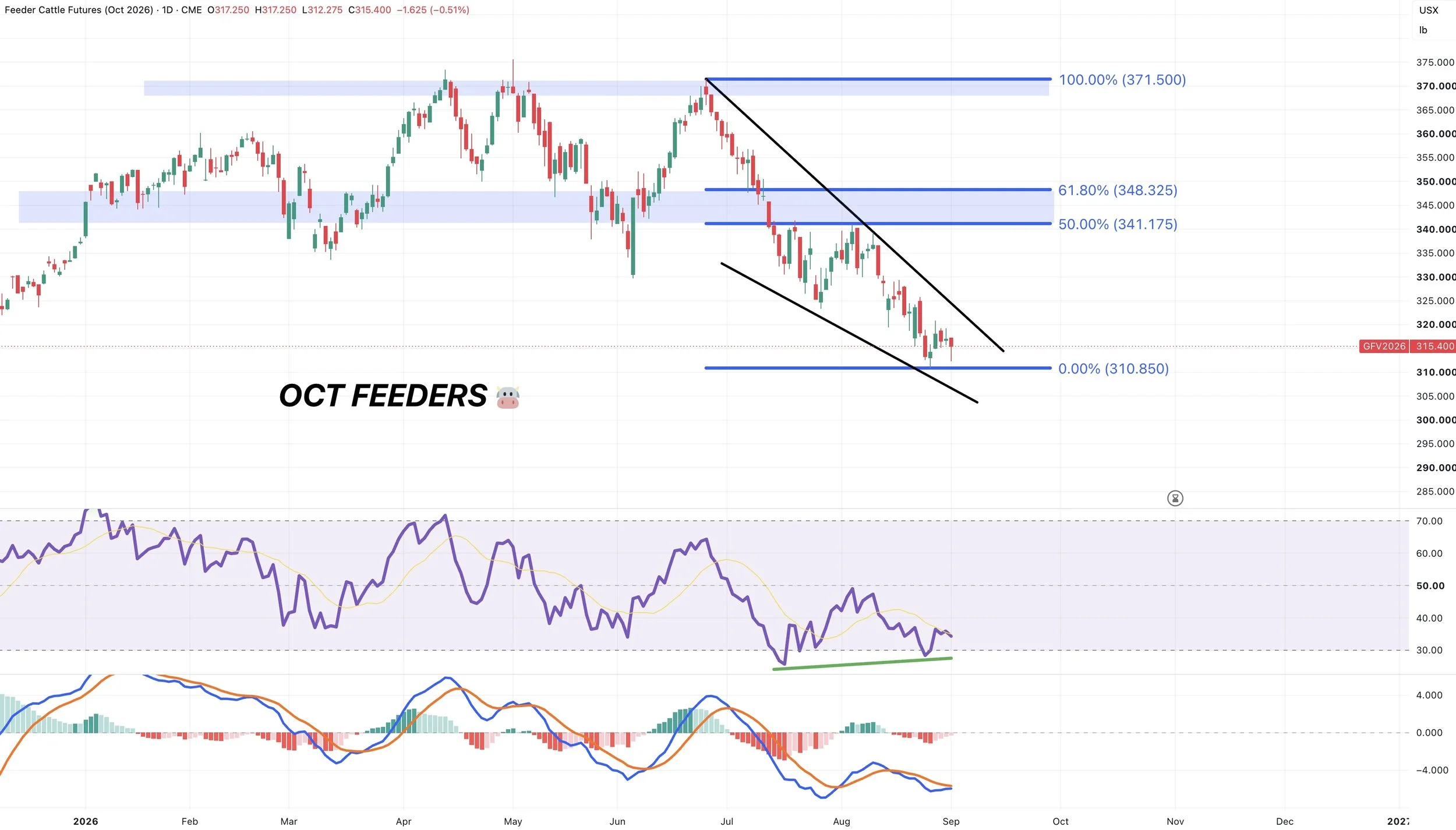
Oct Feeders Chart:
Same thing here.
Essentially trying to catch a falling knife.
We do have a wedge pattern I'm watching.
Looking to protect a sizeable rally towards the golden zone.
Also showing bullish divergence on the RSI and the MACD is close to crossing bullish. So the indicators suggest a possible bounce soon.
Want to Talk?
Our phones are open 24/7 for you guys if you ever need anything or want to discuss your operation.
Jeremey & Office: (806)484-1214
Sebastian: (605)280-1186
Email: sfrost@dailymarketminute.com
Hedge Account
Interested in a hedge account? Use the link below to set up an account or give us a call.
SOYBEAN SELL & HEDGE ALERT
Disclaimer: there is risk of loss trading futures and options. Past performance does not necessarily indicate future results. This is our opinion and should be treated as such.
First off, we do think the grains as a whole ultimately head higher and hold a lot of potential.
However, short term we are nearing a level where it makes sense to manage your risk especially if you are in that situation where you lack storage, need to move stuff off the combine, or are behind in your marketing. This would be a spot where we’d want to get up or get some protection.
If you are in a comfortable spot and not in one of those situations, we do not want to get carried away with sales or put ourselves into an oversold situation. As we see further potential.
This is our first bean alert since around those July highs.
What could you do?
Our preference is always to use options and to hedge, as it gives you the most flexibility in your marketing.
If you don’t have a hedge account, you could simply consider making another incremental sale here.
If you have a hedge account, there are a few routes you could take.
1) Cash Sale & Re-Own:
If you make a sale and would like to keep your upside open, this would be one strategy to consider.
Sell Nov $12.80 put
Buy Nov $13.40 call
Sell Nov $14.50 call
This gives you a max upside of $14.50, in exchange, you could re-own beans on the board at $12.80. This would be roughly a zero cost trade, but selling options does require margin.
Or another strategy would be:
Sell July $12.80 put
Buy July $13.80 call
Sell July $16.00 call
This would give you upside until $16, in exchange, you could re-own beans on the board 60 cents below the market. This would be roughly a zero cost trade, but selling options does require margin.
2) No Sale & Downside Protection:
If you’d rather not make a sale and simply protect your downside, this would be a different strategy to consider.
We want to ride this thing up as much as possible. So instead of spending a bunch of money putting in a longer term floor we’d rather have a shorter term floor. For example, the July $13.40 put costs 75 cents which is way too expensive. Where as the $13.00 put that expires in 10 days are 11 cents or the $13.20 puts are 20 cents, which would give you a floor of $13.00 until that USDA report. So we prefer shorter term puts.
If you have questions about what you could do or want to discuss your specific situation please feel free to reach out to us anytime.
Office: (806)484-1214
CHART & REASON FOR ALERT
Nov Beans 🌱
The main reason for the alert is that we hit our next target.
The golden fib.
Which is the 161.8% retracement from the August lows up to the July highs.
A common contiunation target.
This of course does not mean we can’t simply continue to run higher.
However, short term this would an area of interest and where a pullback would not be entirely surprising.
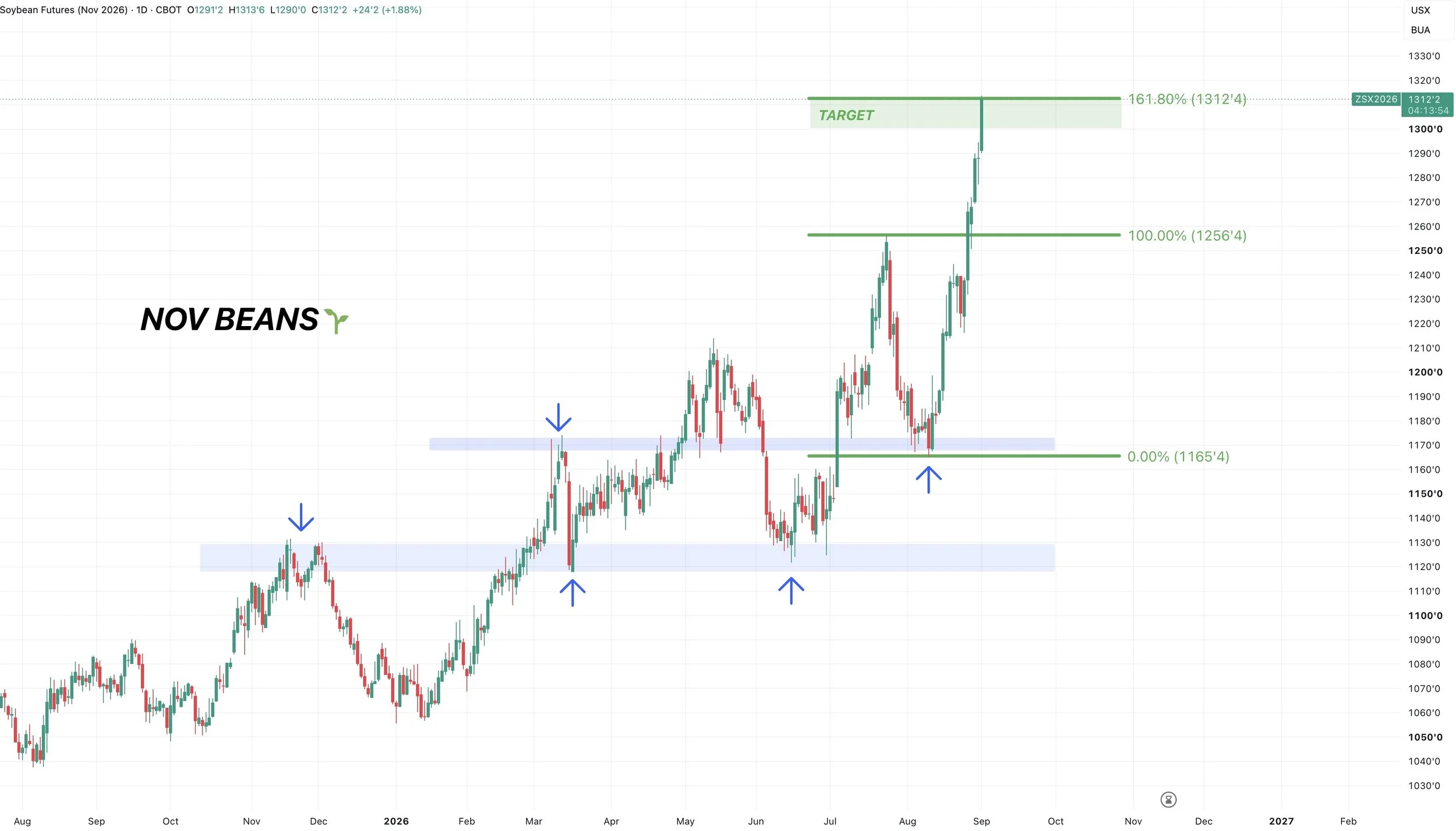
This is the first time beans are in the teens since 2023.
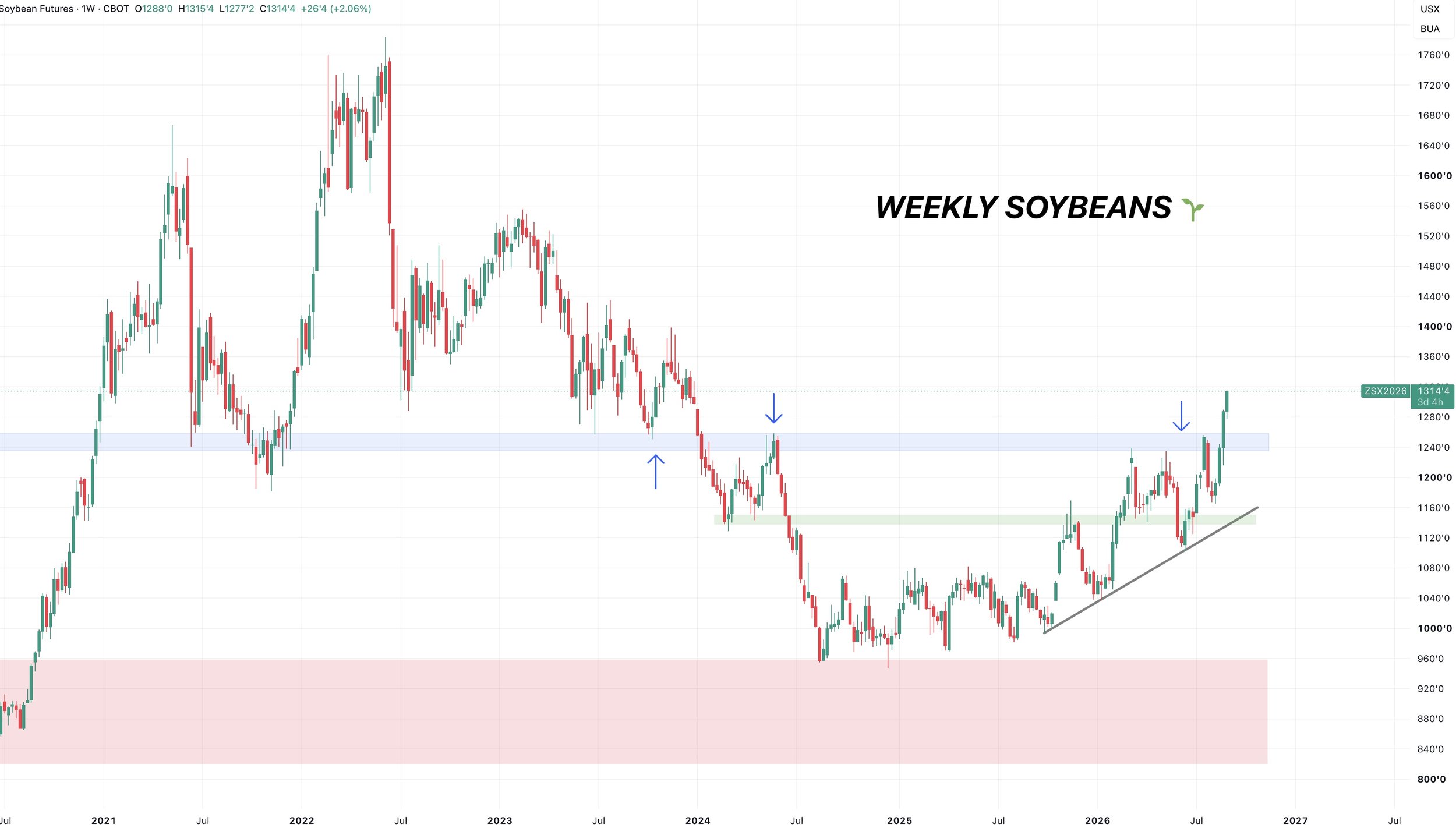
We are also starting to get pretty overextended on the indicators.
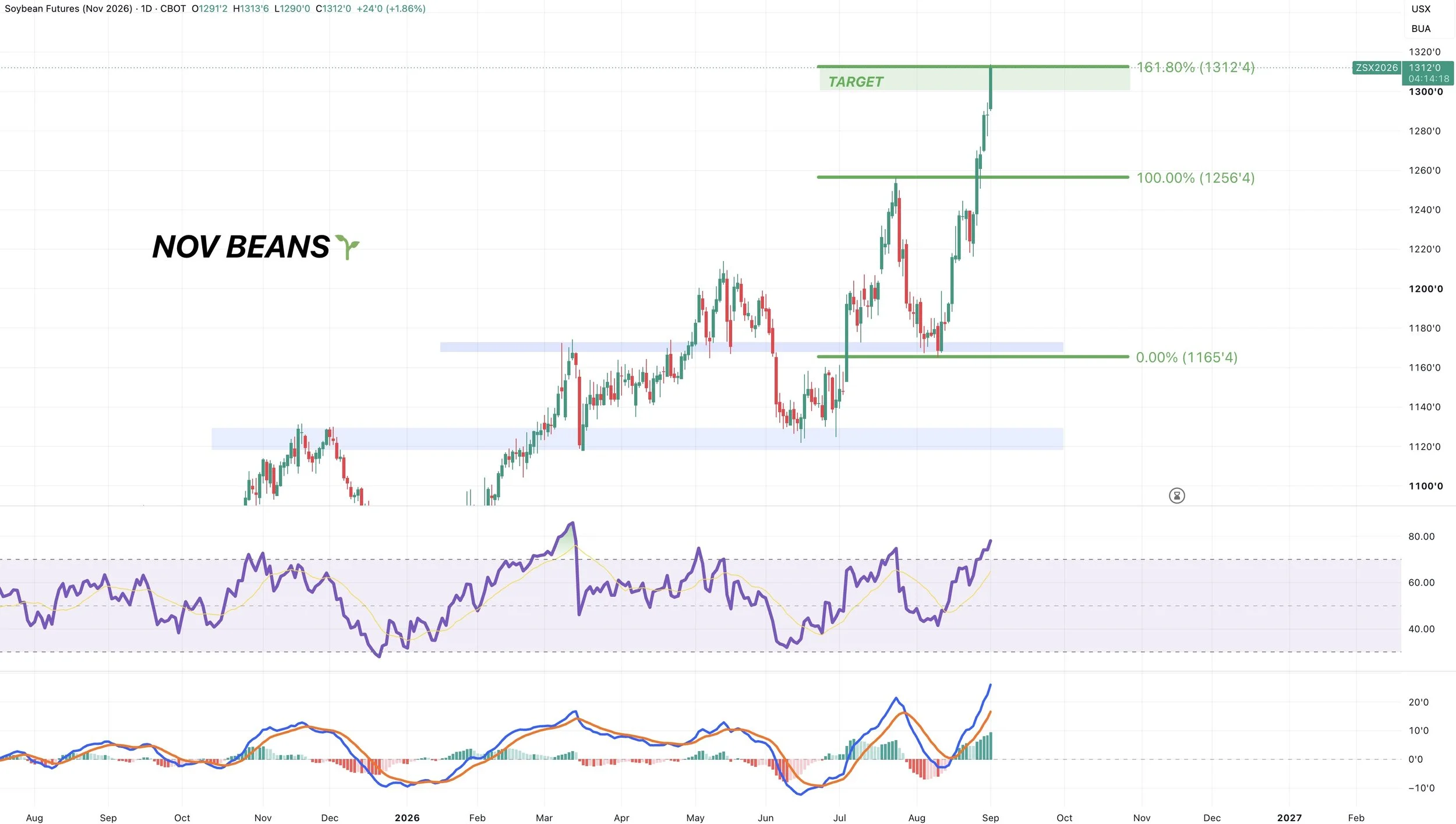
Want to Talk?
Our phones are open 24/7 for you guys if you ever need anything or want to discuss your operation.
Jeremey & Office: (806)484-1214
Sebastian: (605)280-1186
Email: sfrost@dailymarketminute.com
Hedge Account
Interested in a hedge account? Use the link below to set up an account or give us a call.
WHAT’RE THE OPPORTUNITIES IN GRAINS?
AUDIO COMMENTARY
Wheat closed +20 cents off the lows
Talk of de-escalation pressured wheat
This market will be subject to volatility
Opportunities in the spreads & options
Don’t want to be oversold here
Could get some harvest pressure eventually
What happens to prices if everything is sold?
When the natural seller is gone, prices often can go higher
The funds are getting very long
Sep USDA will be important
Defining whether to be bullish or bearish
One big year can make up for a few bear market years
Funds biggest buyers since 2012
In 2012 we topped on USDA report
Use the high implied volatility
Getting paid to have offers out there & store
The boat is heaviest before it flips
Do and don’t strategies
History doesn’t repeat but it often rhymes
Listen to today’s audio below
Your free trial recently ended
Our Labor Day sale ends this weekend
Keep access to our updates + alerts
Want to Talk?
Our phones are open 24/7 for you guys if you ever need anything or want to discuss your operation.
Jeremey & Office: (806)484-1214
Sebastian: (605)280-1186
Email: sfrost@dailymarketminute.com
Hedge Account
Interested in a hedge account? Use the link below to set up an account or give us a call.
BIG MONEY BETTING ON 2022 REPEAT?
AUDIO COMMENTARY
New highs in everything today
Wheat leads the way higher
Peace talks in Russia at dead end
Implied volatility has gone through the roof
Options market betting on 2022 wheat potential
Huge opportunity in options right now
People jumping on bullish bandwagon
Best August ever for Dec corn
Lot of comparisons to 2010 and 2020
Sky is limit but there are unknown risks
Major Sep USDA report coming soon
Have your finger on the trigger for stuff that needs to be moved by the end of the year
Getting close to corn & bean target levels
Don’t be surprised if we are down hard one of these days
What’ll cause buyers to stop buying the dip?
If you are underwater on sales
How are you reacting?
What strategies might fit you?
Could see Dec-26 start to invert on Dec-27
Should you be patient or aggressive?
Keep a couple bullets left to fire
That potential we’ve been talking about for a very long time is starting to unfold
Today’s wheat alert. KC hit target (chart below)*
Listen to today’s audio below
Want to talk?
Office: (806)484-1214
KC WHEAT CHART
Dec KC Wheat Chart 🌾
This was the main reason we issued the sell signal & hedge alert today.
We hit our first target in KC wheat.
$8.50 was the implied move from this cup and handle pattern we’ve been talking about for the last several weeks.
Not only that but it was the golden fib. The 161.8% retracement from the June lows up to the May highs.
We of course don’t have to stop here, but it’s a good area to do something. As we are now +$2.20 off the lows from June.
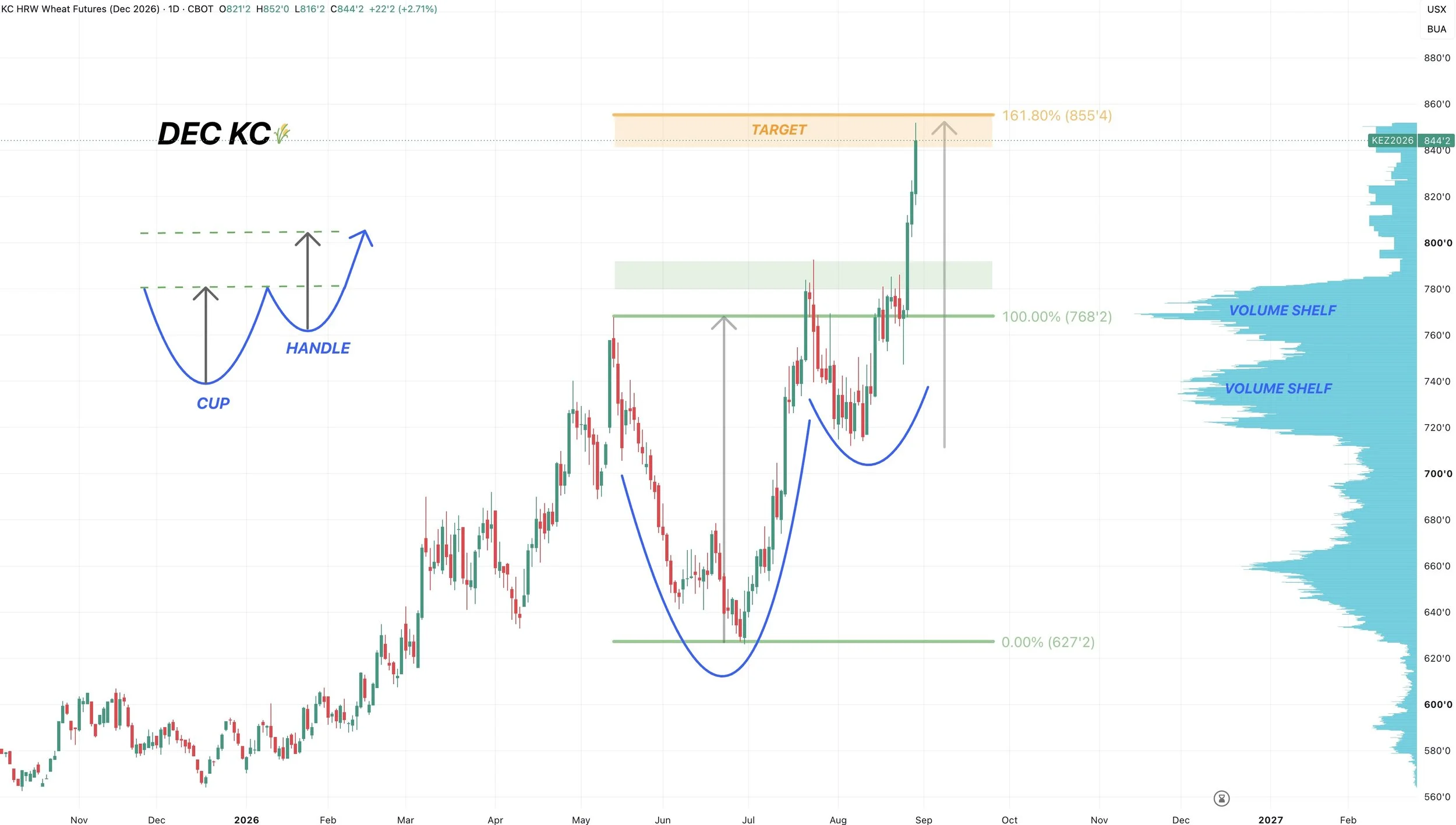
One other thing to note is that we do have some slight bearish divergence on the RSI as well.
Prices clearly made new highs, but the RSI has not made new highs vs the July highs.
This of course does not mean wheat cannot keep pushing. Because it can. But given this along with hitting the target is enough of a reason to be considering managing some risk up here at multi-year highs.
Wheat was trading under $5.00 last fall. It’s at $8.50 now.
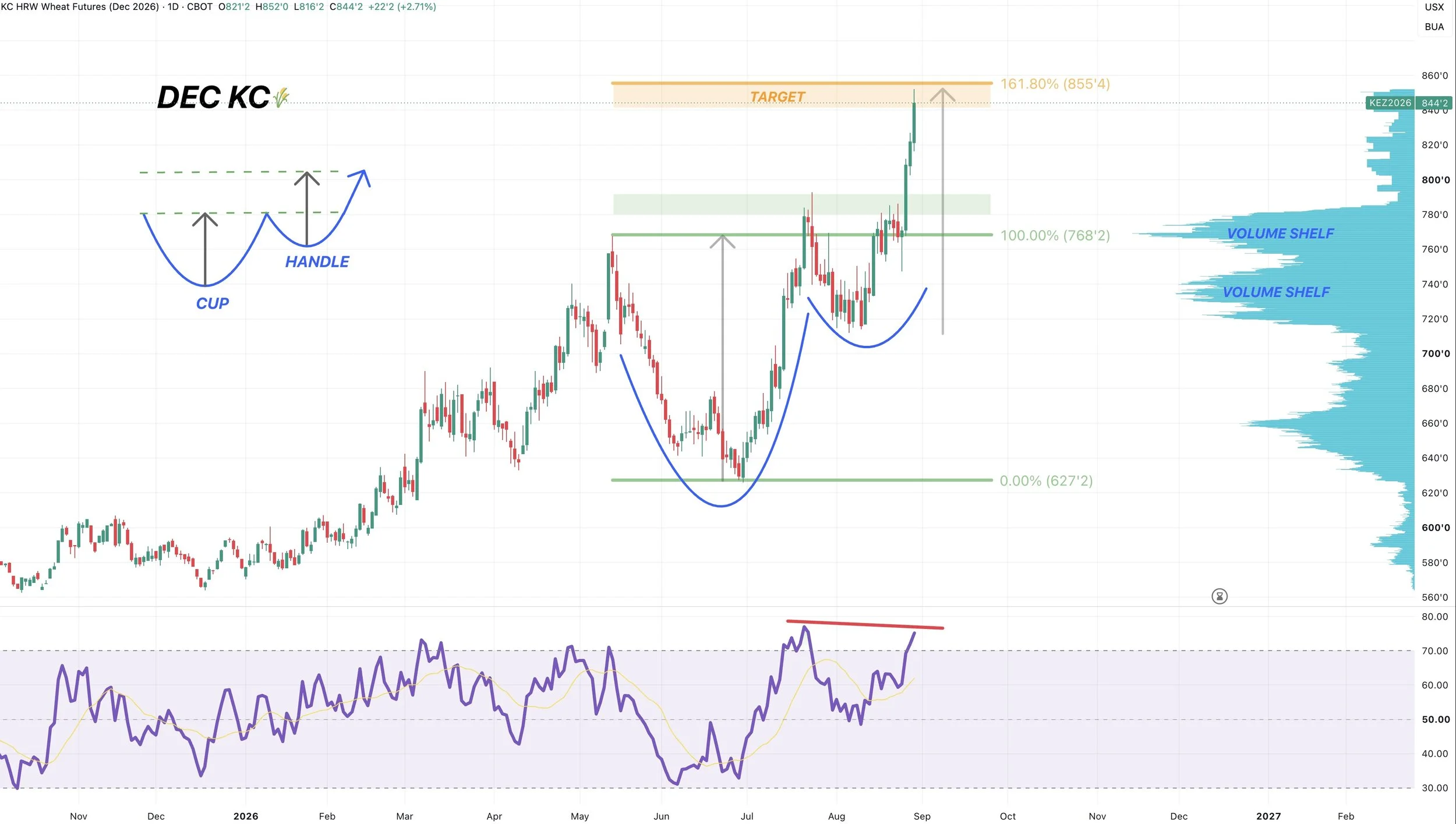
Want to Talk?
Our phones are open 24/7 for you guys if you ever need anything or want to discuss your operation.
Jeremey & Office: (806)484-1214
Sebastian: (605)280-1186
Email: sfrost@dailymarketminute.com
Hedge Account
Interested in a hedge account? Use the link below to set up an account or give us a call.
KC WHEAT SELL & HEDGE ALERT
Your free trial recently ended
Don’t miss future alerts or updates. Take advantage of our Labor Day sale
Disclaimer: there is risk of loss trading futures and options. Past performance does not necessarily indicate future results. This is our opinion and should be treated as such.
We think grains as a whole have plenty of potential, but we feel this is a good area to manage your risk in the wheat market.
There are plenty of routes you could take, whether you are simply making an incremental cash sale here. Or if you are using options to cover your downside risk.
One thing we like doing is selling the increased implied volatility. As the market is giving you a good opportunity to collect that high premium and essentially having an offer to sell your wheat a lot higher if it gets there. Keep in mind selling options does require margin.
As an example:
$11.00 Dec KC wheat calls are 16 cents
$13.00 Dec KC wheat calls are about 7 cents
Below are some hedge & re-ownership strategies we like based on whether you are making a sale and want to keep your upside open, or if you want downside protection for unsold wheat:
1) If you do not want to make a sale: downside protection strategy
Sell $9.50 call
Buy $8.20 to $7.20 put spread
This gives you a floor of $1.00 under $8.20. With the potential to sell $1.00 above the market
Cost is about even money
2) If you made a sale and want to keep your upside open: re-ownership strategy
Sell cash wheat and re-own
Buy $9.50 to $11.00 call spread
Sell $7.50 put
Cost is about even money
If you have questions or want to talk through your specific situation and put together a strategy please feel free to reach out to us anytime.
Office: (806)484-1214
Those of you with spring wheat, you could consider cross hedging with KC wheat. For more info on this give us a call.
Reason for Alert: KC Target Hit
Dec KC Wheat 🌾
KC has hit our first target of $8.50
That is the implied move from this cup and handle pattern we broke out of that we have been talking about for the last several weeks.
The $8.55 level is also the golden fib and 161.8% retracement from the July lows up to the May highs.
We of course don’t have to stop here, but it’s a good area to do something. As we are now +$2.20 off the lows from July.
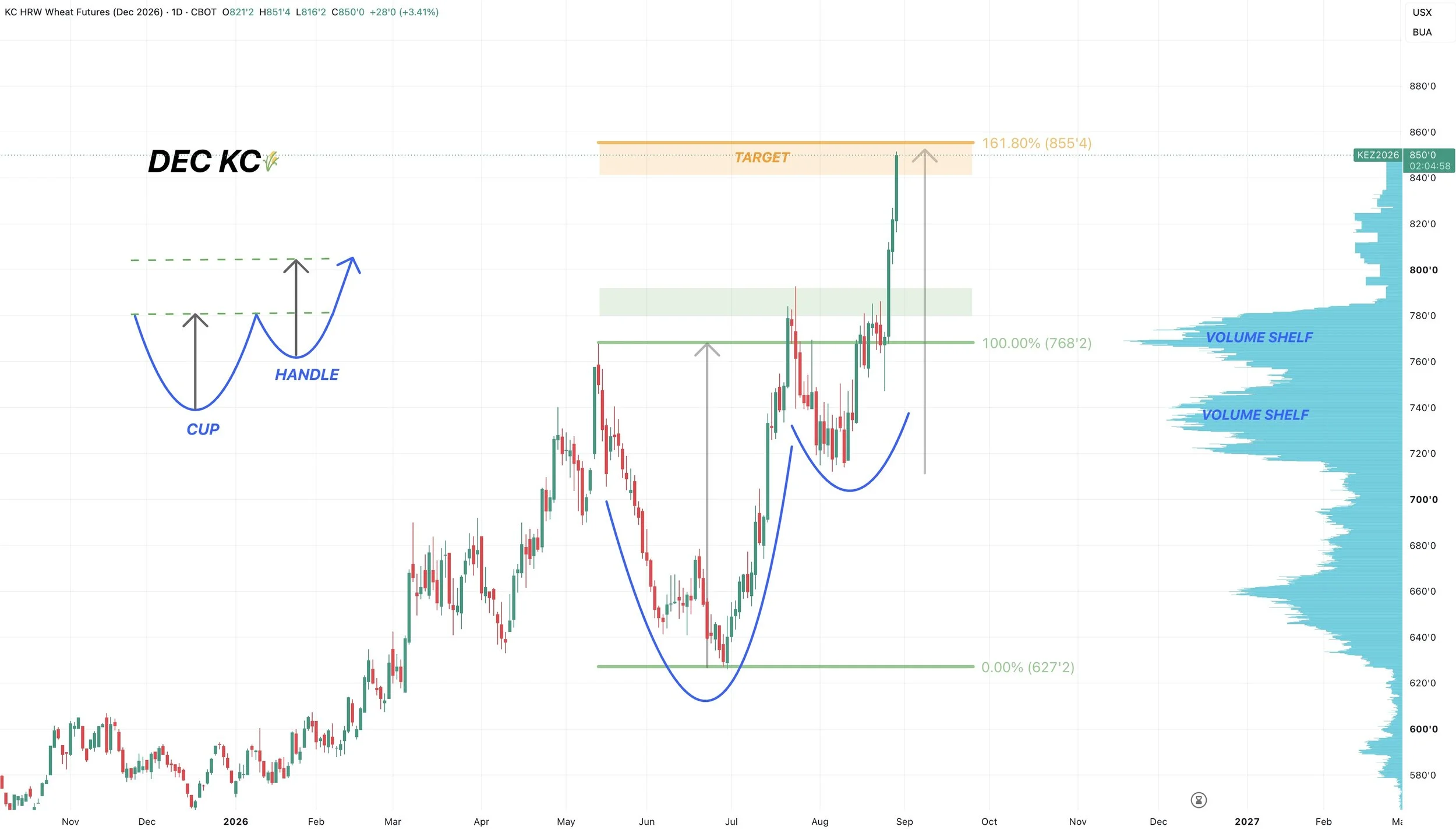
One other thing to note is that we do have some slight bearish divergence on the RSI as well.
Prices clearly made new highs, but the RSI has not made new highs vs the July highs.
This of course does not mean wheat cannot keep pushing. Because it can. But given this along with hitting the target is enough of a reason to be considering managing some risk up here at multi-year highs.
Wheat was trading under $5.00 last fall. It’s at $8.50 now.
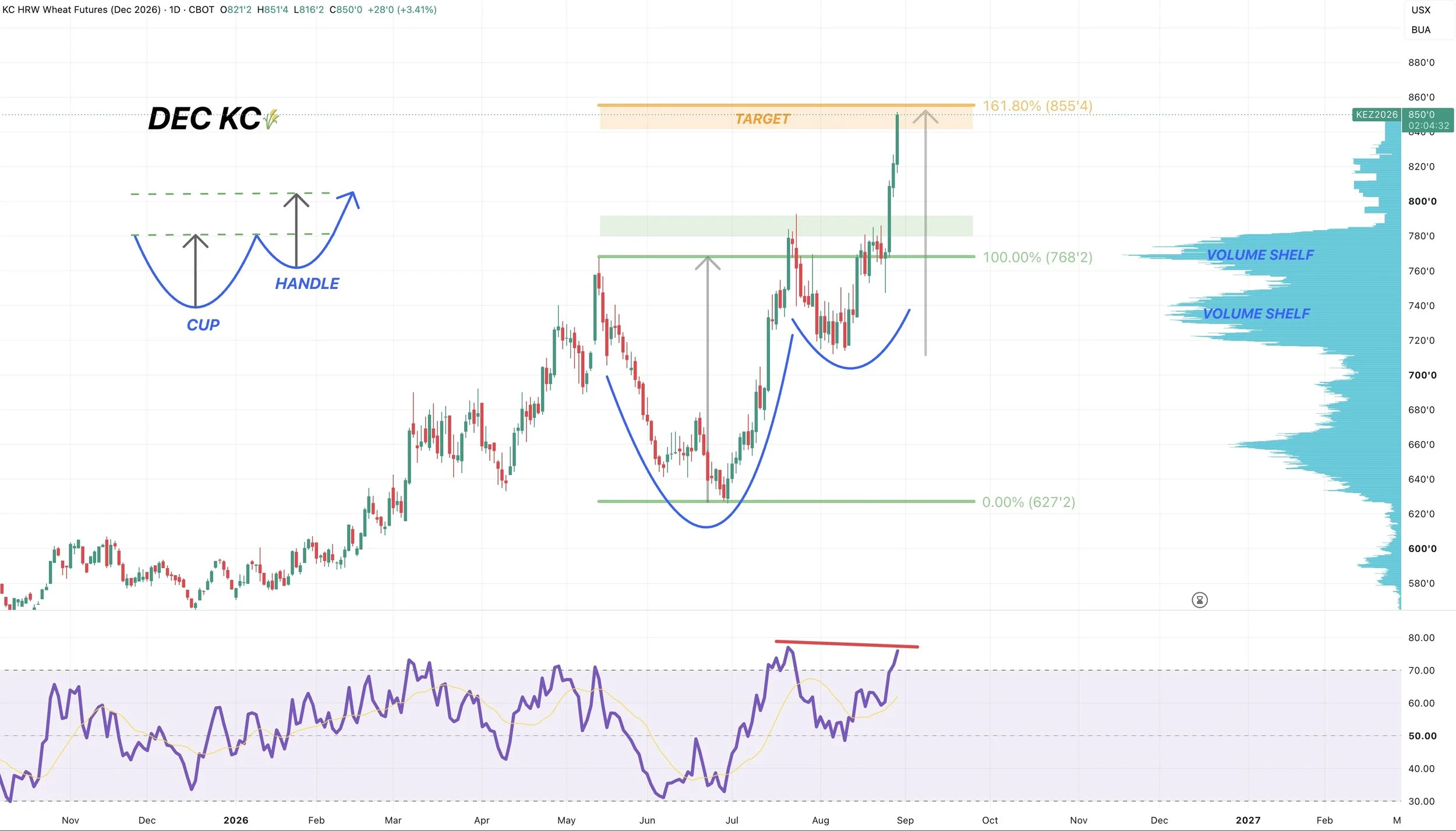
Want to Talk?
Our phones are open 24/7 for you guys if you ever need anything or want to discuss your operation.
Jeremey & Office: (806)484-1214
Sebastian: (605)280-1186
Email: sfrost@dailymarketminute.com
Hedge Account
Interested in a hedge account? Use the link below to set up an account or give us a call.
2026 VS 2020 VS 2010. WEEKLY BREAKOUTS?
MARKET UPDATE
You can scroll to read the usual update as well. As the written version is the exact same as the video.
Timestamps for video:
Overview: 0:00min
2010 vs 2020: 0:55min
Corn Story: 3:15min
Beans Story: 5:15min
Corn Charts: 8:15min
Bean Charts: 12:15min
Wheat Charts: 13:00min
Cattle Charts: 14:35min
Want to talk?
Office: (806)484-1214
Futures Prices Close
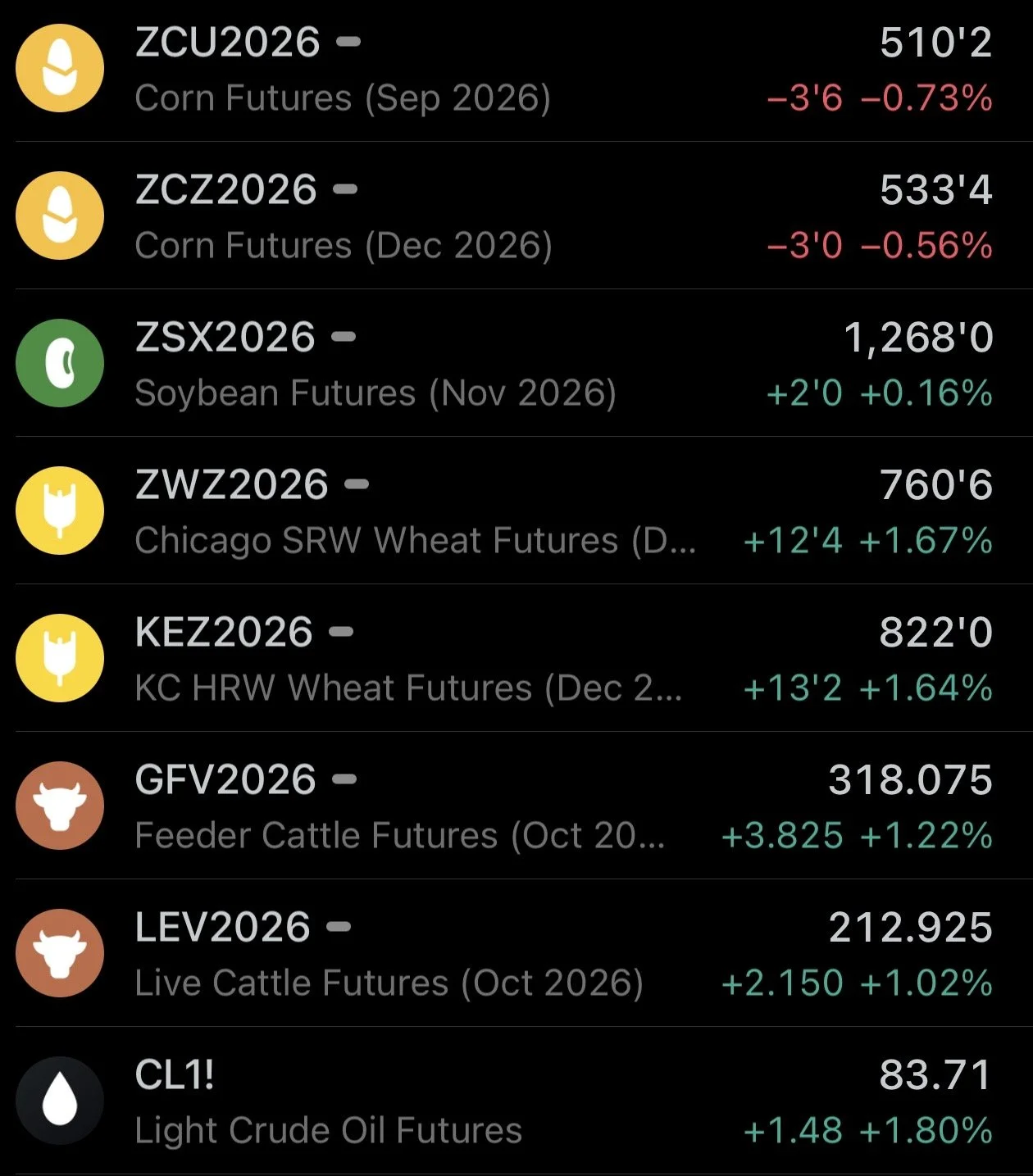
Overview
Grains mostly higher led by the wheat market following wheat's limit up day yesterday surrounding escalations over in the Black Sea.
The markets were under pressure overnight, but saw some buying and rallied well off the lows.
Soybeans were down -15 cents but ended the day higher.
Wheat was down around -6 cents but ended up double digits.
Corn was down almost -9 cents but closed down just -3 cents. Posting it's first day lower after 6 straight days of being higher.
What's going on in the Black Sea?
The Black Sea issue was never resolved as we had been talking about, as it felt like the market was under pricing the risks.
Essentially, that wheat over there still can’t move with the ports being shut down, and there is no sign of any sort of resolution.
Russia and Putin said they are preparing to further escalate attacks on Ukraine
2026 vs 2020 vs 2010
This is the main topic I want to talk about today.
Is it possible to see a repeat of 2020 or 2010?
Corn is on track to have it's strongest August of ALL-TIME.
Up +15.3% on the month.
Surpassing 2011's record.
What are the only years we saw similar strength in August?
2022, 2020, 2011, 2010
Two of those were during a bull market. 2022 and 2011.
Two of them came right before a bull market. 2020 and 2010.
Which brings me to my next point of discussion..
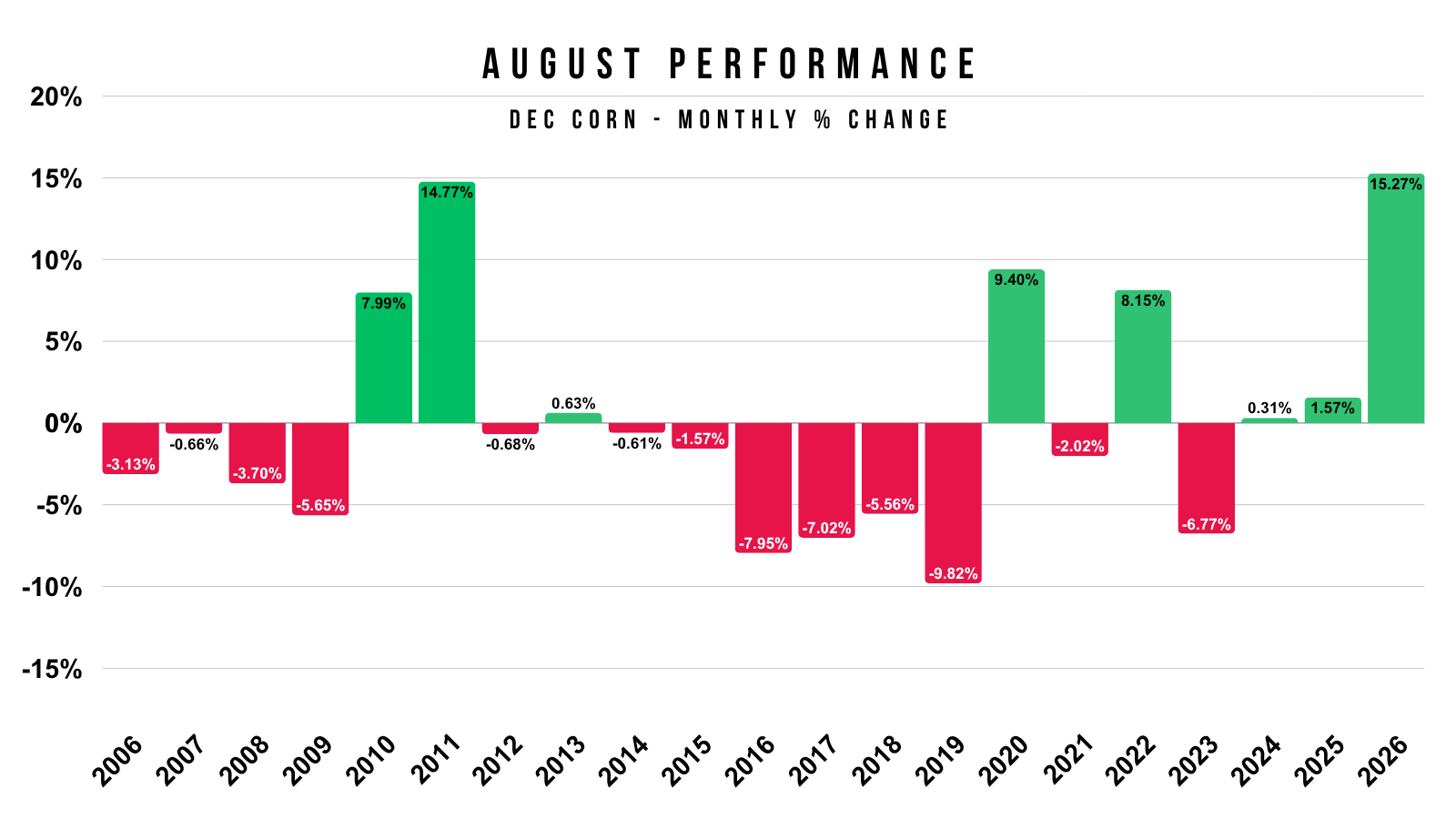
Now let's get into some other data.
I've shown this chart recently.
Corn has only posted it's highs in August or later a few times.
2011 and 2012 both topped in August. That's the only two year's we've ever seen our highs in August.
We have never seen our highs printed in September or October.
2010 and 2020's highs came in November at the end of the year. As they simply ran the rest of the year.
What happened after both 2010 and 2020?
We saw a bull market.
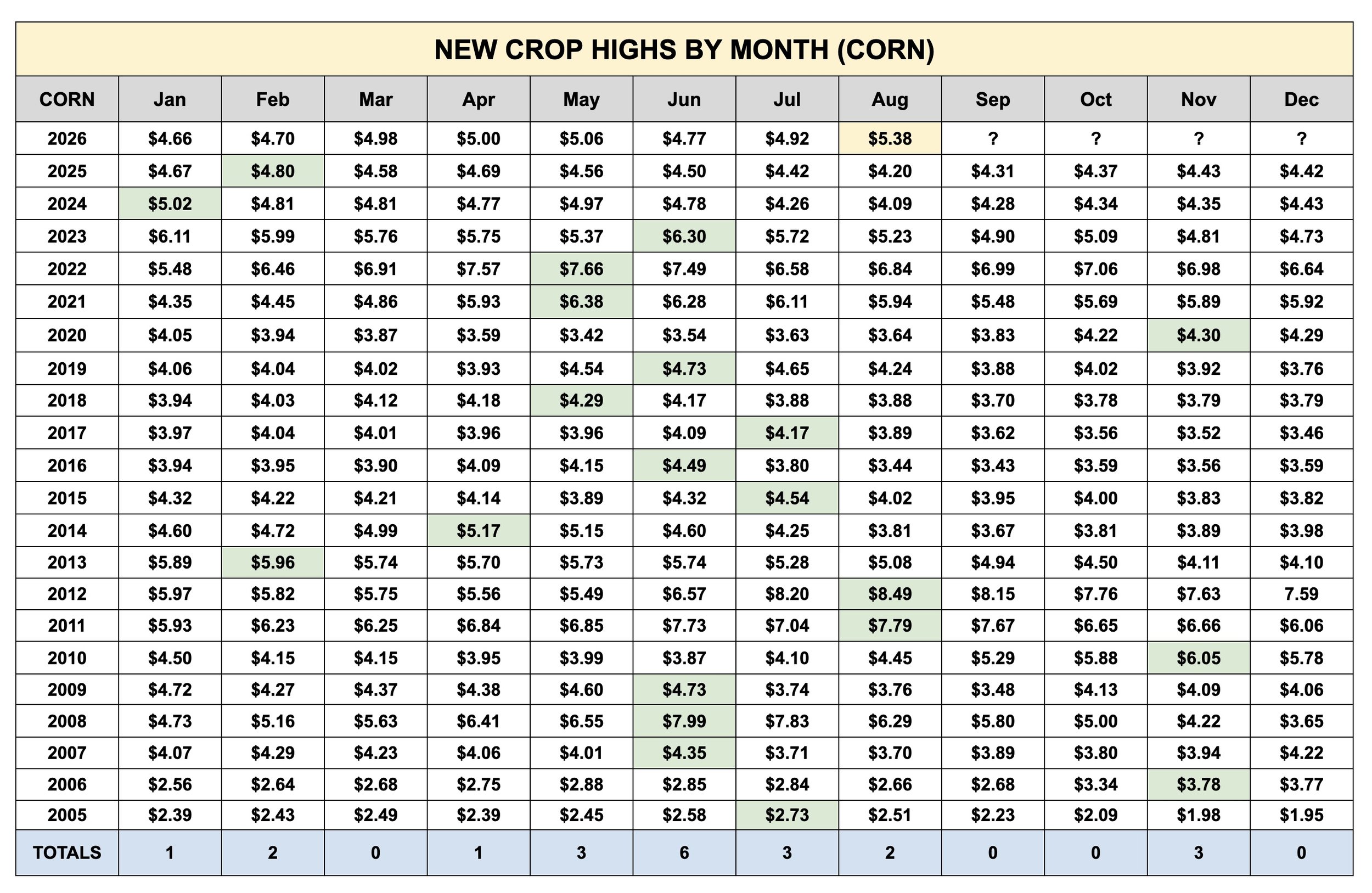
So we have four years that featured a high in August or later.
2020, 2012, 2011, and 2010.
Which year does this more closely resemble?
I'd argue this year is a lot more similar to 2010 and 2020.
In 2011 and 2012, we were already in a bull market
2020 and 2010 were in a bear market and then started the bull market.
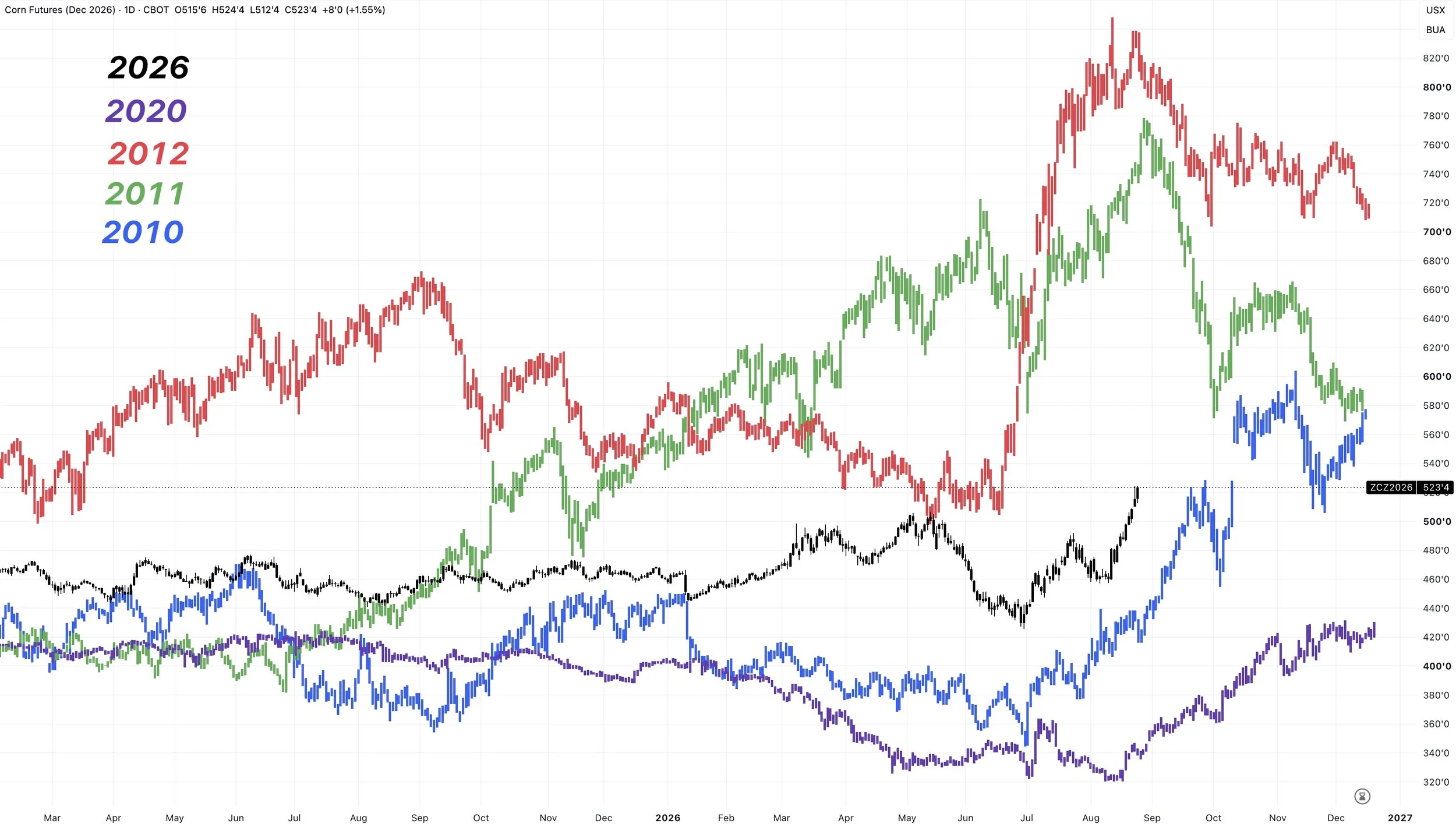
Here is chart comparision of Dec corn for 2026, 2020, and 2010.
Very similar price action.
We bottomed right around that USDA report at the end of June in all three years.
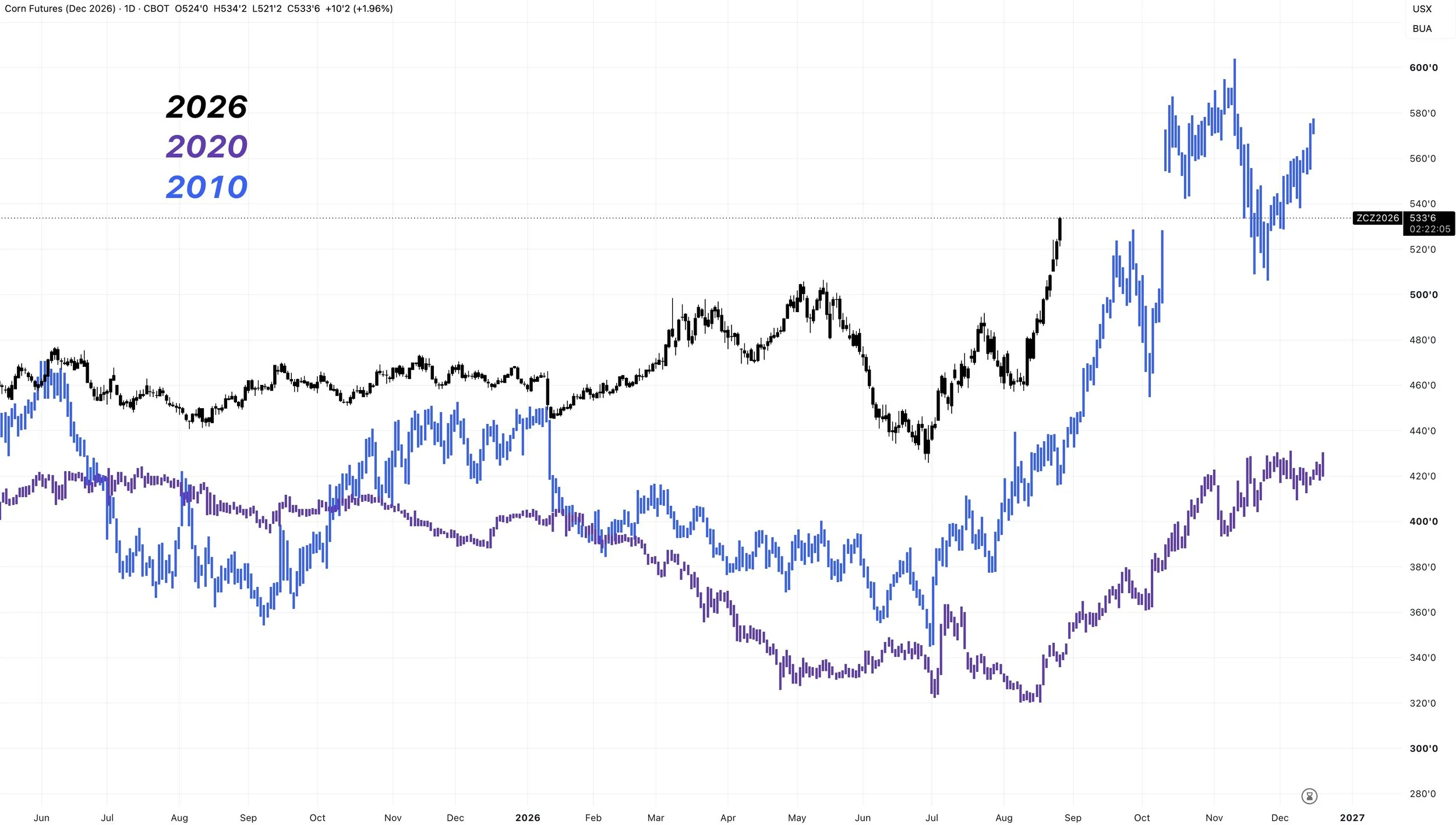
To give you a better visual representation of what happened after those years.
Here is Dec-27 vs Dec-21 and Dec-11.
Does this mean we "have" to see a repeat of 2010 or 2020? No.
But there are several friendly things going for the corn market, and definitely some similarities to those years.
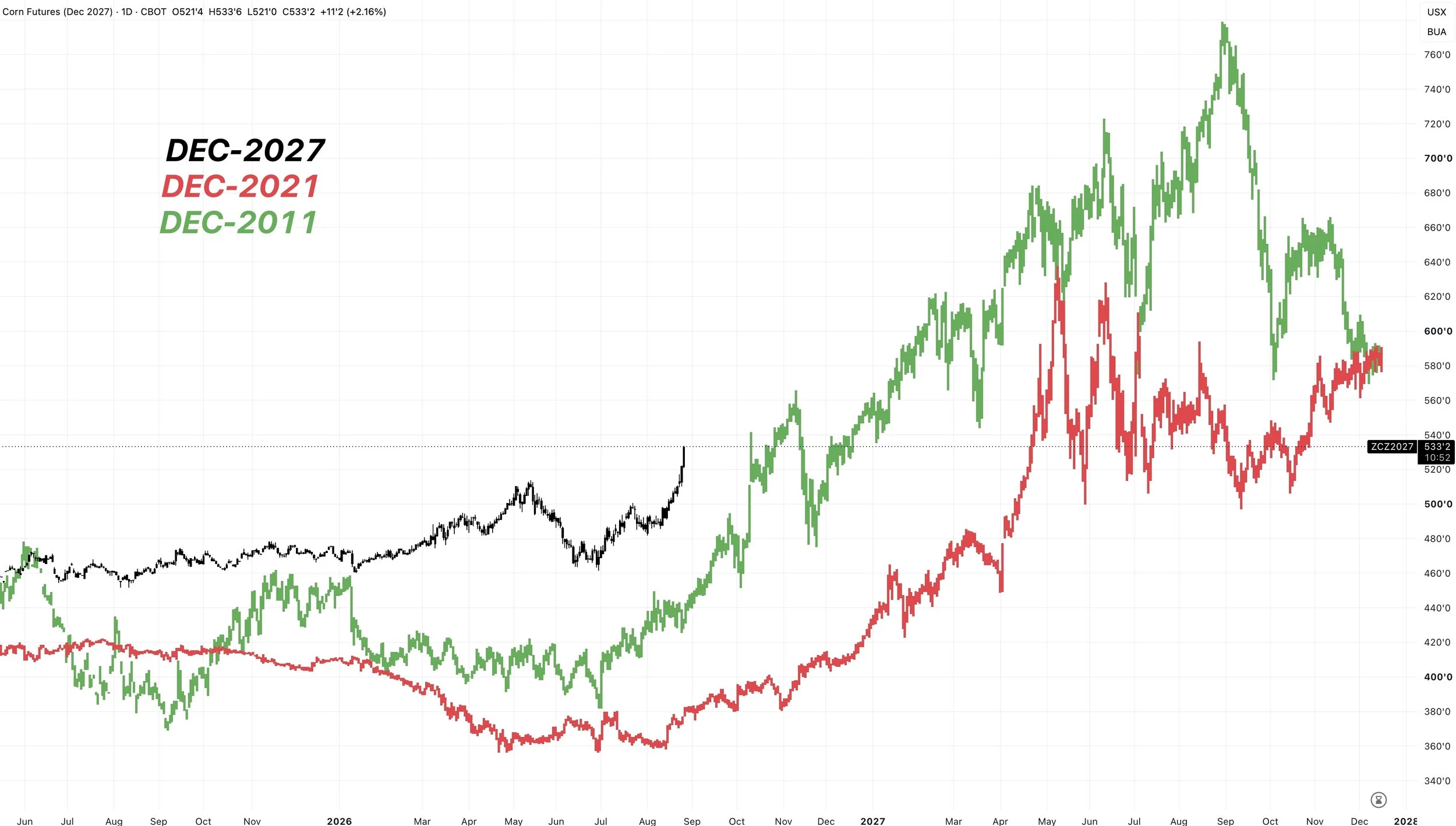
Quick Bull Cases
Fundamentally, there is plenty of potential as we've went over countless times.
We've already talked about the majority of this before, but let's go through it quick.
Corn: Bull Case
Yield:
For starters, corn simply can’t afford a sub 180 yield without the balance sheet getting awfully tight.
As it's already sitting on the verge of bullish territory at a 10% stocks to use.
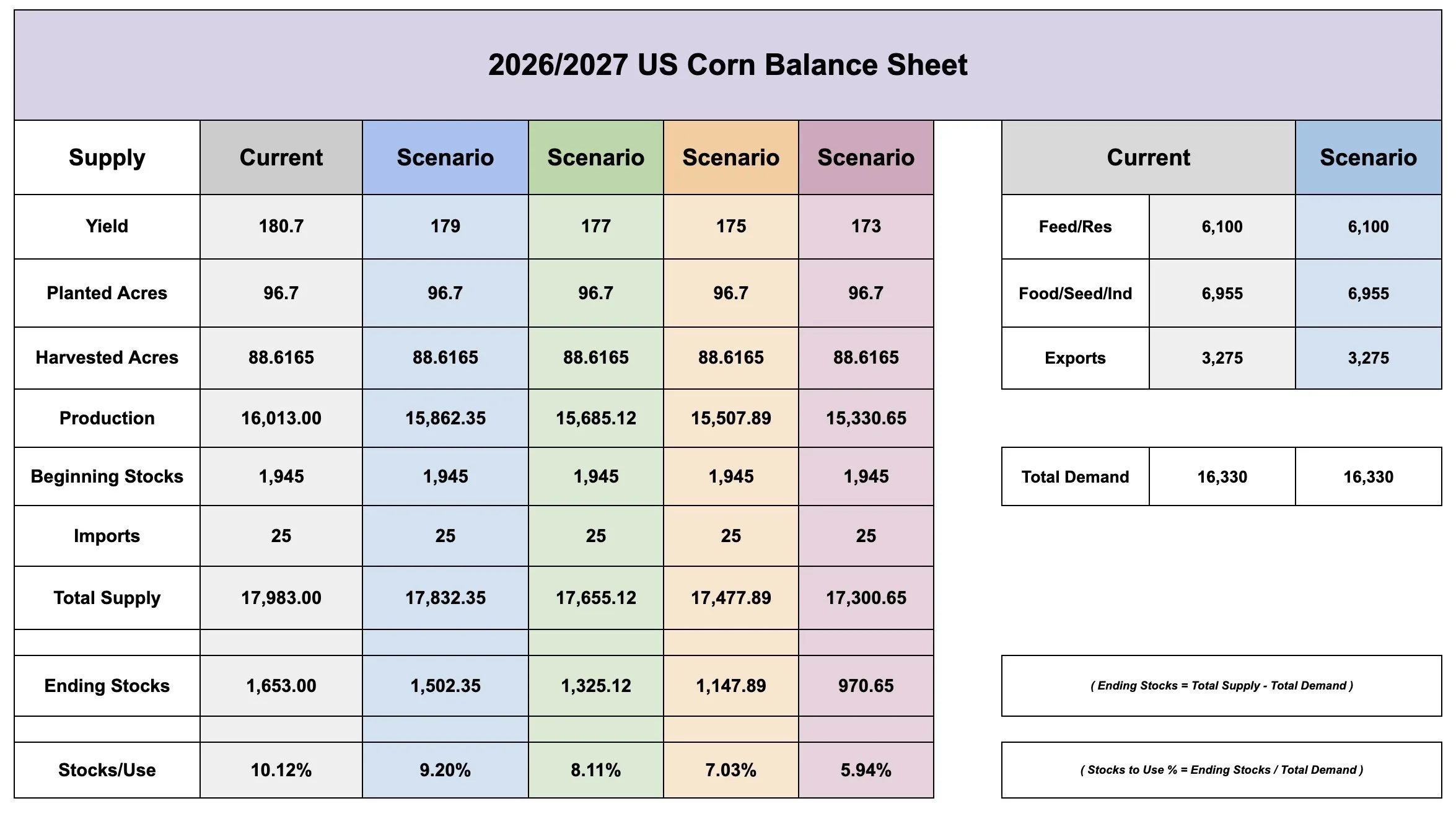
Stocks to Use:
Anything in that 8-9% range is usually associated with a lot higher prices.
What if the stocks use stays around 10%?
Well then corn is probably fairly priced around this $5.00 or so range. Take 2024/25 as an example.
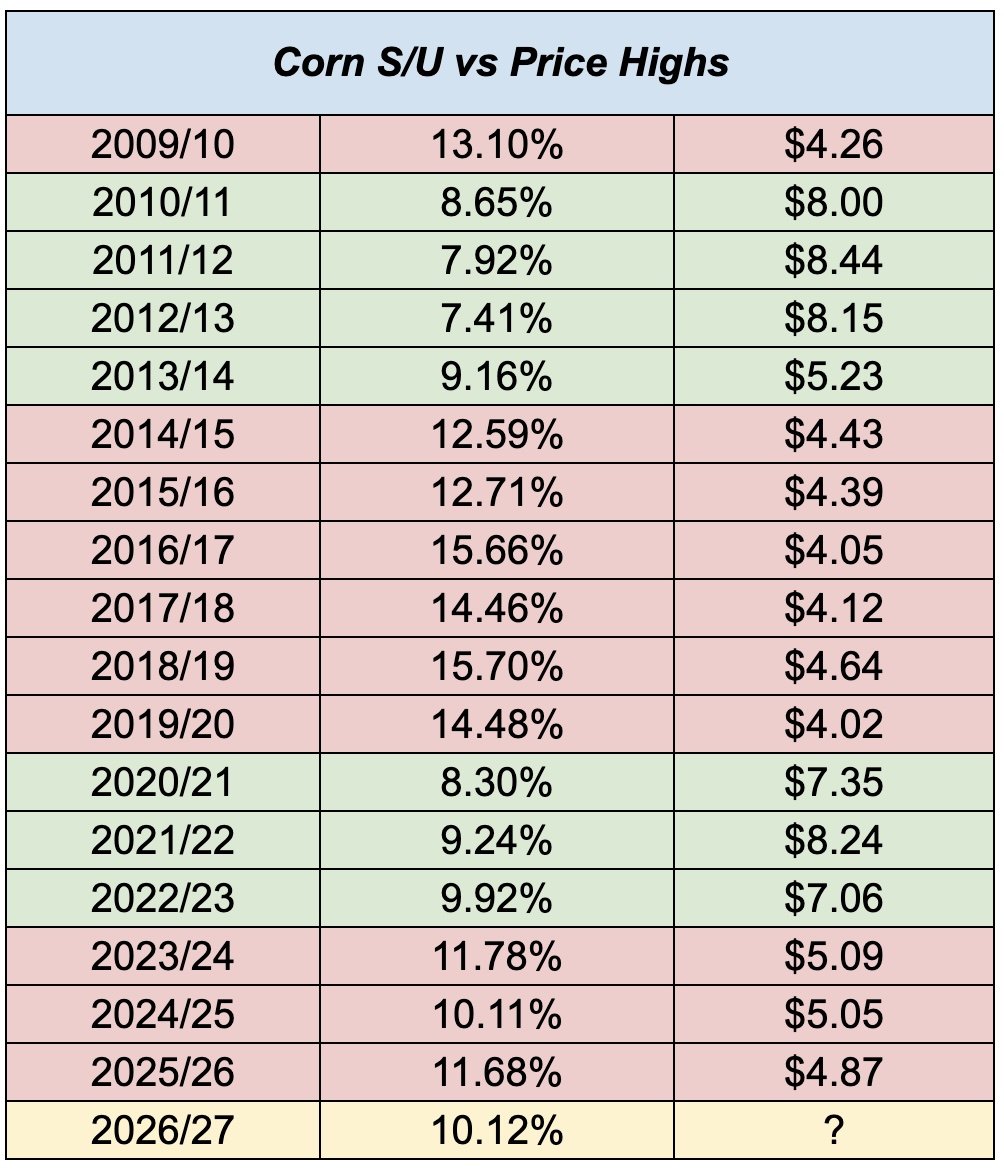
Pro Farmer vs USDA:
We went over this earlier this week, but if you look at the history of the Pro Farmer and USDA data correlation, it would suggest yield is lower.
Pro Farmer has correctly predicted where yield went from August to the final in the last 10 of 12 years.
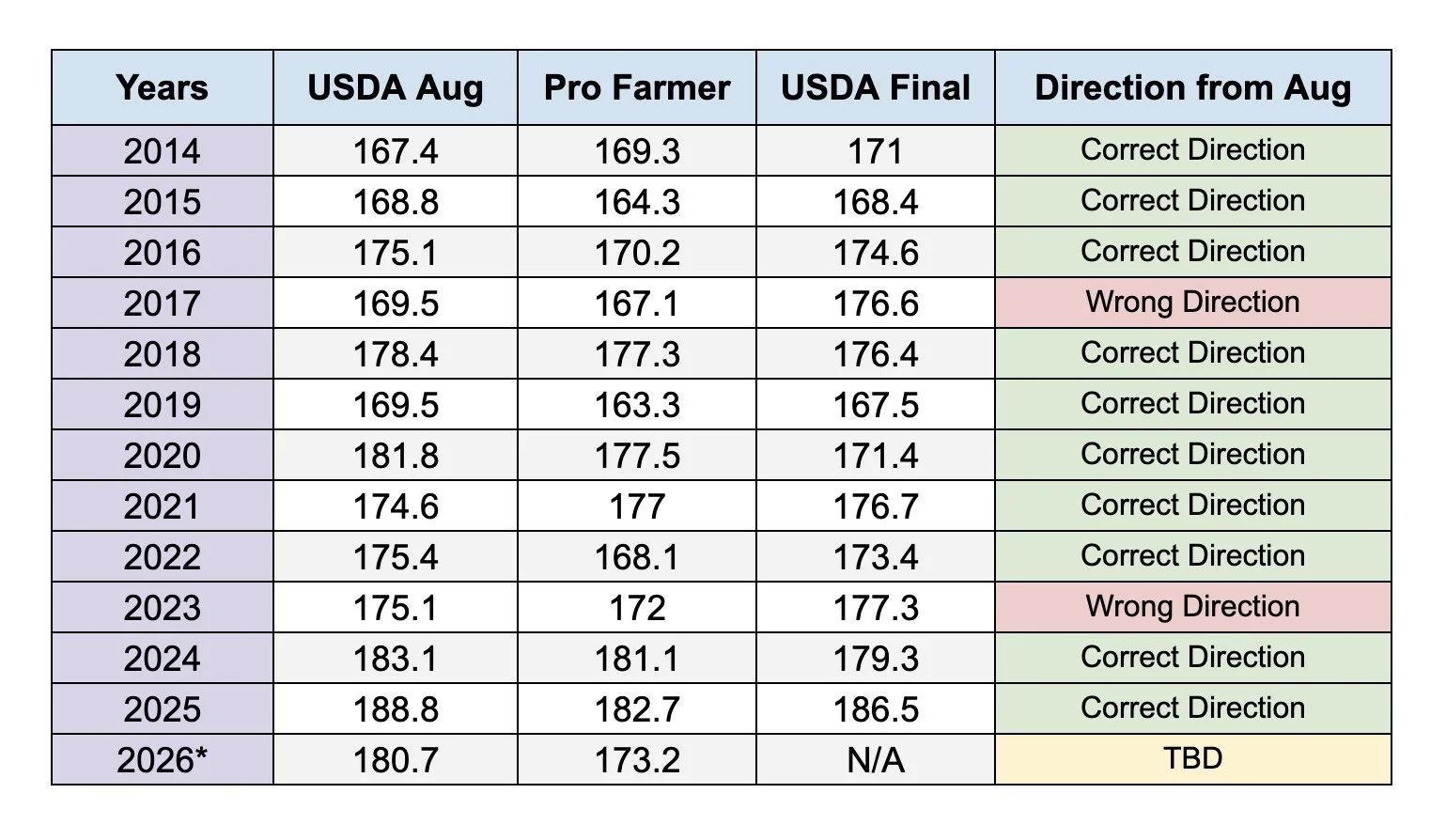
Pro Farmer's 173 yield was -7.5 bpa below the USDA's August estimate of 180.7
That would be the largest difference between the two ever.
We've only seen the tour come in 5 bpa below the USDA in three years.
2019, 2022, and 2025.
In all three of those years, the USDA lowered yield from August by at least -2 bpa.
Based on all of the data, it would suggest a yield lower than the USDA but not quiet as low as Pro Farmer.
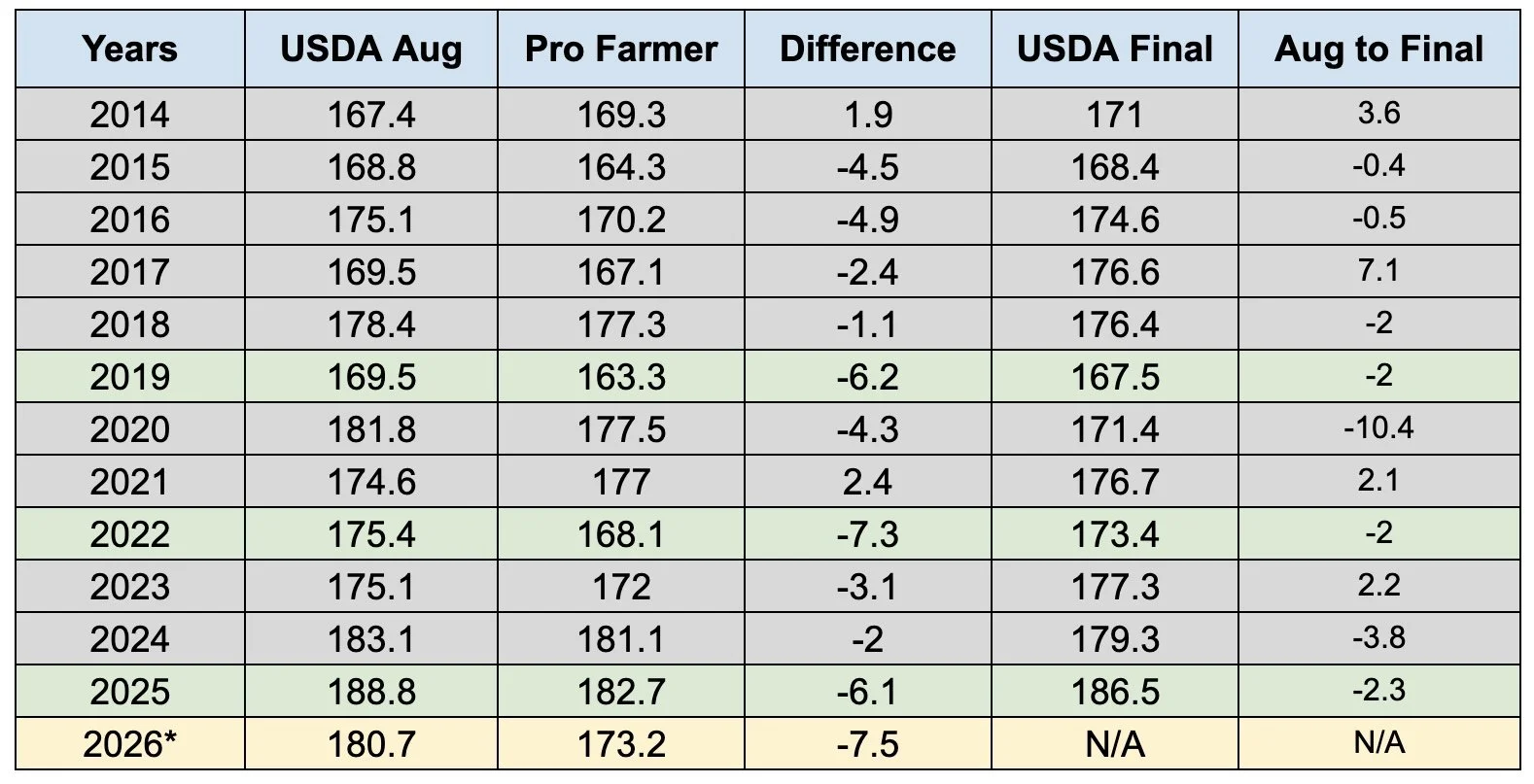
Here is another good way to look at it.
This chart shows the USDA's final yield deviation from trend along with how Pro Farmer's yield deviated from the USDA's trend.
Pro Farmer tends to get the direction right, but tend to slightly over shoot things to the downside.
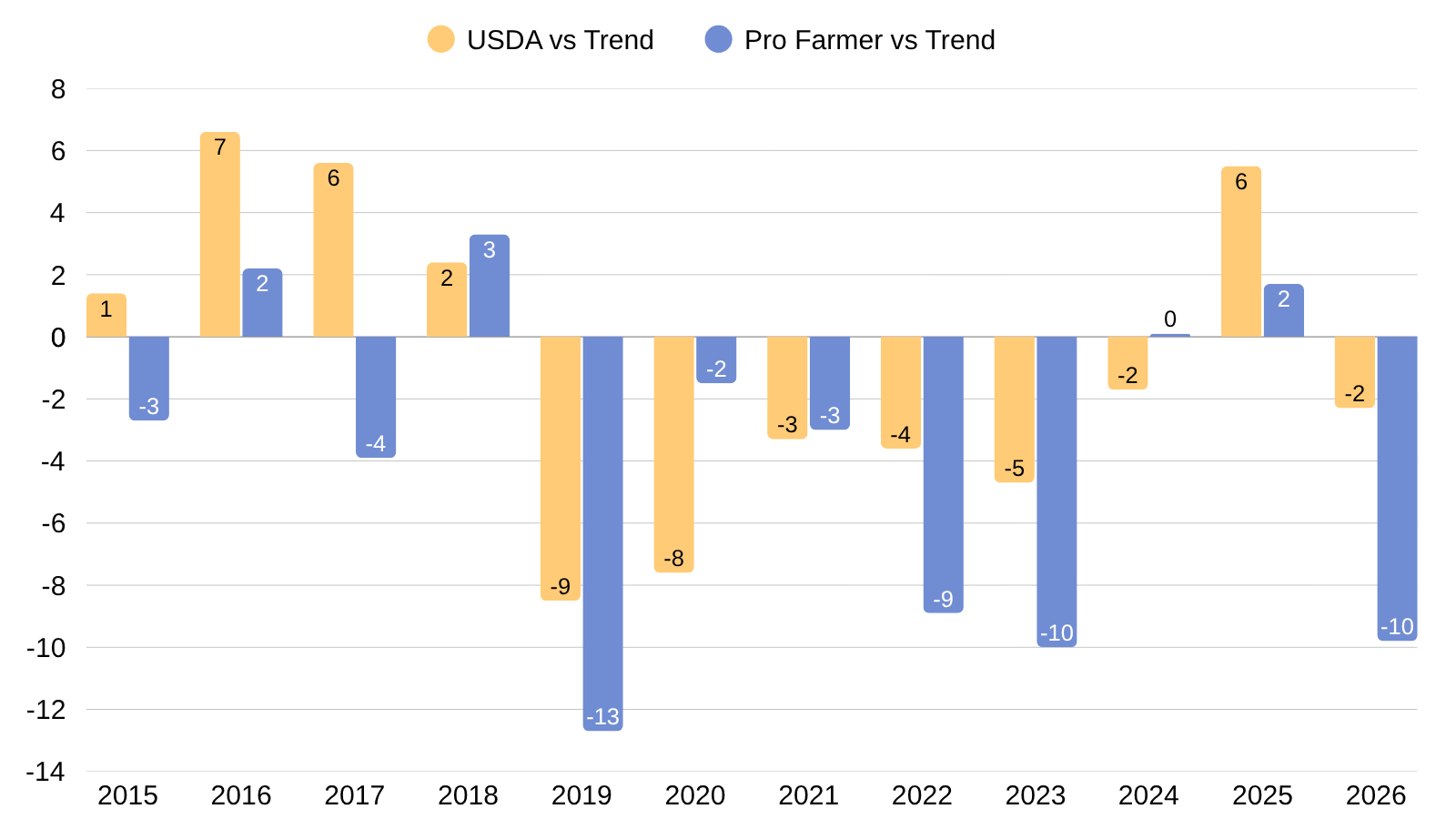
Soybeans Bull Case:
Soybeans had recently been lagging corn due to some biofuel headlines as well as the ideas about the crop being big.
We've already talked about most of these possibilities before, so again, there isn’t much new here. It's the same stuff we've talked about before.
Brazil:
Brazil has consistently been pumping out record crop after record crop.
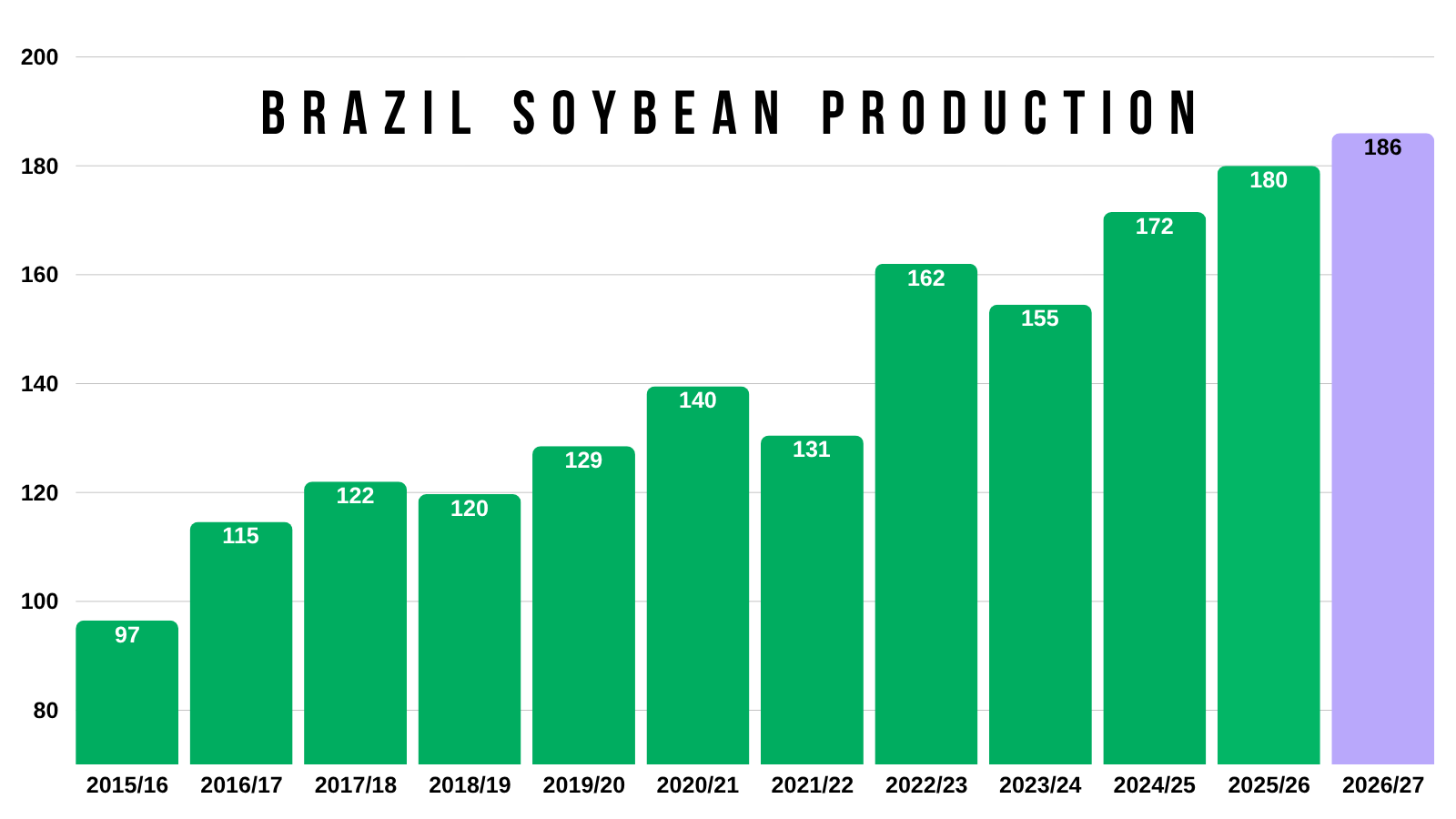
Tight World Story:
Yet.. that's not enough to add to the world balance sheet.
It continues to shrink. Despite a projected big crop in the US and the record crops in Brazil.
That's not bearish.
The world situation has a very high correlation to soybean prices.
Prime Examples:
2012: Low S/U and high prices
2019: High S/U and low prices
2022: Low S/U and high prices
2025 has the highest S/U since 2019, as a result we saw the lowest prices since then.
That S/U has now been consistently getting tighter the last few years.
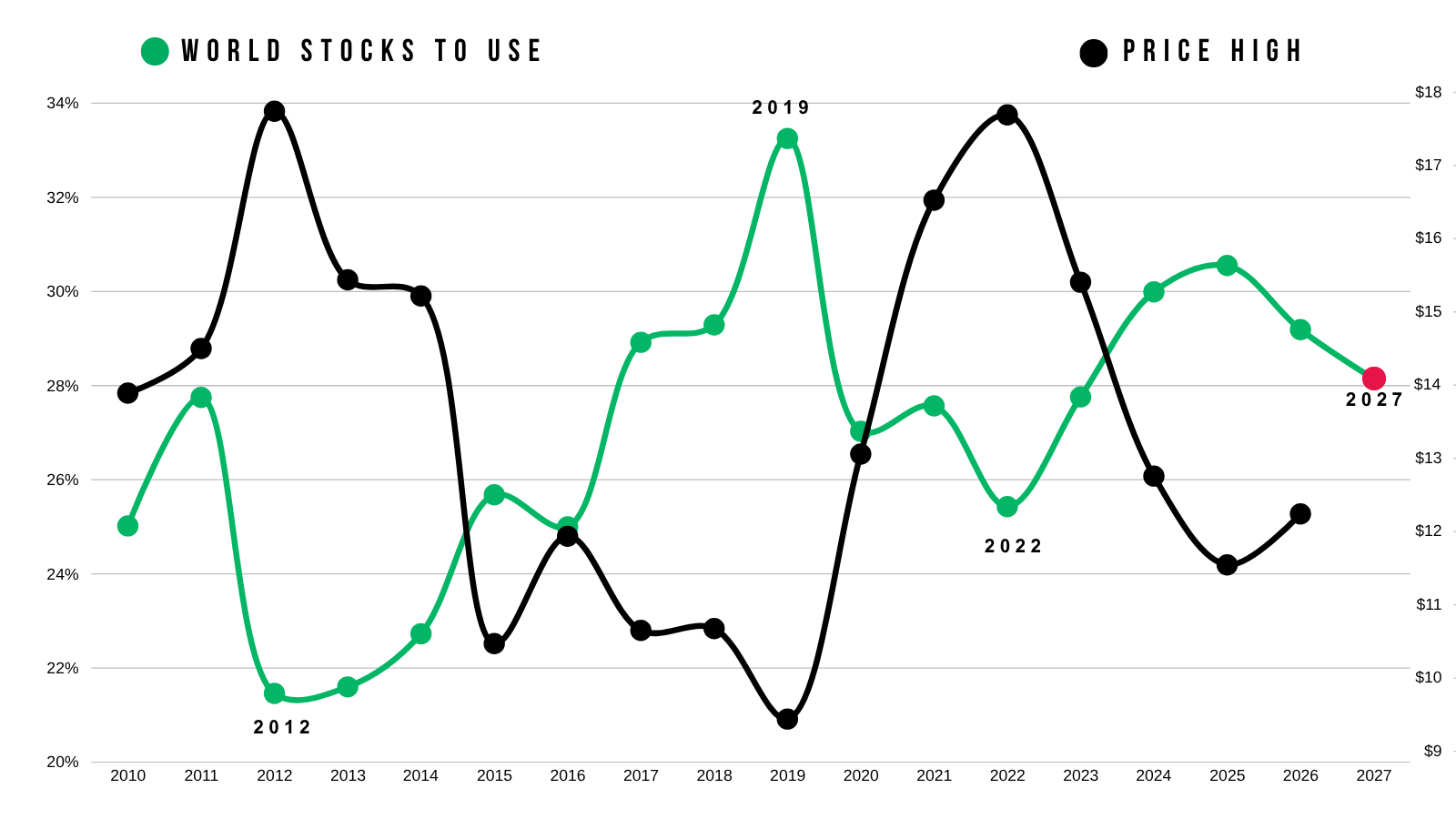
Super El Nino:
They say we have the strongest Super El Nino of all-time coming.
This has historically led to Brazil being dry during October to March.
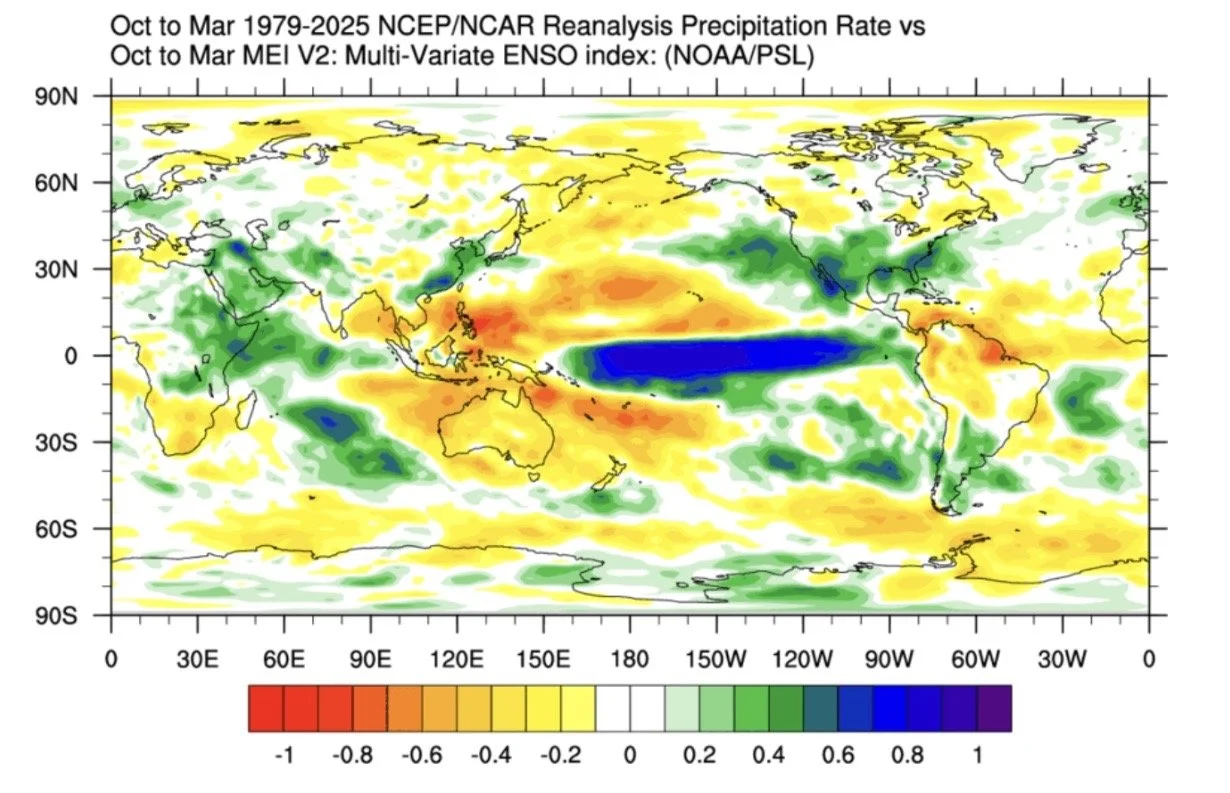
Great Demand:
Crush demand remains at a record.
It's not going anywhere.
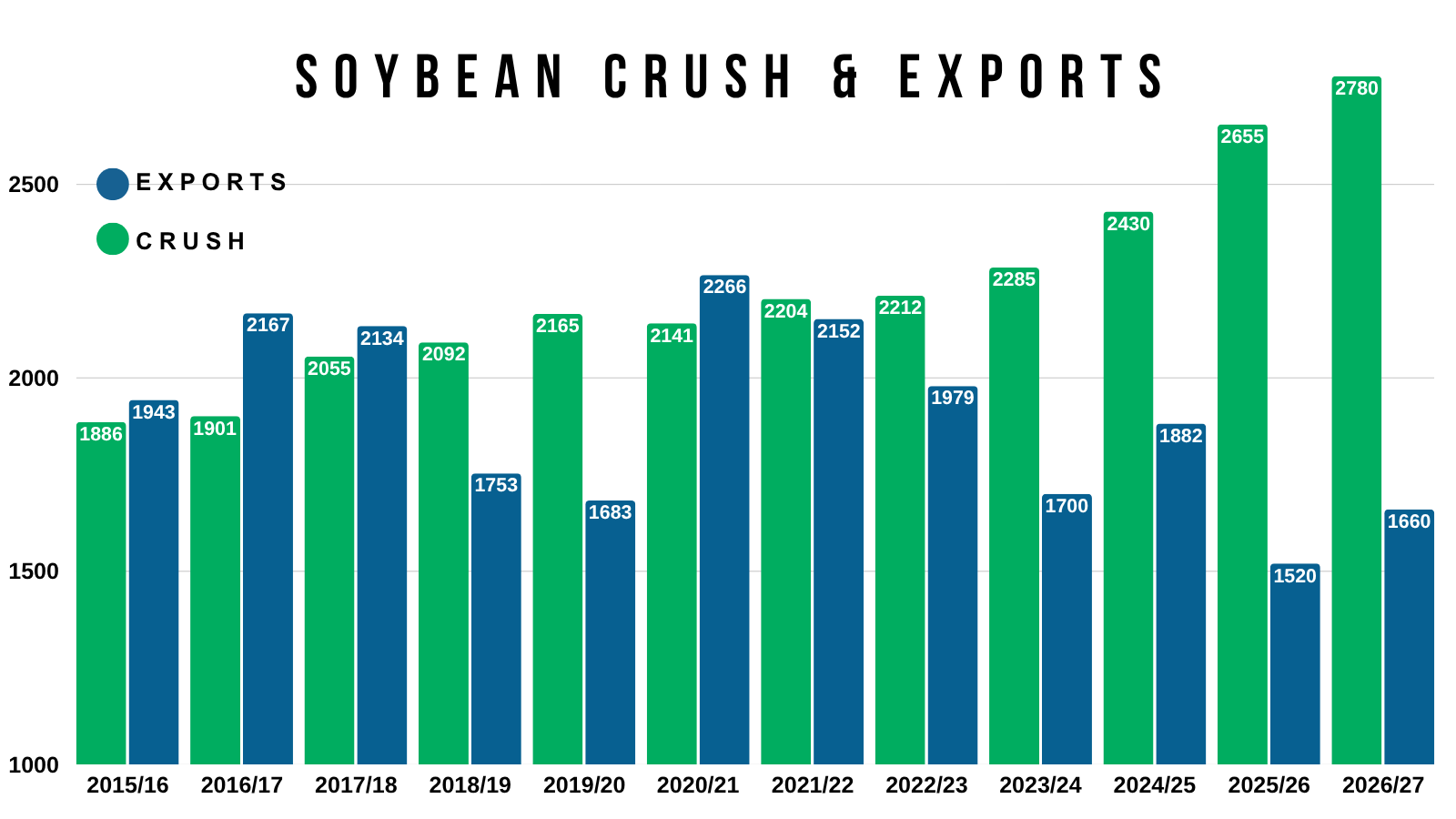
There is a reason our domestic demand is the best it's ever been despite relative low expectations for exports.
Because crush is that strong.
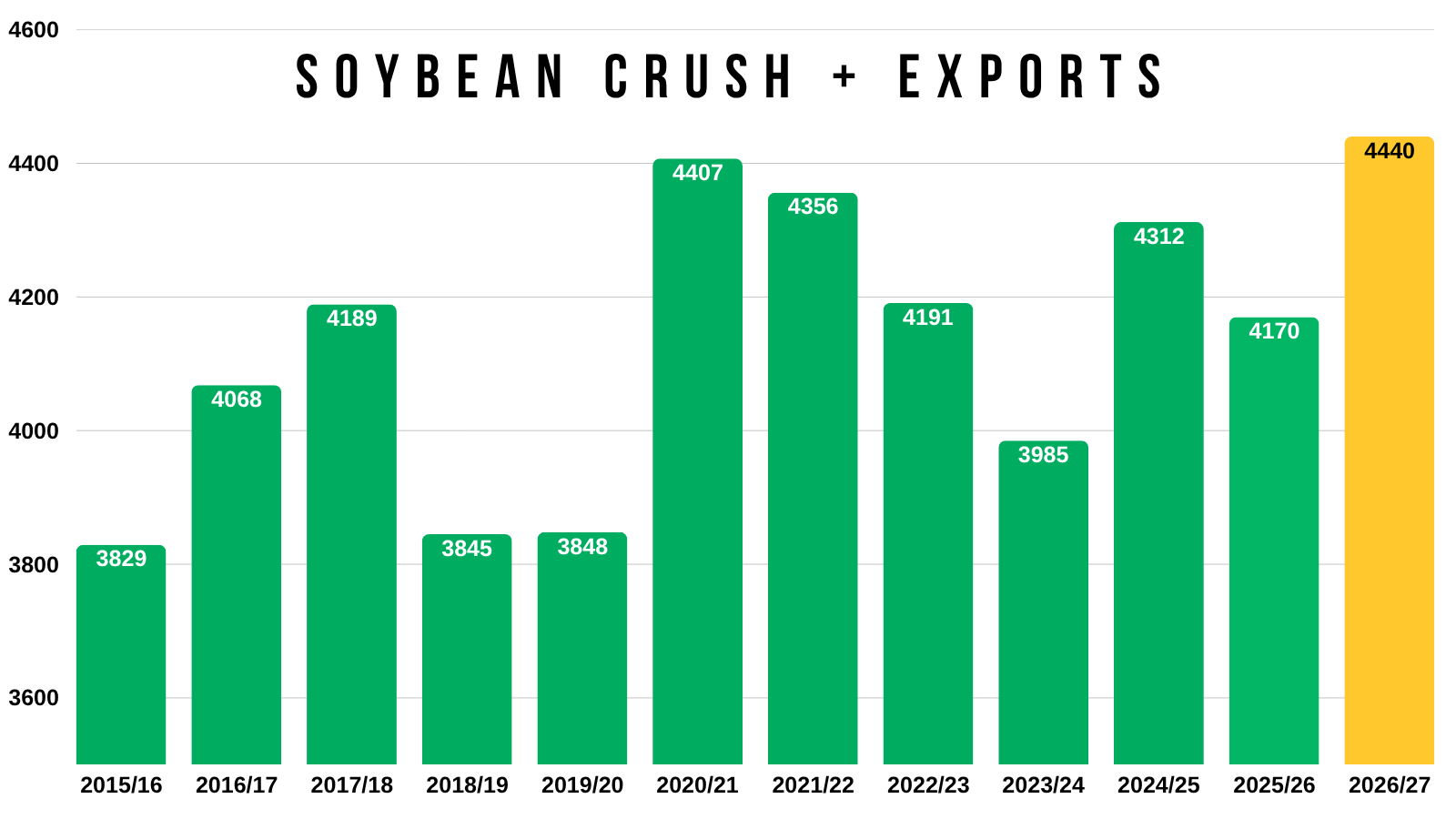
China's Promise:
If China agrees to buy what they said they would, we simply do not have the available supply to fulfill that goal without rationing demand.
Because the USDA only expects our exports to be up 140 million vs last year.
Yet China said they are going to be buying 480 milllion more than last year.
That's a pretty massive difference. The size of our entire carryout.
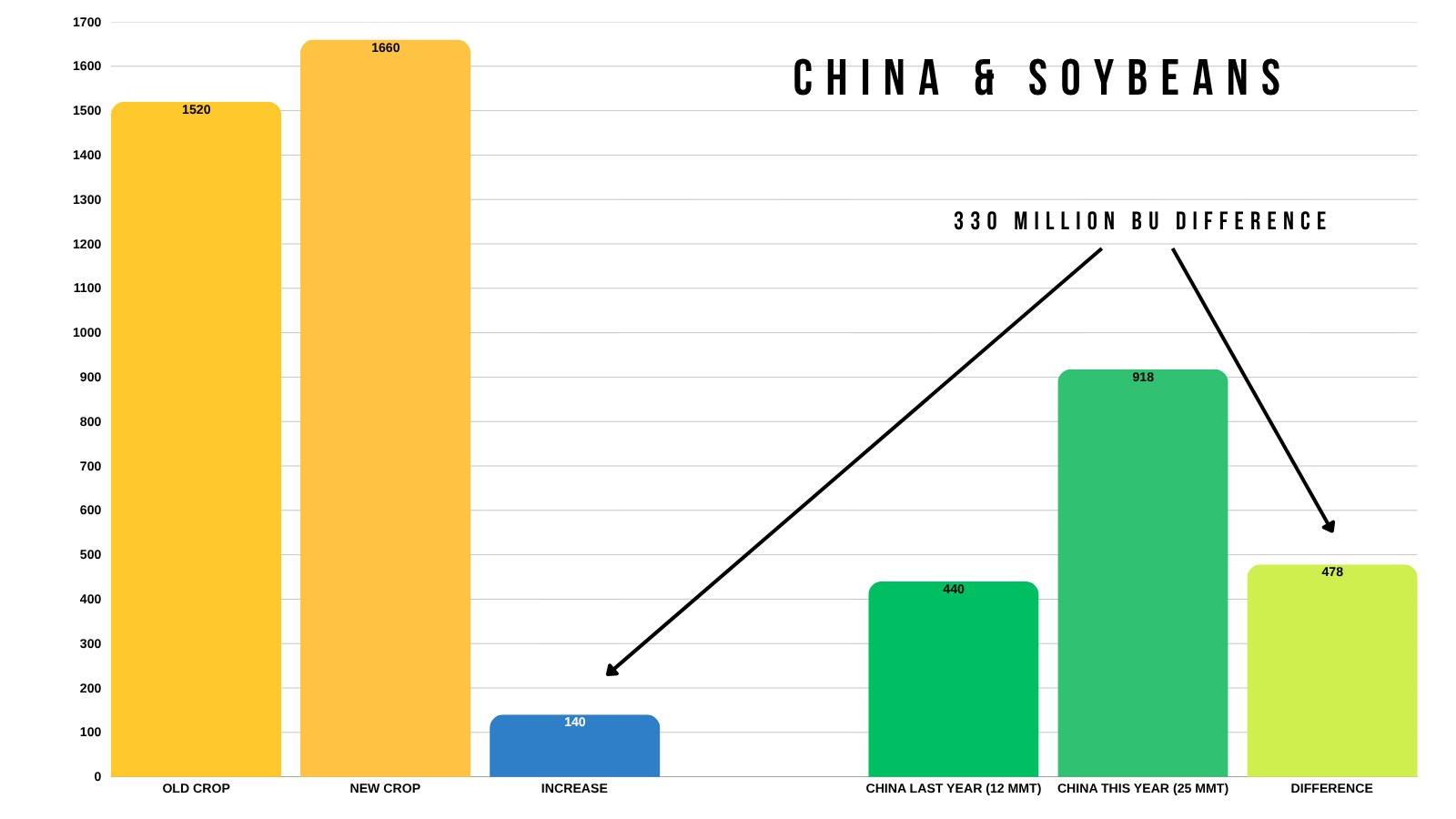
There was some new surrounding China crops today.
Reports are saying that heat and floods are threatening their corn and soybean crops.
We have yet to see them make any of those non-soybean purchases they agreed to yet.
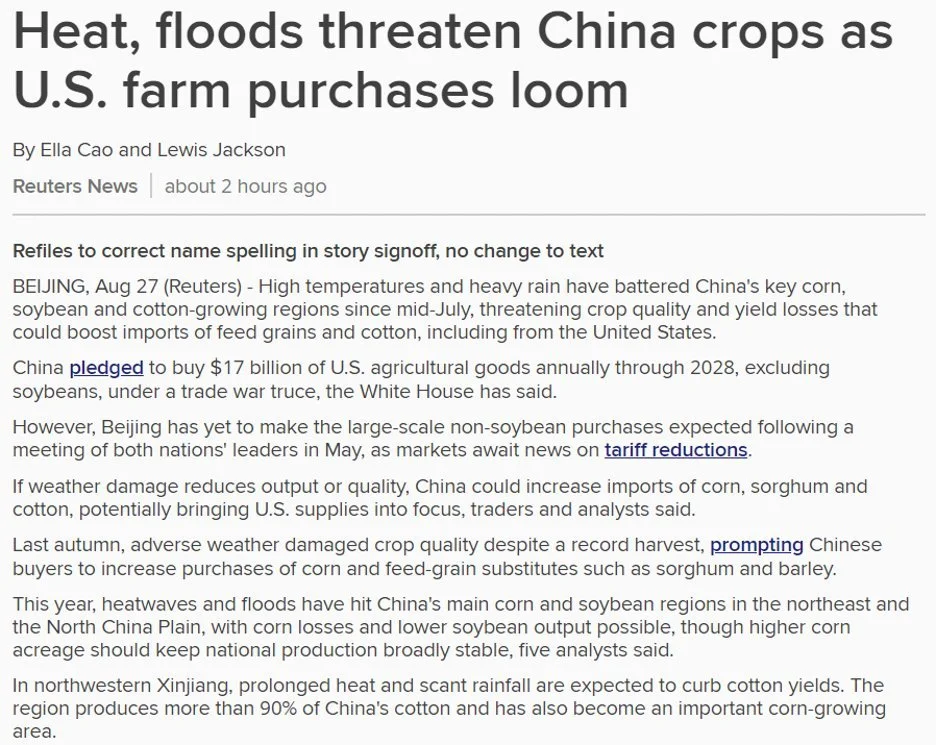
Soybean exports have actually been pretty impressive.
Look at our soybean exports to China.
They are on their best pace since 2021 and 2022.
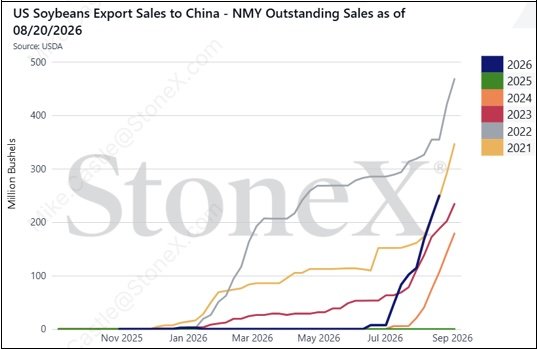
So we have a world situation that is shrinking despite bigger crops year after year.
We have record crush demand.
China is buying, and if they want to meet that goal, we'll likely have to ration demand to non-China destinations.
That is why soybeans have potential.
Soybean Highs by Month:
I had some requests for this chart after sharing the corn one.
Here is Nov soybeans highest price for every single month since 2005.
We have only posted our highs in August twice. 2011 and 2013.
We have only posted our highs in September once. 2012.
We have never posted them in October.
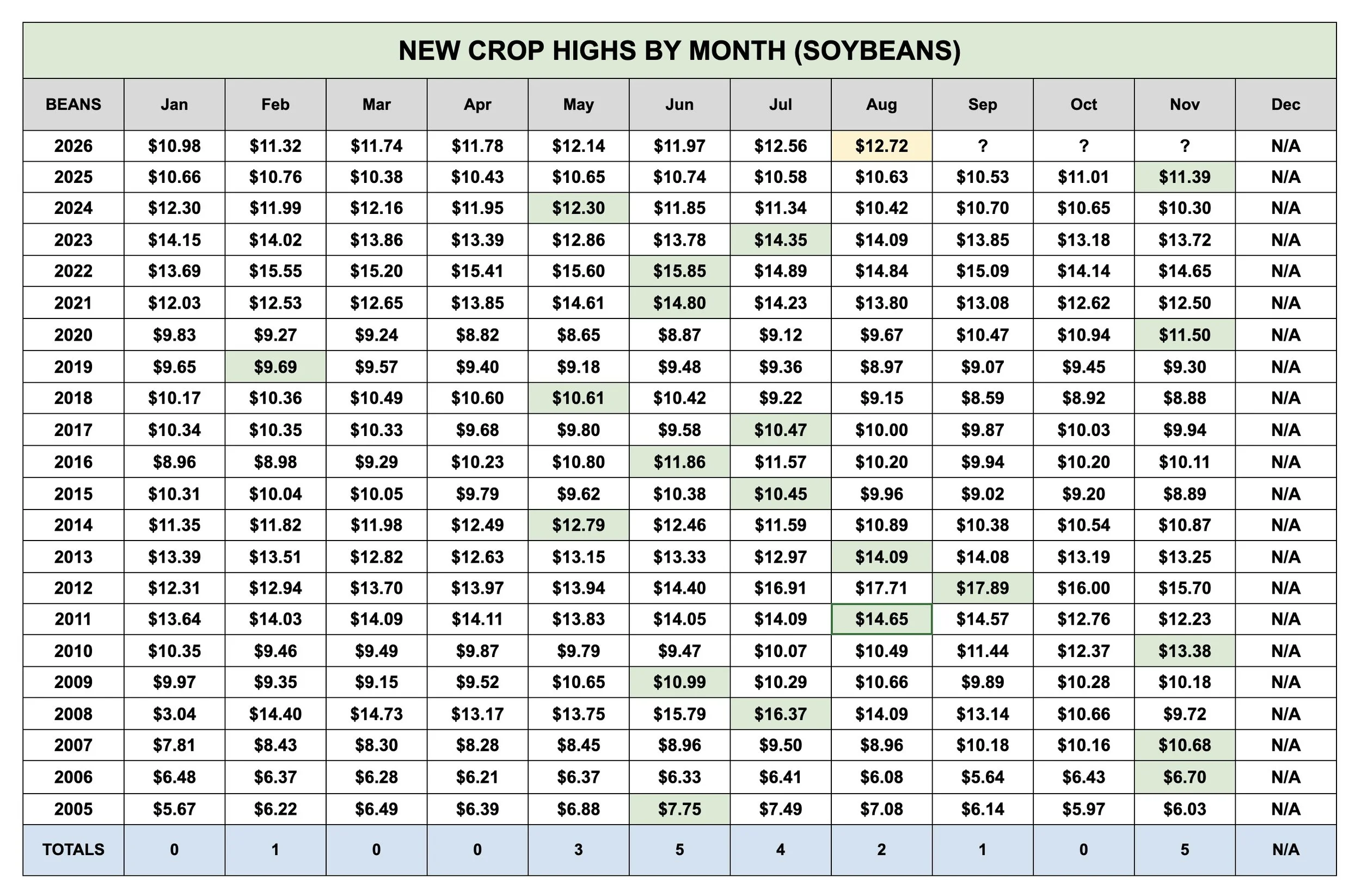
Charts: Weekly Breakouts?
Corn
Weekly Chart:
Corn just posted it's first series of higher lows and higher highs of the entire bear market.
Seems like a big deal to me.
We broke above $5.00 for the first time since July 2023.
Breaking above those 2025 highs as well as the 2021 lows. So it was a pretty clear level of resistance we just cleared.
Which opens the door to further upside potential.
So it's starting to look promising for corn. And appears like the long term trend has possibly shifted higher.
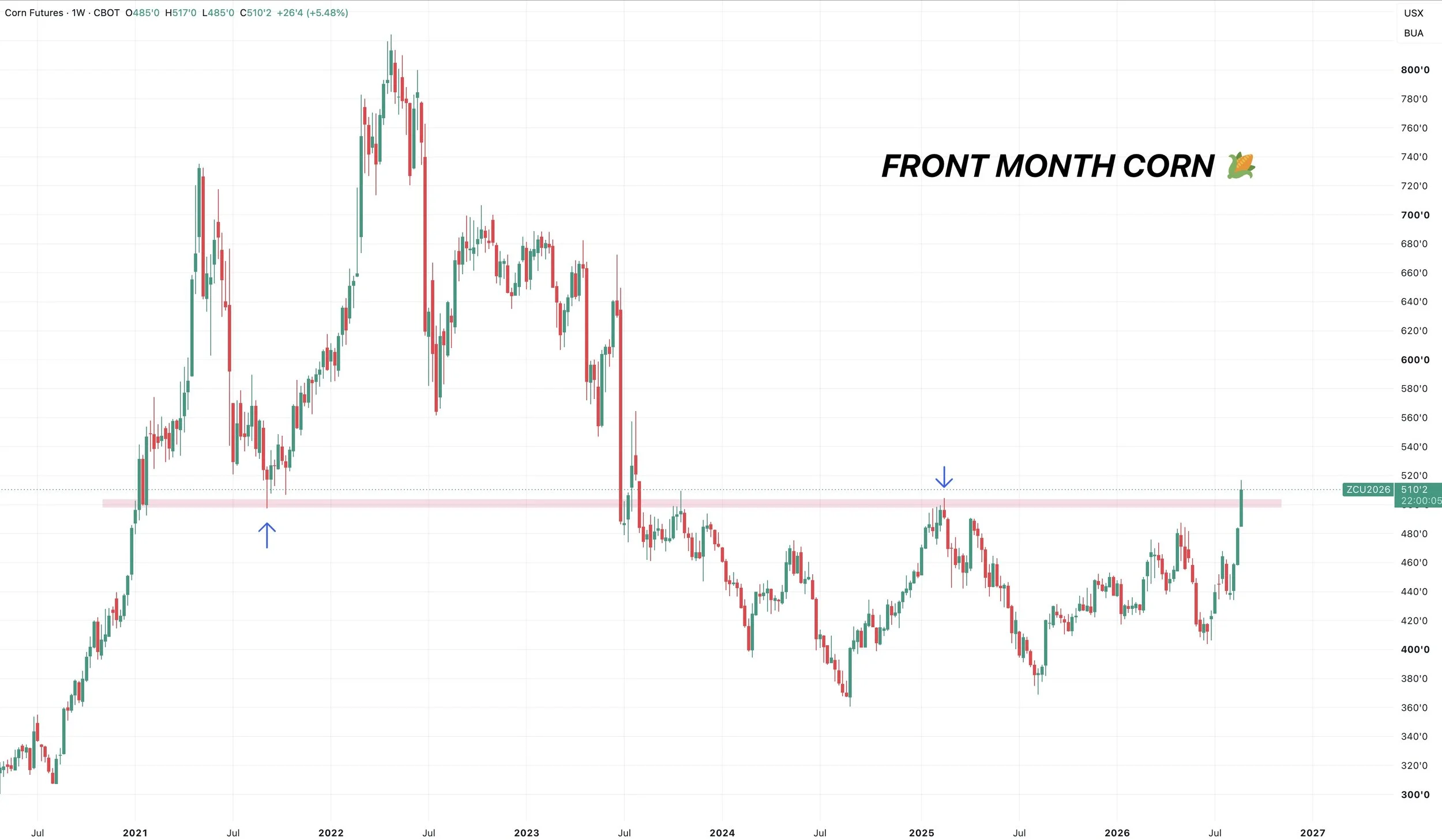
Monthly Chart:
We could also be potentially breaking out on a monthly basis.
Corn tends to be trapped in a $1.00 range, and we could be breaking out of that range.
I outlined every major spike over the years.
If you notice, most of those spikes that fade often occur between May to July. As they are typically associated with a weather scare and where the market seasonally posts it's highs.
We rarely just randomly top out in August. Because it's usually not some traditional weather scare that dies out.
I marked August in 2010 and 2020 for reference.
On a front month basis, corn has only topped in August once which was 2012. But again, this doesn’t feel the same as that year for obvious reasons.
In 2012 we were already in a bull market.
Right now we are busting out of a range, similar to 2010.
So the chart does look optimistic.
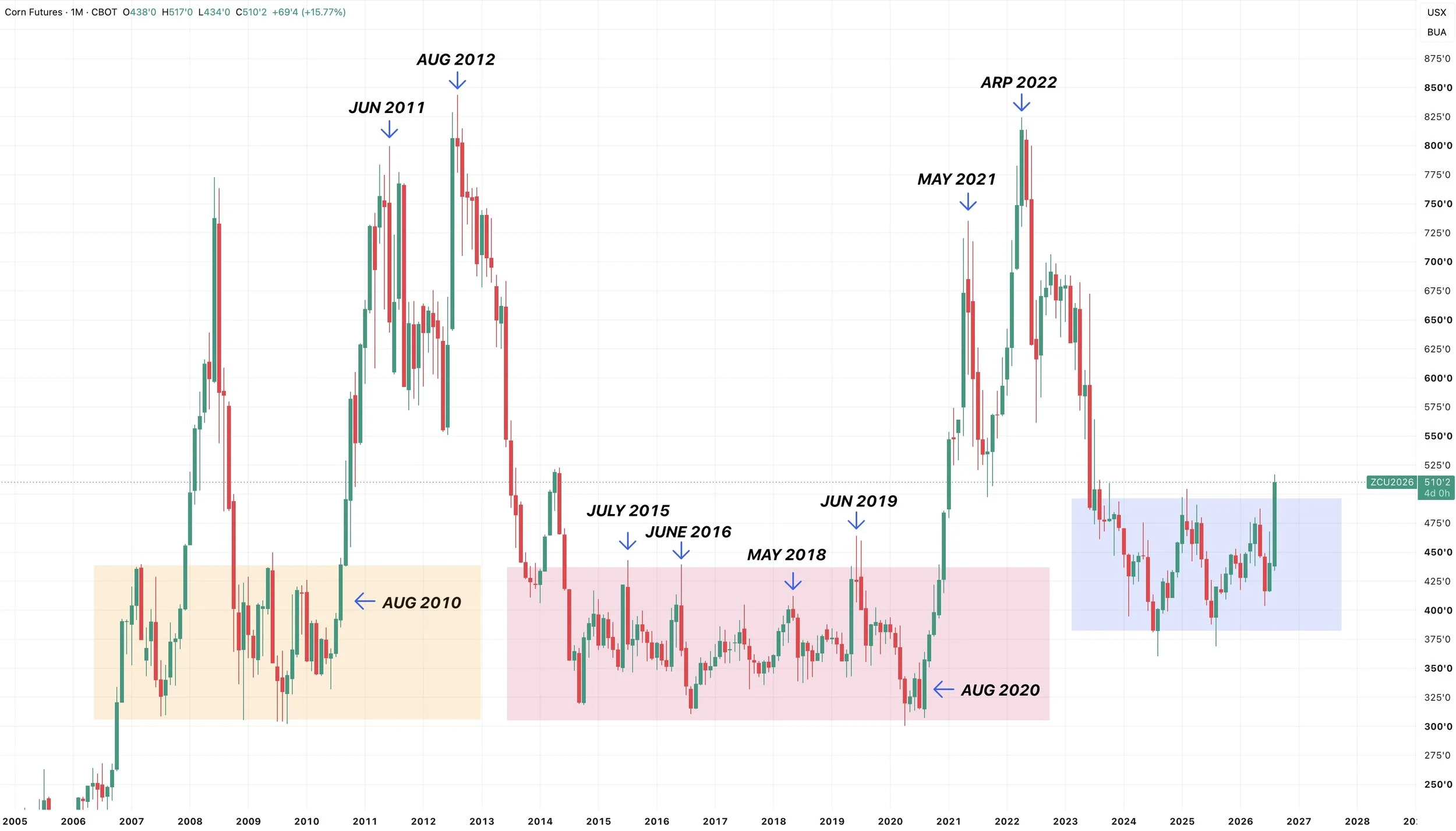
Here is a chart with the noise removed.
Obviously this does not have to happen.
But there are definitely some similarities to 2010 and 2020.
As both broke out of their bear market ranges.
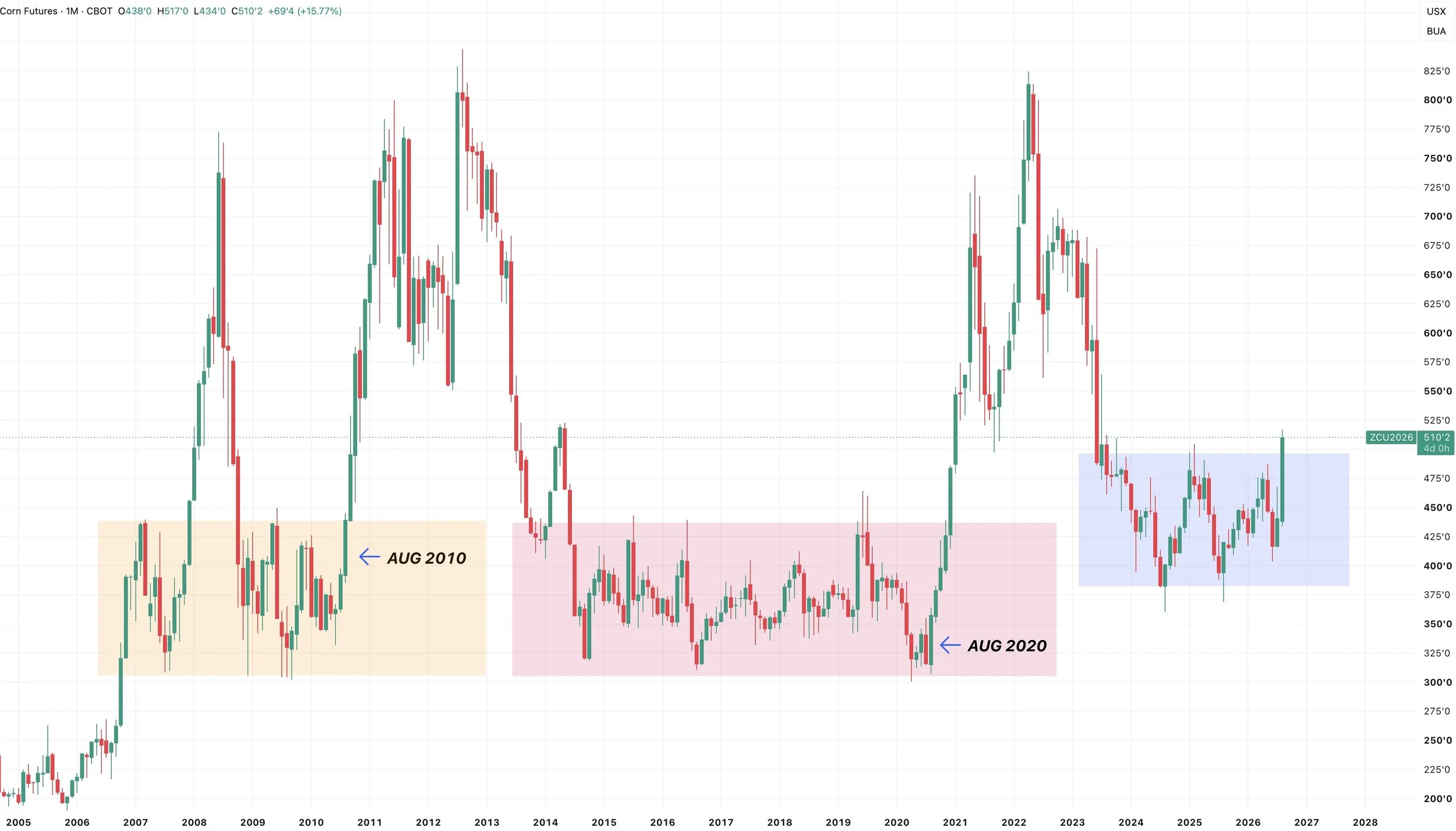
Dec Corn Daily Chart:
The next target is that $5.50 range.
$5.56 is the golden fib from the contract lows up to the May highs.
That's probably good area to consider doing some de-risking.
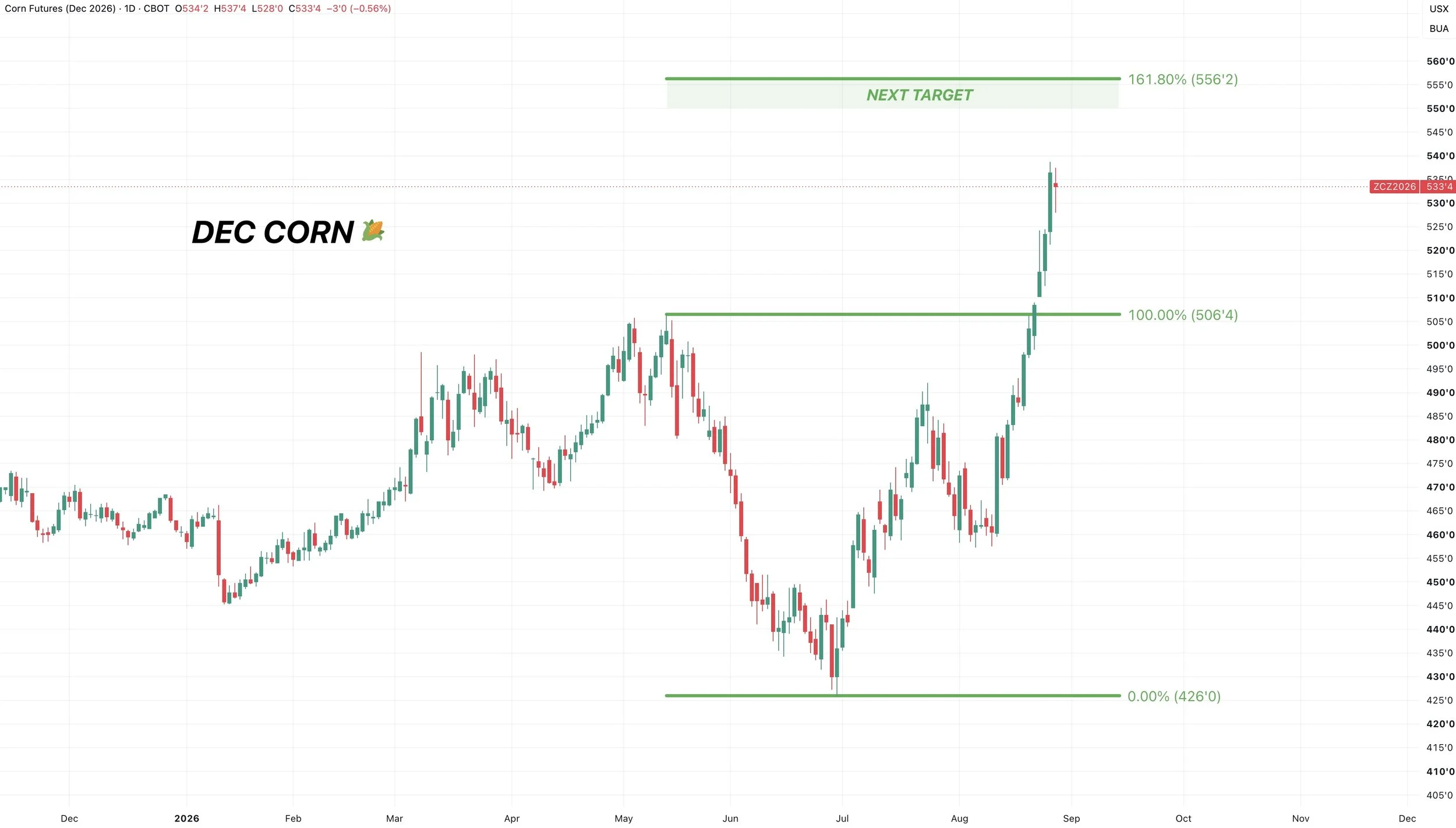
This market could stall out short term at anytime.
We have rallied +80 cents in two weeks and gone straight up.
This market could drop a lot and still be completely fine and still hold a bullish structure.
We could drop all the way back down to $4.90, which is 40 cents lower than we are today, and it would still be considered a healthy pull back.
A standard pullback to the 38.2% to 61.8% retracements would also be a simple re-test of prior resistance.
So I'd view that as an opportunity if it happened.
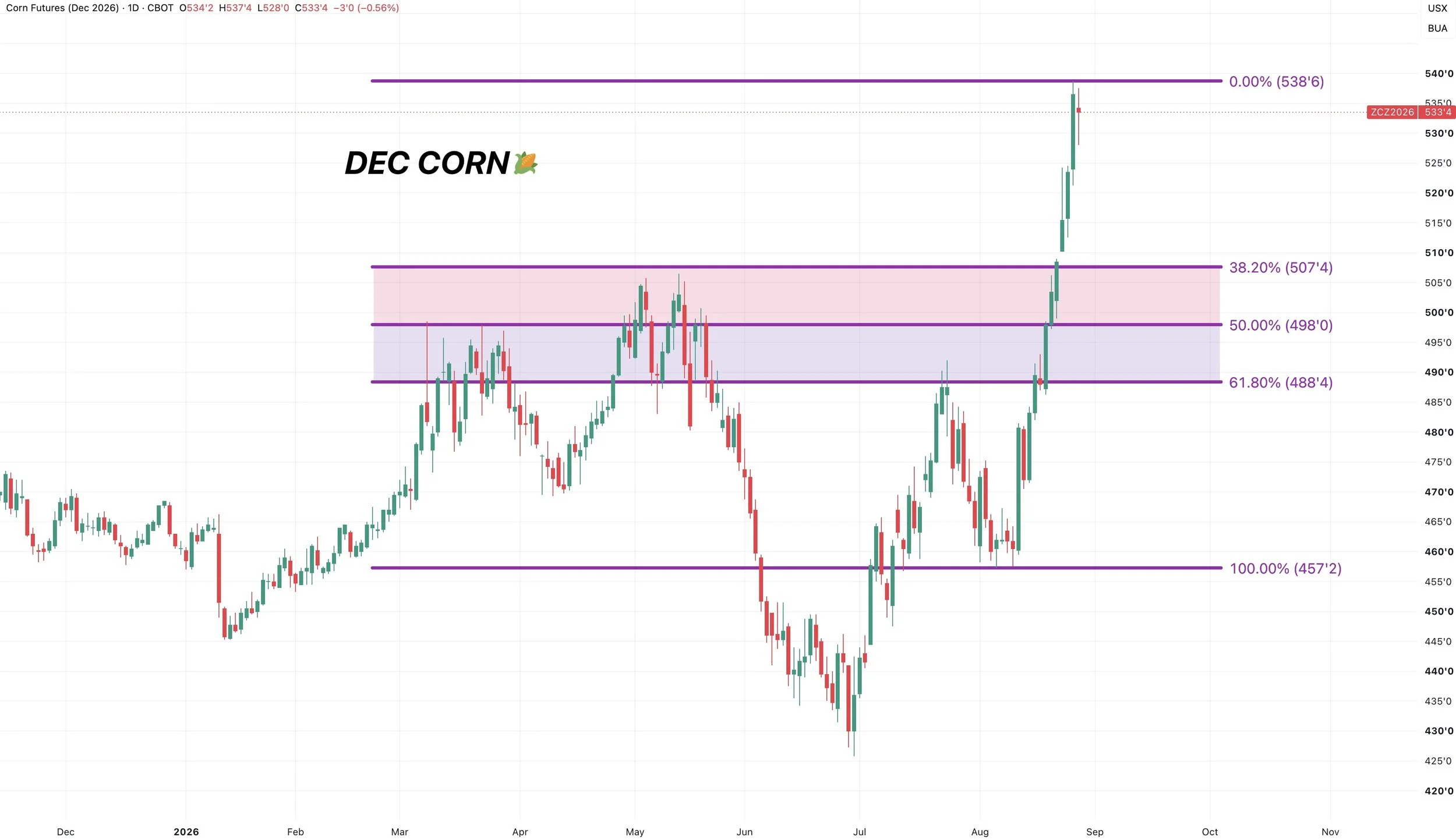
Corn Marketing Thoughts:
1) If you lack storage, need to move stuff off the combine, or are behind in your marketing etc:
You should probably be doing something here and getting yourself to a comfortable spot.
Just scale into something whether that's some sales or some protection.
We are at multi-year highs heading into harvest, which rarely happens, given we are usually posting our lows right about now.
So this isn’t a rally you want to completely ignore if that's you.
2) Those with plenty of time:
We like being mostly patient. We don’t mind doing something such as small sales or some downside protection, but we do not want to get carried away or put ourselves in an oversold situation given the potential.
Would you be more mad if...
1) you did nothing and corn went back to $4.00
2) you sold everything and corn ran to $6.00
That's a question you have to ask yourself, but I'd assume plenty of you would be more mad with scenario two.
There is potential for the first time in a long time. It does not have to shake out. But if it does, we do not want to miss out on it. So we like keeping plenty of bullets in the chamber in case it does.
We just want to have some flexibility.
If you're someone who needs to some help, whether that's getting upside exposure because you are oversold, or if you want to protect your downside, reach out and we'd be happy to help.
Office: (806)484-1214
2027 Crop:
We are not a fan yet.
Dec-27 isn’t that attractive here with the input costs to begin with.
The only way we'd consider doing something is if you have your inputs locked in.
There is more risk for Dec-26 corn than there is for Dec-27. As 26 will lead the market higher or lower.
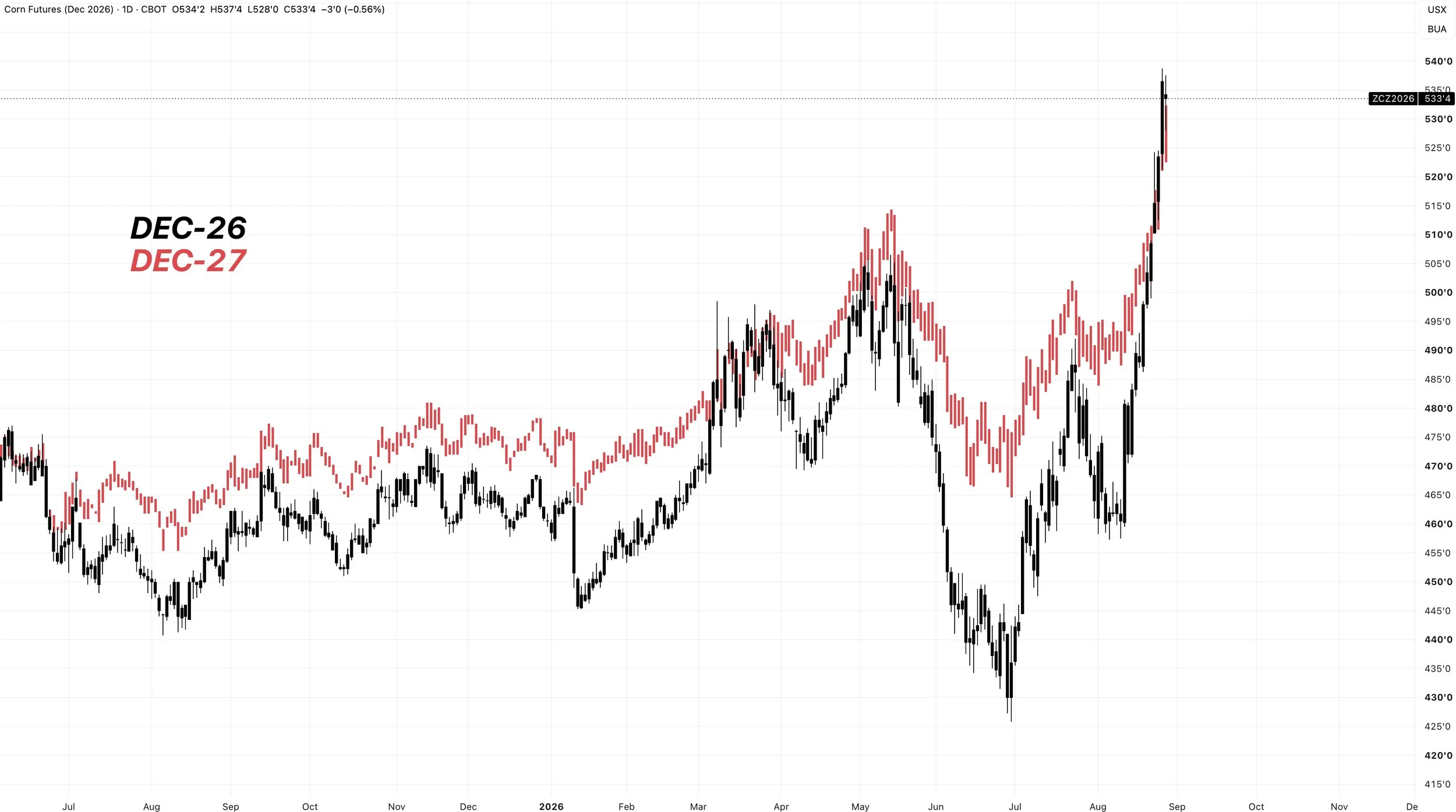
Soybeans
Weekly Chart:
Potentially breaking out here.
We broke above those recent highs which was a pretty important level.
Not only is it the recent highs, but it's the highs from 2024 and the lows from 2023.
So breaking above this level would look good and potentially open the door to more upside.
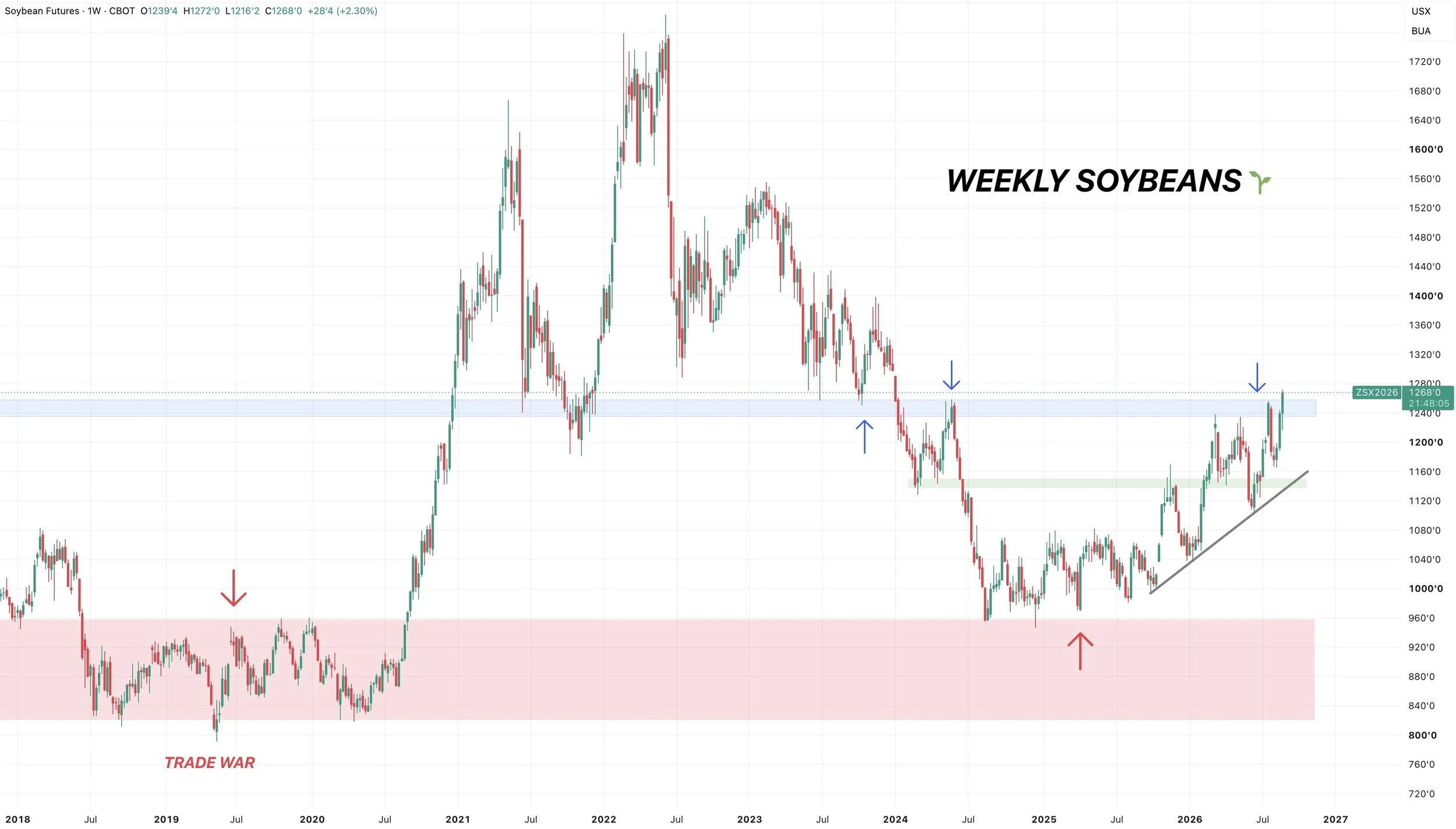
Nov Beans Daily Chart:
We broke above those July highs.
I am currently targeting the $13.00 area to take a few chips off the table.
$13.12 is the golden fib from the recent lows up to the July highs.
The golden fib means it's the 161.8% retracement of that move. Which is a common continuation target.
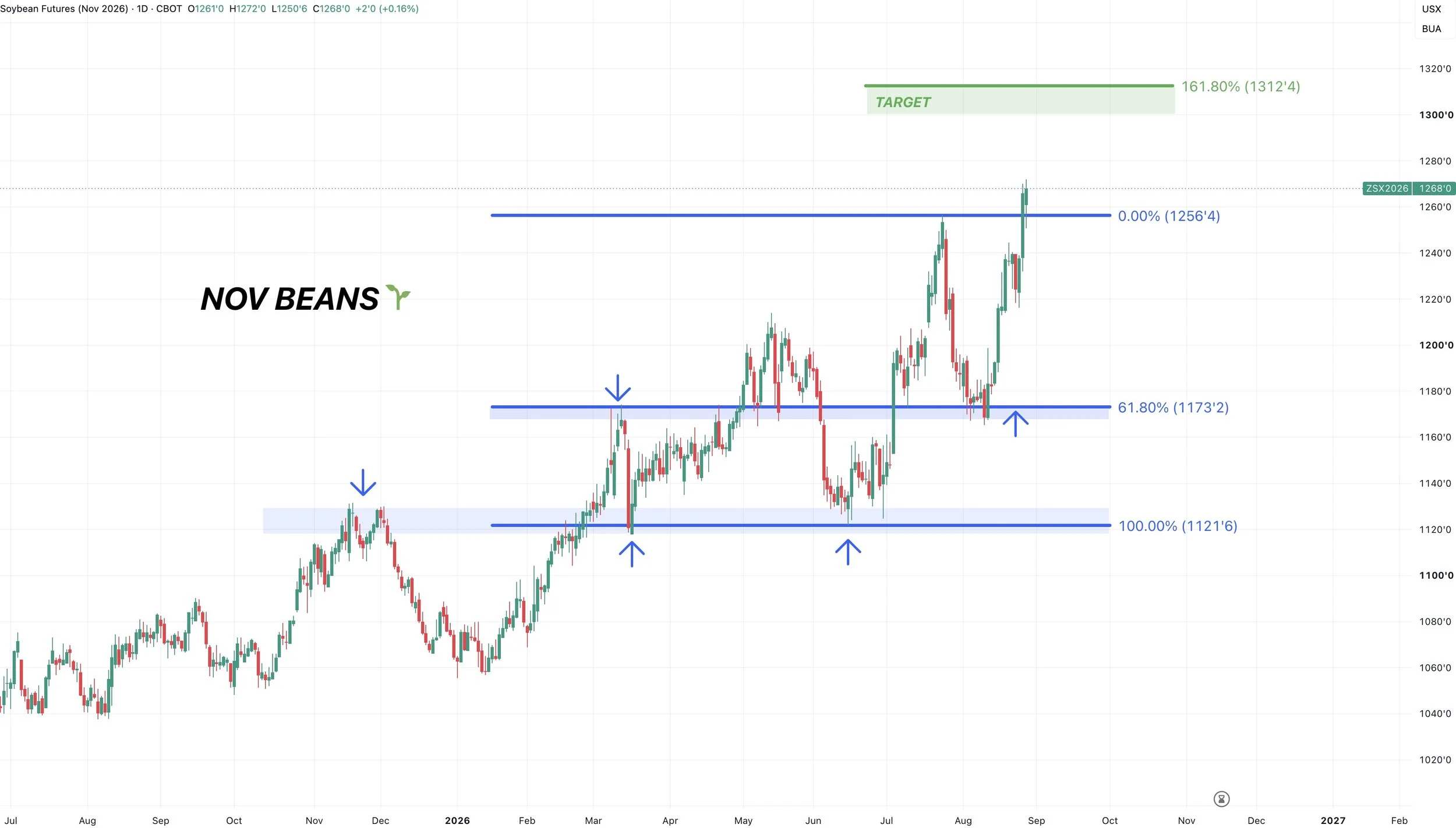
Wheat
Weekly KC Chart:
We broke that key level a few weeks ago and are running as a result.
That $7.50 range was:
The recent highs.
Highs from 2024.
Lows from 2023 and 2022.
Highs from 2021.
So the chart looks great. And it's opening the door higher.
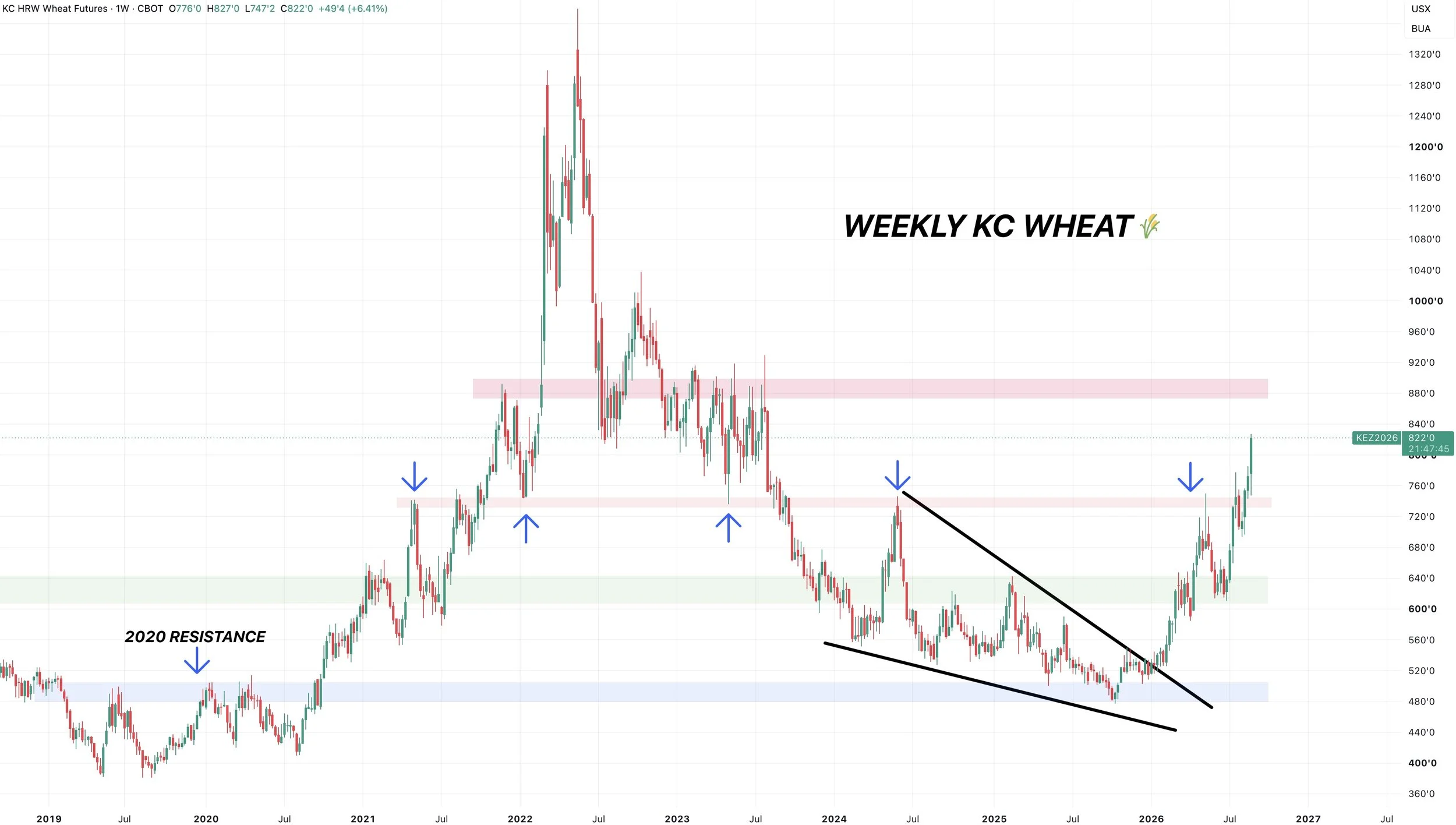
Monthly KC Chart:
Here is an interesting chart that compares the current rally to the rally from 2008 to 2011.
Up until this point, they do look very similar.
We had that big spike, followed by a massive drop.
We then got a mini pop, followed by one last leg lower.
We then turned the market around.
On that 2011 run, we ran up towards that $9.00 range.
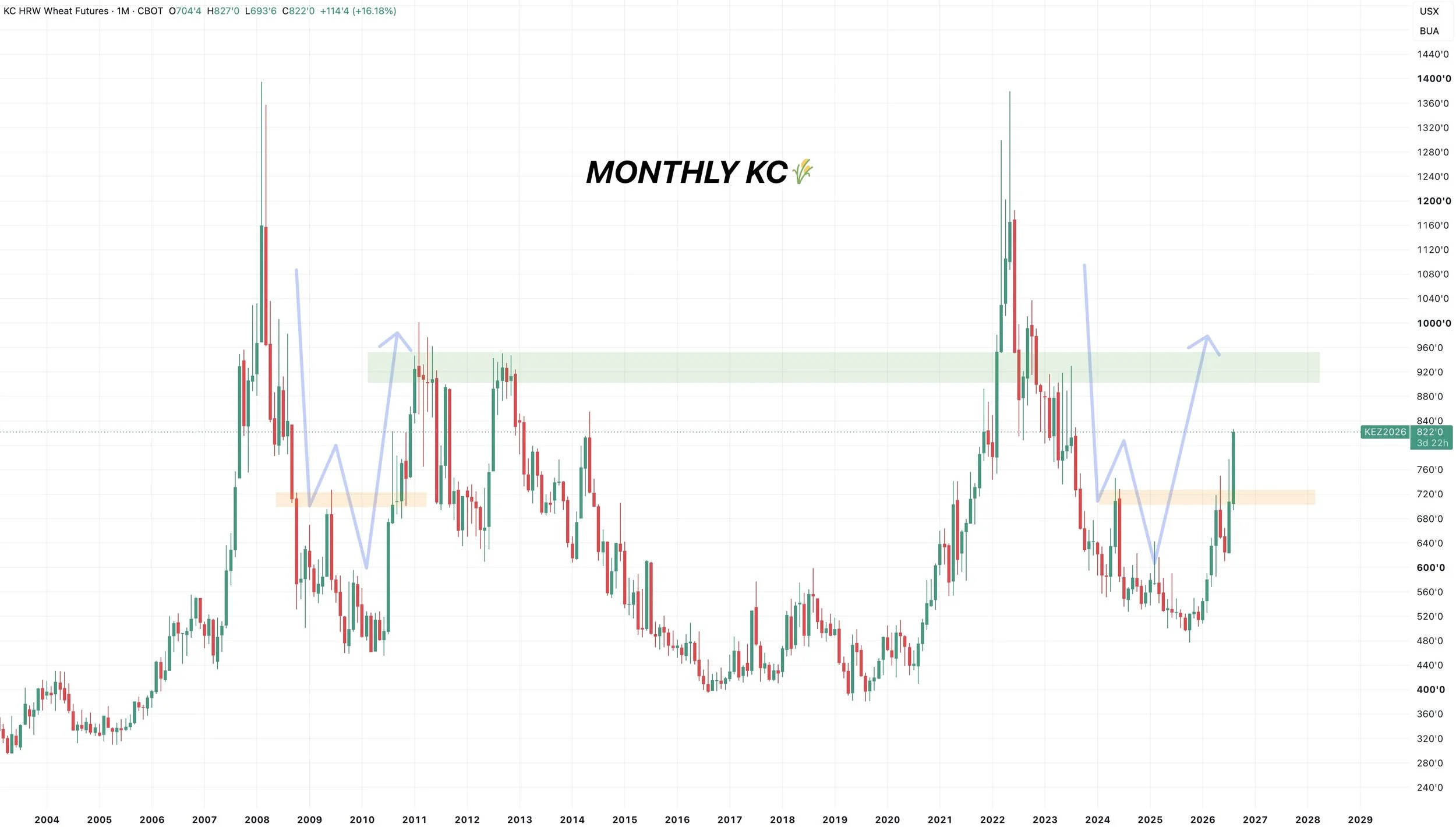
Dec KC Daily Chart:
We blasted off the volume shelf, posting new highs.
We still have this cup and handle pattern.
The implied move takes you to $8.40 to $8.50
That same range is the golden fib from the summer lows up to the May highs.
So that's going to be an area of interest and where I'd like to do something if it came.
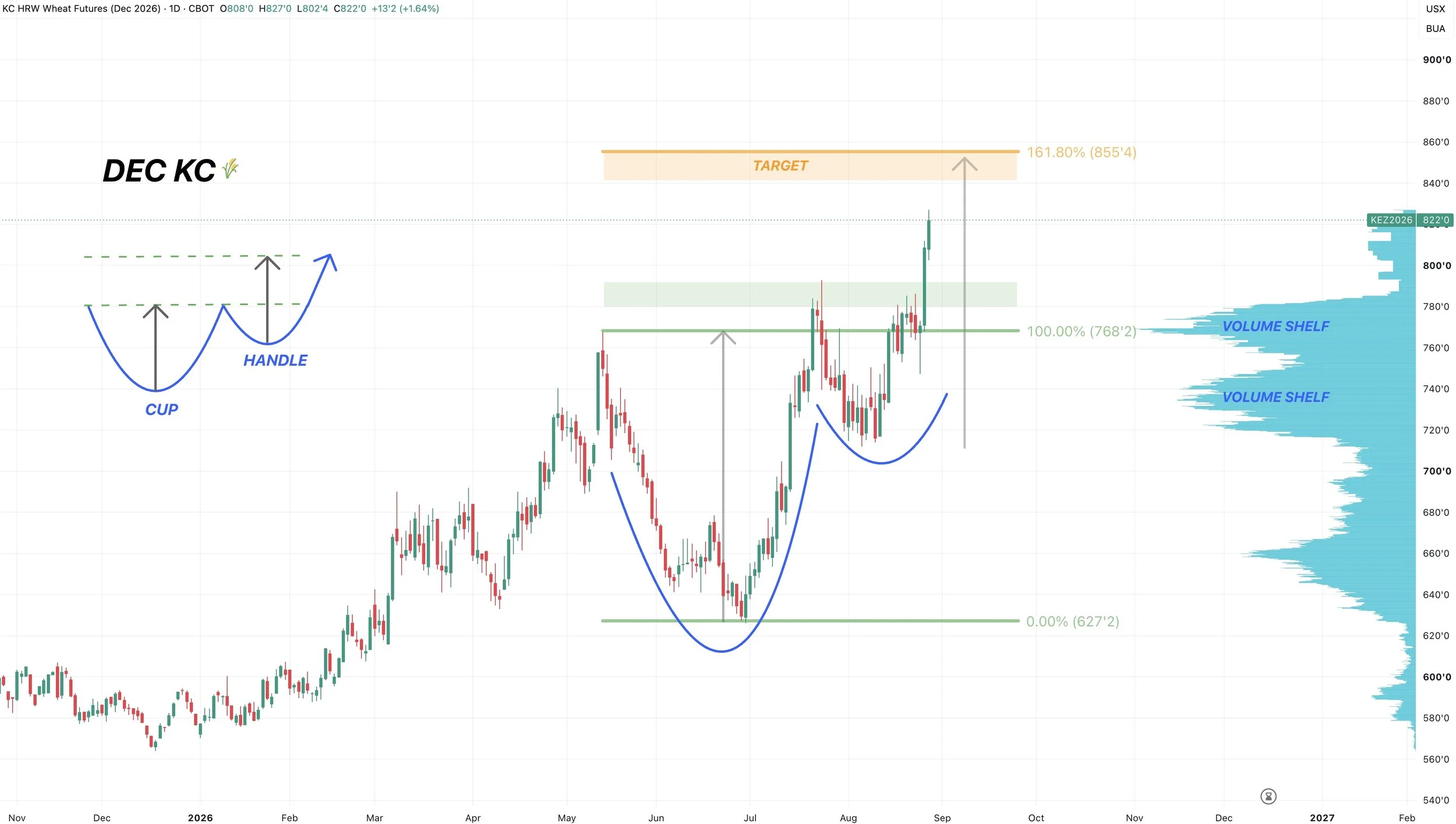
MPLS Wheat Chart:
Testing this high time frame resistance once again for the 3rd time.
If we can get the breakout, it could spark a leg higher.
We still have this cup and handle pattern here as well.
We have the golden fib that sits around $8.15 which is going to be an area of interest if we break out.
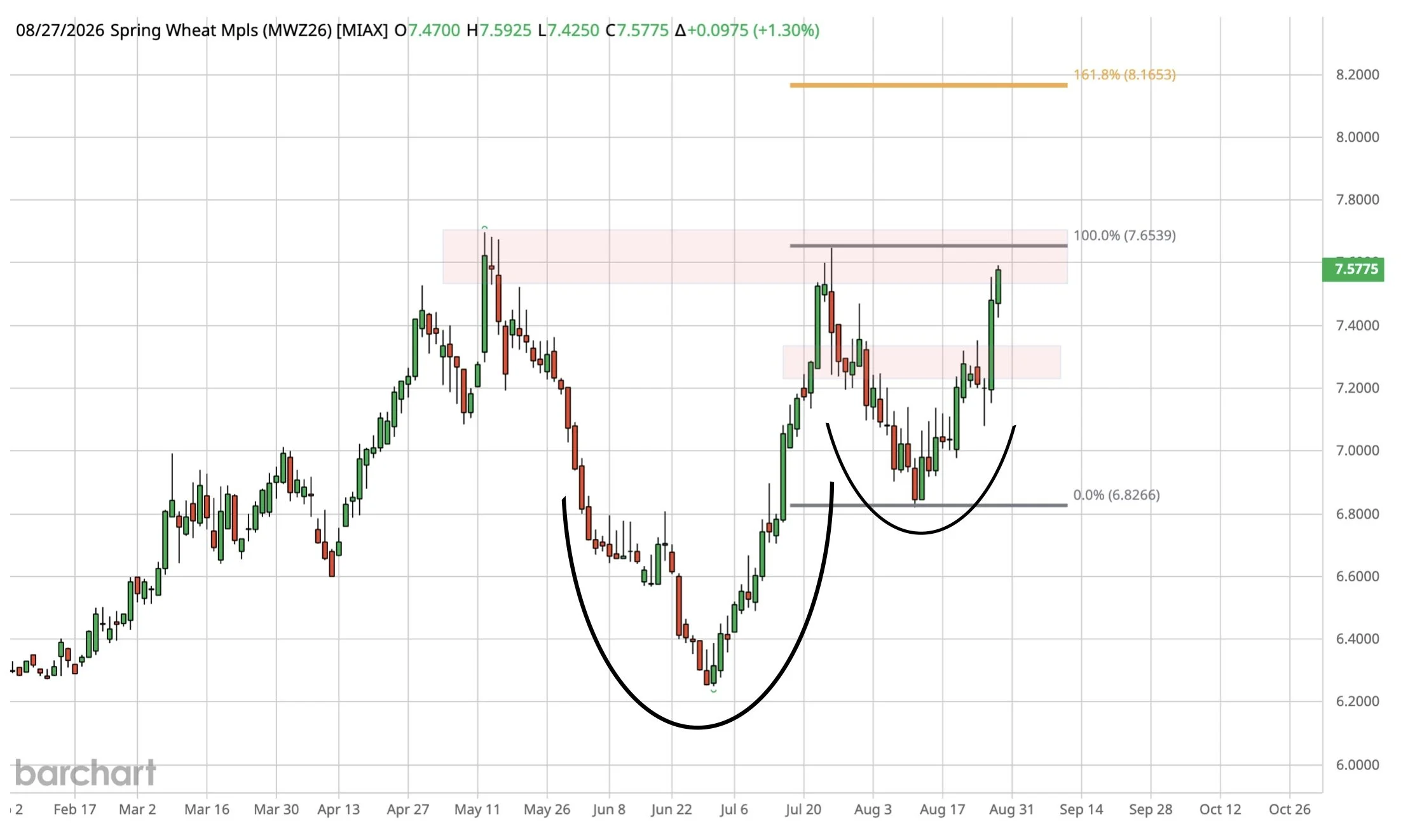
Cattle
Oct Live Chart:
Cattle still free falling, but had a decent day today.
I'd want to protect any sizeable rally towards the 50-61.8% retracements.
That same level is prior support and resistance.
We are still showing some bullish divergence on the RSI, so that gives some optimism for at least a dead cat bounce out of here.
But overall the trend in cattle is clearly lower unless you managed to break above that blue box.
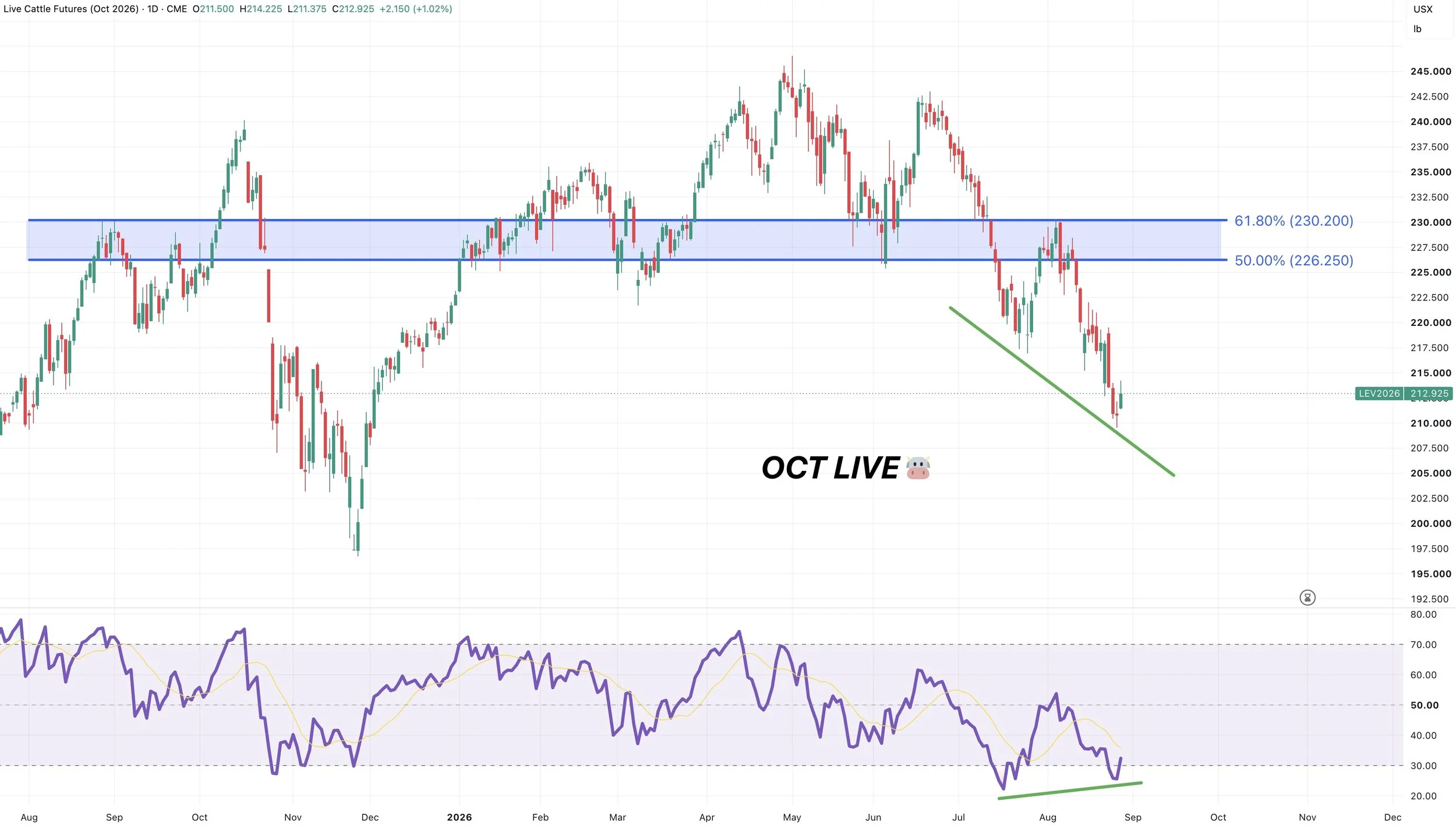
Oct Feeders Chart:
Same thing here.
Looking to reward any sizeable rally.
We do have somewhat of a wedge pattern to watch if we get a breakout.
Also still showing bullish divergence which is about the only positive thing down here.
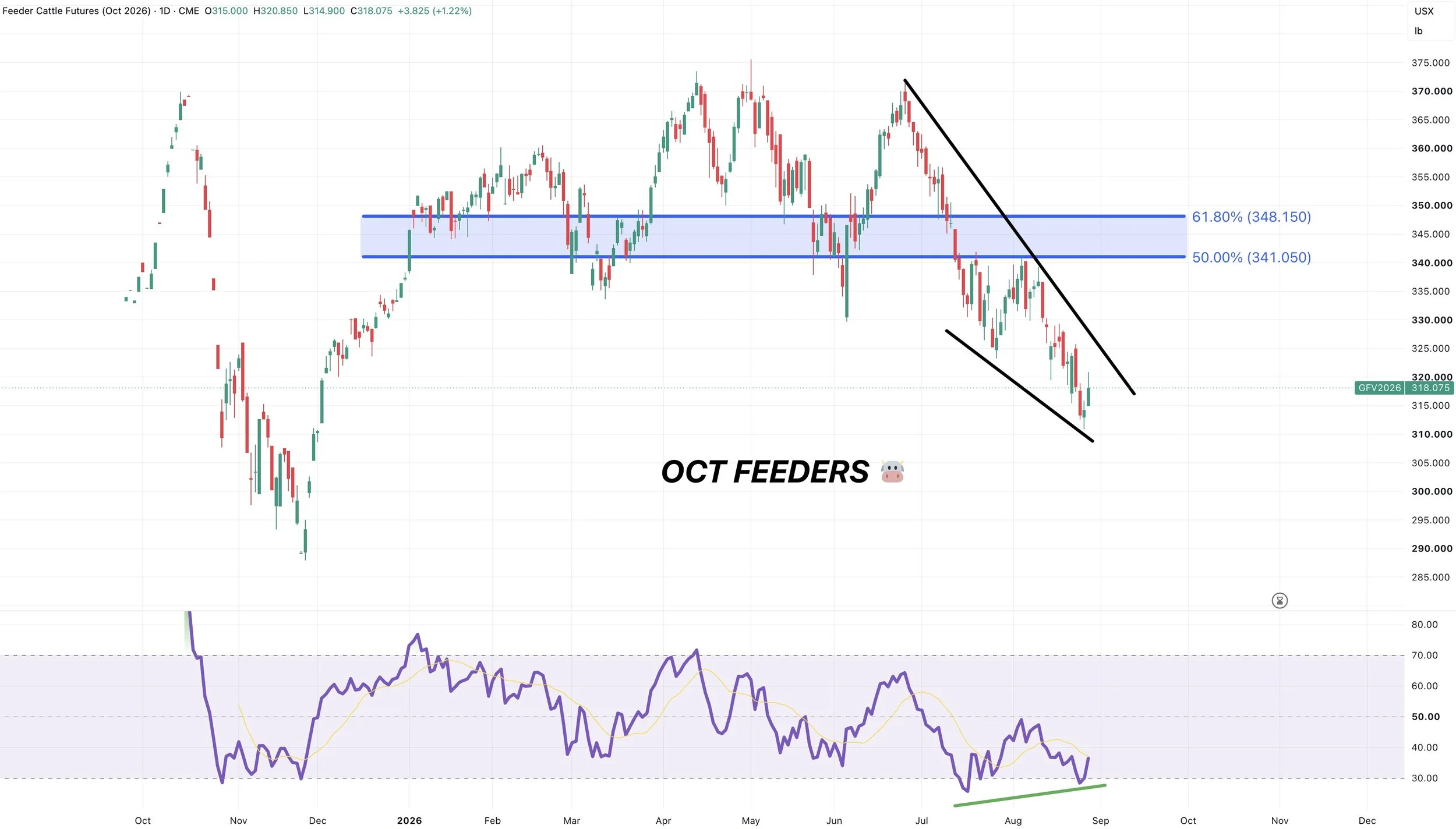
Want to Talk?
Our phones are open 24/7 for you guys if you ever need anything or want to discuss your operation.
Jeremey & Office: (806)484-1214
Sebastian: (605)280-1186
Email: sfrost@dailymarketminute.com
Hedge Account
Interested in a hedge account? Use the link below to set up an account or give us a call.
GRAINS KEEP RUNNING
AUDIO COMMENTARY
New highs across the grains
More issues in the Black Sea
Breakouts on the charts in grains
Yield debate continues to accelerate
There is plenty of farmer selling but someone is buying the dips in this market
If you have to move stuff then reward these prices. If you do not to move stuff then do not get carried away
Who should consider 27 sales or not?
If you know you are oversold. What to do?
The simplest strategy for being oversold
Could this be similar to 2010 or 2020?
Don’t be afraid to protect yourself. But do not let buyers talk you into fear selling
Make the buyers pay up. Don’t give grain away
We have some issues around the world
Prices need to go higehr to slow demand
There is a ton of potential. The options agree
Tools that add to your bottom line
Using premium to lock in worse case scenarios
Market thinks crops are getting smaller
Balance sheet can’t afford Pro Farmer yield
This market is why marketing isn’t one size fits all
Turning the odds in your favor
How to use targets and floors
Weekly corn breaking out? (Chart below)*
Next targets below audio*
2026 vs 2020 vs 2010 comps below audio*
Listen to today’s audio below
Want to talk?
Office: (806)484-1214
2026 vs 2020 vs 2010
I’ll be diving into these more in tomorrow’s video update but thought I’d throw them in here today.
Here is Dec-26 compared to Dec-20 and Dec-10.
They do look pretty similar.
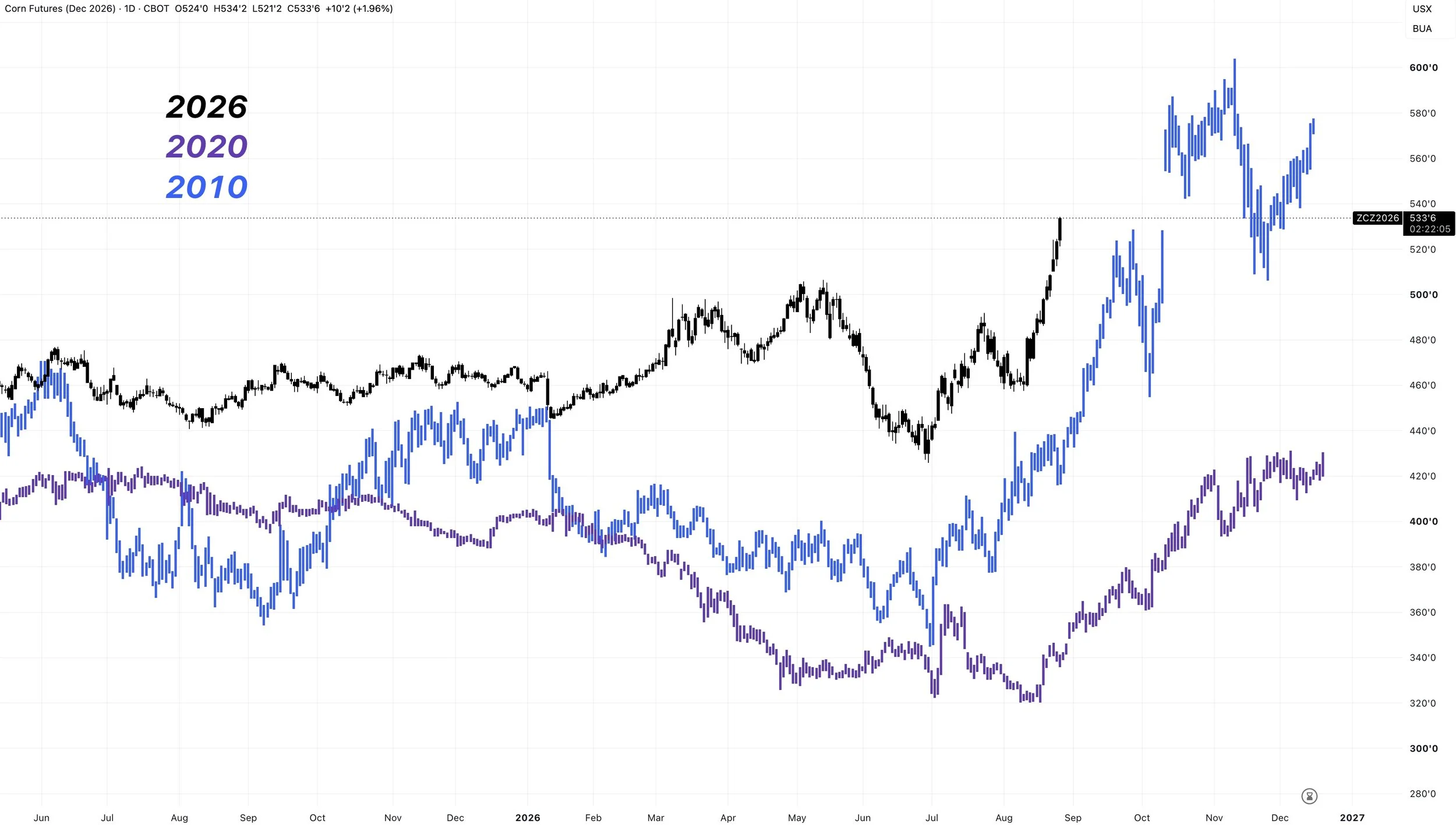
This next chart gives you a better visual of the continuation of the rally from 2020 and 2010.
This is Dec-27 vs Dec-21 vs Dec-11.
Again, I’ll be going over a lot more details about this in tomorrow’s market update.
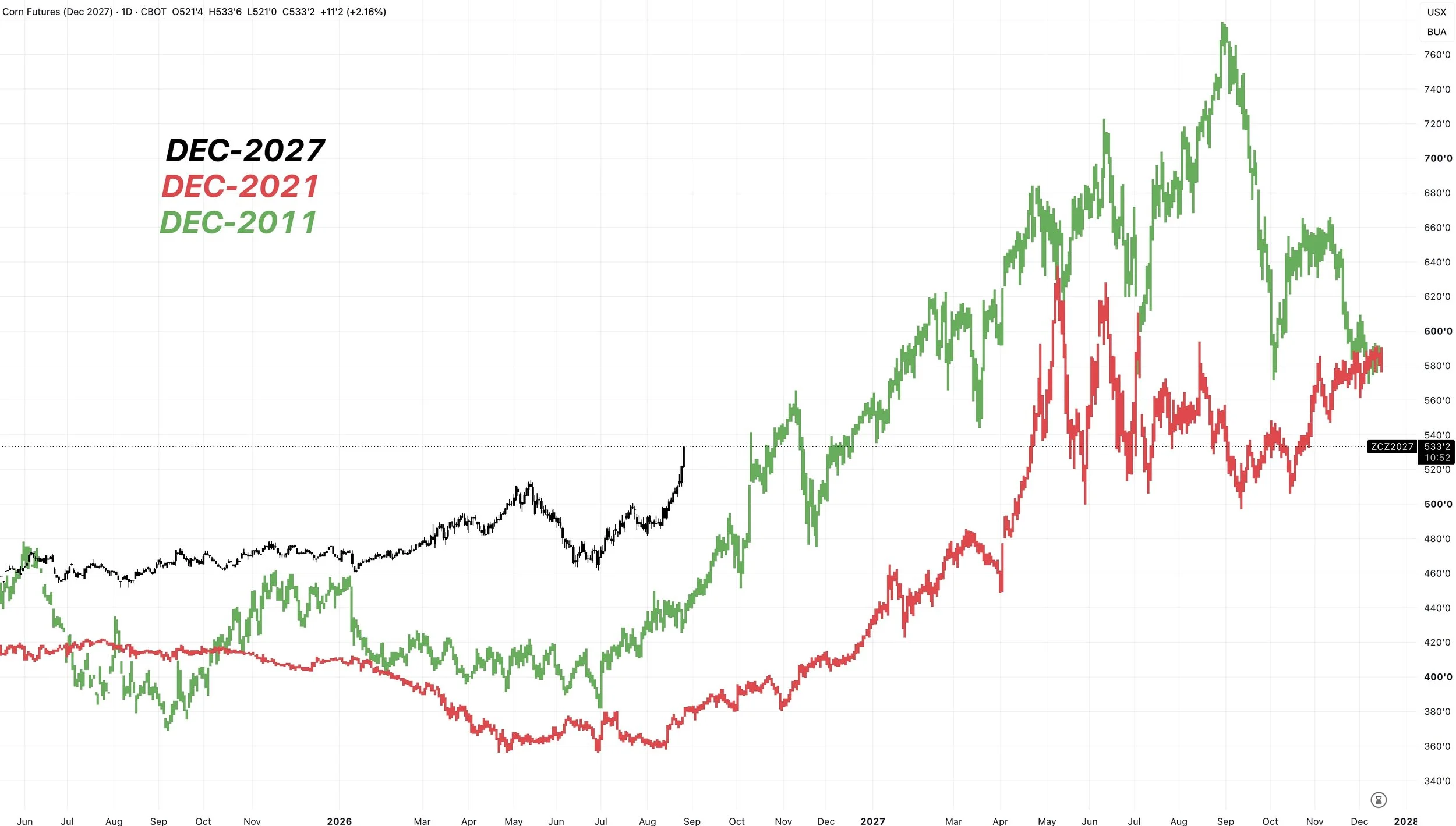
WEEKLY BREAKOUTS?
Weekly Corn 🌽
We broke those highs from 2025.
This is a big deal. As this would be our very first series or higher lows and higher highs during this entire bear market.
Not only that, this $5.00 level was a big level of resistance we just broke through.
It was the highs from 2025 and the lows from 2021.
We have not had a weekly close above $5.00 since July 2023.
This looks promising long term for corn.
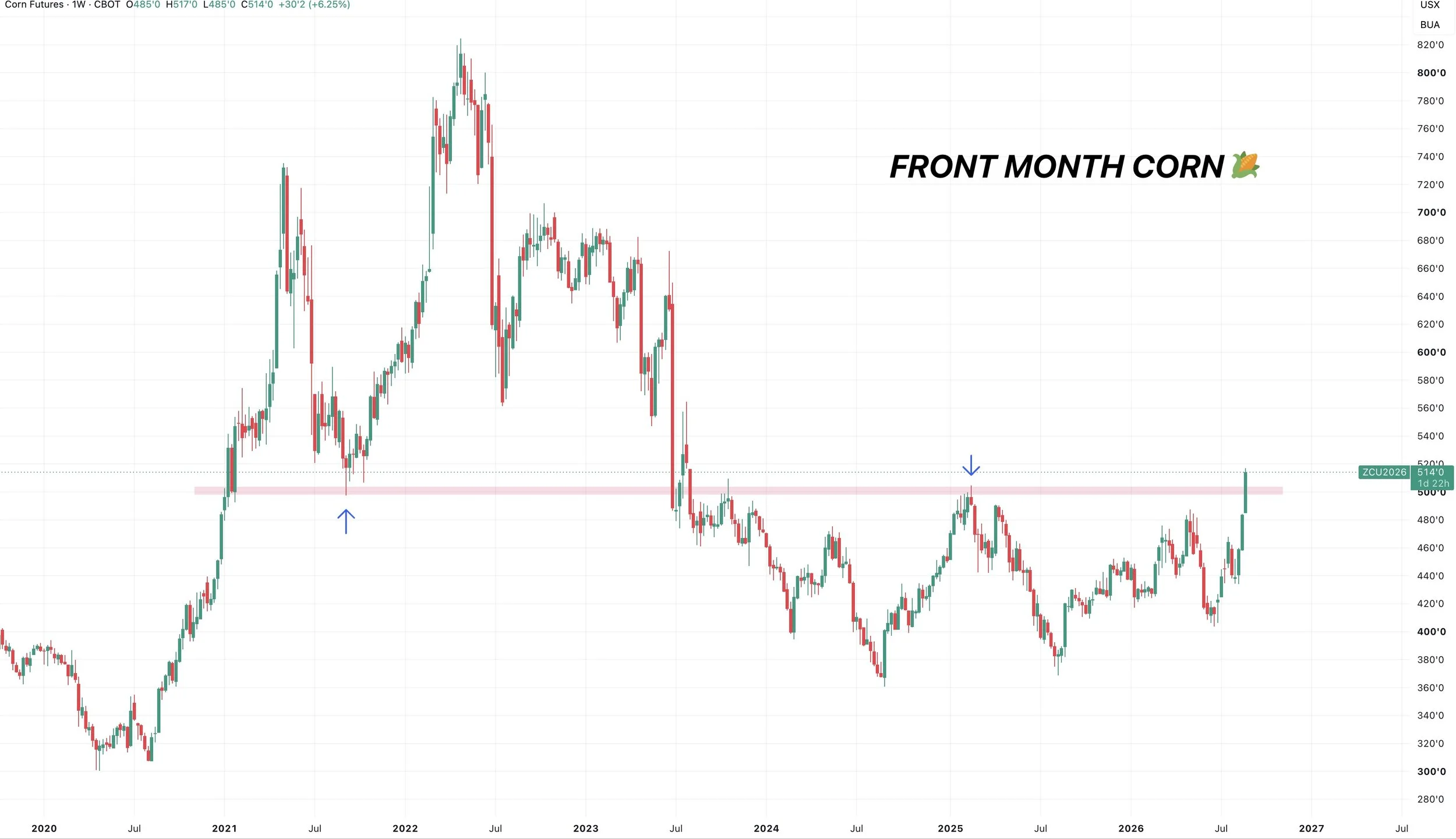
Monthly Corn 🌽
Here is the monthly chart for another view.
We’ve shown this before.
Corn is always trapped in a $1.00 range before it breaks out.
The old ceiling is always the new floor.
It’s still a little early, but it looks like we could very well be breaking out of this $4.00 to $5.00 range.
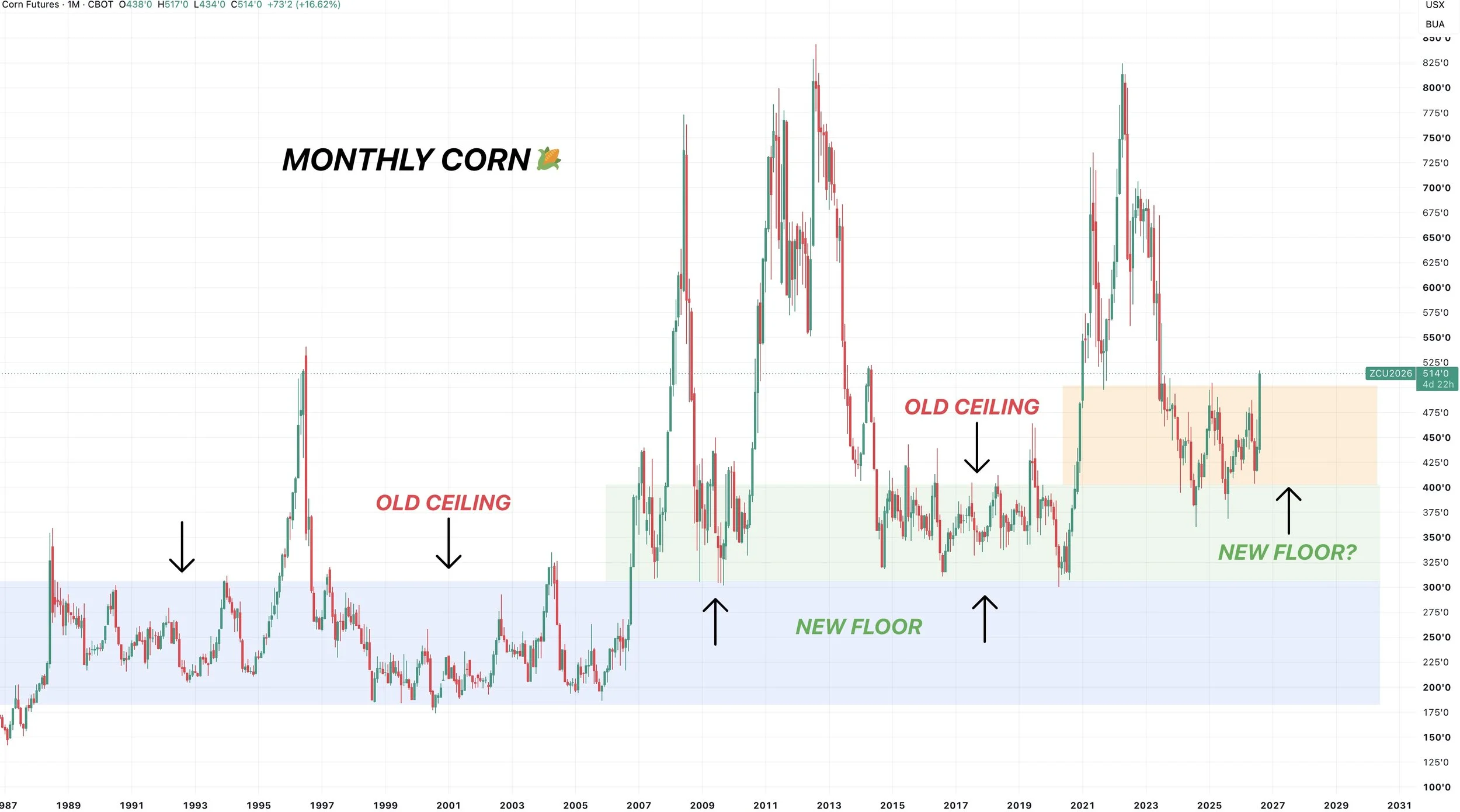
Weekly Beans 🌱
A little early here as well, but if we break above this level it would look very constructive for soybeans.
Like we’ve talked about for months, the long term structure of this chart is very bullish.
If we are able to bust above this level it would look very good.
As this was the recent highs. It was the highs in 2024. It was the lows in 2023 and 2021.
It’s been a clear level of support and resistance.
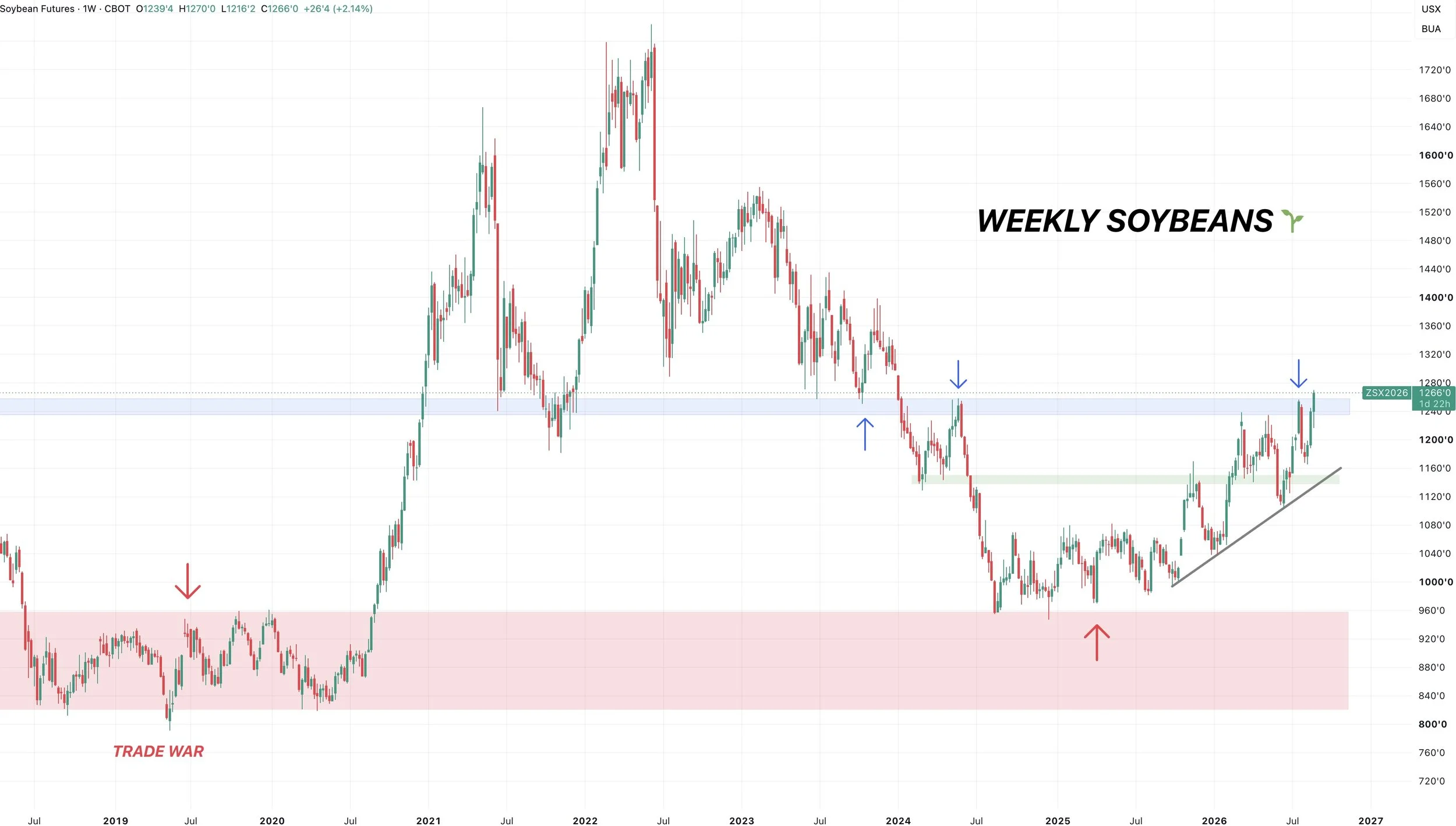
Weekly KC Wheat 🌾
We finally broke that key resistance.
That $7.50 range was the highs from 2024. It was the lows from 2023 and 2022. It was the highs from 2021.
We broke the resistance, as a result we are seeing more upside.
Could very well still have room to run when taking a long term view.
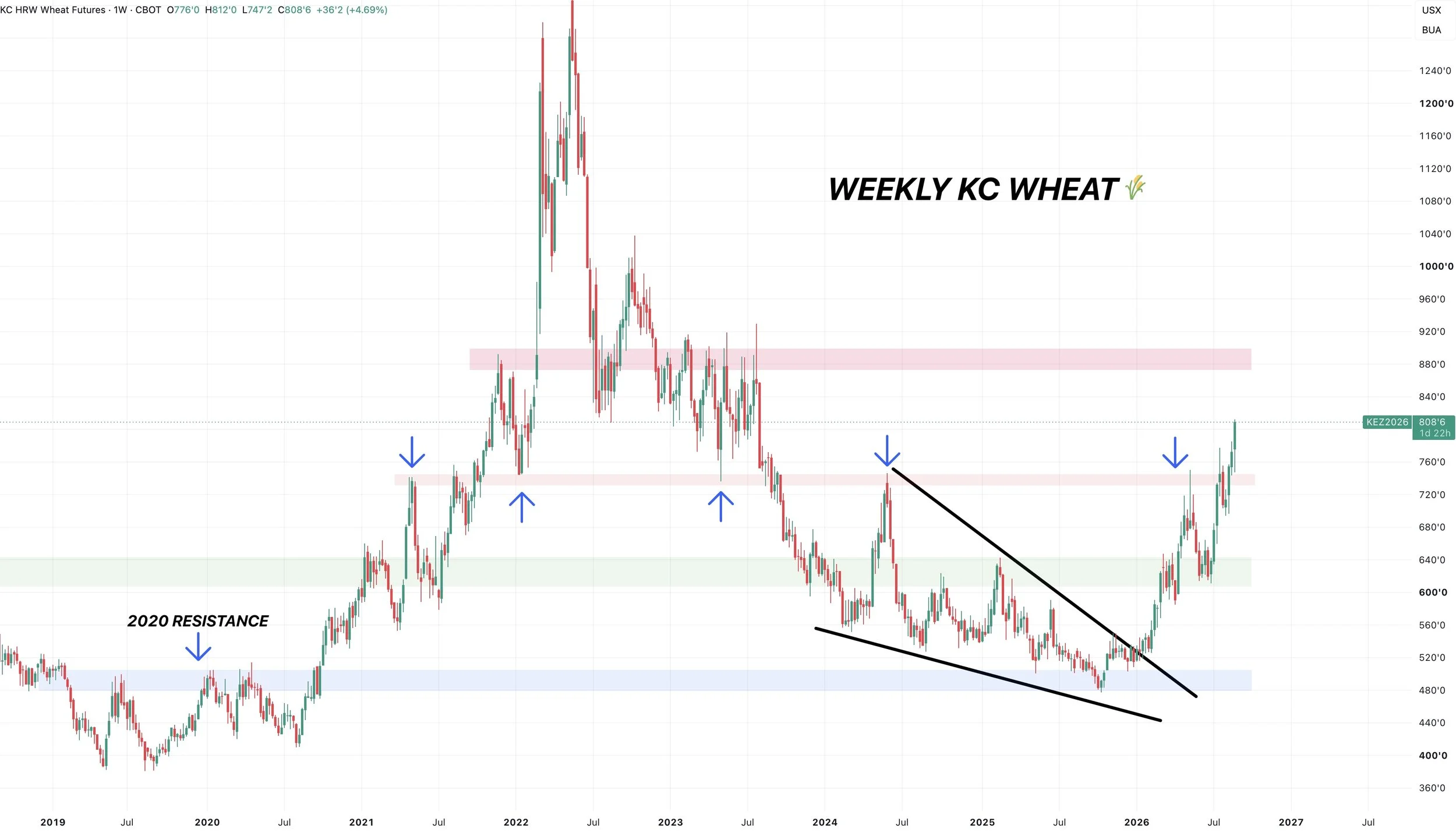
NEXT POSSIBLE TARGETS
Dec Corn 🌽
Clearly breaking out.
$5.50 range is the next target.
$5.56 is the golden fib from the contract lows up to the May highs.
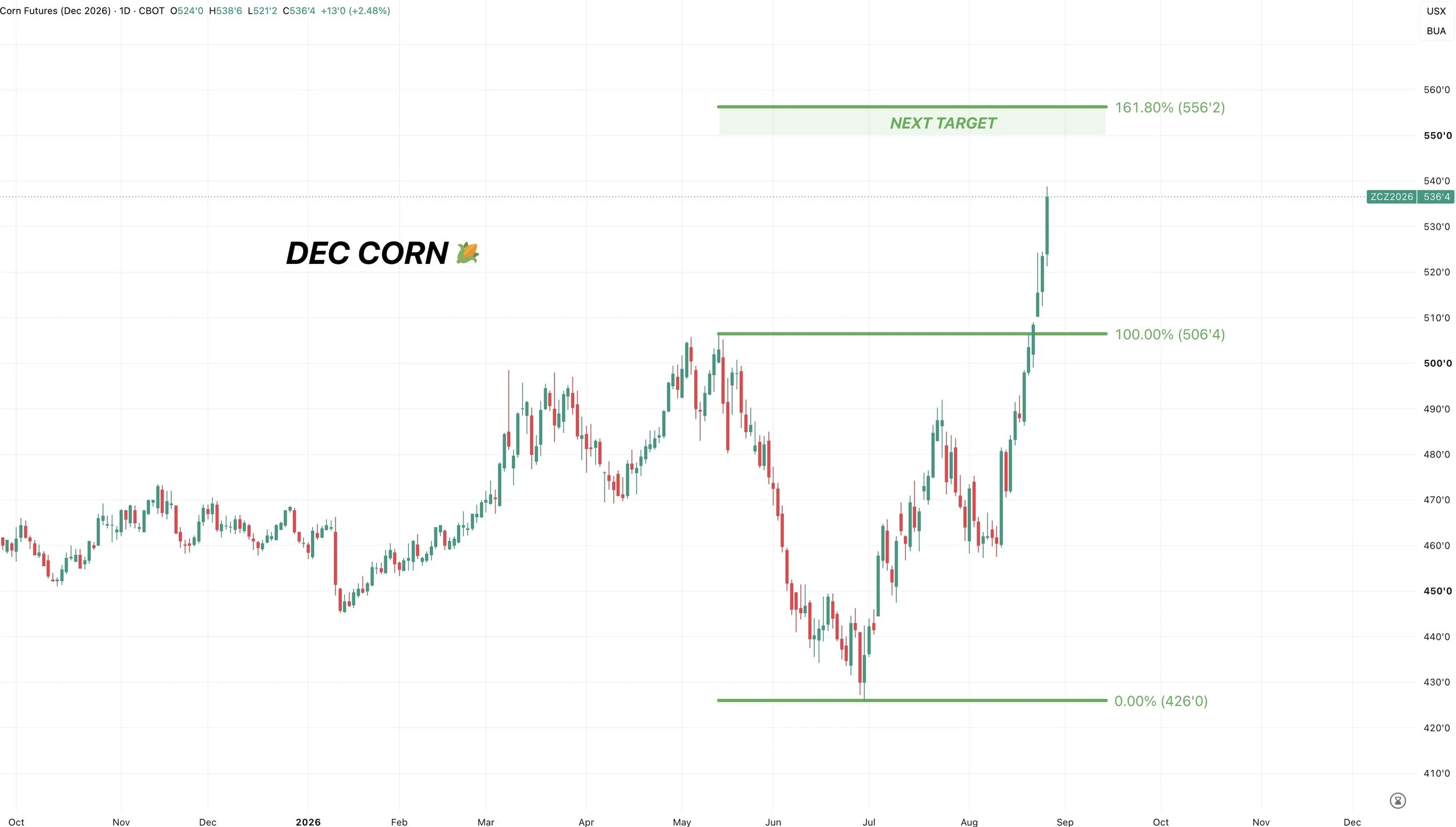
Nov Beans 🌱
We broke above the July highs.
$13.00 range is the next target.
$13.12 is the golden fib from the recent lows up to the July highs.
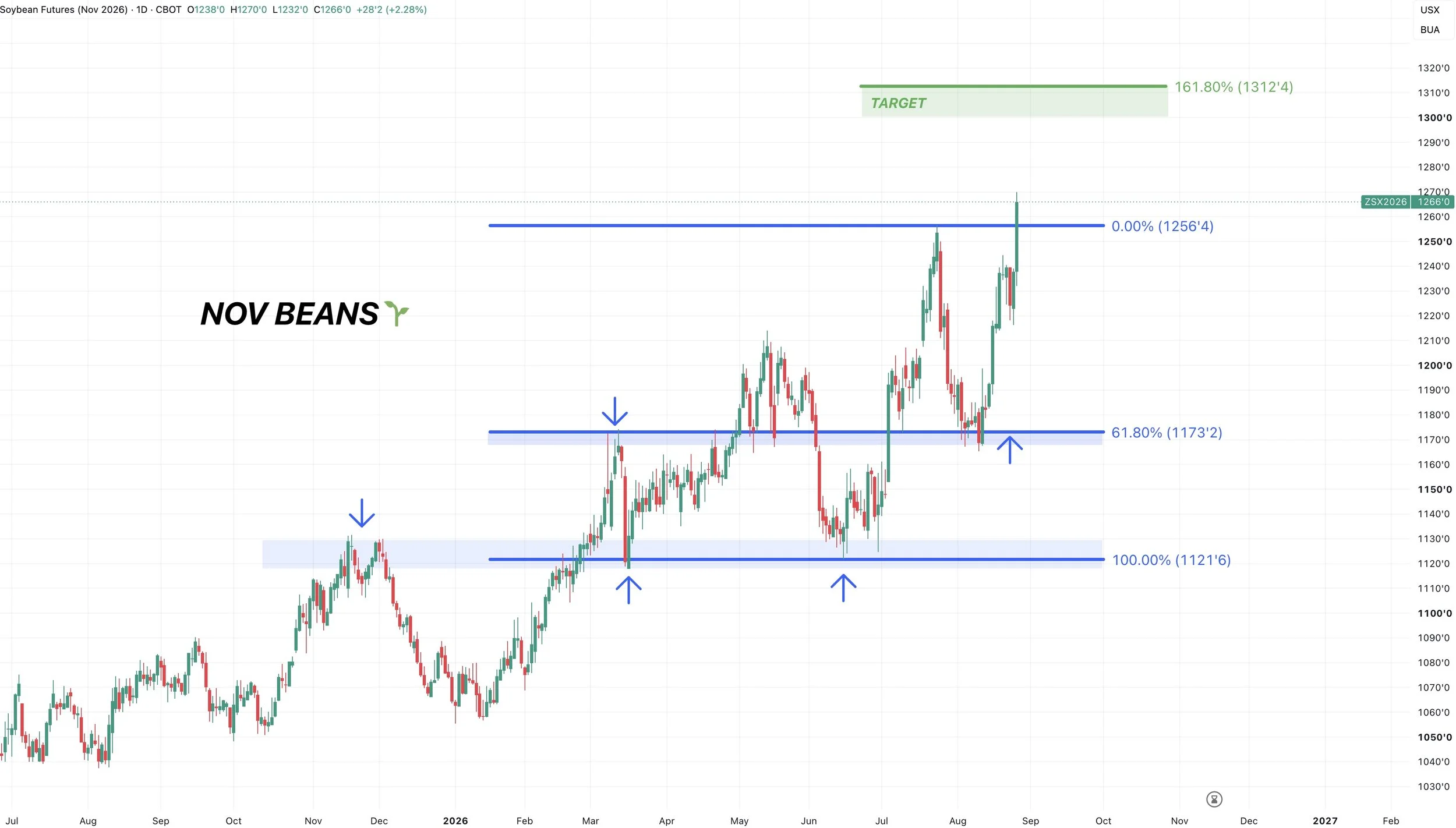
Dec KC Wheat 🌾
Breaking out. Blasting off that volume shelf.
$8.40 to $8.50 is the next target.
That is the implied move from this cup and handle pattern we are breaking out of.
It’s also the golden fib from the June lows up to the May highs.
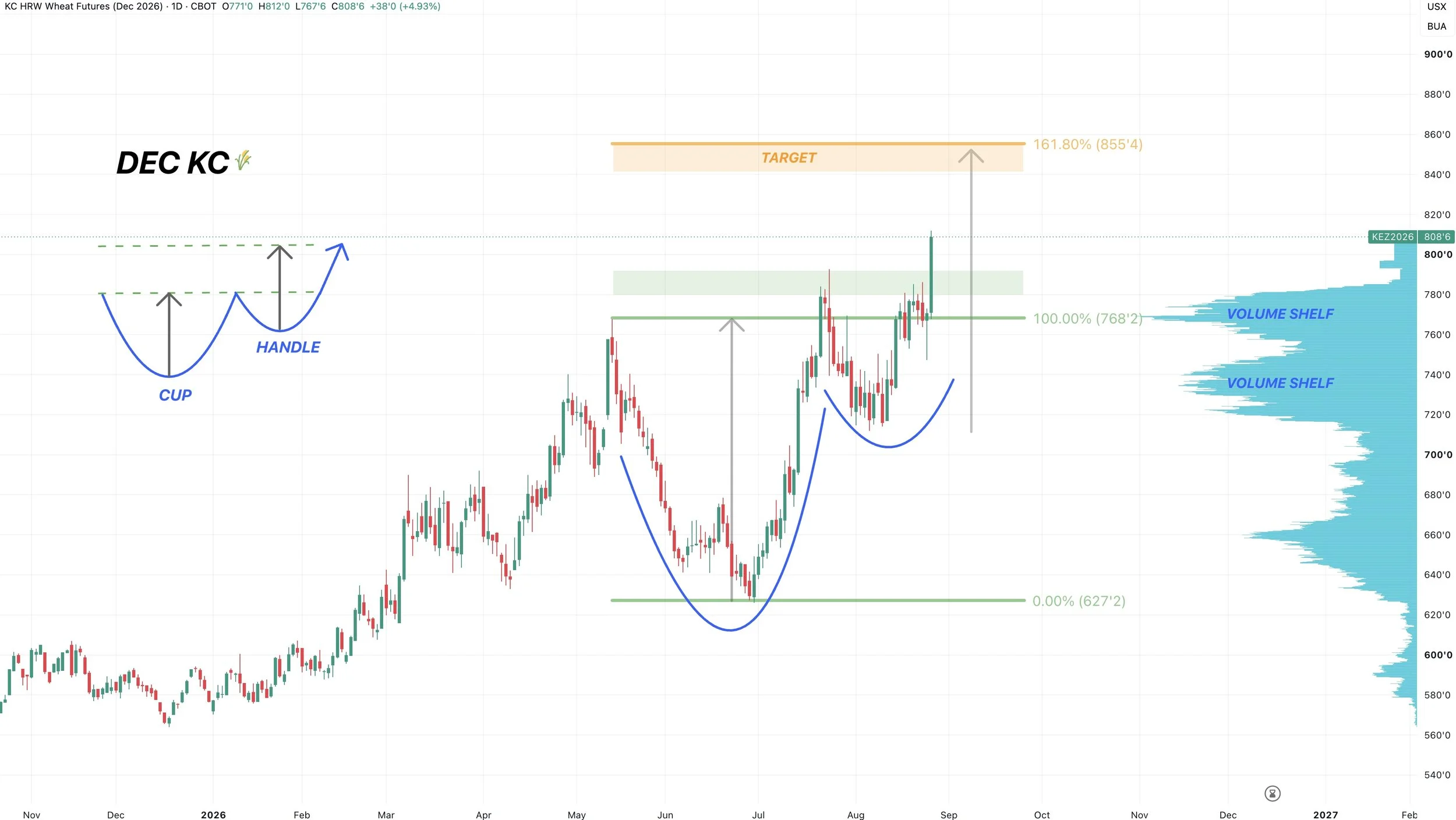
Want to Talk?
Our phones are open 24/7 for you guys if you ever need anything or want to discuss your operation.
Jeremey & Office: (806)484-1214
Sebastian: (605)280-1186
Email: sfrost@dailymarketminute.com
Hedge Account
Interested in a hedge account? Use the link below to set up an account or give us a call.
CORN NEW YEARLY HIGHS. PRO FARMER 173 YIELD
AUDIO COMMENTARY
Corn posts new highs for the year
Reversals on the cattle charts
Friendly cattle on feed after Trump comments
Pro Farmer says 173 corn yield
Largest difference between tour & USDA ever
Funds long large amount but room to buy
Pro Farmer increased bean production
What to do if you are oversold?
Market doesn’t believe we have huge crop
Can sell $6-7 corn calls for decent money
China buying a lot of soybeans
Corn been straight up since USDA report
This market is largely led by demand
Making new highs when usually make lows. Counter seasonal rallies can be pretty powerful
Great opportunities for protection here
We want to ride the wave higher via options
Do not want to gap higher then close lower
Pro Farmer vs USDA data below audio*
Listen to today’s audio below
Want to talk?
Office: (806)484-1214
Your free trial has expired
TOUR VS USDA DATA
Pro Farmer: 173.2
Aug USDA: 180.7
Difference: -7.5
Below is a graph that shows the last several year’s difference from the tour vs the final USDA.
Simply by looking at the graph, the tour has a tendency to be lower than final yield, but does that tell the whole story?
Make sure to keep scrolling as we dive deeper into this data.
The last chart I show has the most data and breaks it all down.
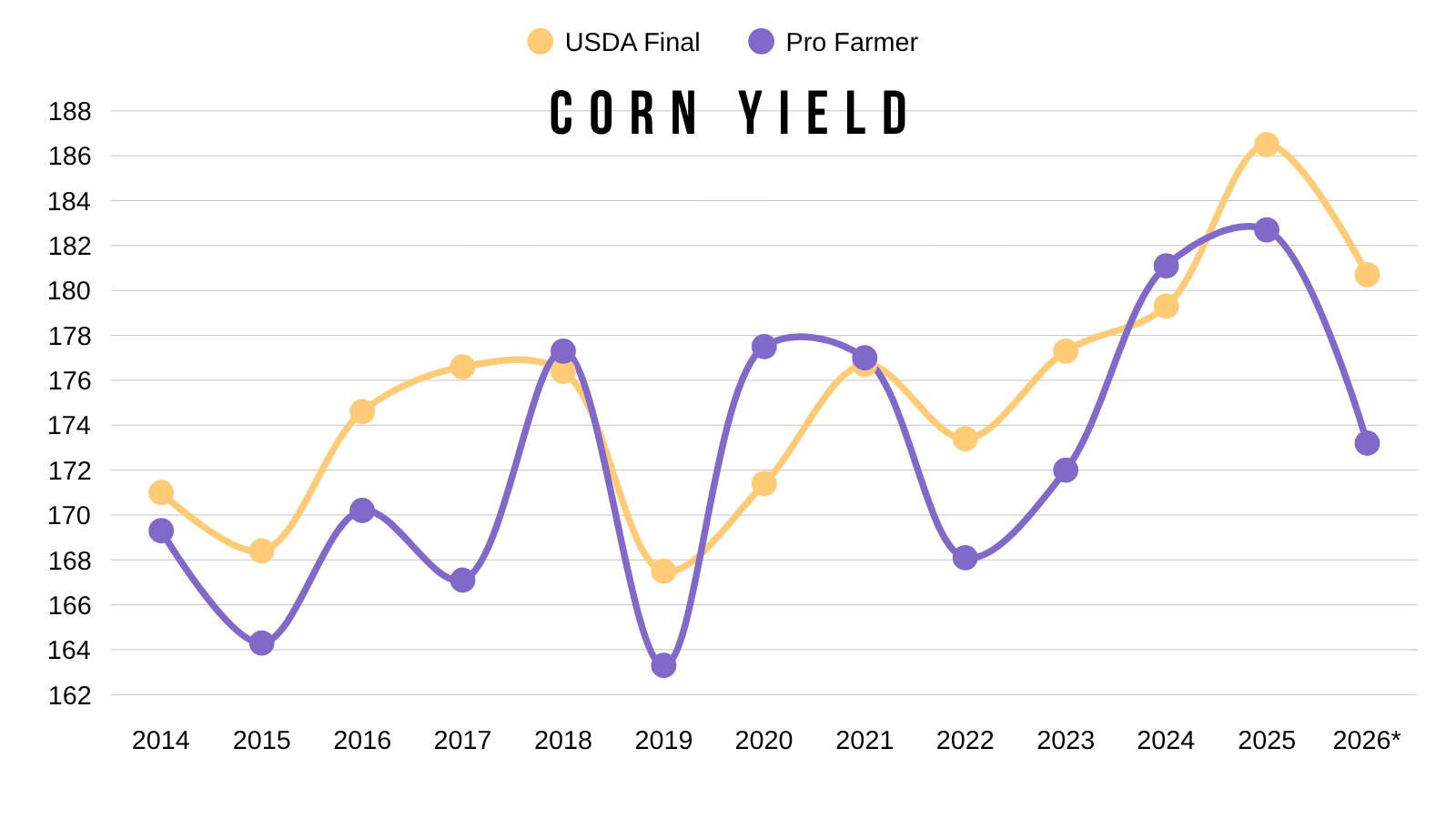
This graph shows the last 20 years of the tour vs final USDA.
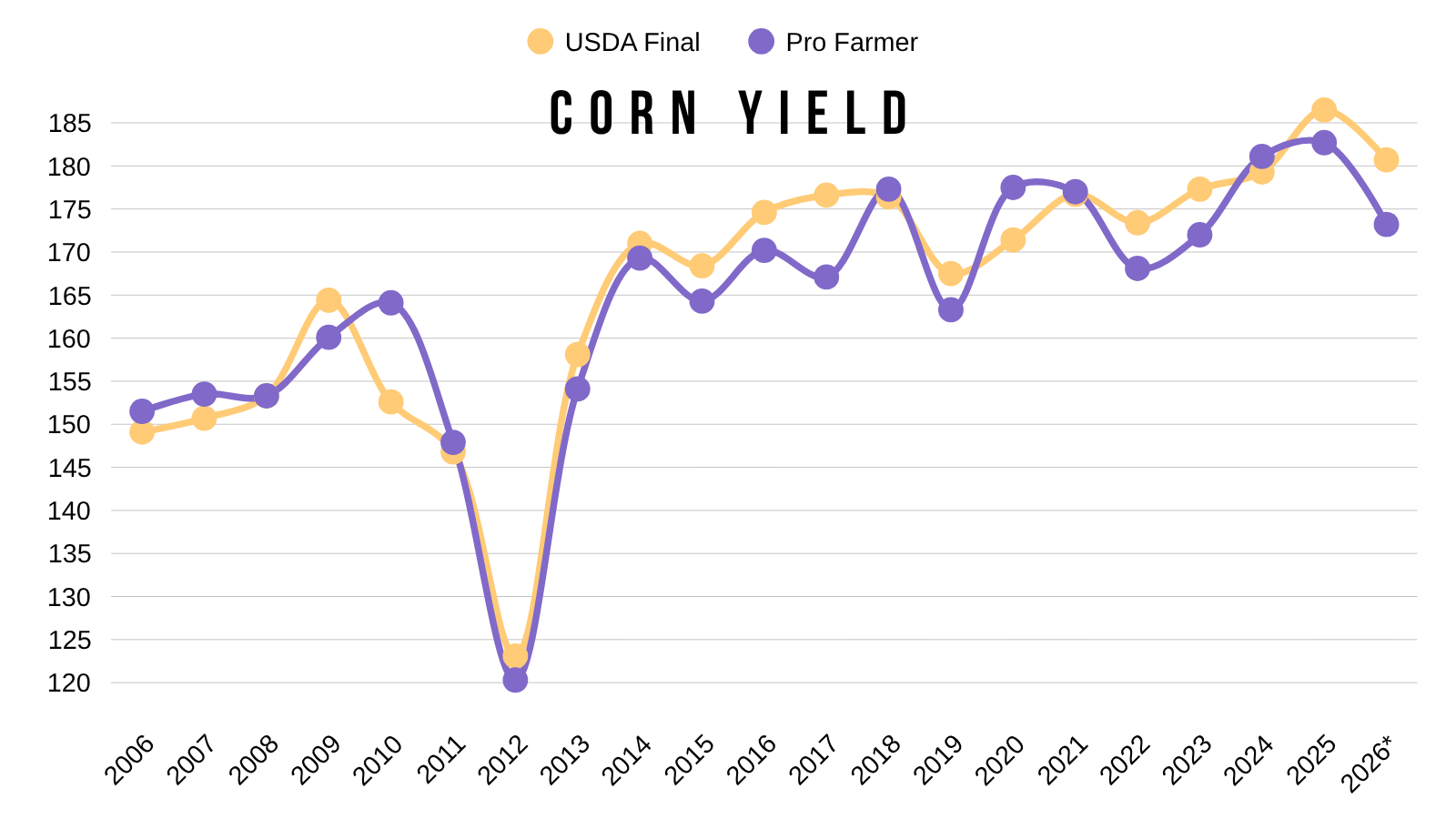
Average Deviation: Tour vs Final USDA
Here is a chart that shows the data for the last 20 years and how far off the tour has been from the final USDA.
Over the last 20 years, the average deviation has been around 3-4 bushels higher or lower when compared to the final USDA.
Over the last 10 years, Pro Farmer has on average came in 2.5 bpa lower than the final USDA.
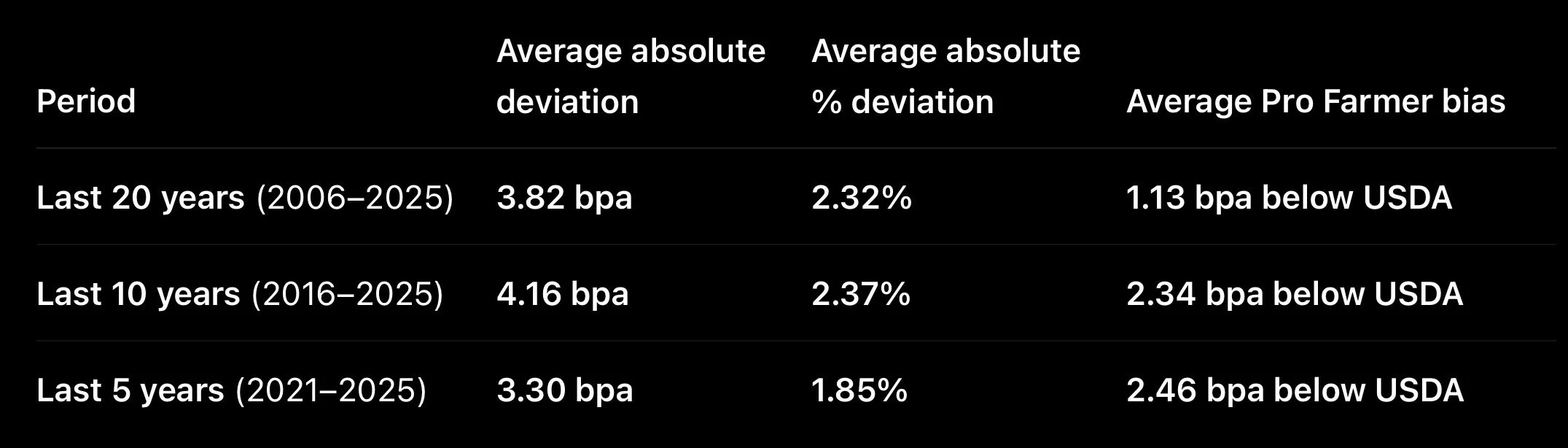
Tour vs Aug USDA vs Final USDA:
Since 2014, the tour has correctly pointed in the direction of where final yield came in compared to August in all but two years.
The two years it was wrong on the direction were 2017 and 2023.
Pro Farmer’s 173.2 is -7.5 bpa below the USDA’s 180.7
That would be the largest difference between the tour and the Aug USDA in at least a decade.
Here are some other years where Pro Farmer was more than 5 bpa below the Aug estimate and what happened to final yield.
2019:
Tour -6.2 bpa below Aug USDA
Final USDA was -2 bpa below Aug USDA
2022:
Tour was -7.3 bpa below Aug USDA
Final USDA was -2 bpa below Aug USDA
2025:
Tour was -6.1 bpa below Aug USDA
Final USDA was -2.3 bpa below Aug USDA
So each time the tour has been this far below the USDA’s August number, the final yield has came in lower than in August.
But the final yield did not come all the way down to the Pro Farmer numbers.
Take a look at 2019, 2022, and 2025 on this table for reference.
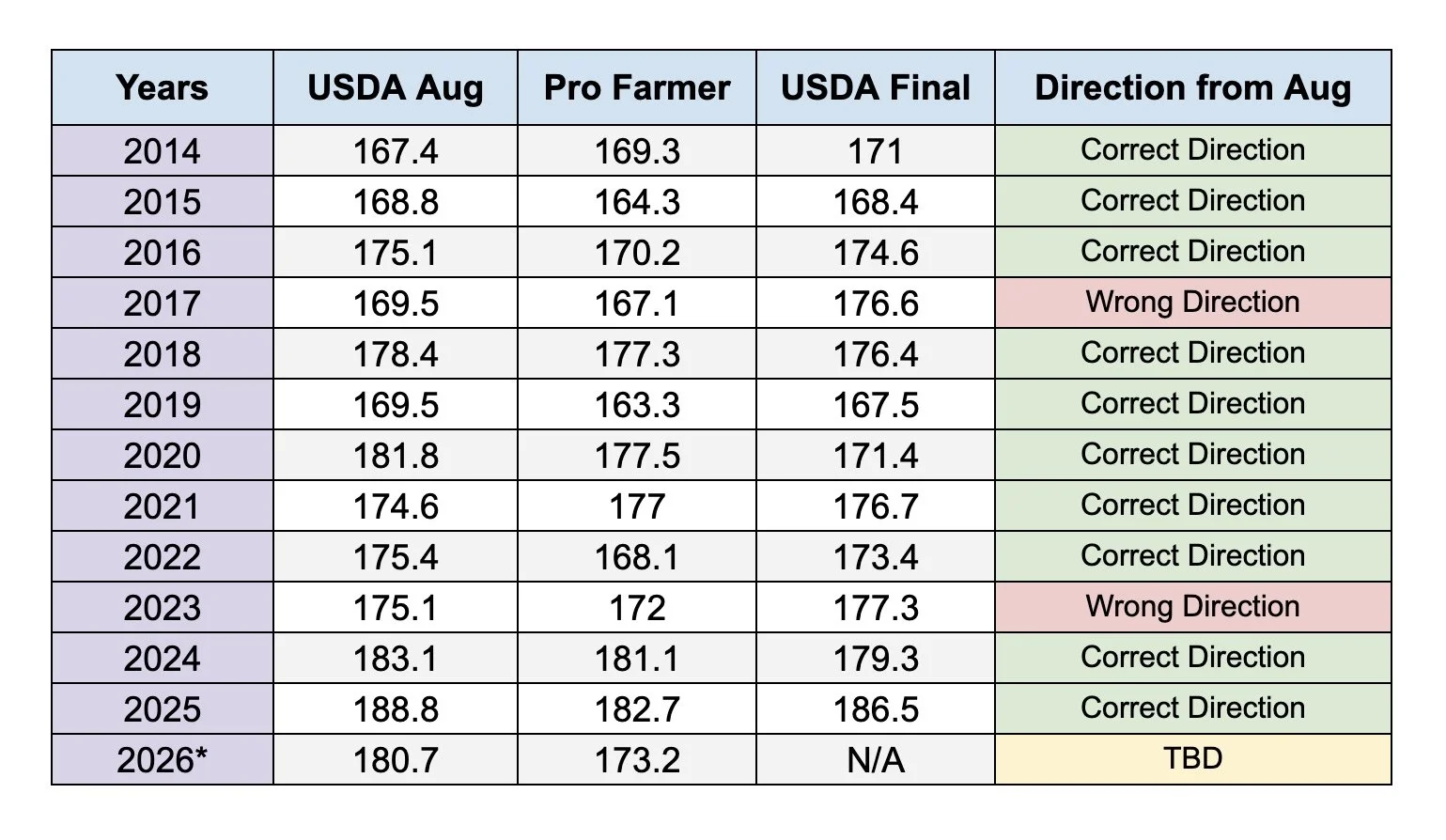
Here is the tour vs Aug USDA vs final USDA chart.
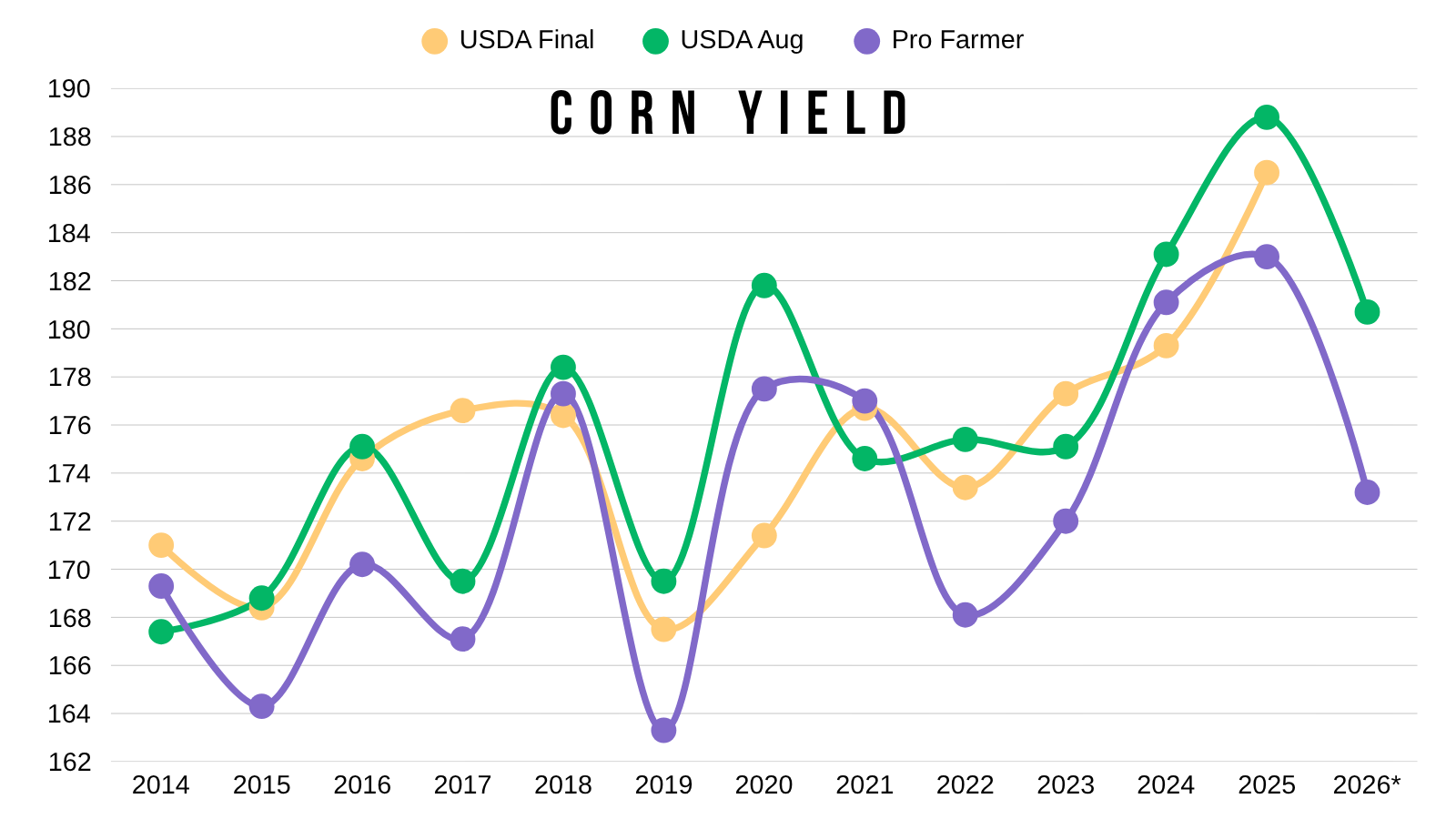
Want to Talk?
Our phones are open 24/7 for you guys if you ever need anything or want to discuss your operation.
Jeremey & Office: (806)484-1214
Sebastian: (605)280-1186
Email: sfrost@dailymarketminute.com
Hedge Account
Interested in a hedge account? Use the link below to set up an account or give us a call.
GRAINS KNOCKING ON YEARLY HIGHS
MARKET UPDATE
You can scroll to read the usual update as well. As the written version is the exact same as the video.
Timestamps for video:
Crop Tours: 0:00min
Corn: 1:50min
Corn Charts: 7:00min
Beans: 9:15min
Beans Charts: 11:15min
Wheat Charts: 12:50min
Cattle Charts: 14:20min
Want to talk?
Office: (806)484-1214
Your free trial has expired
Futures Prices Close
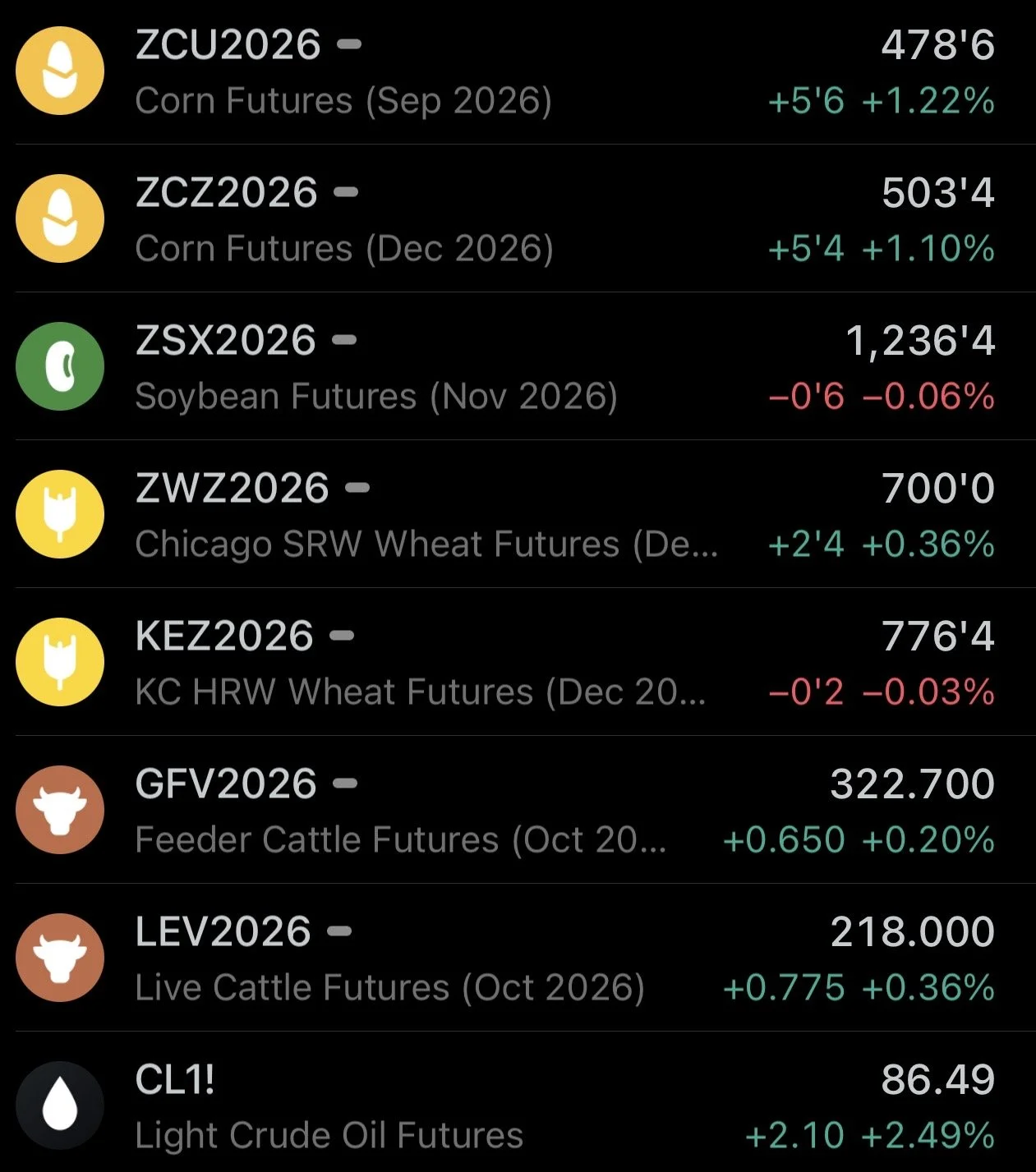
Overview
Corn continues to lead the counter seasonal rally off the back of the Pro Farmer crop tours that continue to show disappointing results.
Corn, soybeans, and wheat are all knocking on the door of their highest prices they've seen all year long. Within striking distance of contract highs in all three as well.
Dec corn is up +45 cents the last week alone, since last week's USDA report.
Let's jump right into the crop tours as this is the main headline that's caught the market's attention.
Crop Tours
The results have been coming in quiet a bit worse than most were expecting.
This has led to the market to starting to question what happens to the balance sheet if yield drops even further. Below the USDA's recent 180.7 bpa. We'll get into this later, but it would make things very interesting.
So far we only have the data for 5 states. They did western Iowa, but the full Iowa results will be out tonight.
Corn:
Below is a chart that shows how the USDA expects each states yield vs last year. Along with how the crop tour expects yield vs last year.
The crop tour has yields lower than the USDA for every single state they've toured so far.
Even states such as Ohio and Indiana where the USDA expects a better yield than last year, the crop tours are showing worse yields than last year.
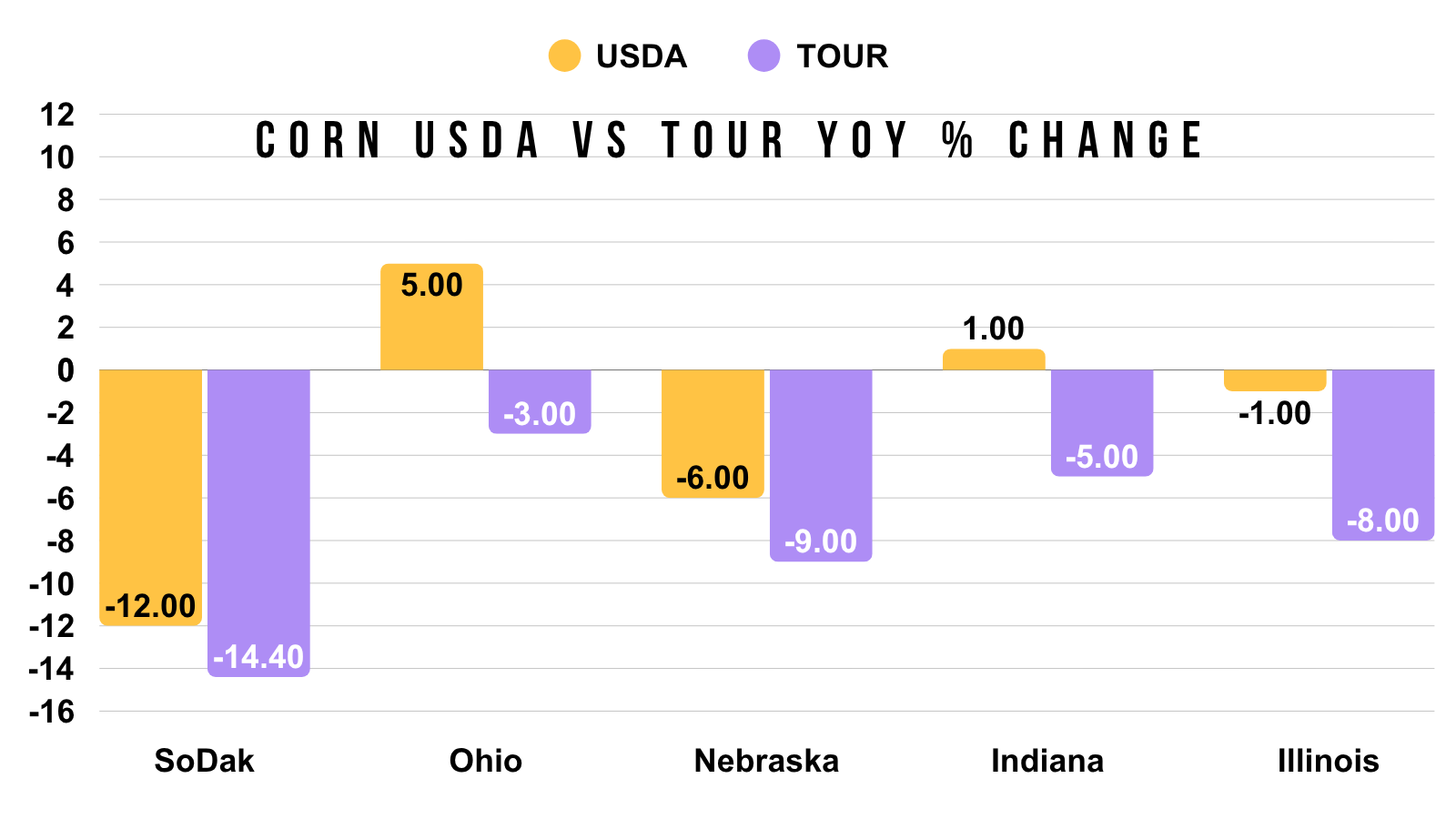
Soybeans:
The tour has pod counts lower than the USDA expects yield in every state besides from Nebraska.
Again we are seeing similar results here like in corn.
The USDA has yield improving vs last year in Ohio, Indiana, and Illinois. Yet the tour's results are showing lower pod counts in all of them.
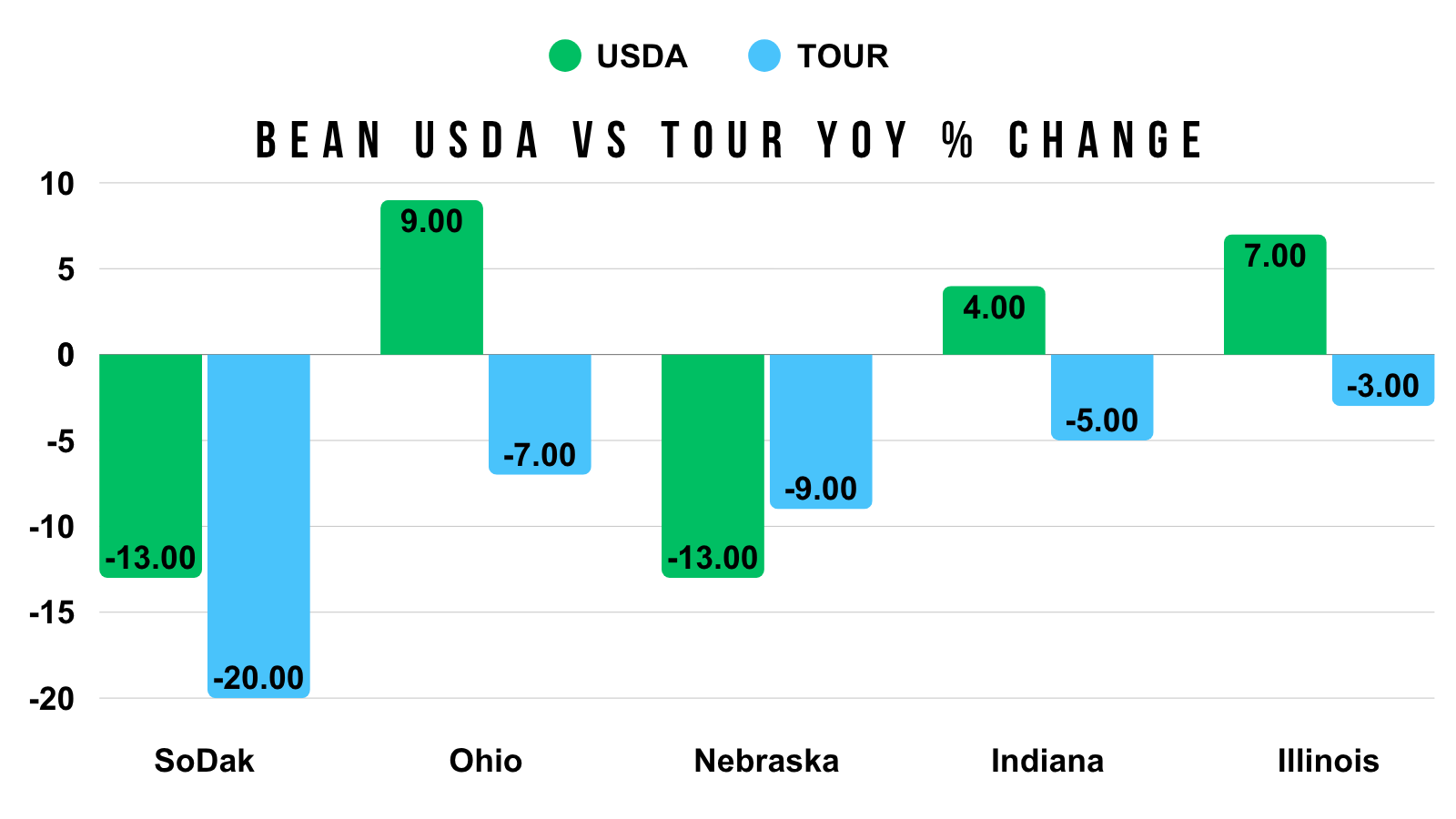
Today's Main Takeaways
Corn
Fundamentals:
These tours are sparking a lot of conversation about a yield below 180.7 bpa.
And what happens if yield were to come in lower than that, perhaps in that 175 to 178 range?
A 180.7 bpa yield would still be the 2nd largest yield of all-time.
A 178 yield would be the 3rd largest of all-time.
So a yield below 180 would not be out of the realm of impossible.
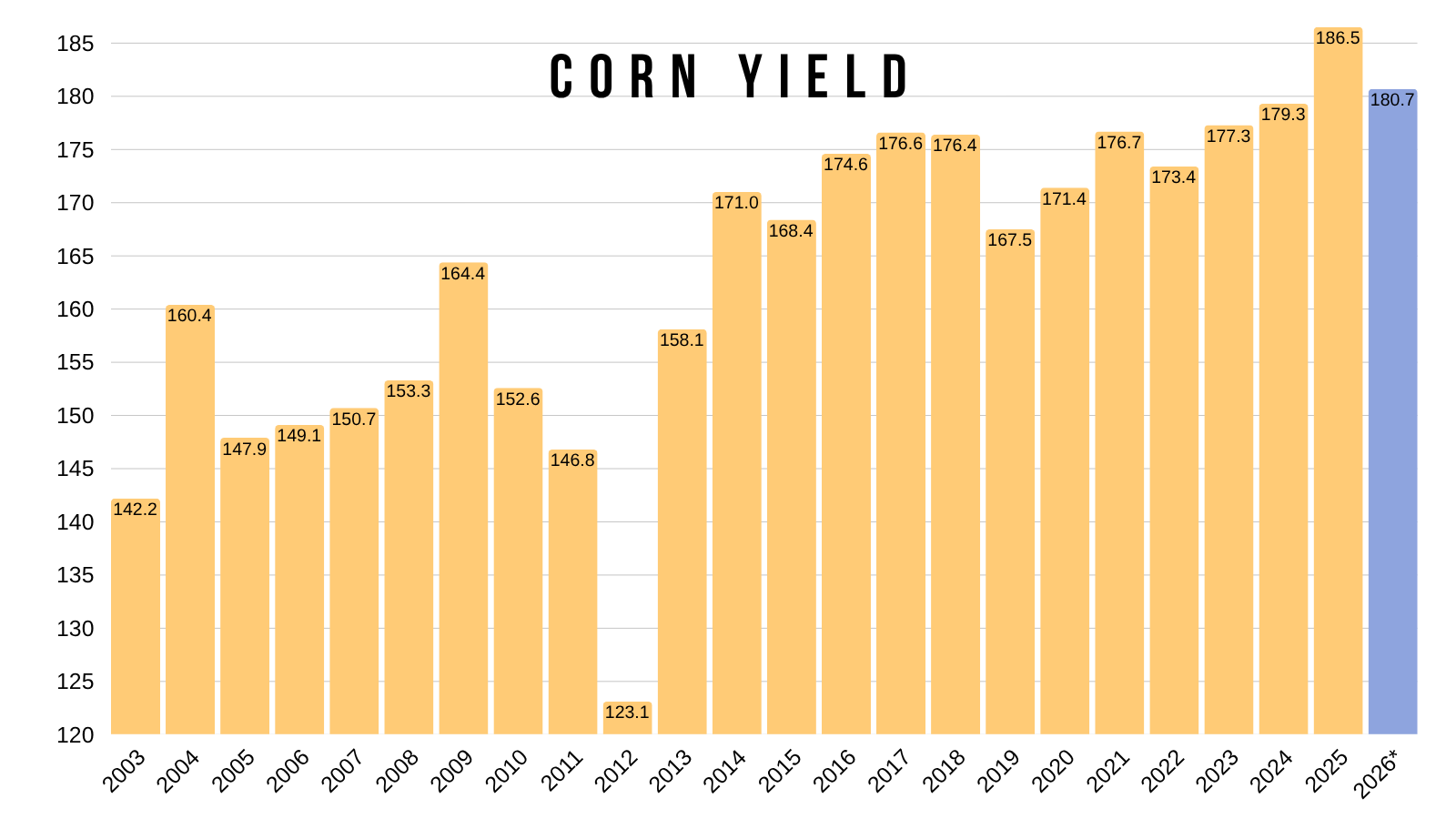
If yield gets much lower from here, we simply cannot meet the record demand we've been creating with these low prices the last few years.
We could realistically see one of the largest crops we've ever seen and still run into some bull market conditions simply due to demand.
Our exports have literally doubled since 2022/23.
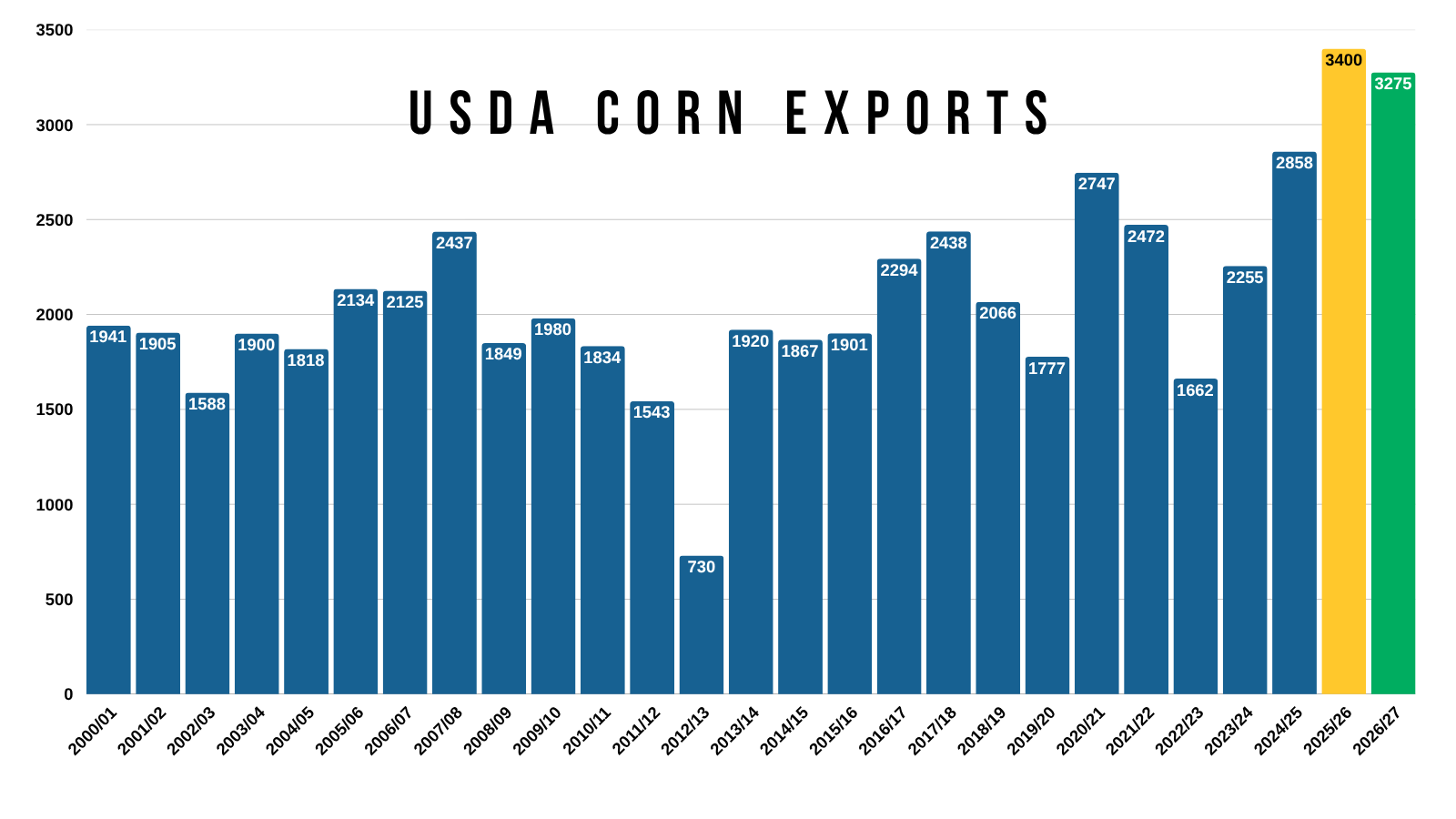
What happens if yield is sub 180?
Let's throw the numbers into the balance sheet.
For these examples, we will be leaving demand unchanged.
179 yield = 9.20% S/U
178 yield = 8.66% S/U
177 yield = 8.11% S/U
Those are all very bullish scenarios with a sub 10% stocks to use.
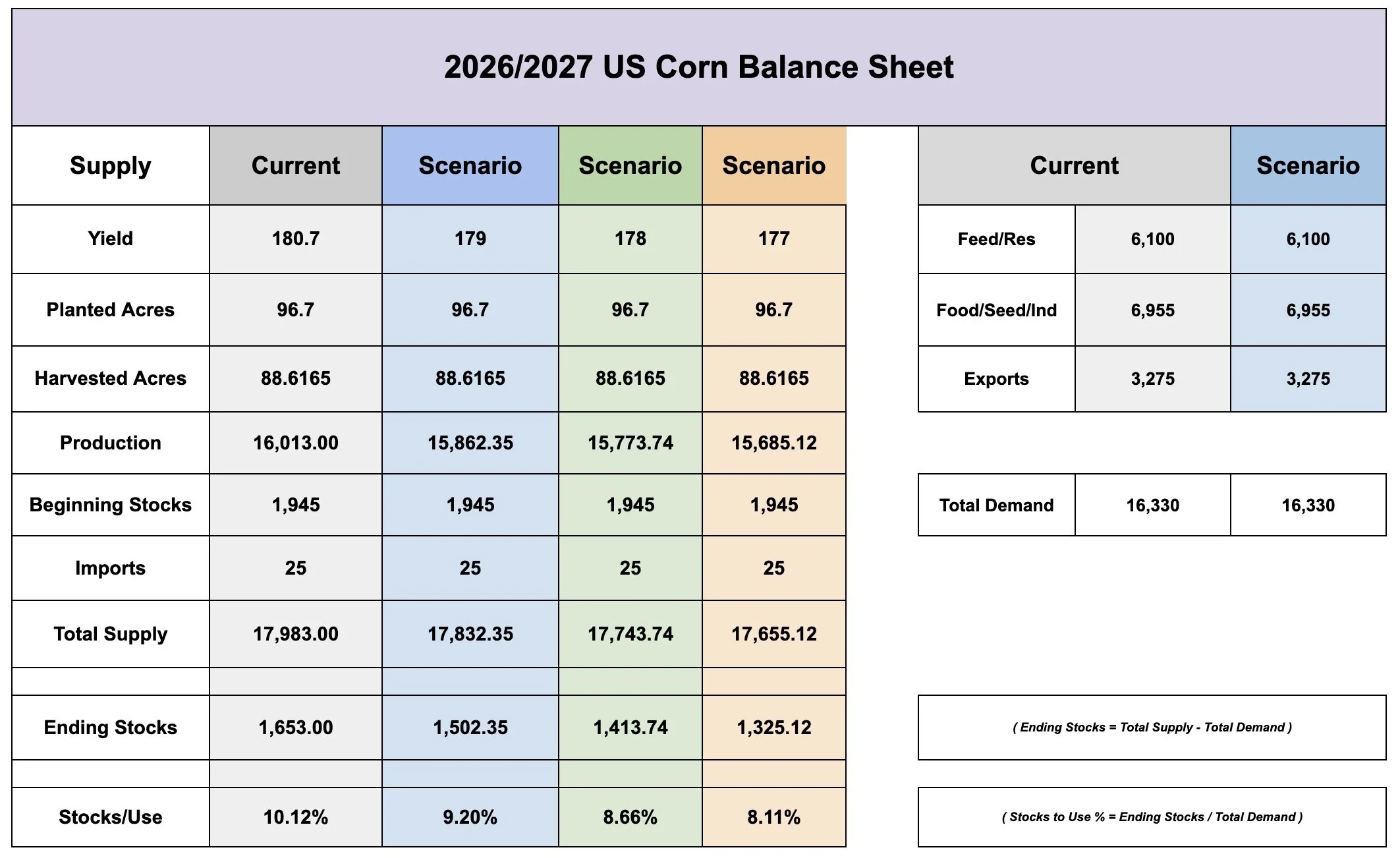
Normally, the USDA will try to offset losses in supply with losses in demand.
However, just because we have less supply does not mean that the demand is simply going to disappear.
To justify us losing demand, prices would need to go higher.
Demand isn’t going anywhere unless we have high enough prices to incentive doing so. Prices at these levels are not going to do that.
This record demand needs to be met with supply, or we should go higher.
One very possible thing we could see happen is the USDA bumping up our old crop exports once again.
Let's say they bump them by +100 million.
That alone drops the new crop balance sheet below a 10% S/U even if yield ends up at 180.7 bpa.
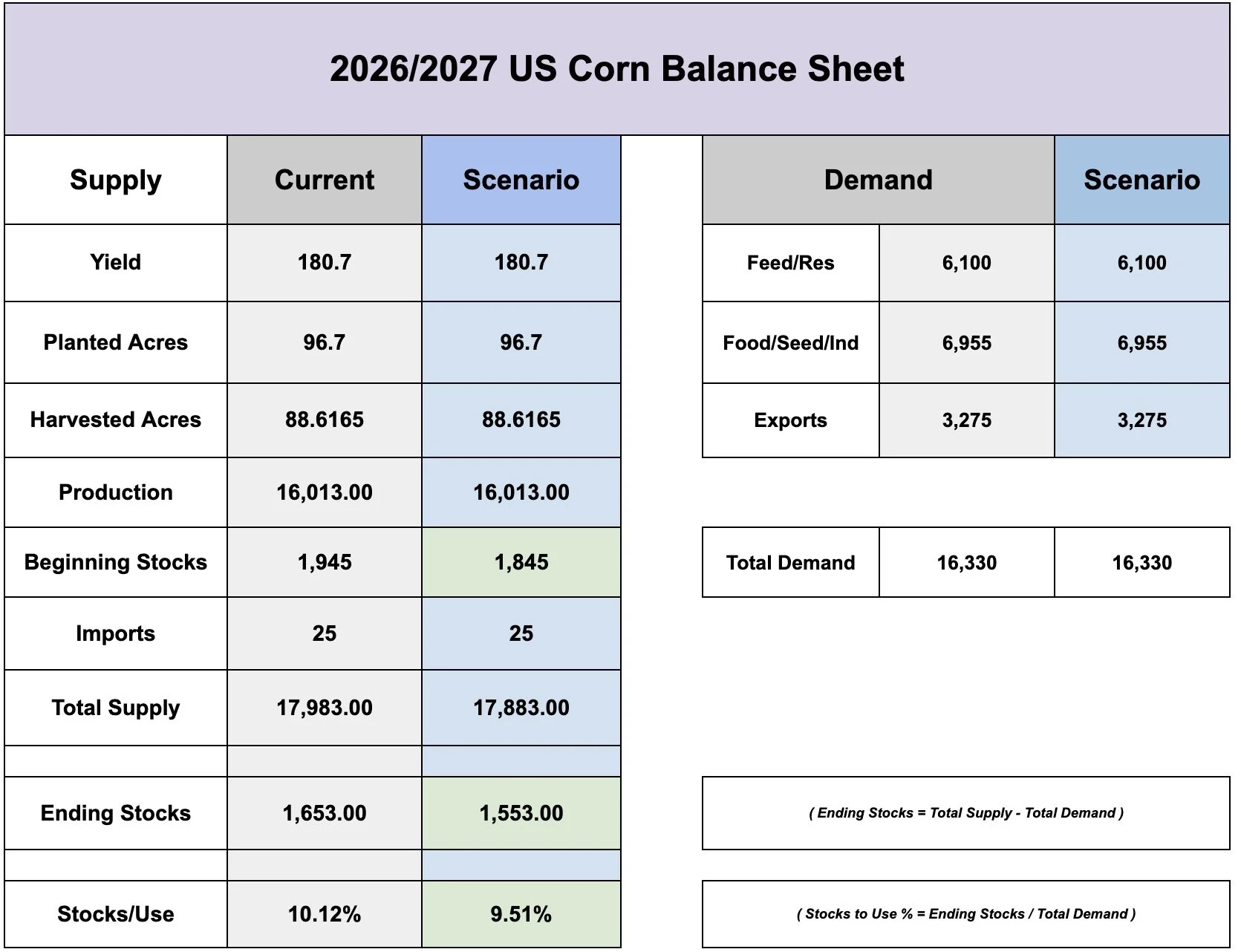
Like we've talked about a thousand times.
If you want corn much above $5.00 or so, that stocks to use needs to fall below 10%.
Each bull run has had a below 10% stocks to use.
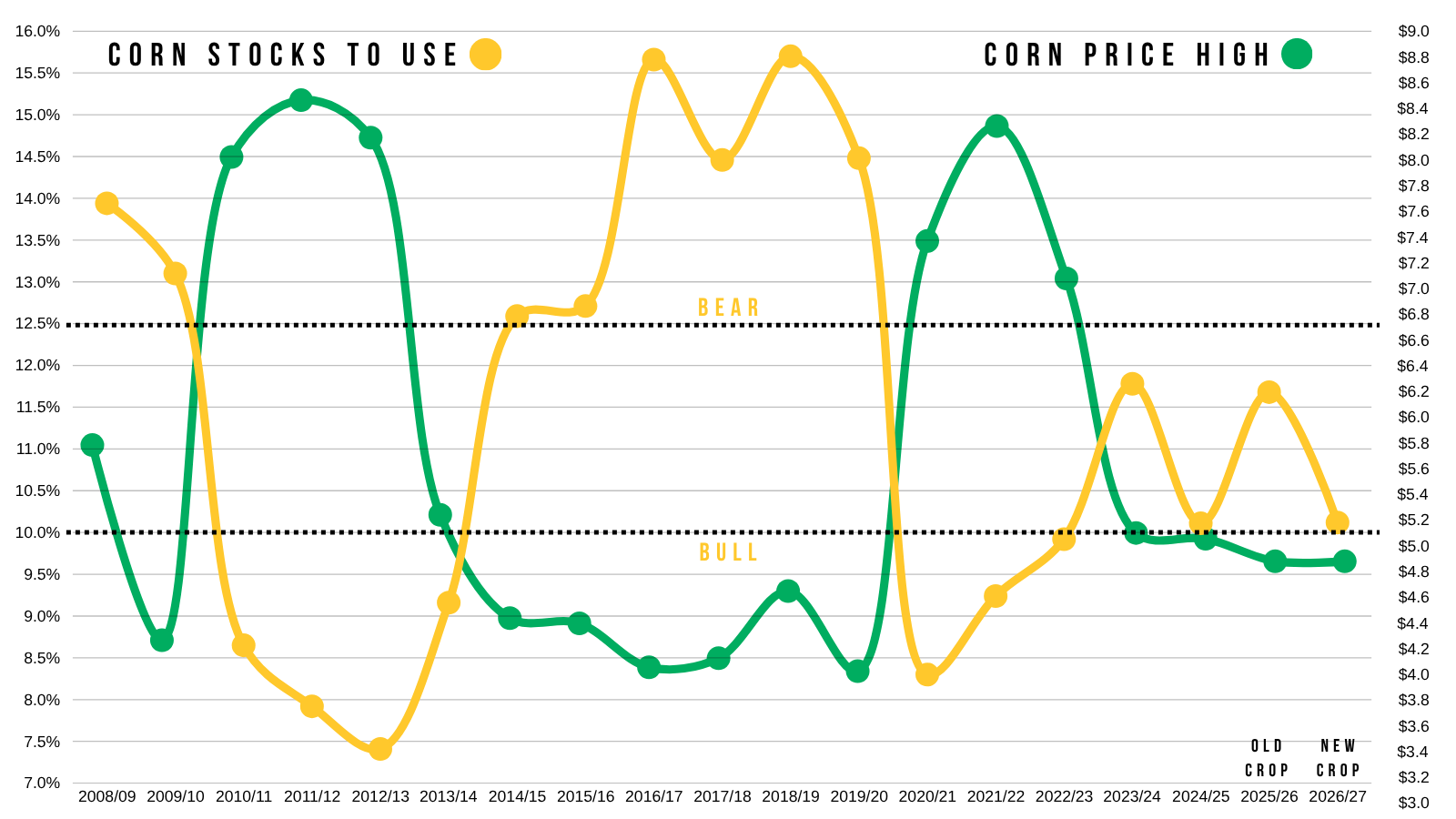
As we've talked about the last week, we are starting off in a very tight spot.
As of the August USDA, we have the tightest situation for August since 2022.
With the potential to get even tighter if yield doesn’t rise or if the USDA doesn’t find more acres again.
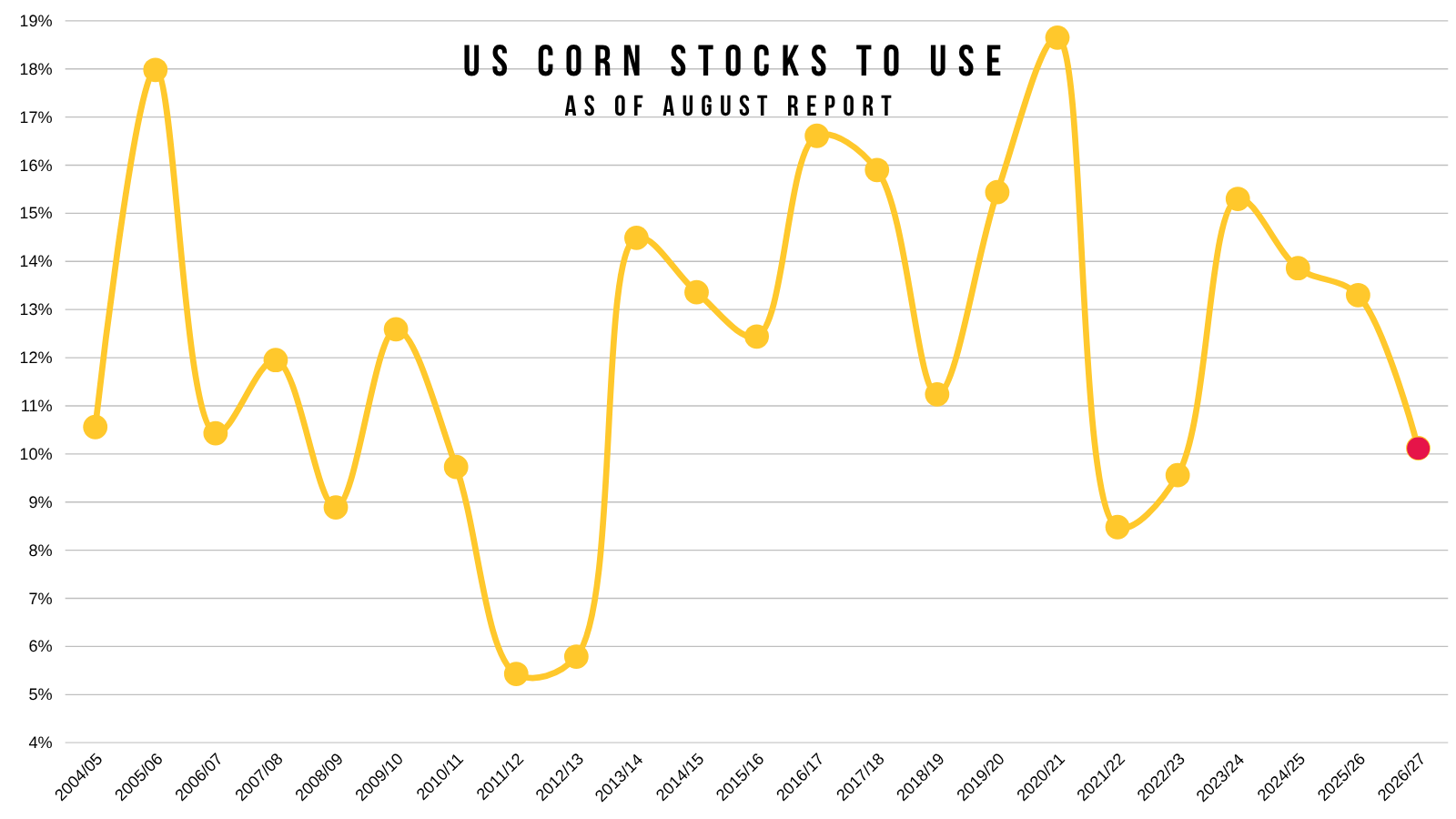
Not only do we have the tight US situation.
Let's not forget the world is the tightest it's been on corn in over a decade.
So the world clearly needs the US to perform. Or we simply can’t meet the global demand.
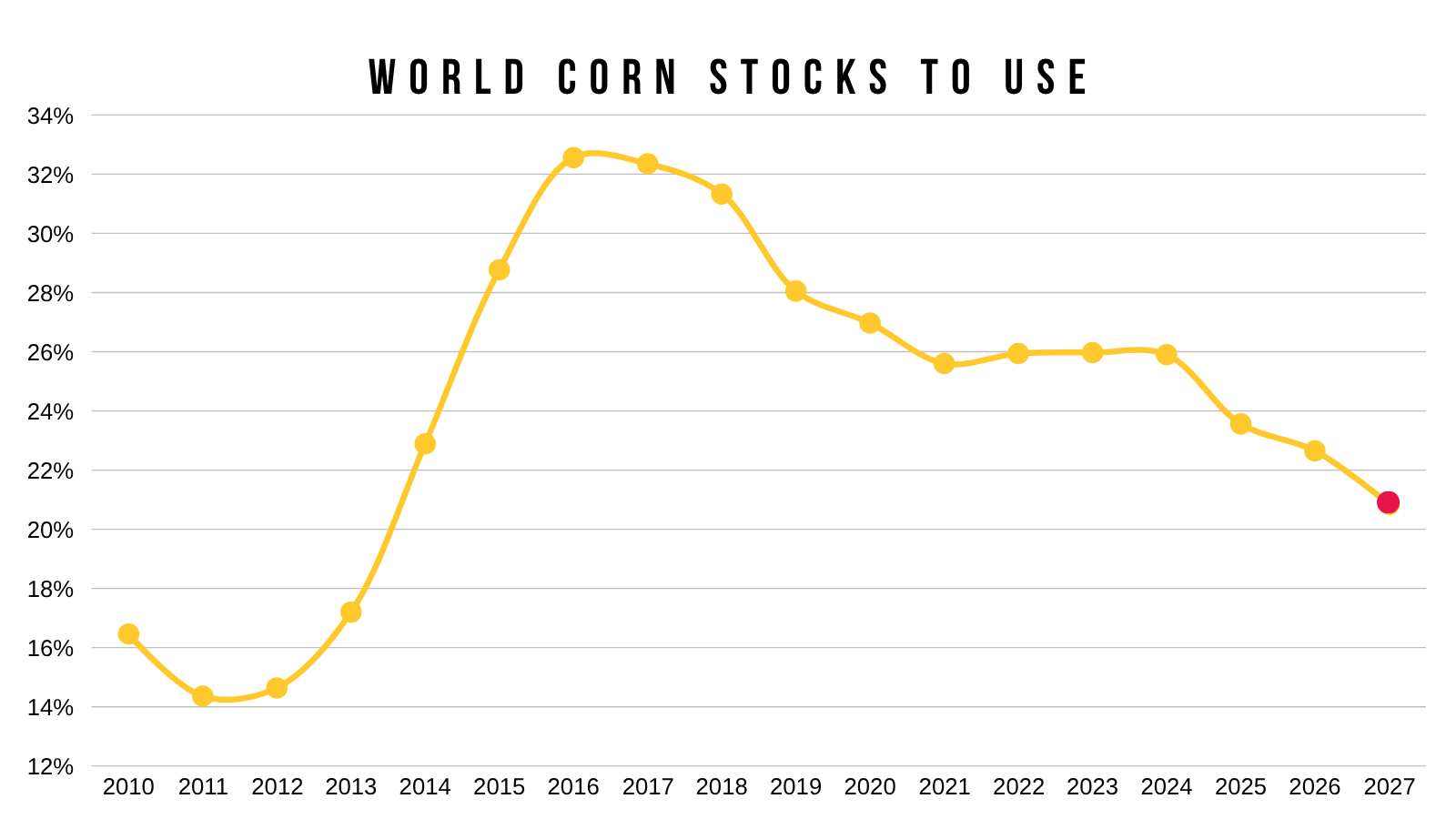
Highs by Month:
We haven’t shown this chart since May. This shows new crop corns highest price for every single month the last 20 years.
Today we came within a penny of those May highs.
We have not posted our highs for the year in August since 2011 and 2012.
Other things to note, we have never posted our highs in September or October.
The last two bull markets came after we posted our highs in November the year prior. (2020 and 2010).
So if you are looking for an indication we are going a lot higher. Posting new highs into the end of the year has been a good sign.
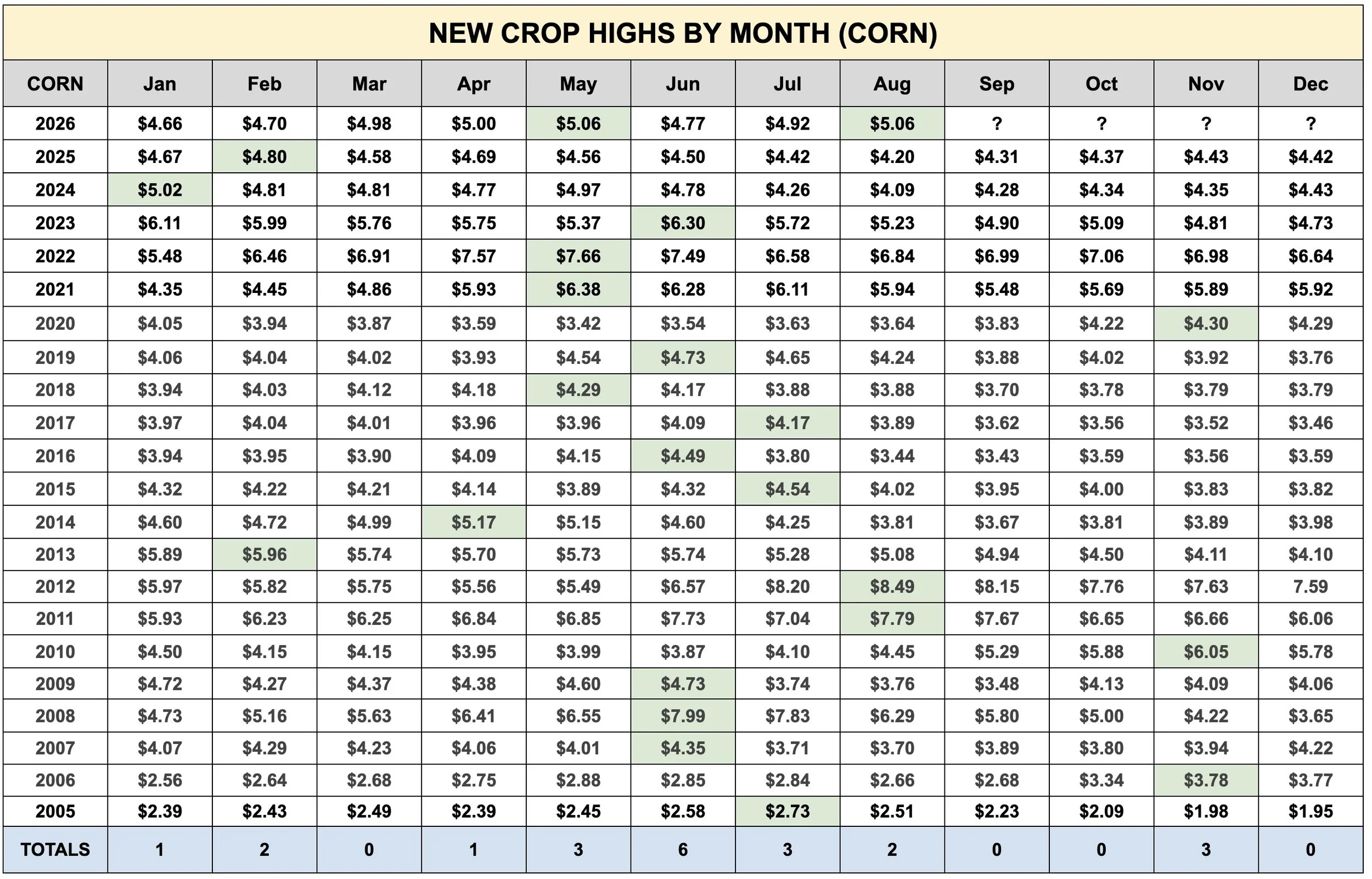
Yesterday's Alert:
Yesterday we did send out a sell and hedge alert.
This was mostly geared towards those who:
Are behind in their marketing
Are short on time
Lack storage
Need to move off the combine
Our thoughts are still that corn has a ton of upside potential.
So if you are in a comfortable spot in your marketing and don’t need to do anything, we like being plenty patient. As I think we will see more opportunities down the road.
Jeremey talked about this in depth yesterday. But one thing we do NOT want to do is put ourselves in a situation where we are oversold.
We've been in a multi-year bear market. Nothing would be worse than selling everything and having this market go crazy high.
Do we "have" to go massively higher? No. But we have to respect that the potential is there for the first time in a long time. So it makes sense to keep plenty of dry powder in case that does happen, even though, it doesn’t "have" to happen.
But those who are in one of those situations where you need to be more proactive, you can not completely ignore this opportunity.
We are at our highest price we've had all year, heading into harvest.
This has been a phenomenal counter seasonal rally.
They don’t happen that often.
Normally we are posting our lowest price for the year right about now, not our highest price.
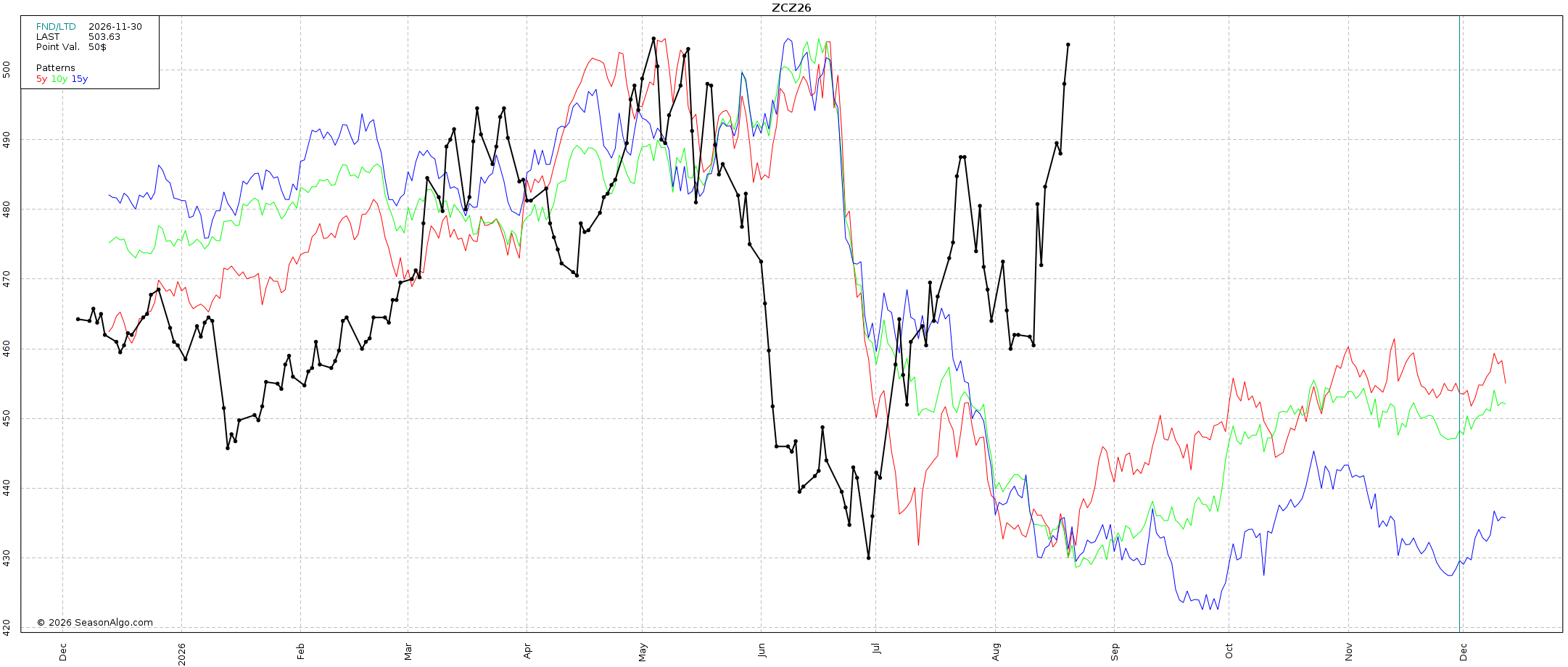
If you compare Dec corn over the last several years.
This is the highest price we've seen for today's date since 2022.
Surpassing 2023 and sitting far above both 2024 and 2025.
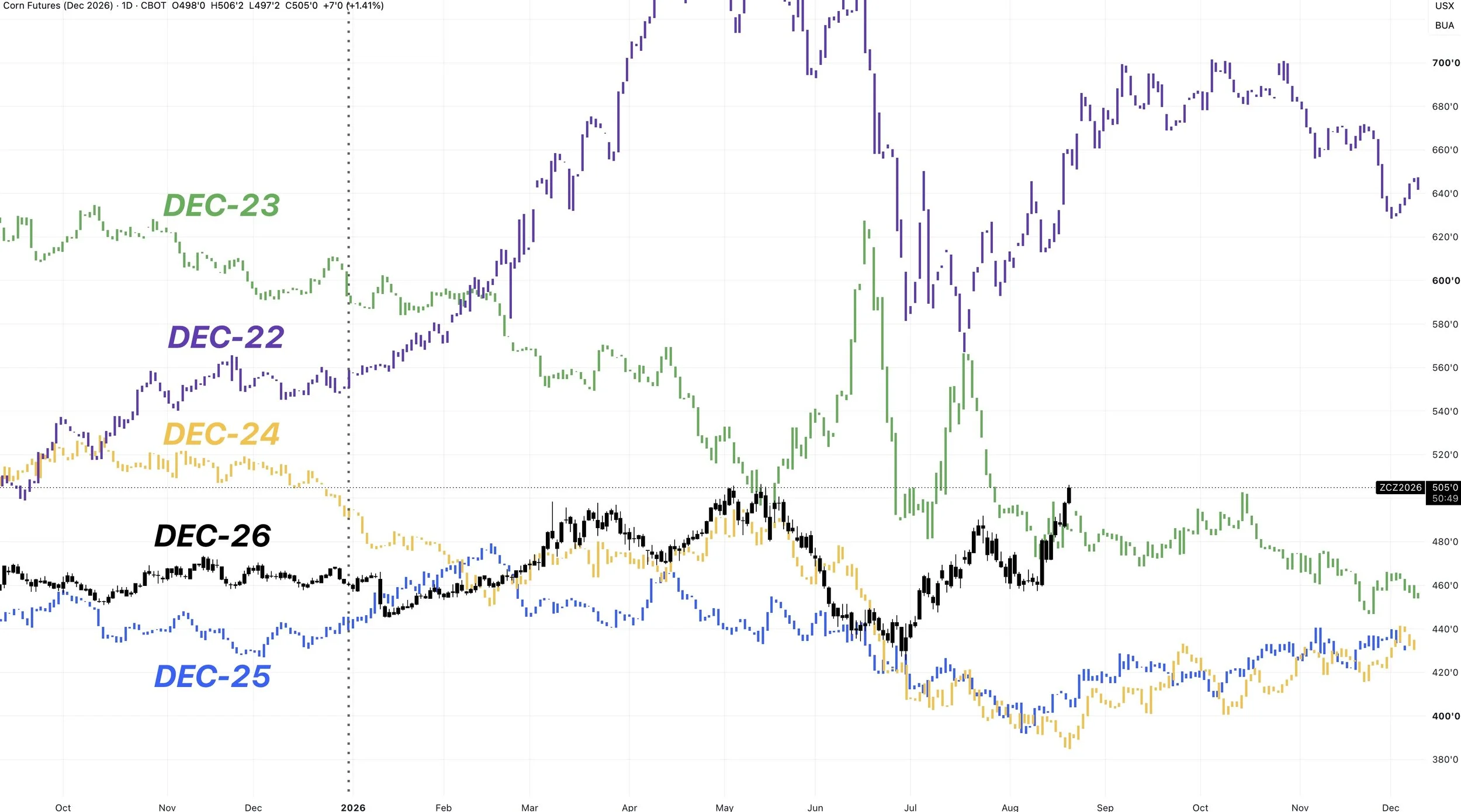
In yesterday's alert, we covered a few different strategies you could consider.
We always prefer to use options as a tool to lock in a floor or keep your upside open. As using options simply gives you a lot of flexibility in your marketing.
Some of those strategies included puts for downside protection. Selling calls to help pay for the puts. Or selling some cash and re-owning with options.
If you have questions on them, as always please give us a call or a text and we'd be happy to help.
Office: (806)484-1214
Alert: Click Here to View
Dec Corn Chart:
We tapped those highs from May and closed about -3 cents off the highs.
Could we just blast through here? Sure it's possible.
This could also turn into a short term double top.
Considering we just ran +45 in the last week without stopping.
Rallies need to breathe and a pullback would be healthy.
If we get a decent pullback, I think it would be viewed as a good re-ownership opportunity. As I like the idea of owning corn into the end of year.
If the pullback happened right here, I'd be eyeing the $4.75 to $4.80 range for now.
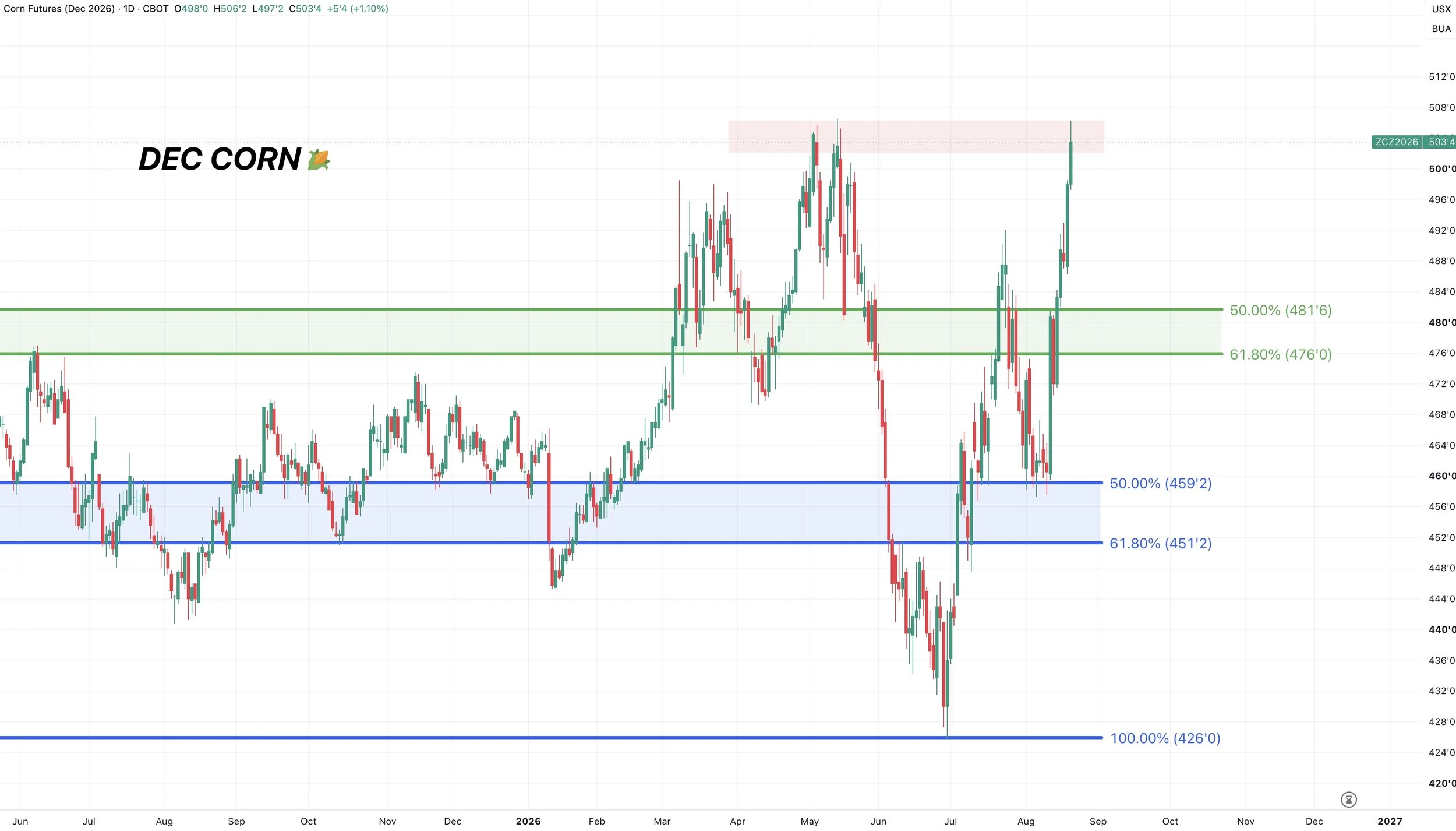
RSI Divergence:
We still have bearish divergence on the RSI.
It doesn’t mean we cannot go higher. Just a reason to have some caution here soon.
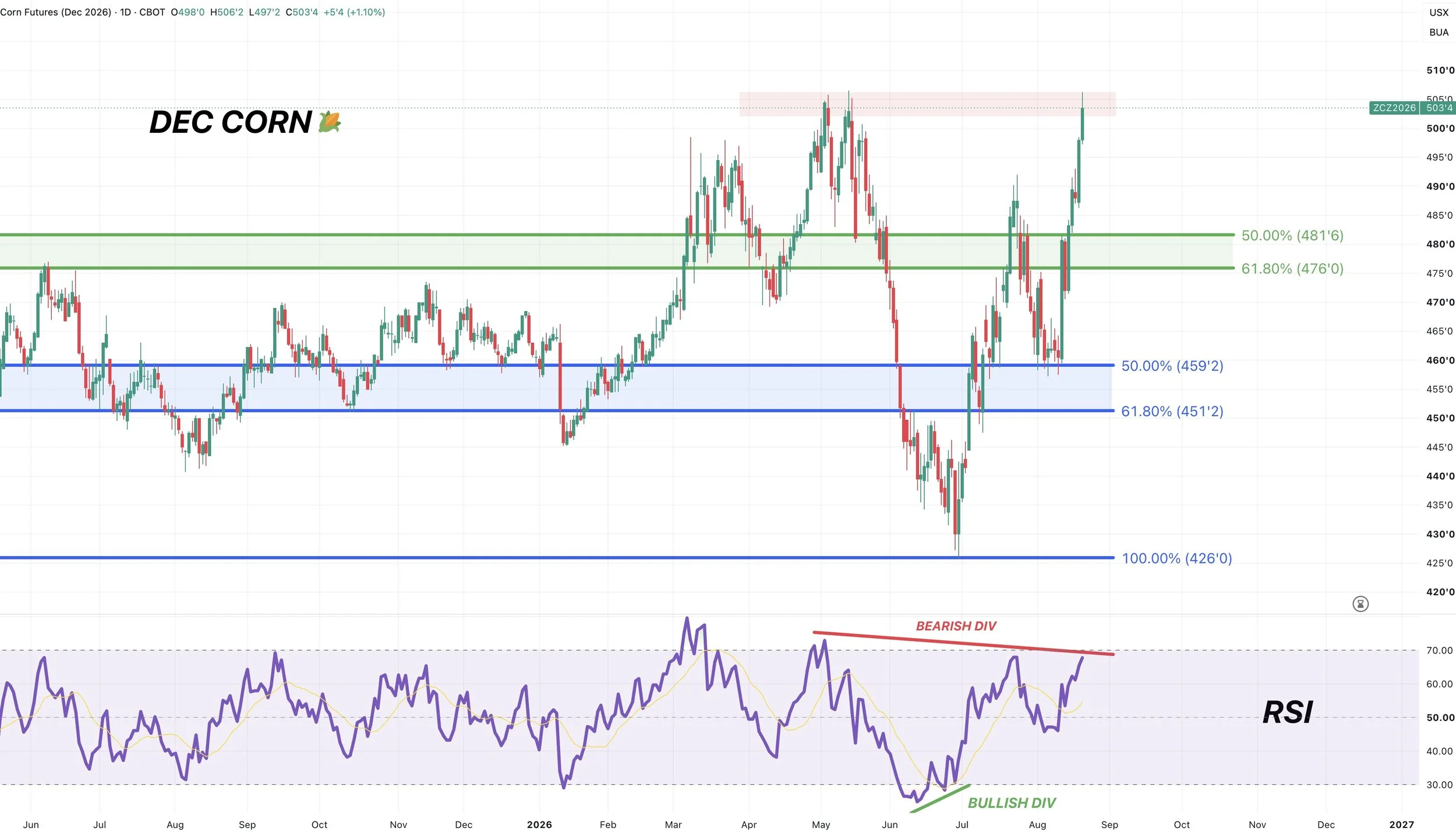
Possible Dec Targets:
As for our next targets.
$5.13 is the golden fib from the August lows up to the July highs. Meaning it's 161.8% of that move.
That same level is contract highs.
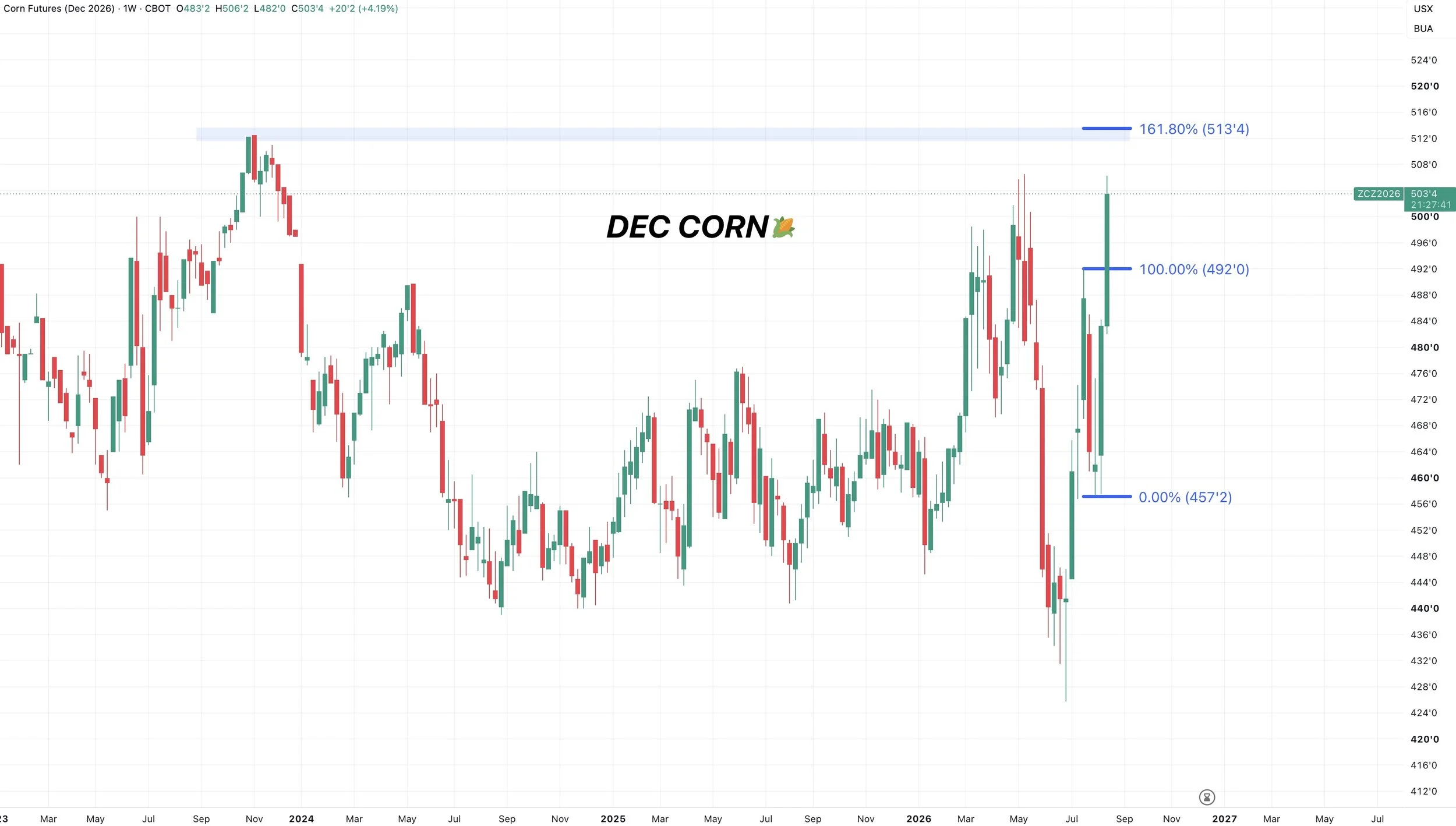
Beyond that, we open the door up to some higher possibilities.
I'm sure the next targets will change, but one we have out there is the $5.50 range.
$5.56 is the golden fib from the contract lows up to those May highs. Again, the golden fib means it's 161.8% of that move.
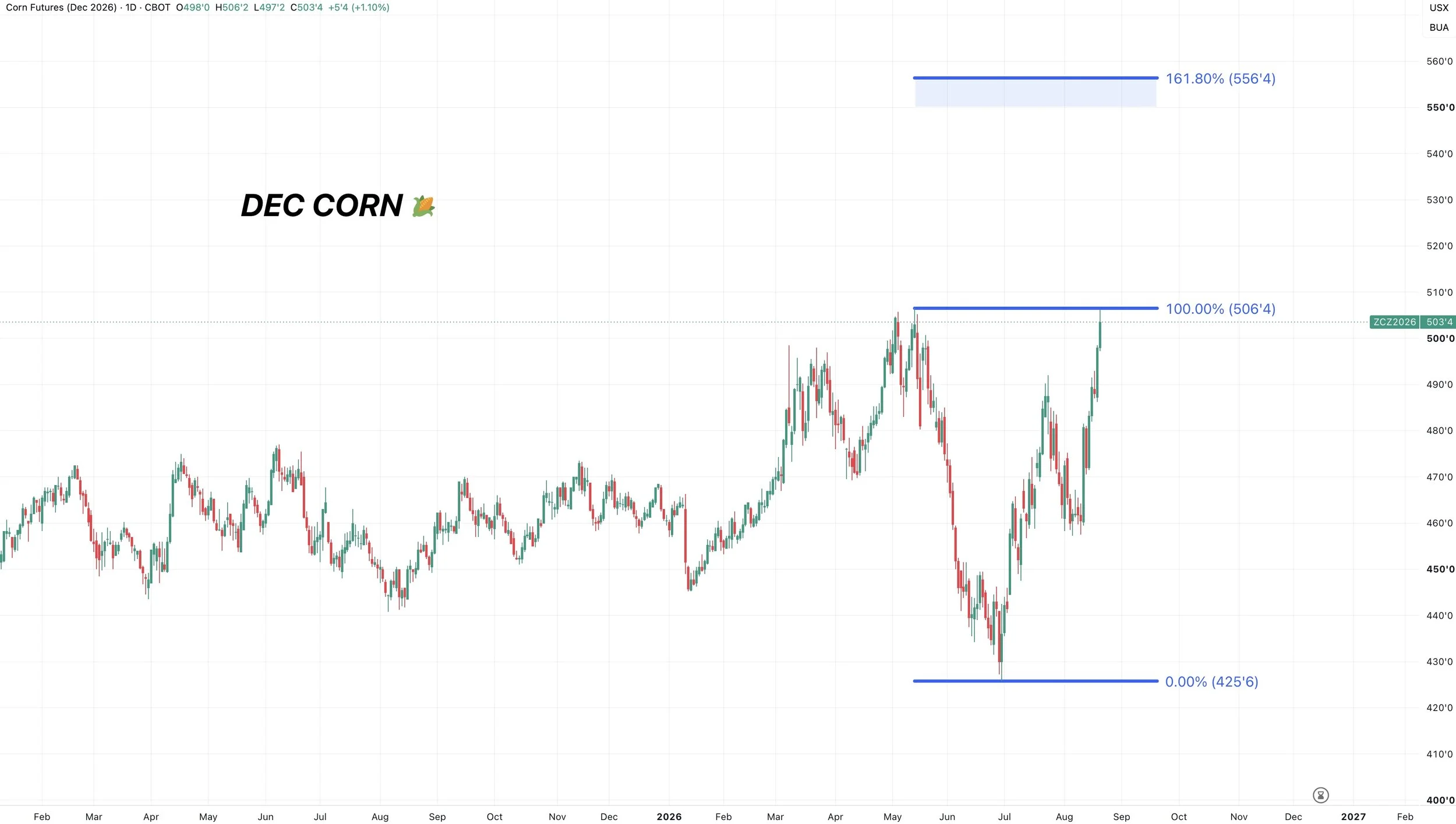
Continuous Front Month Chart:
If we look at the continuous charts.
We are running into some possible resistance here as well.
With a simple trend line that marked the 2025 highs and the highs from May.
However, if we crack above that, things get interesting.
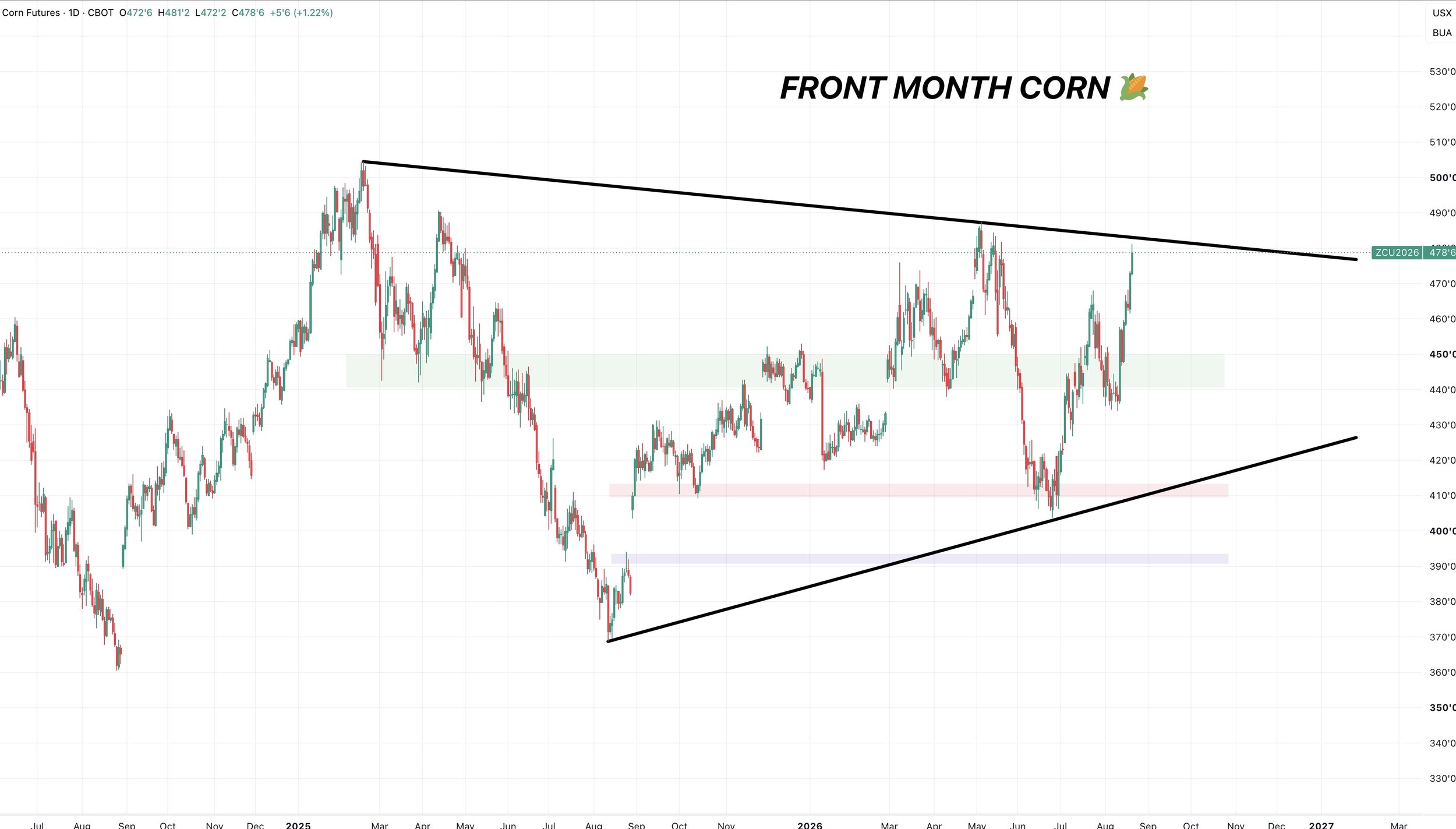
Monthly Chart:
Corn tends to be trapped in a $1.00 range.
In the 90's and early 2000's that range was $2.00 to $3.00
From 2014 to 2020 that range was $3.00 to $4.00
Our new range has been $4.00 to $5.00
Each range has turned the prior ceiling into the new floor.
If we break above $5.00 on a front month basis, it would look like we are breaking out the range. It would also be our very first higher high of the entire bear market.
So if we break $5.00, it would be a good sign of things to come when looking at the long term structure.
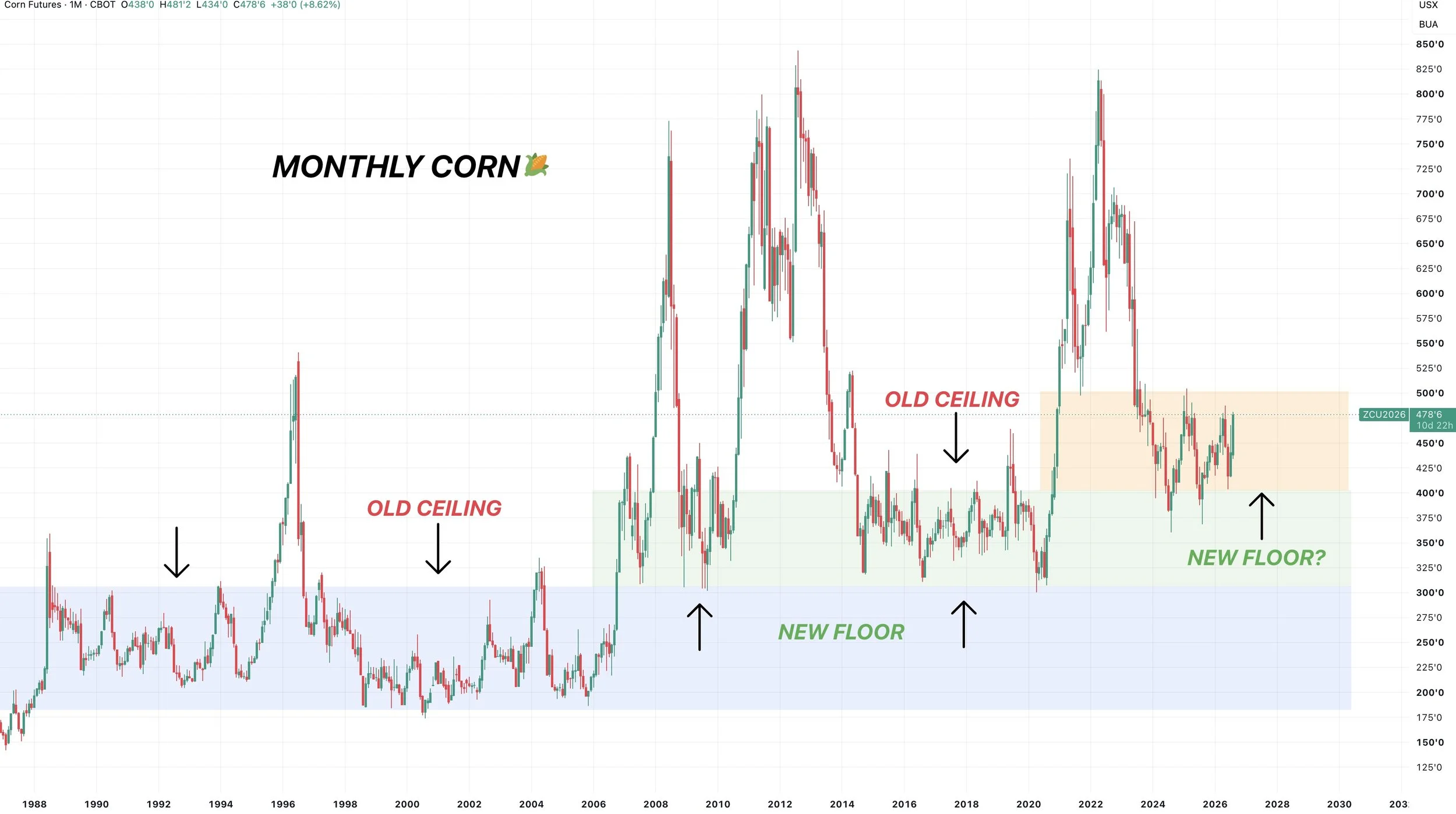
Soybeans
Fundamentals:
Crush demand is hot.
China is consistently buying. We continue to see flash sales almost daily.
Here is a good graph from GrainStats (@GrainStats on X).
Our soybean sales for next marketing year are their best since 2021/22.
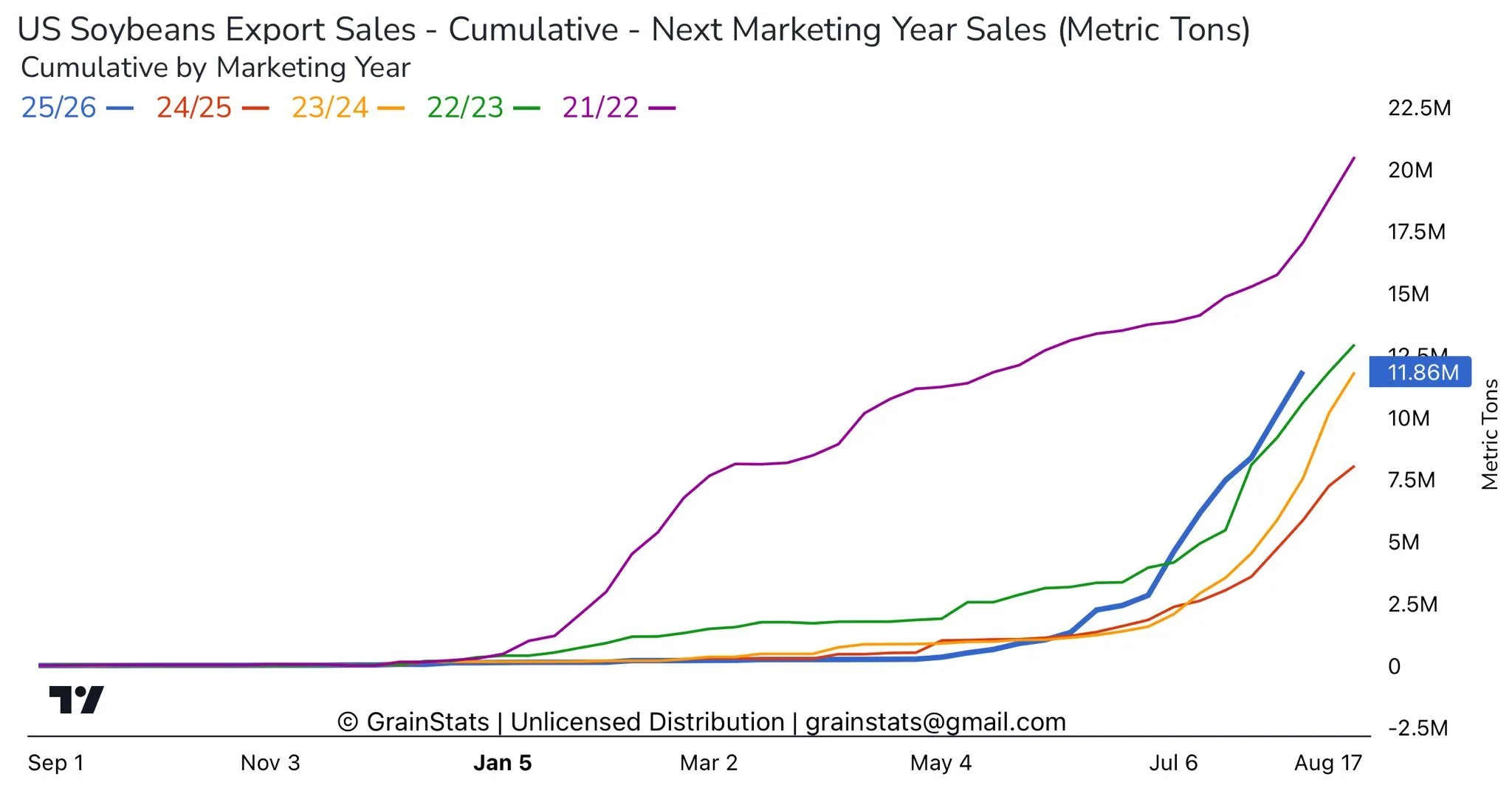
We've talked about this before, but if China ends up fulfilling that goal, the market has not priced that in yet.
The USDA expects exports to be up just +140 million vs last year.
Yet.. China says they are going to be buying +480 million more than last year.
A massive 340 million difference between the two.
The entire US soybean carryout is 320 million bushels.
So we clearly don’t have the supply to fulfill that goal unless we ration demand to non-China destinations.
Prices likely need to go higher to ration demand.
This is one of the biggest bull arguments for soybeans.
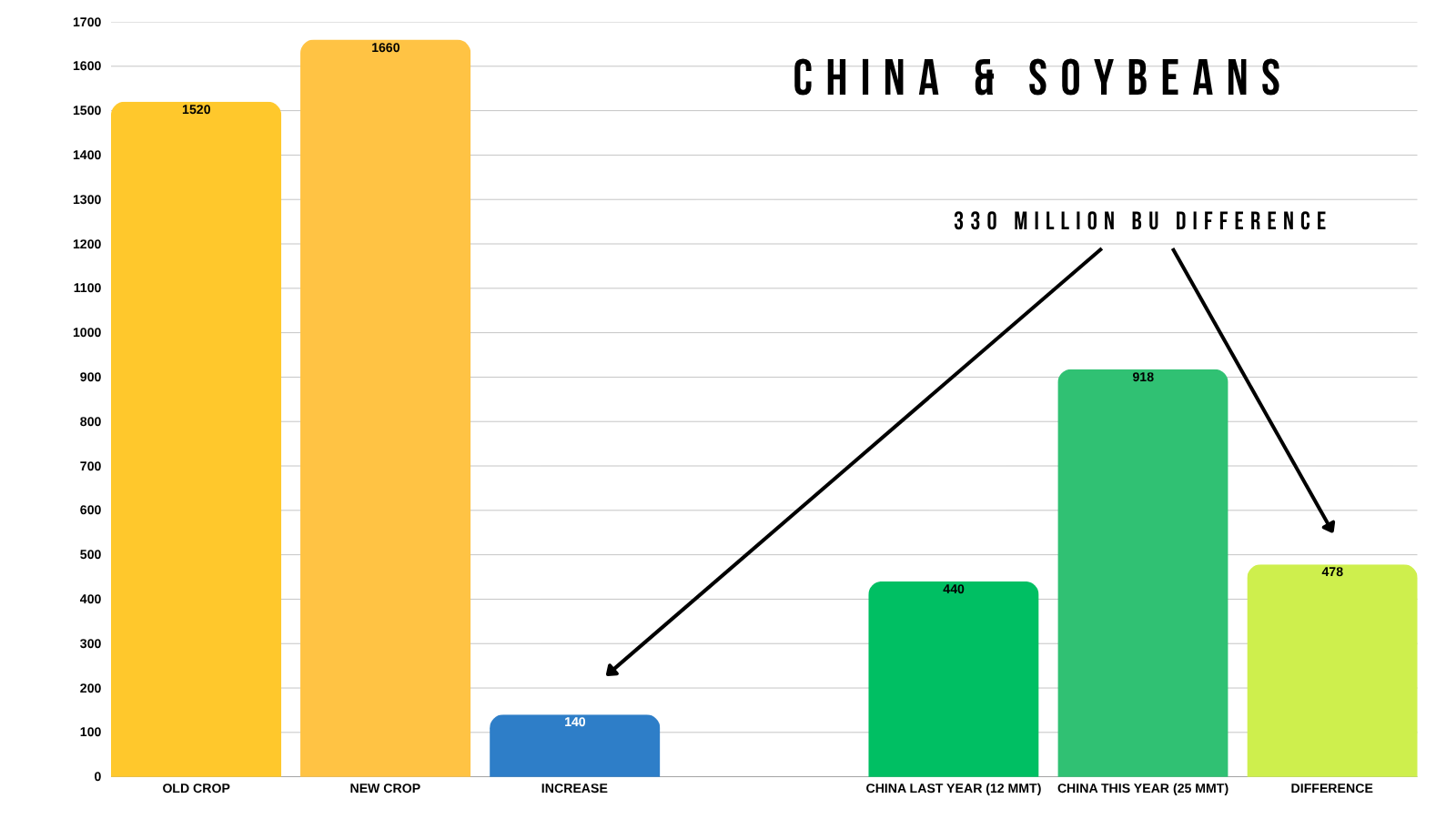
South America is going to be the other big wild card.
If we look at the world situation for soybeans, it's not bearish.
it's actually the tightest it's been in several years.
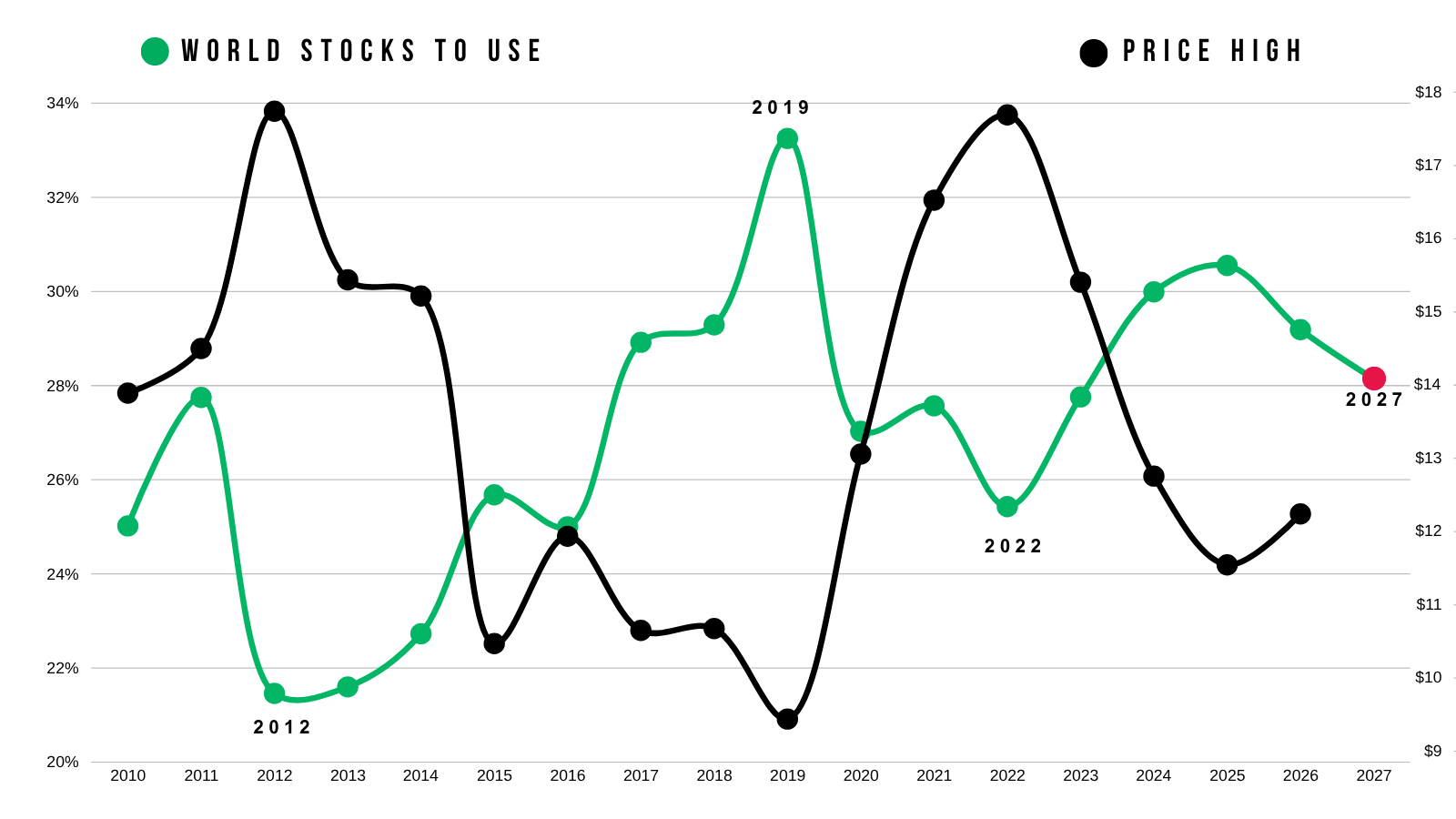
This is with Brazil consistently producing record crop after record crop.
What do you think happens if South America has a hiccup? Things would get awfully interesting for the soybean market.
The world's largest producer continues to put out record crops, yet the global situation continues to get tighter. Because demand is that strong.
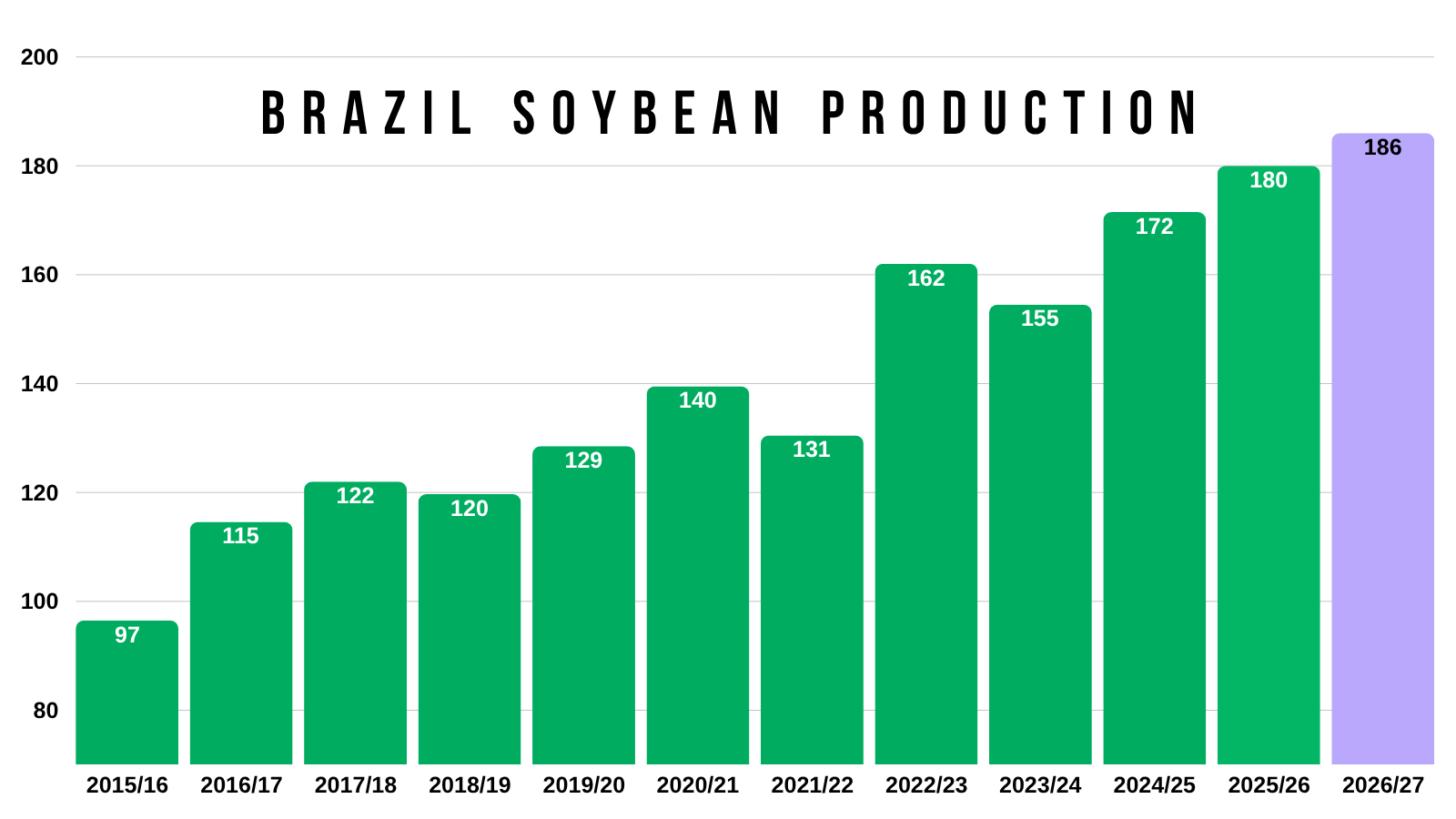
I'm no weather guru.
But right now they are saying that this current Super El Niño is the strongest of all-time.
Here's a nice chart from Karen Braun (@kannbwx on X).
This shows the sea surface temperature anomalies.
It's sitting at its warmest levels ever for this time of year.
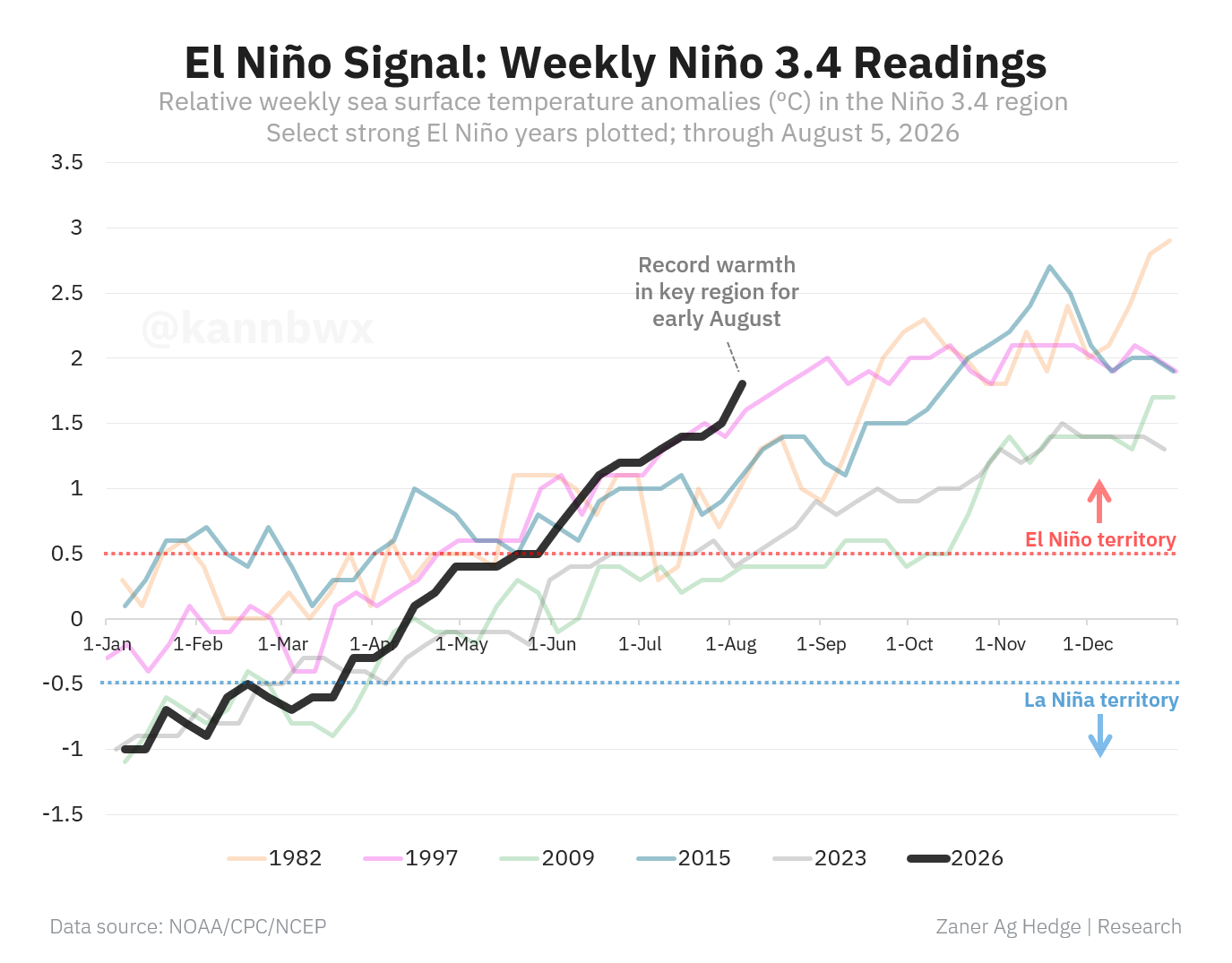
If we look at how El Niño is expected to affect the world globally.
This map shows how El Niño has historically impacted rainfall from October to March.
It's supposed to lead to dry conditions down in Brazil.
Their weather season starts here soon, in a month or two.
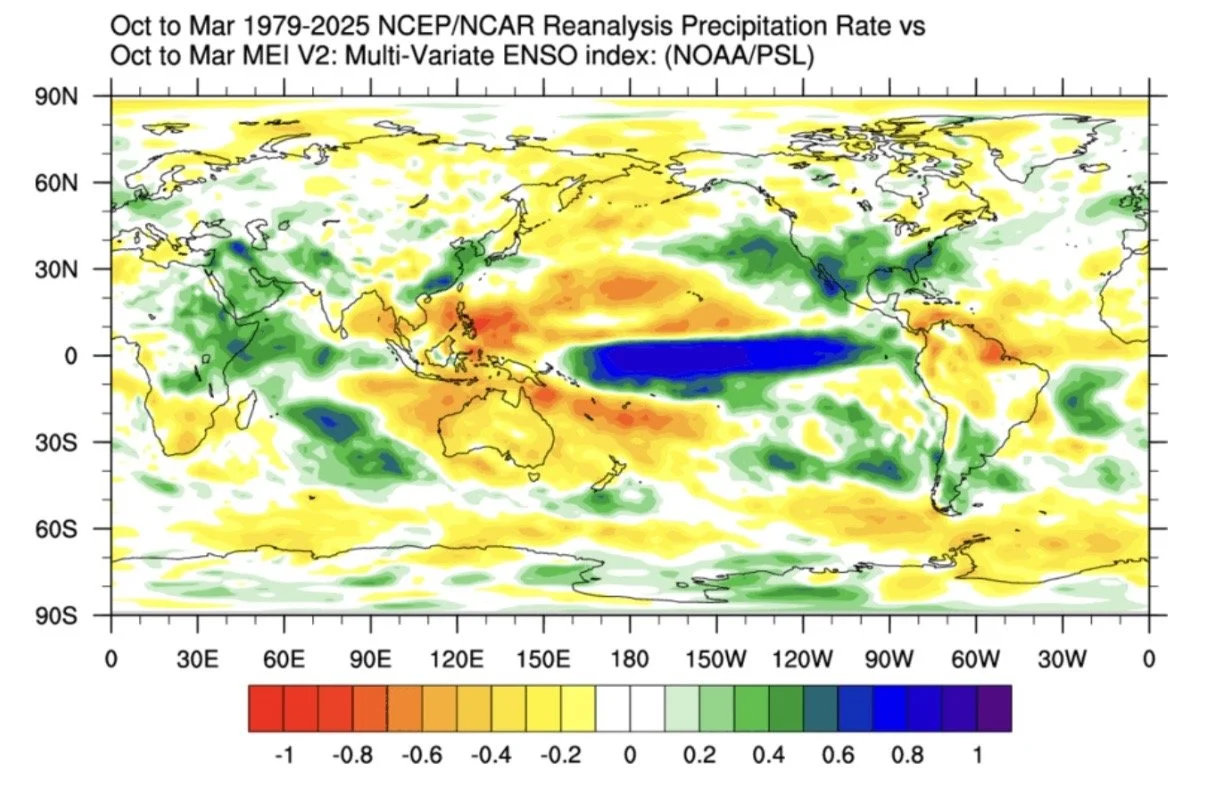
Nov Beans Chart:
We've seen a great rally off that key support and buy zone.
Now to the upside, we broke above that golden zone. Which suggests this is not just a relief rally and that amplifies the odds of us holding those recent lows.
The first big level is of course going to be those recent $12.55 highs, which we are within striking distance of.
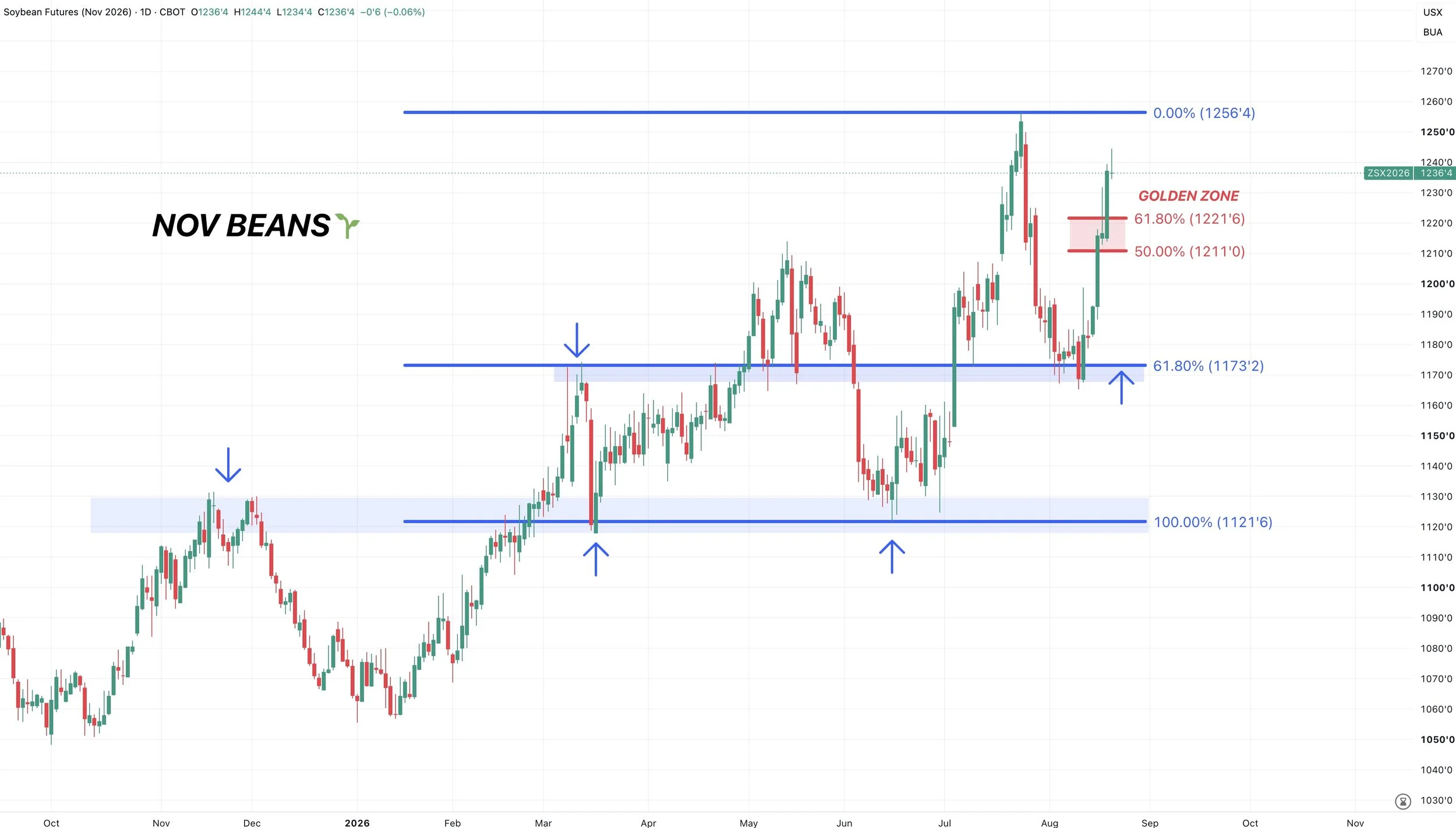
If we get a sizeable pullback, the levels I am currently watching are $11.95 to $12.05 if they come.
That would be the golden zone just above peak volume.
It's also the highs from May.
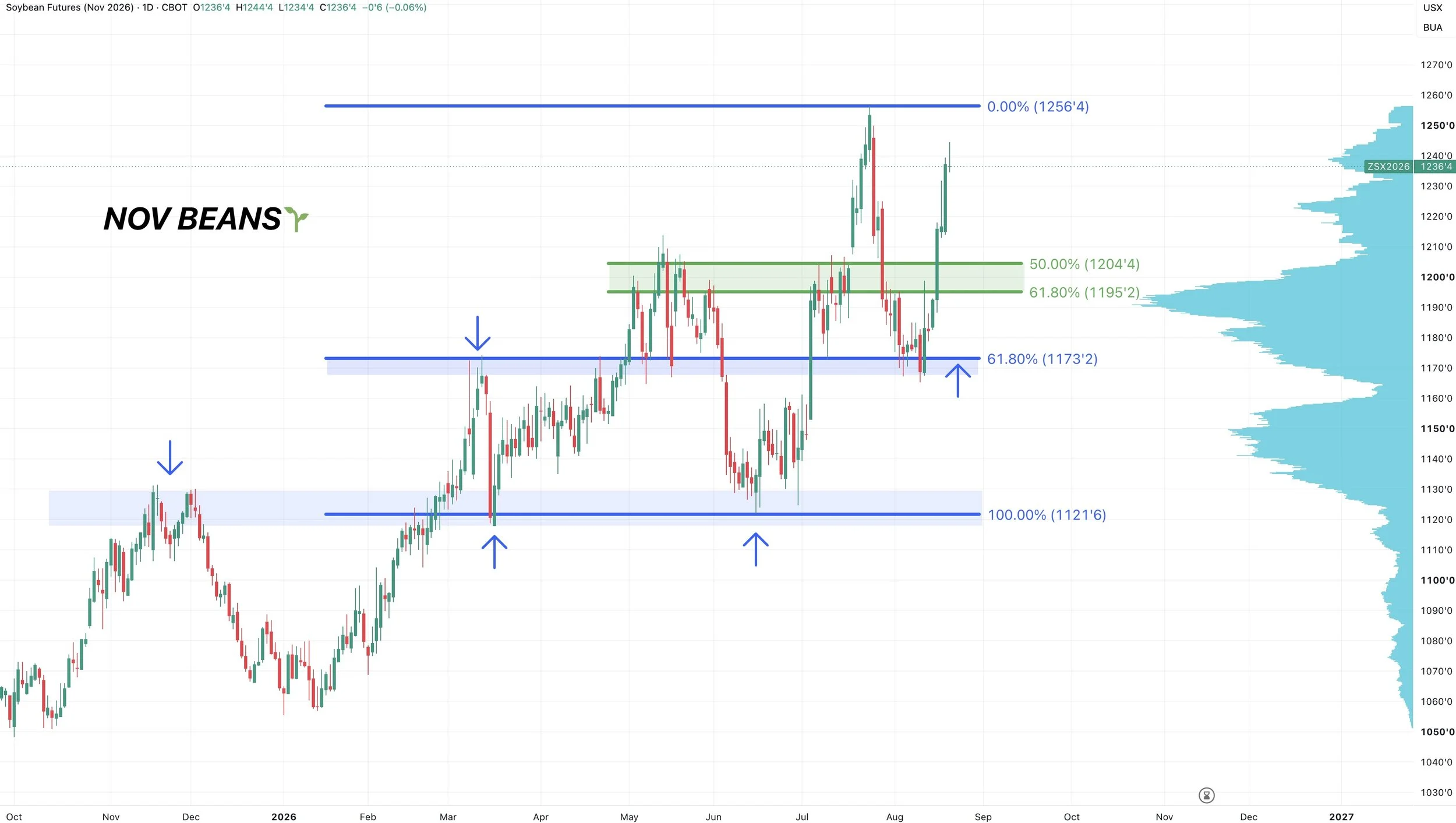
If we break above the recent highs, the next area I am looking to de-risk at is going to be around $13.00
$13.12 is the 161.8% level and golden fib from the recent lows up to those July highs.
Overall I like staying plenty patient in soybean marketing if you're at a comfortable spot and or rewarded those July highs when we talked about taking risk off the table.
Like in corn, we do not want to be oversold simply due to the potential.
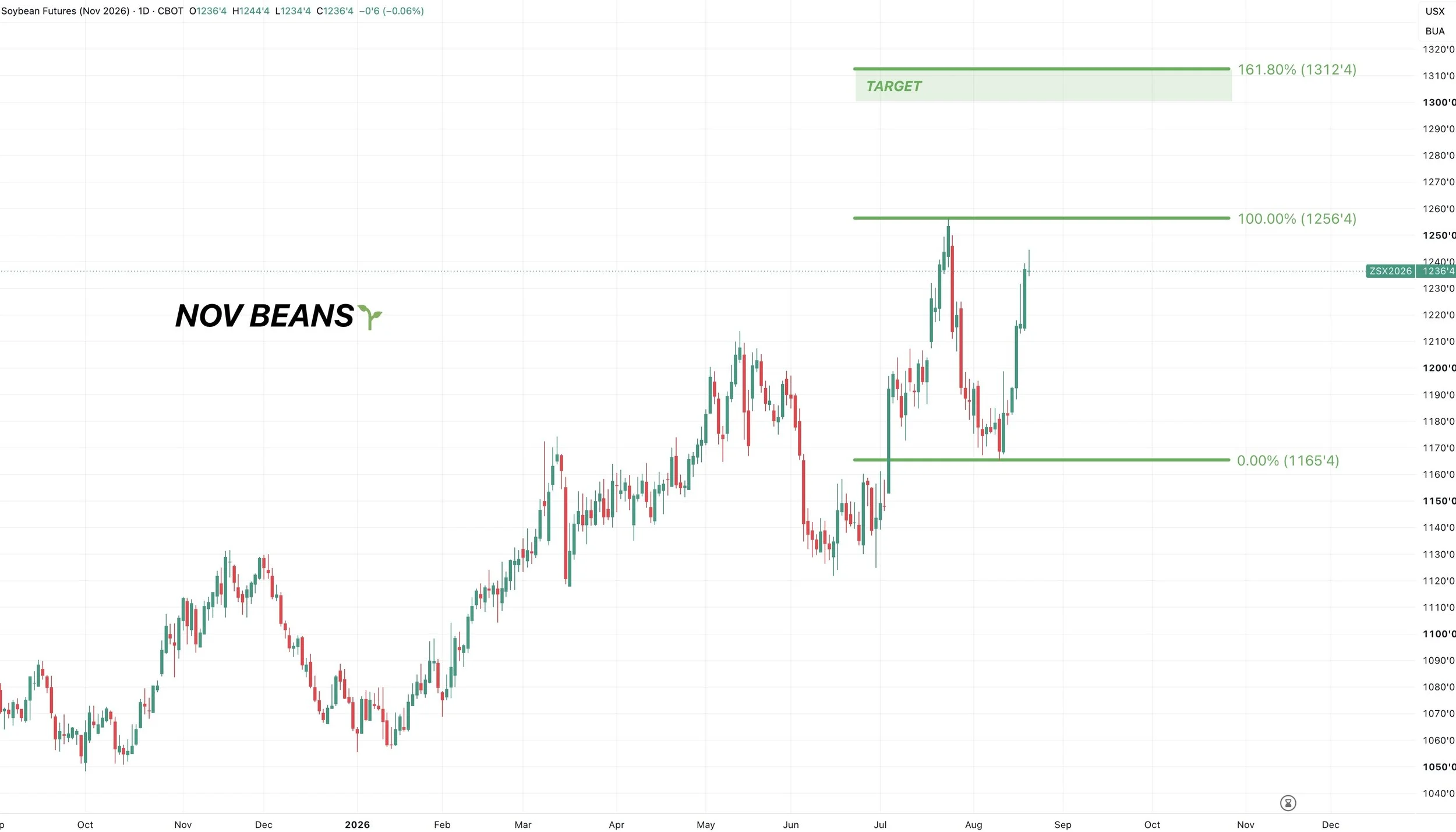
Continuous Front Month Chart:
If we look at this chart, $12.50 is a major level.
It's right where we recently failed.
It's the highs from 2024.
It's the lows from 2023.
So a clear area of key resistance. If we break above it should result in further upside.
There is still an unfilled gap right around $13.00 as well.
The long term structure in soybeans remains pretty bullish purely looking at the chart.
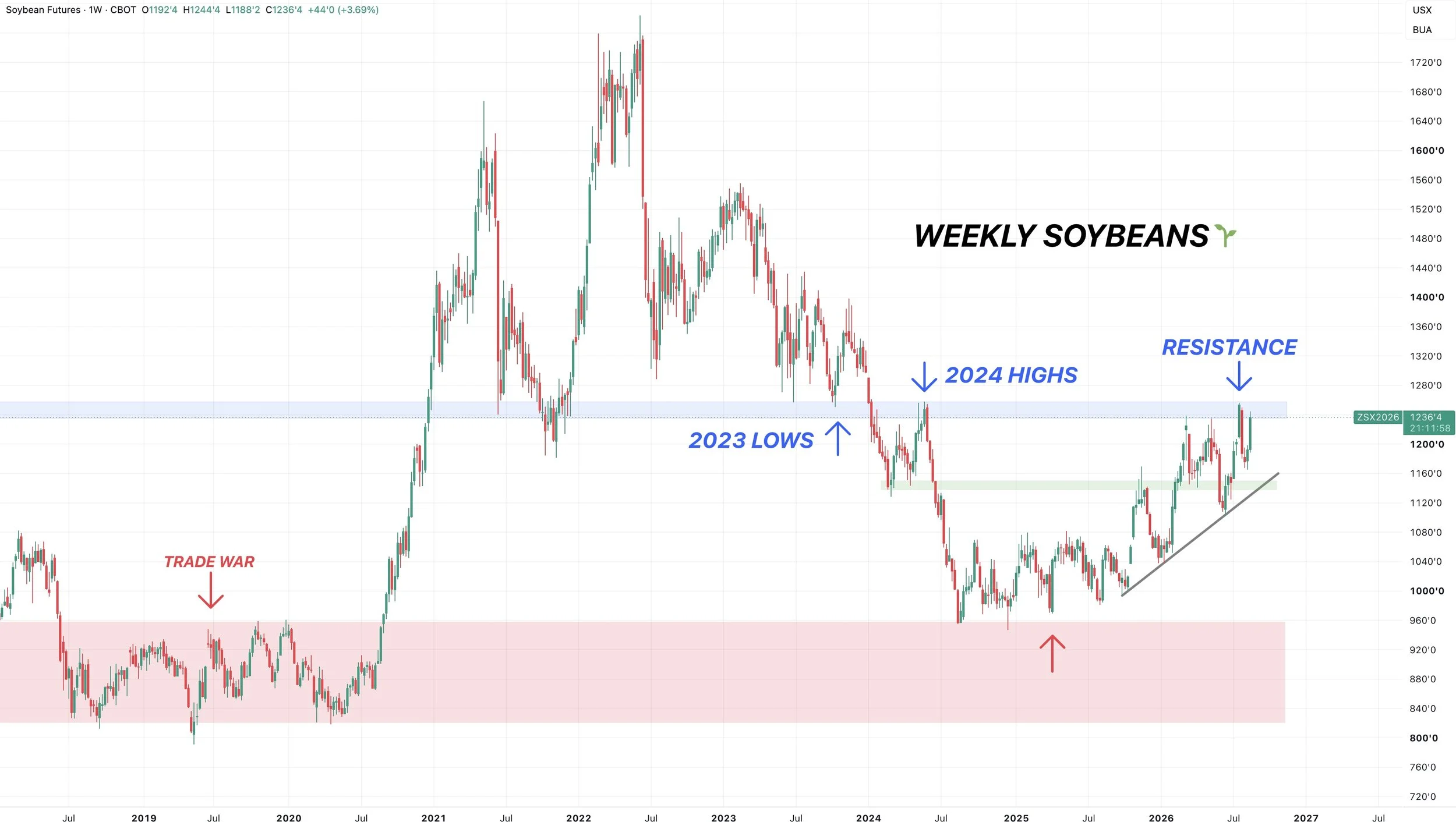
Wheat
Dec KC Wheat Chart:
Currently battling those July highs.
If we happened to get a decent pullback here, the area I'd look for a bounce is $7.40 to $7.48.
Which is the golden zone and peak volume.
On the other hand, if we can bust above these July highs I have a target of $8.40 to $8.50
Which would be the implied move from this cup and handle pattern we are sitting in.
It would also be the 161.8% move from the recent lows up to the July highs.
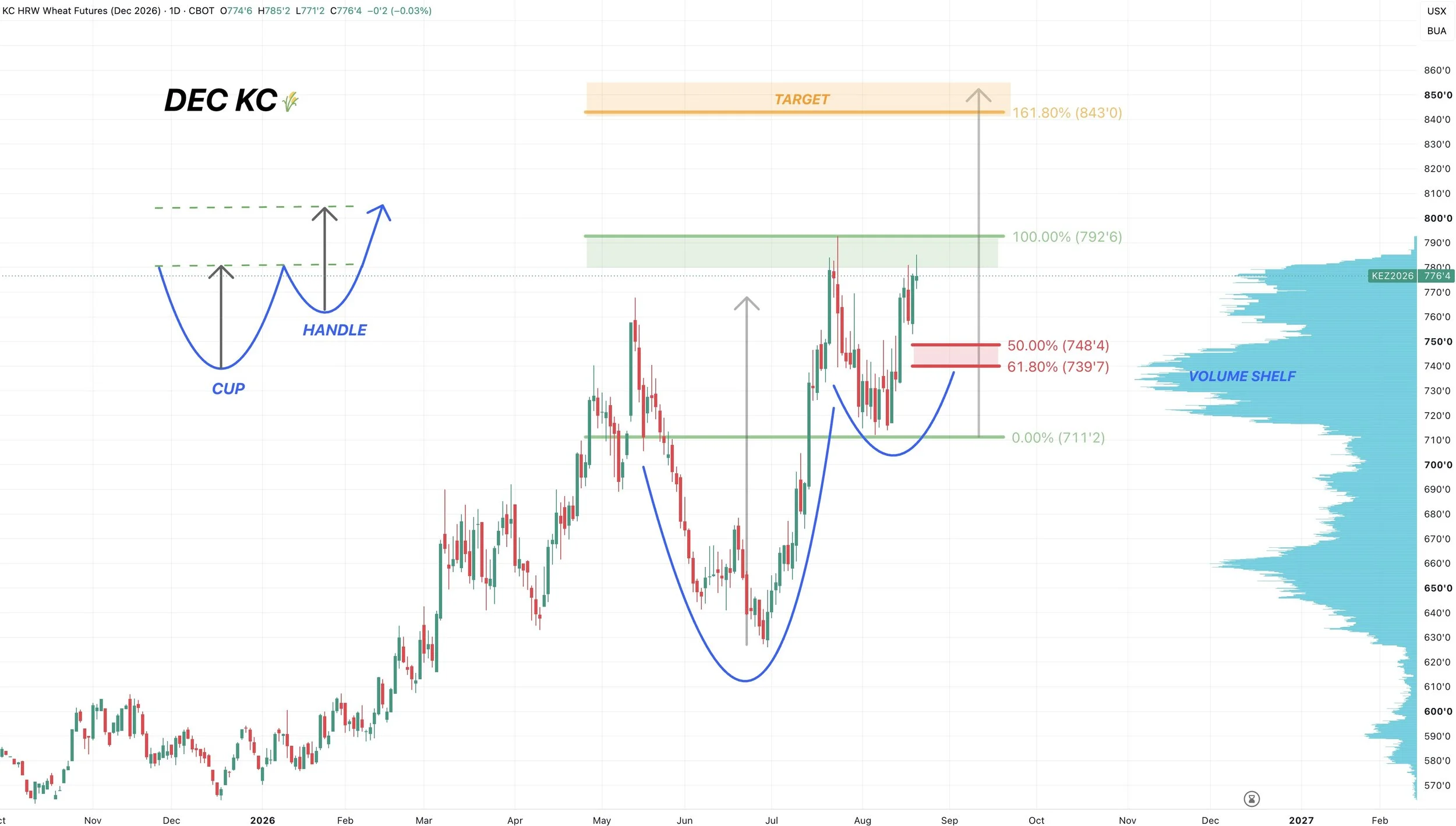
Weekly KC:
The weekly chart looks great.
It appears that we are finally breaking above that major $7.50 resistance on the continuous chart.
That level marked the recent highs.
It was the highs from May earlier this year.
It was the highs from 2024.
It was the lows from both 2023 and 2022.
Lastly, it was the highs from 2021.
So it's been a very clear area of support and resistance countless times.
Breaking above this could very well lead to further upside.
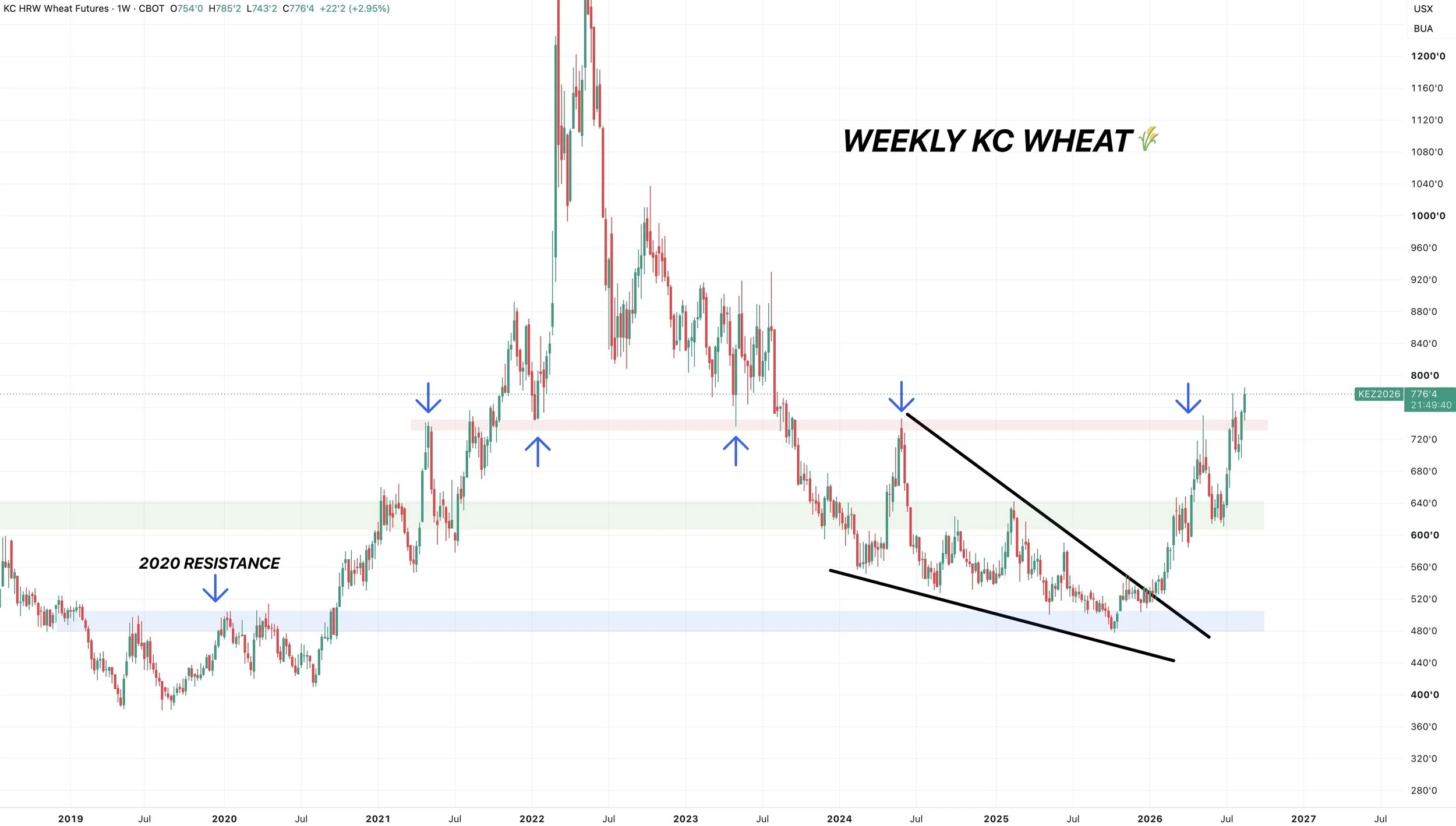
MPLS Wheat:
We've clawed back exactly 61.8% of the sell off. This is an important level.
If we can break above this level, could run towards the highs.
We are sitting in a cup and handle pattern just like the rest of the wheat complex.
If we break above the highs, the golden fib sits at $8.15
(Sorry for the different chart. My usual software I use for charting doesn’t include MPLS wheat)
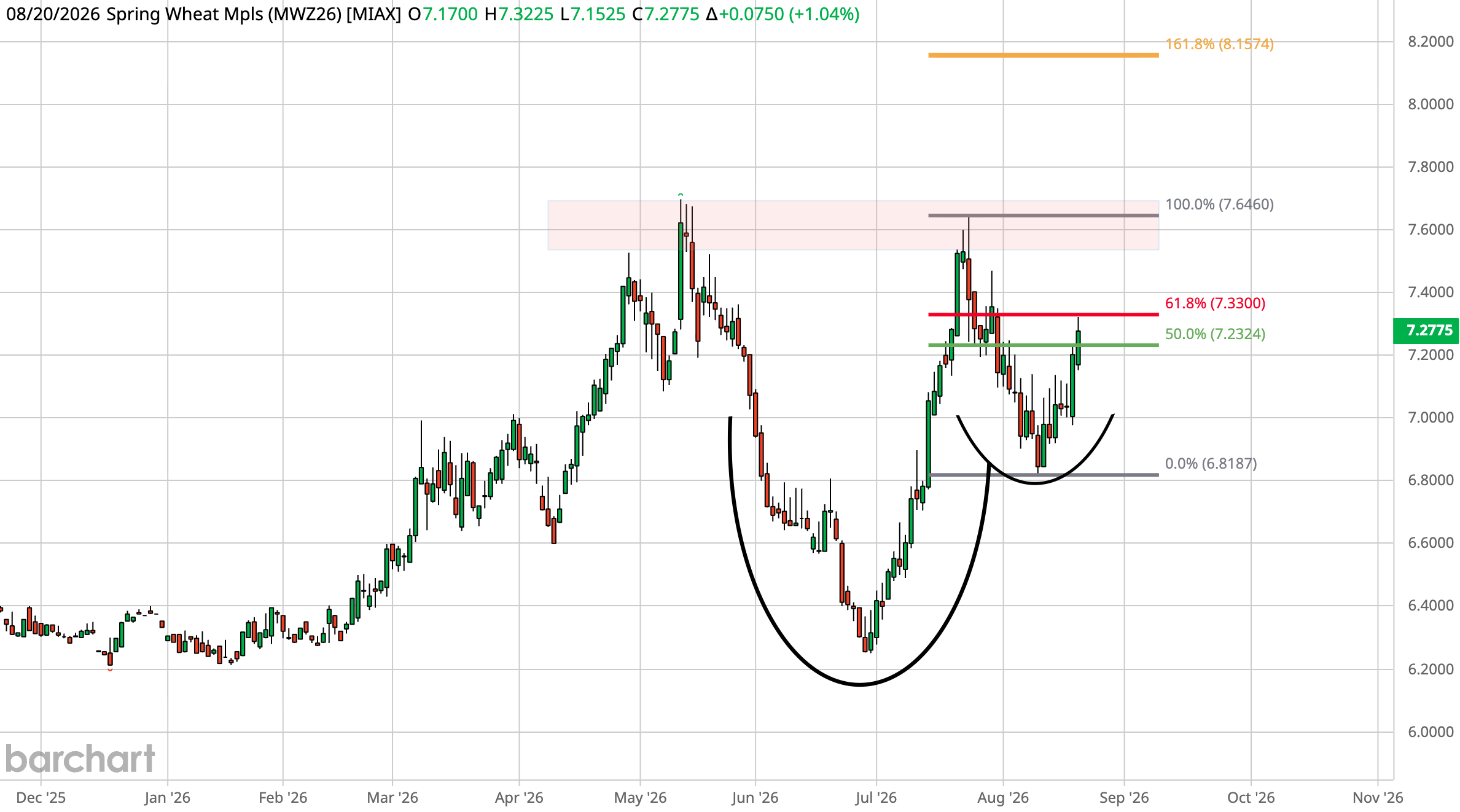
Cattle
Oct Live Chart:
Still trying to cling on to must hold support here.
The 61.8% retracement down to the November lows.
If we lose this level, it could very easily open the door to get another leg lower.
We are showing some bullish divergence on the RSI still. Prices made new lows. Yet the RSI did not.
So that could be a potential sign we're losing some downside momentum here for now.
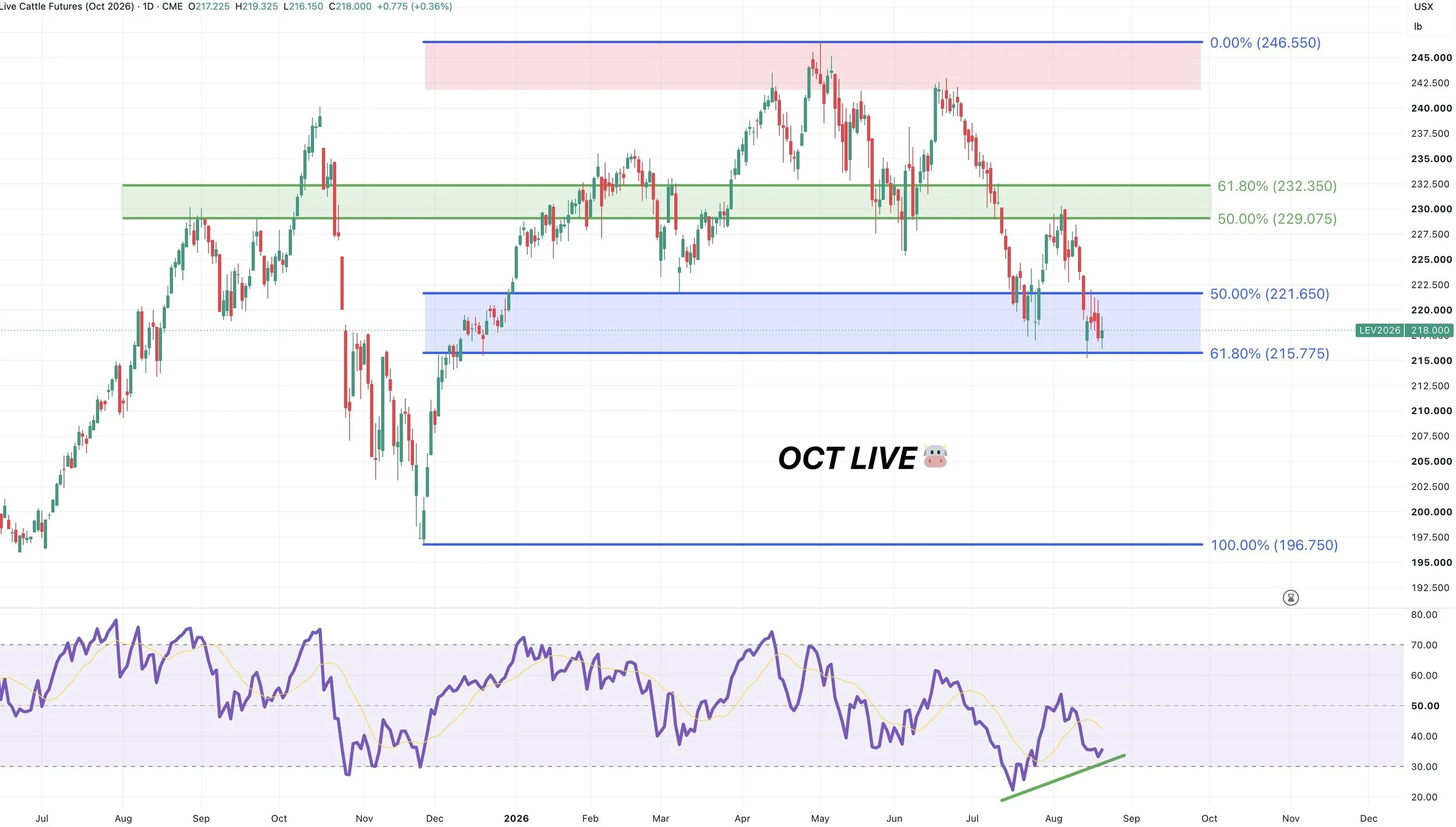
Oct Feeders Chart:
Same story here.
Fighting to hold that key level. We really want to see us hold this 61.8% retracement.
Like in live cattle, we are showing some bullish divergence. So we could be due for a bounce here at key support.
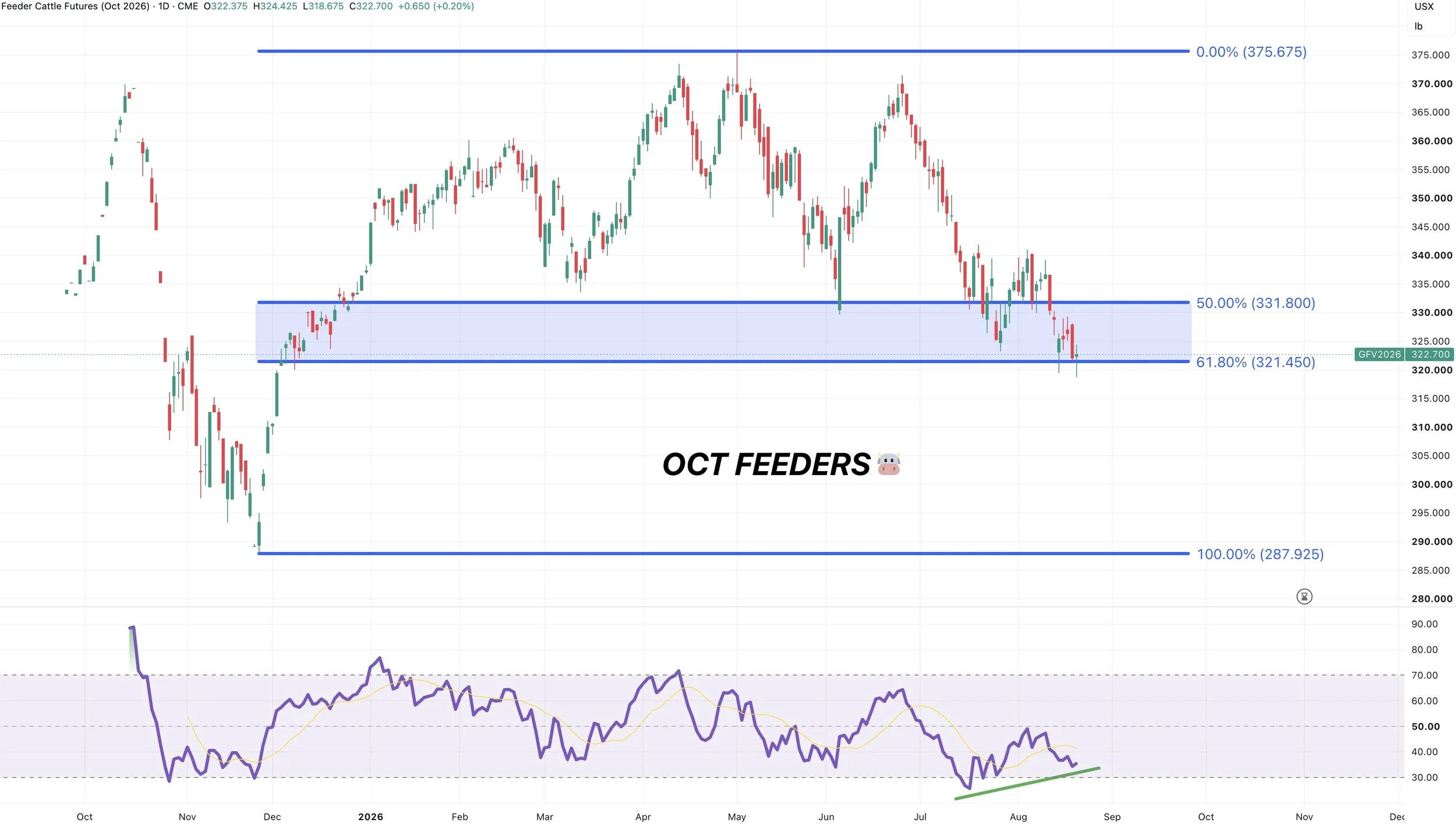
Want to Talk?
Our phones are open 24/7 for you guys if you ever need anything or want to discuss your operation.
Jeremey & Office: (806)484-1214
Sebastian: (605)280-1186
Email: sfrost@dailymarketminute.com
Hedge Account
Interested in a hedge account? Use the link below to set up an account or give us a call.
WEIGHING GRAINS UPSIDE VS DOWNSIDE POTENTIAL
AUDIO COMMENTARY & CHART VIDEO
Don’t miss future updates or signals
Good moves in row crops today
SoDak tour results less than last year
Tour today is in areas that aren’t as good
Crop conditions dropped in corn & beans
Export demand remains great
Bean oil stocks below expected
US soybeans are cheaper than Brazil soybeans for the first time in a long time
How to utilize options in marketing
Get puts when we are higher not lower
More upside potential vs downside?
Fundamentals are shifting friendlier
Corn situation far different than last year
Soybean China situation is very interesting
Big potential is there for the first time in a while
Should you make sales or not?
Balance upside vs downside with probabilities
A lot of talk about flooding
If you are undersold do what you should do
Don’t do everything in one day
I am staying away from sales for next years crop until I have inputs locked in or if we get to levels that have more downside risk than opportunity
Video chart update below audio*
Listen to today’s audio below
Want to talk?
Office: (806)484-1214
QUICK CHART VIDEO
Here is a quick 5min video where I run through the corn, soybeans, and wheat charts.
If you would rather read, I put together a written version below the video as well.
WRITTEN VERSION:
Nov Soybeans 🌱
We're seeing a picture perfect bounce off that key support and "buy zone" we've been heavily discussing the last few weeks.
Why here?
For starters, this was the 61.8% level down to the lows from June lows. The most common retracement.
That same level was the highs from March. So we were able to turn that old ceiling into our new floor. Just like we saw happen in the past.
On the June sell off, we turned the old November highs into our new lows.
We also had a volume gap lower, meaning if we did not hold this level, we were likely going to drop quiet a bit lower. Meaning it was a sink or swim level with an area of invalidation.
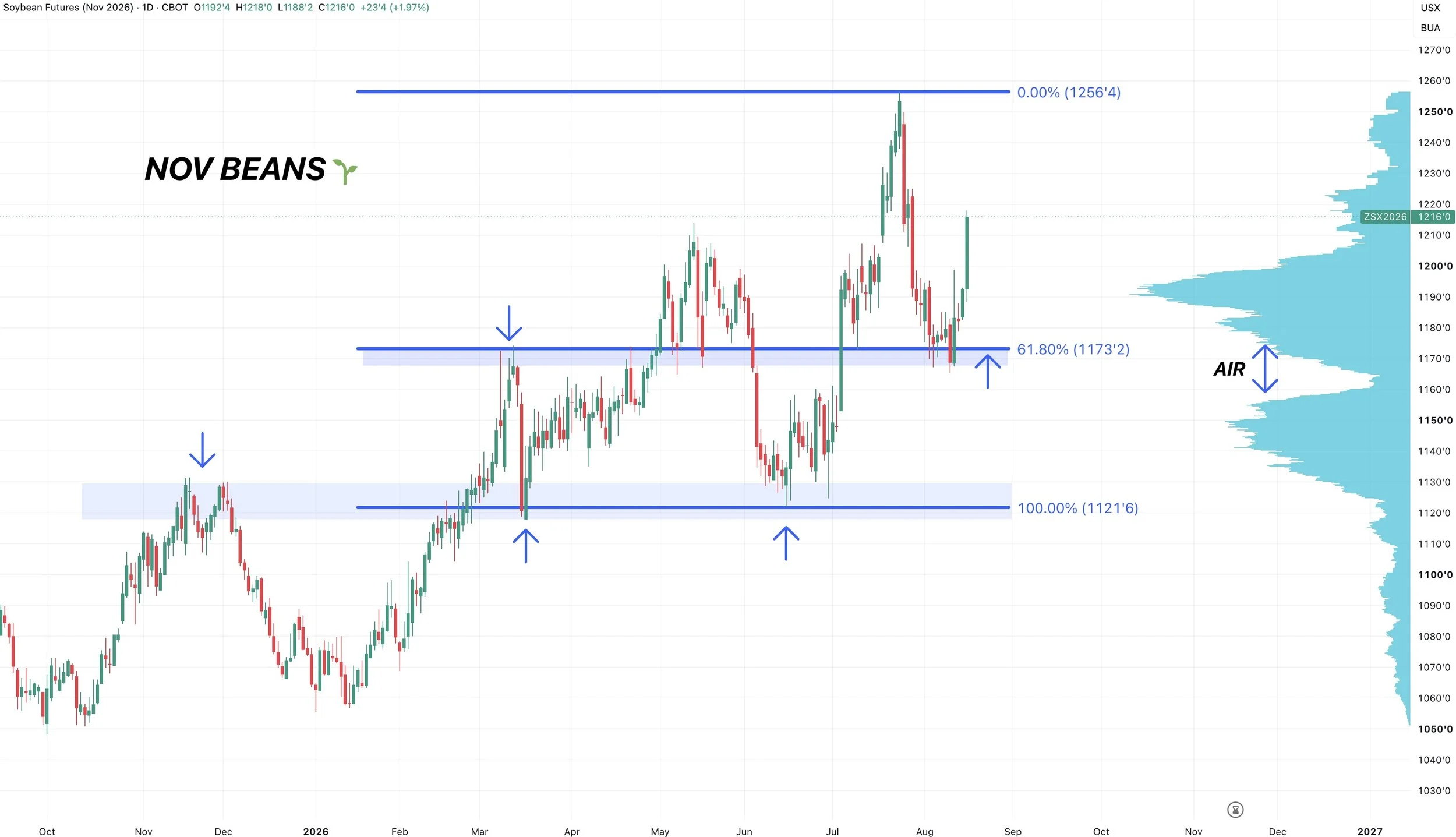
This was also the exact 1 to 1 move from the June sell off.
Meaning this sell off was the exact same size as the one from June. Down to the penny actually.
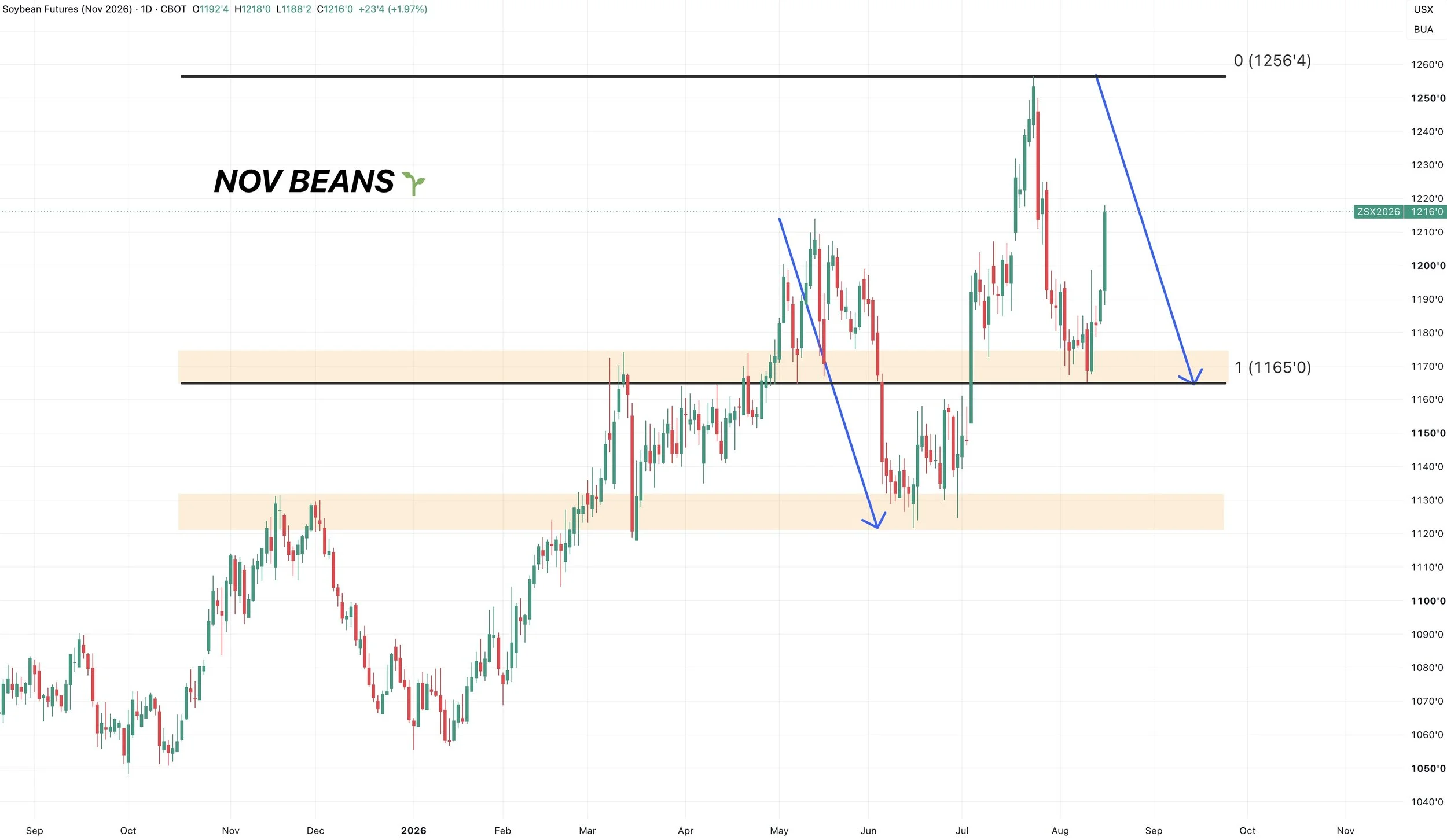
Now what?
We are approaching some "possible" resistance.
We've now clawed back 50-61.8% of this entire sell off from July.
So this would be a common area to stall, but we do not have to. This will be a big level to watch here short term.
If we break above, the next resistance is going to be those highs.
If we get a pullback, I think it would be viewed as a good opportunity. Perhaps a re-test of that peak volume. I'll have exact levels if we actually get a pullback.
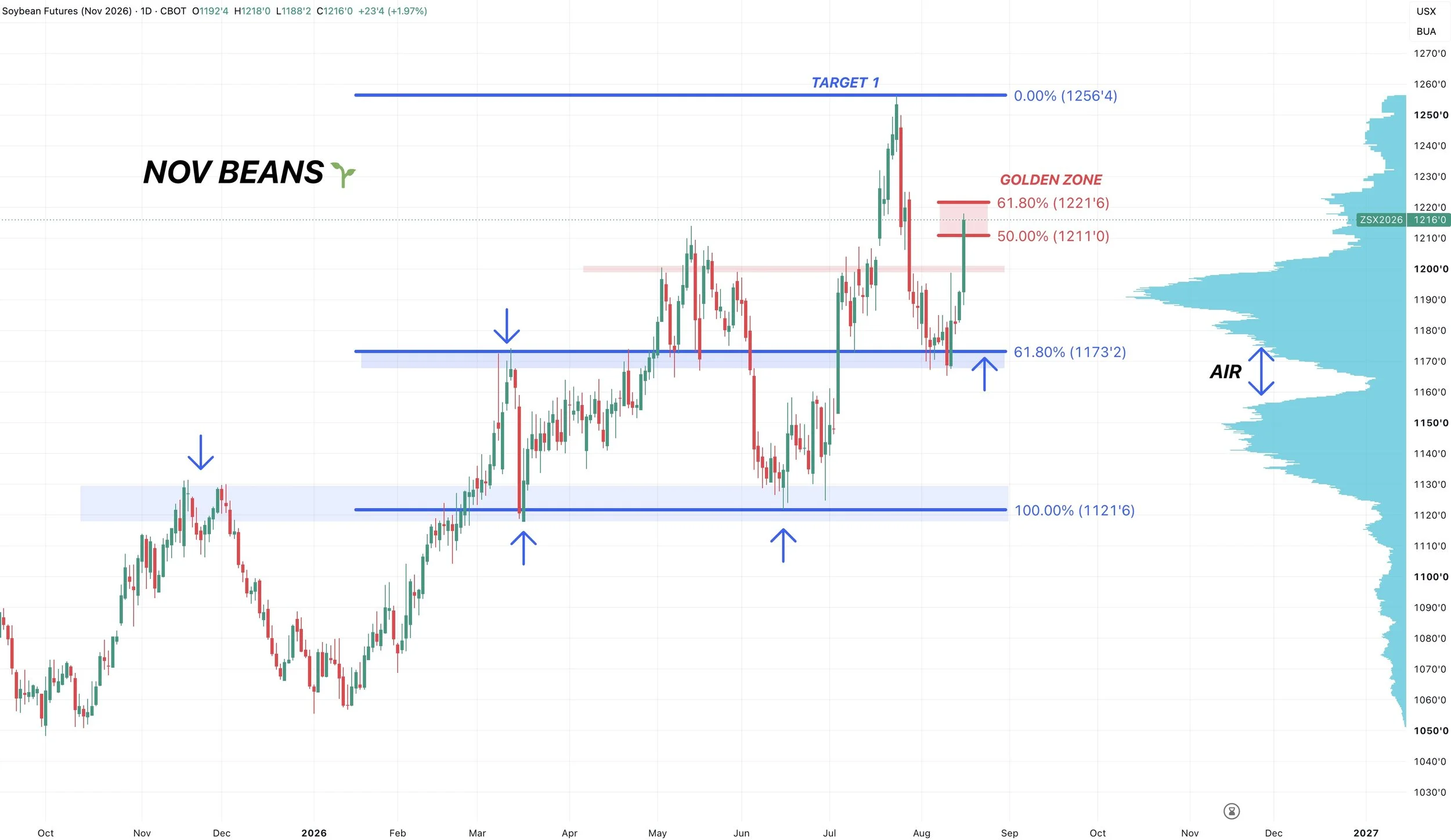
As for a longer term target.
If we are able to break the recent July highs.
I have a target of $13.00 to $13.10.
That $13.10 level is the 161.8% move from the recent lows up to the July highs. A common continuation target.
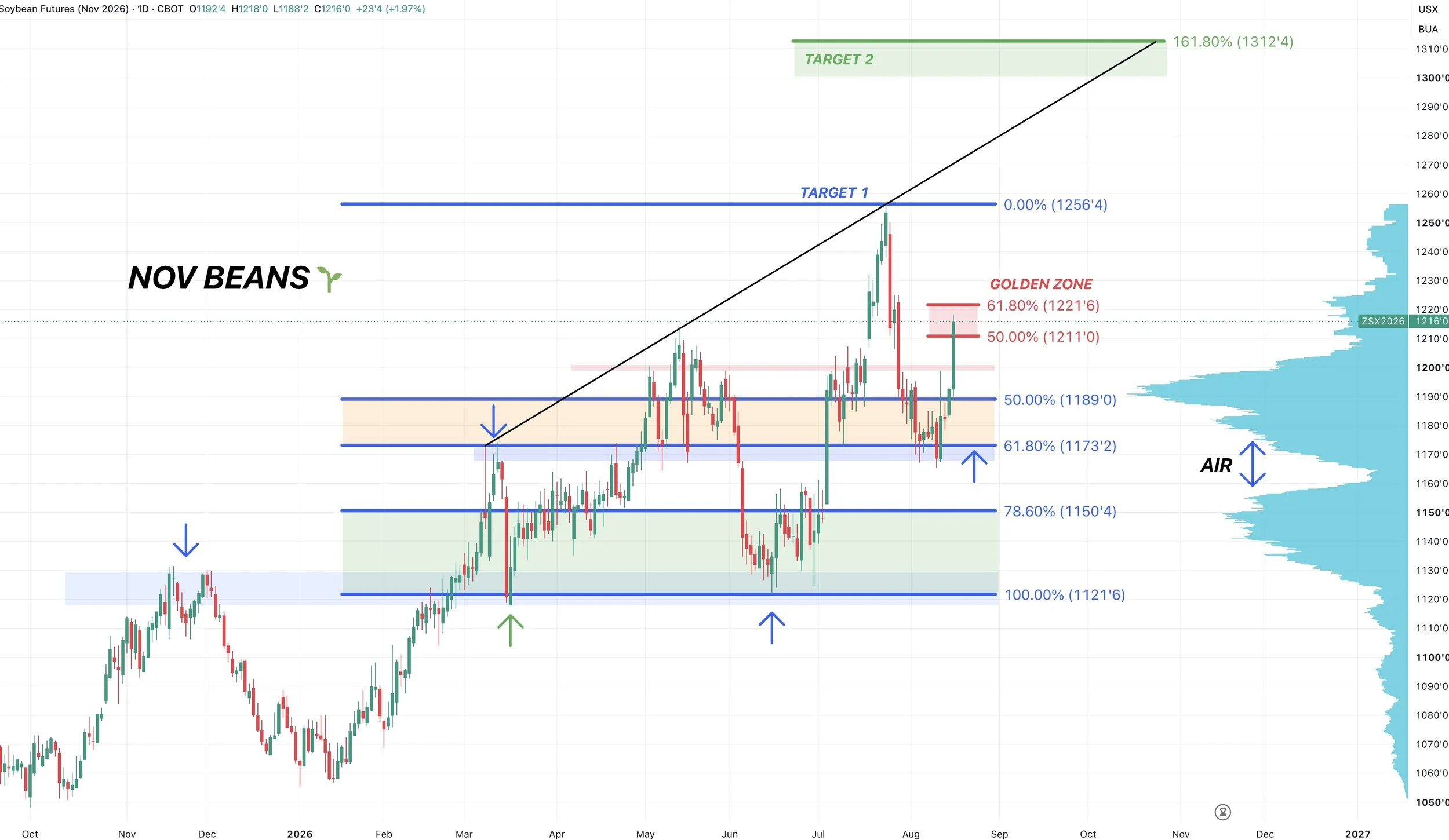
One last thing to note is that the indicators are friendly.
The MACD is crossing bullish for the first time since those June lows.
This is not a perfect indicator, as none are.
But the last several times we saw a bullish cross did lead to further upside.
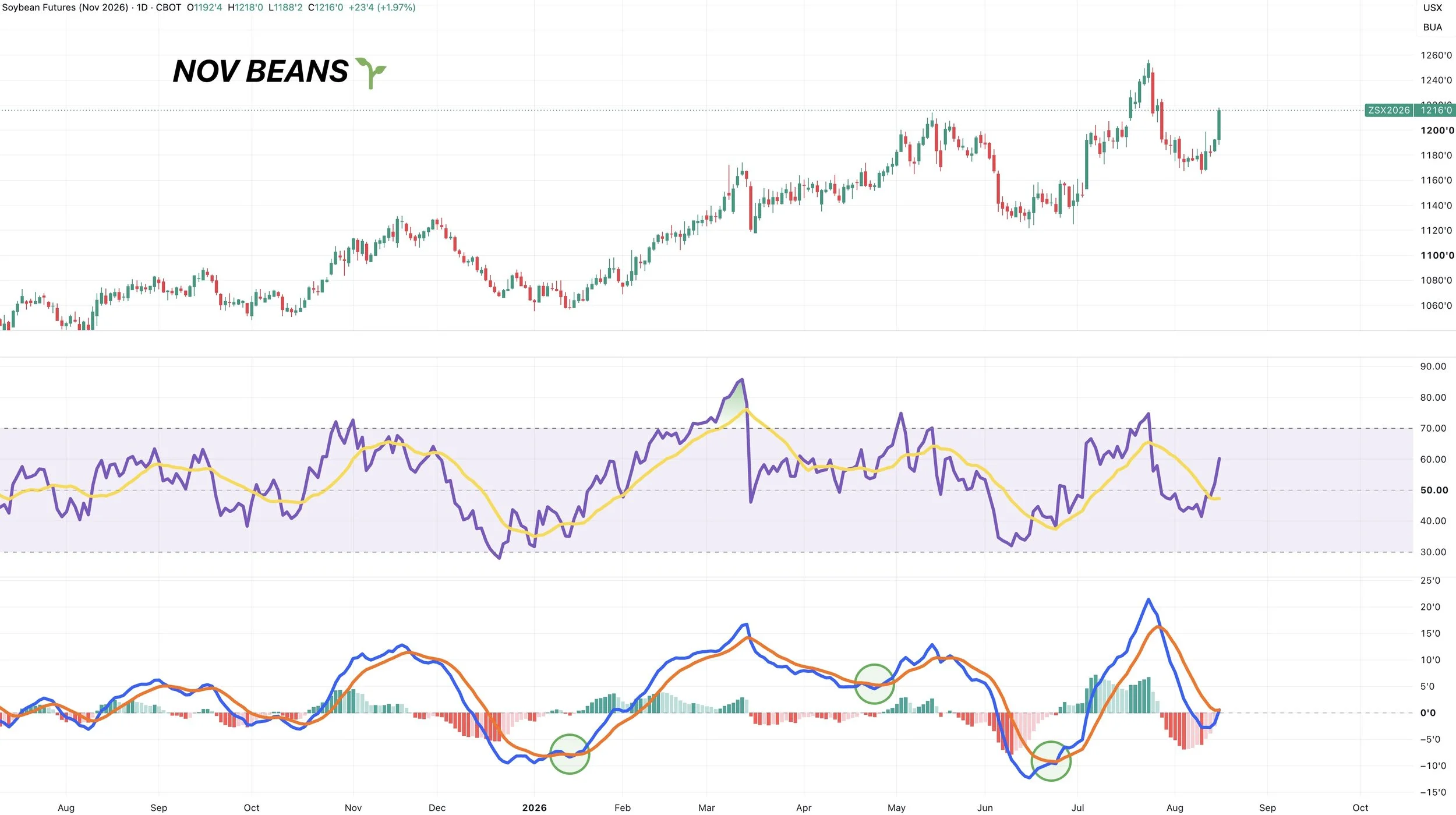
Dec Corn 🌽
We are right up against those highs from July.
So this is clearly going to be a big level.
If we are able to break above, then the next target is of course those highs from March and May.
If we get a rejection here, a reasonable spot to get a bounce would be between $4.70 to $4.75. Which would give back 50-61.8% of the recent little rally we've had.
That same area would line up with those April lows and several highs from last year.
There is also a volume shelf that sits there.
I am not saying we have to get a pullback down to there. I am just saying if we get a rejection here, that would be an area that may offer an opportunity if it comes.
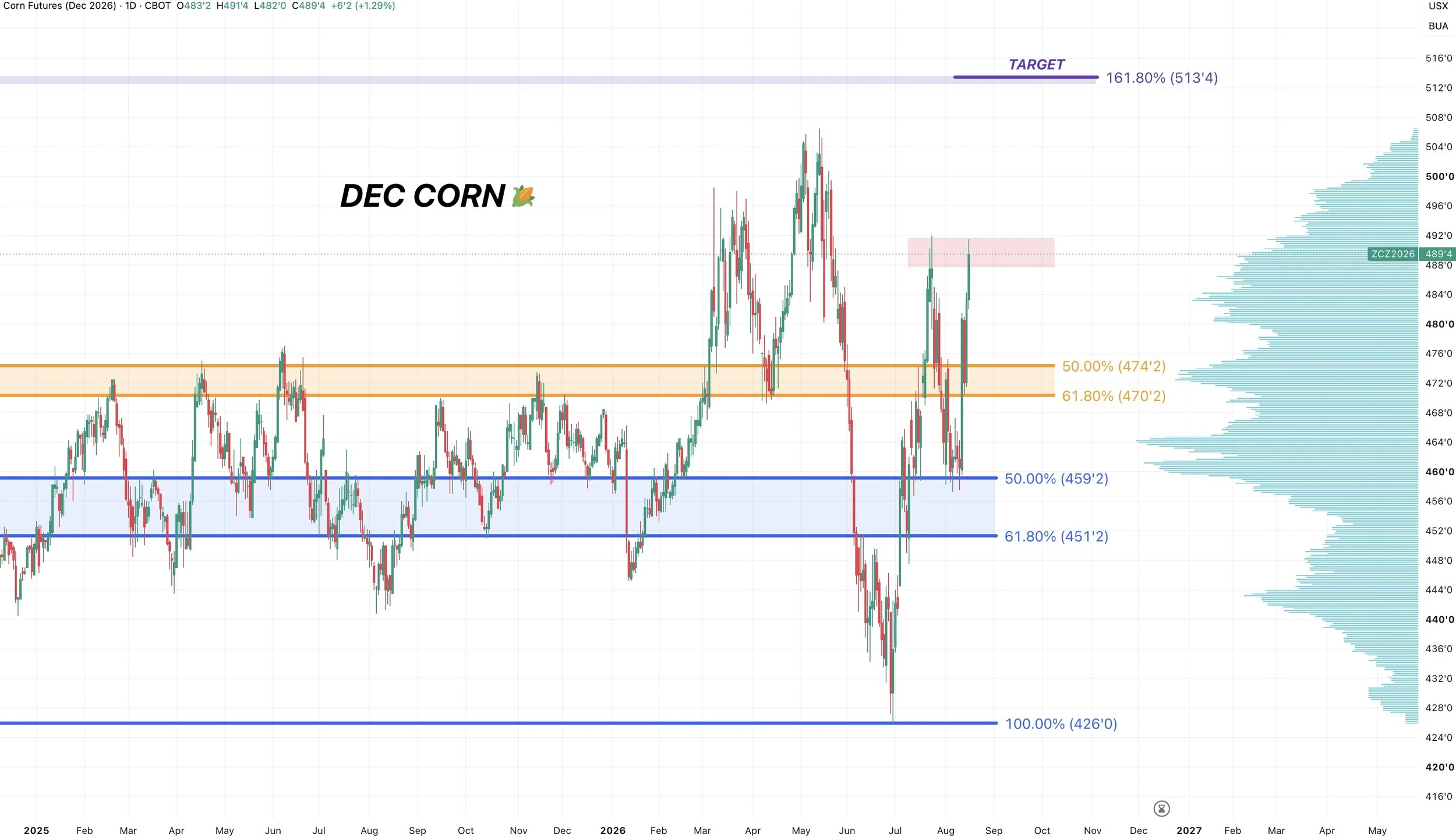
As for a big picture target.
I have a target that sits at $5.13 if we are able to break above both the July and May highs.
That's the 161.8% (golden fib) from the recent lows up to the July highs.
That same level is the contract highs.
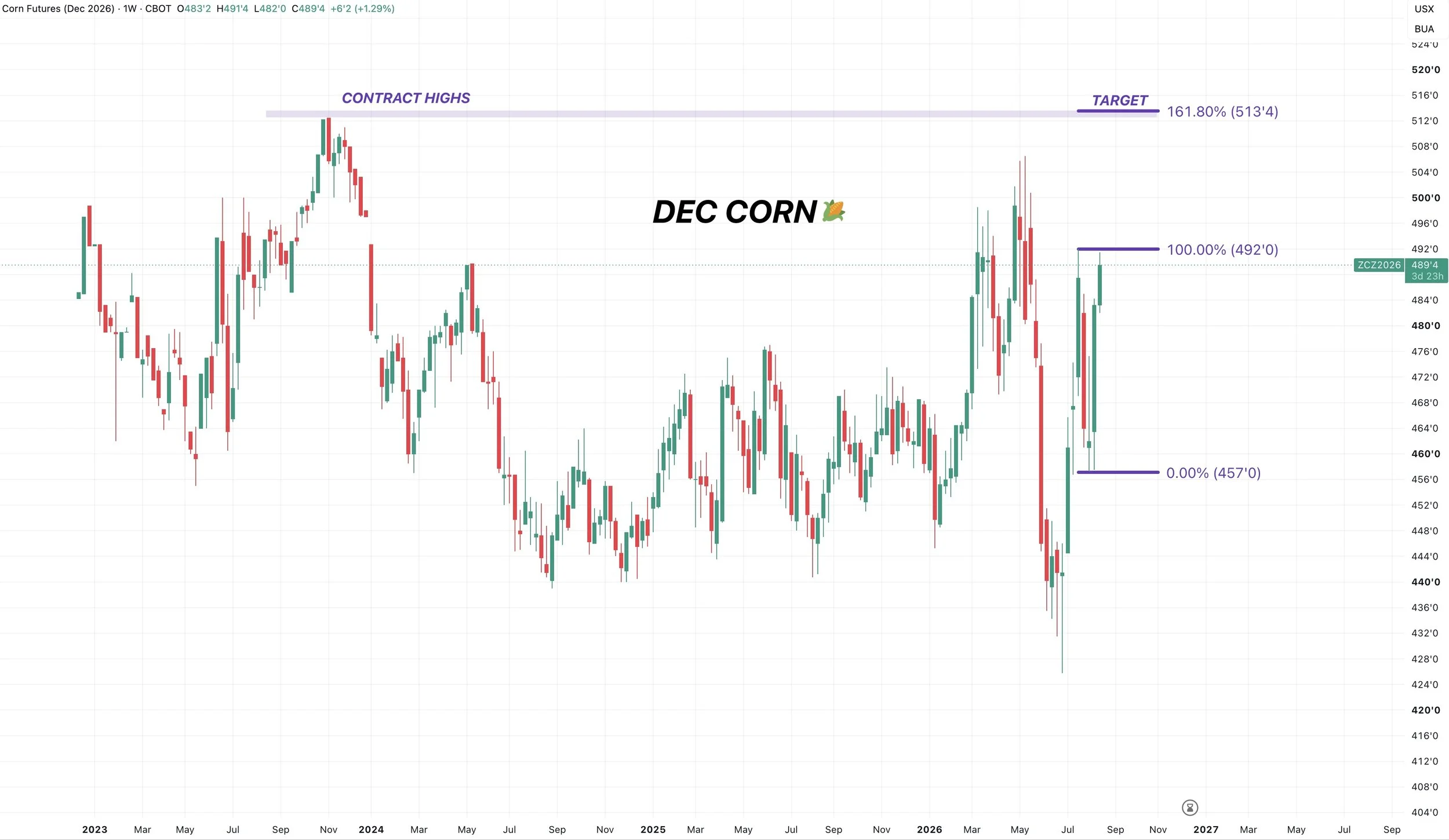
The MACD crossed bullish for the first time since the June lows. Suggesting momentum is higher.
However, one thing to note is that if we take out these July highs we might have some bearish divergence on the RSI.
As prices could post new highs, while the RSI does not.
So it would not be the worst idea to reward this high time frame resistance if it happens and we post new highs and bearish divergence.
Bearish divergence marked the May highs.
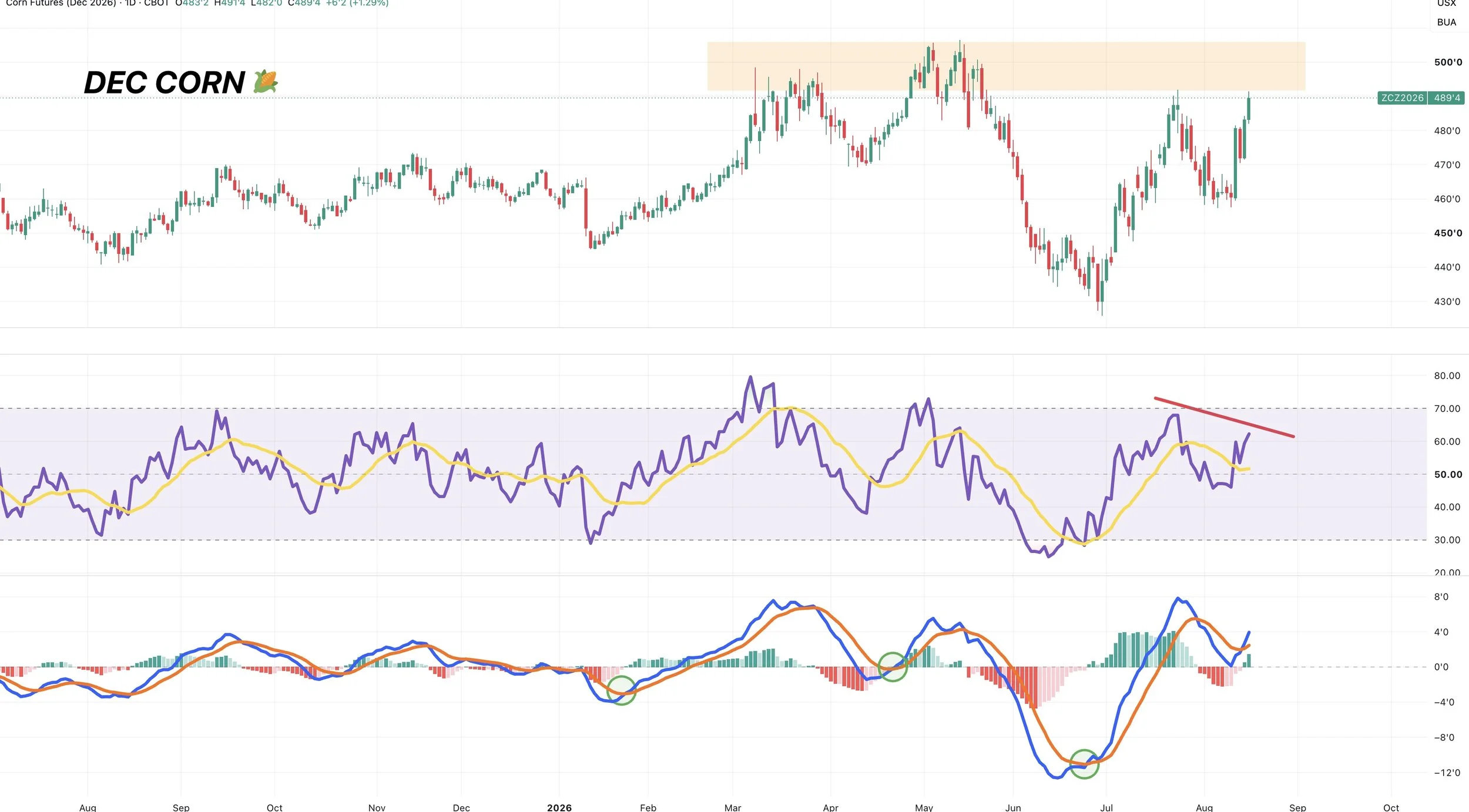
Dec KC Wheat 🌾
We blasted off that volume shelf and launch pad we had been talking about.
We are now up near some possible resistance here and those highs from July.
If we are able to bust through and post new highs, I have a target of $8.40 to $8.50
Which would be the golden fib and the implied move from this cup and handle pattern we have. But for this to be vaild, we of course need to post new highs.
That target is also subject to change, but is my long term target for now.
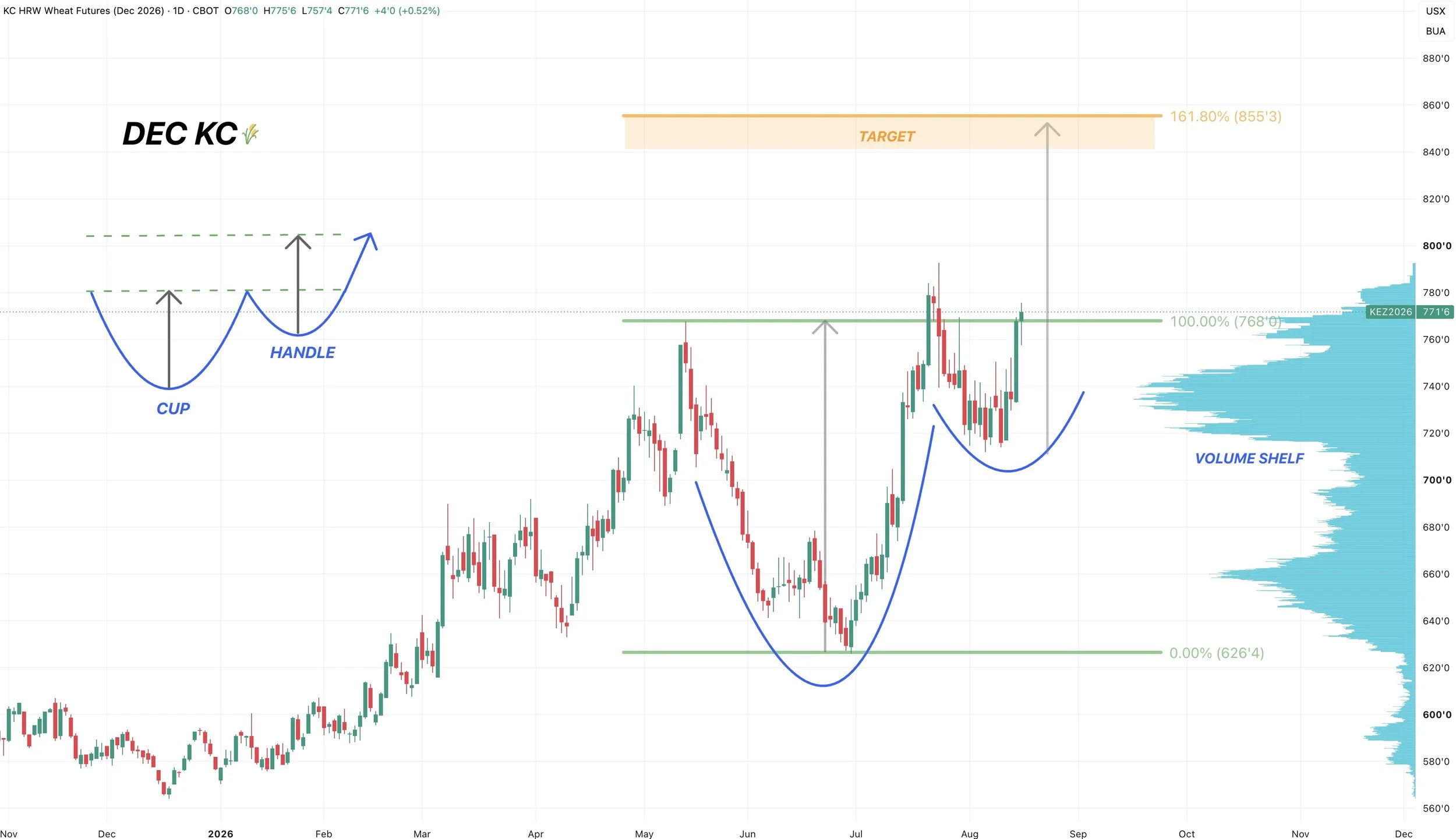
Dec Chicago 🌾
We bounced right in that golden zone where we wanted to see us find a bottom. Also sitting in a potential cup and handle pattern here as well.
Chicago is at some resistance here.
We've clawed back 50-61.8% of the entire sell off.
This same level is peak volume. So we could struggle here.
However, if we break above, the next resistance is those highs.
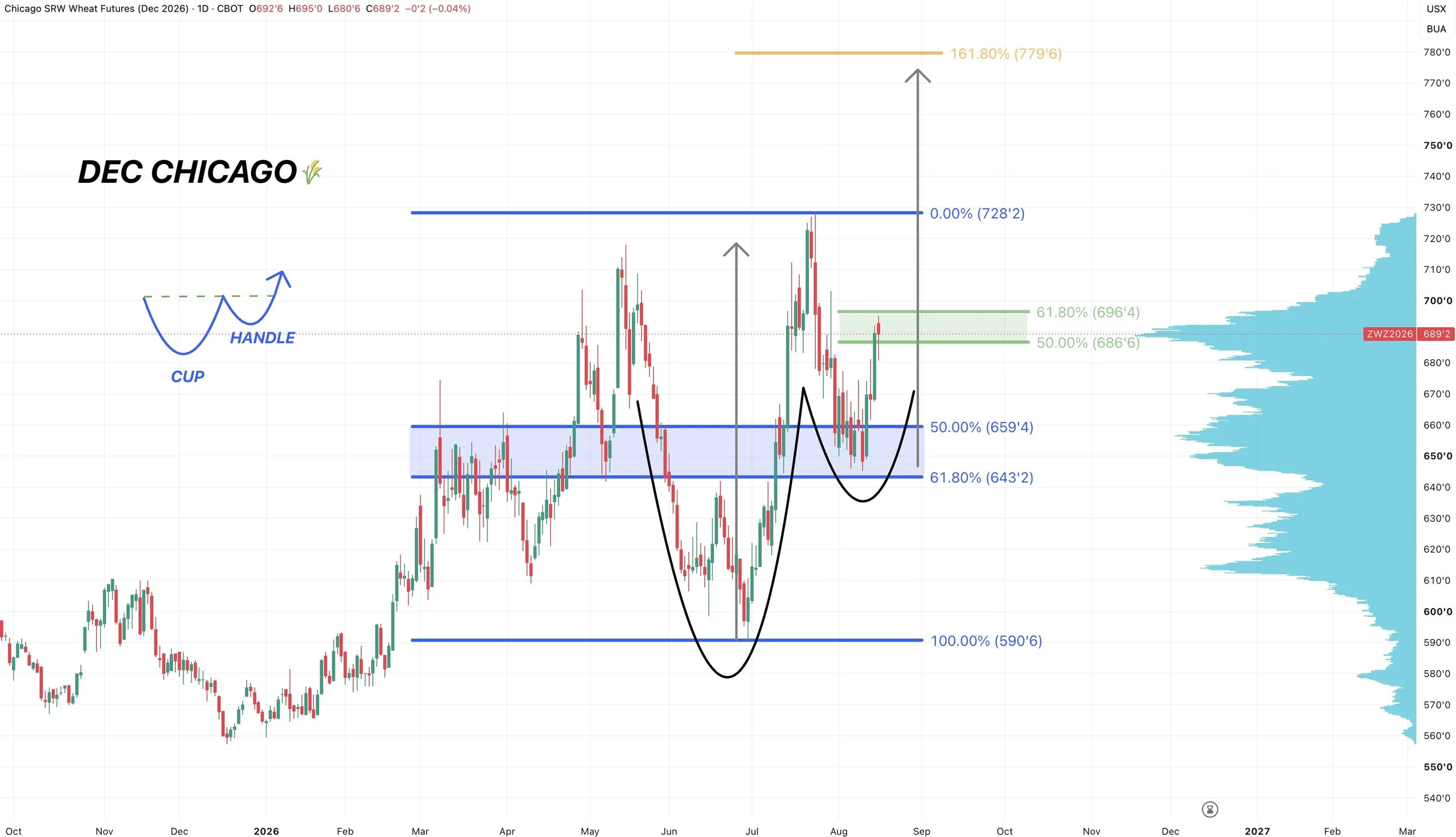
Want to Talk?
Our phones are open 24/7 for you guys if you ever need anything or want to discuss your operation.
Jeremey & Office: (806)484-1214
Sebastian: (605)280-1186
Email: sfrost@dailymarketminute.com
Hedge Account
Interested in a hedge account? Use the link below to set up an account or shoot us a call.
DOES THE USDA CHANGE ANYTHING?
MARKET UPDATE
Your free trial has ended
You will no longer receive every daily update or alert. Make sure you subscribe so you don’t miss out on future ones
Here is extended access to our USDA sale
You can scroll to read the usual update as well. As the written version is the exact same as the video.
Timestamps for video:
USDA: 0:00min
Corn: 2:55min
Beans: 10:00min
Wheat: 14:35min
Cattle: 16:10min
Want to talk?
Office: (806)484-1214
Futures Prices Close
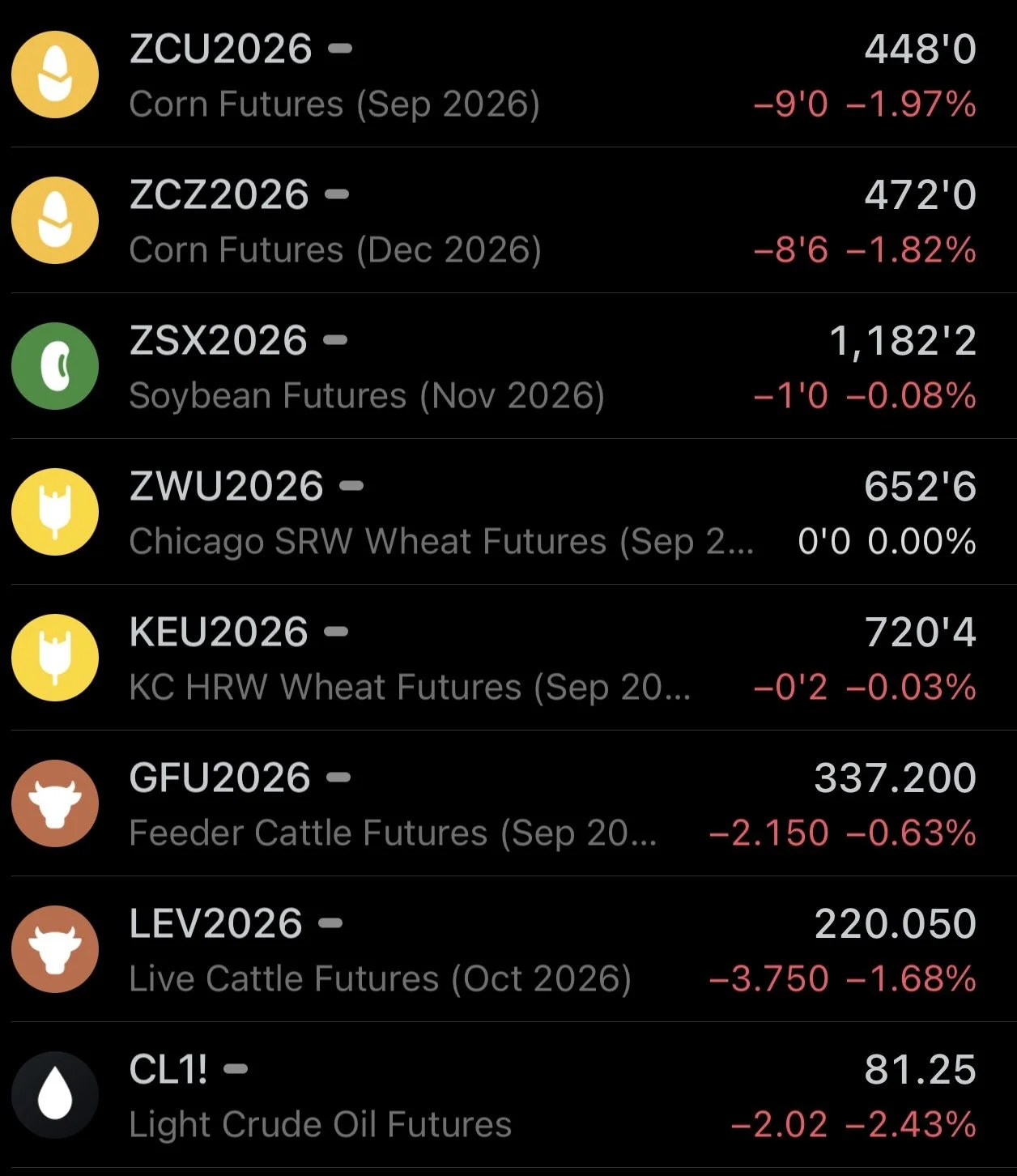
Overview
Grains on the weak side following yesterday's strong move with the USDA report. As today corn gave back a good portion of yesterday’s rally, meanwhile soybeans and wheat were just fractionally lower.
Yesterday was Dec corn's strongest day of the entire year. It was actually the first time this contract has ever traded +20 cents higher on a single day.
So being unable to follow up that move is disappointing, but seeing some weakness following the strongest day of the year isn’t a surprise or reason for concern.
USDA
We covered the report in yesterday’s audio, but today we are going to do a deeper dive into what some of this could potentially mean moving forward especially for corn.
Balance Sheet Changes
Corn Balance Sheet:
First I wanted to look at corn.
Here is the balance sheet changes.
Red = Bearish Change
Green = Bullish Change
Yellow = No Change
First off we got that yield drop from 183 to 180.7 bpa.
However, we also saw them bump acres by +1.4 million.
So this led to nearly a wash on the supply side.
Despite that big yield drop, our total production actually increased just slightly by +13 million bushels. Because the extra acres more than offset the yield cut.
So why did the balance sheet get tighter if we actually gained more production?
Well that would be due to demand.
The USDA raised old crop exports by +75 million. As a result, the new crop beginning stocks fell -75 million.
At the same time, they also bumped our new crop exports by +75 million.
So with the +150 in demand, and +13 million in production. The net loss to carryout was -137 million.
This led to our stocks to use ratio falling down to 10.12%.. which we will touch on more here later in today's update.
This number was probably the friendliest item, given acres offset the yield.
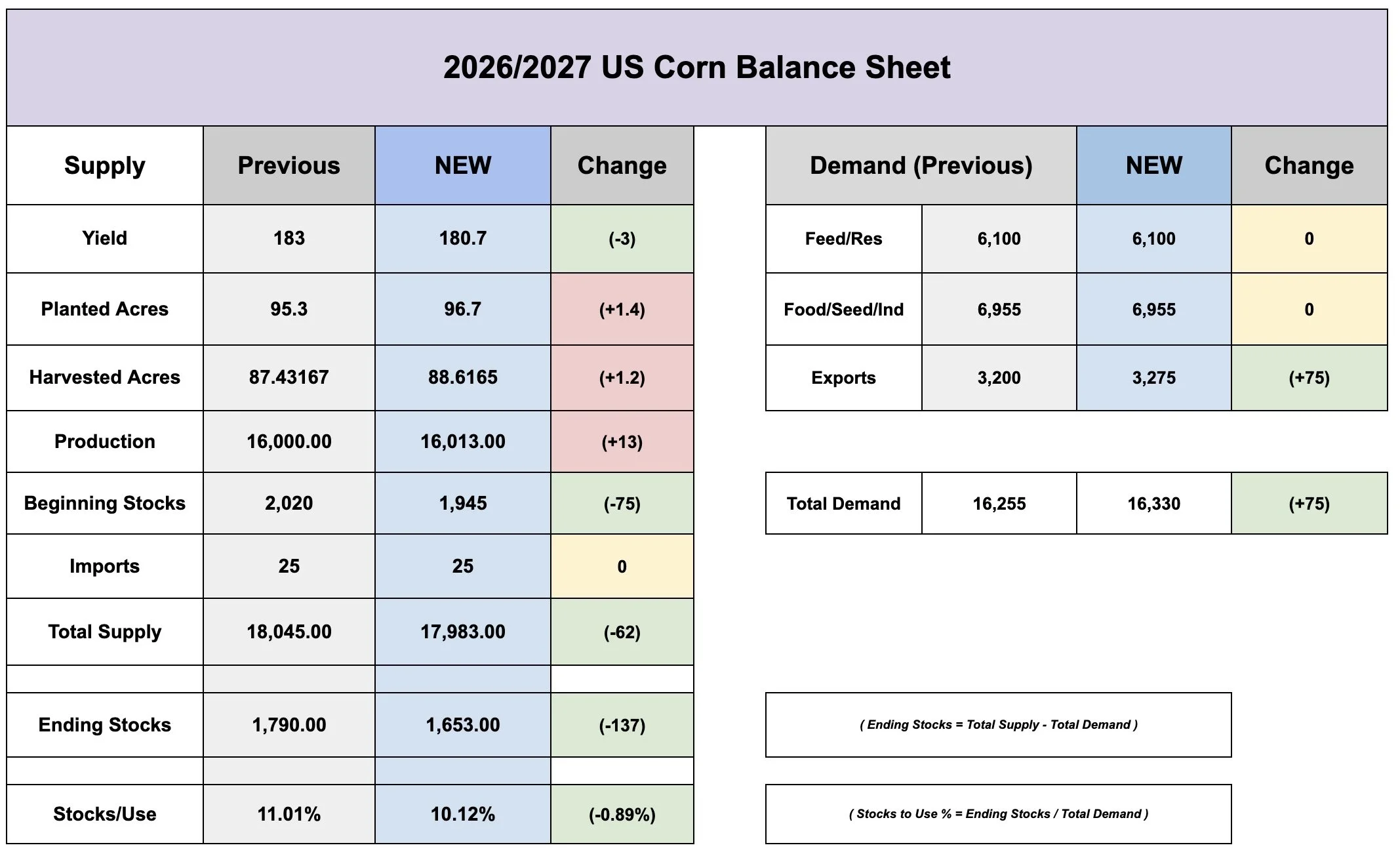
Soybean Balance Sheet:
Now soybeans didn’t have all that friendly of a report.
I'd call it mostly neutral.
We saw yield drop from 53 to 52.7 bpa.
But just like in corn, we saw more acres. Those extra acres more than offset the losses in yield.
With total supply increasing by +40 million despite the lower yield.
At the same time, the USDA bumped crush by +30 million.
So we saw a net increase of +10 million to the carryout.
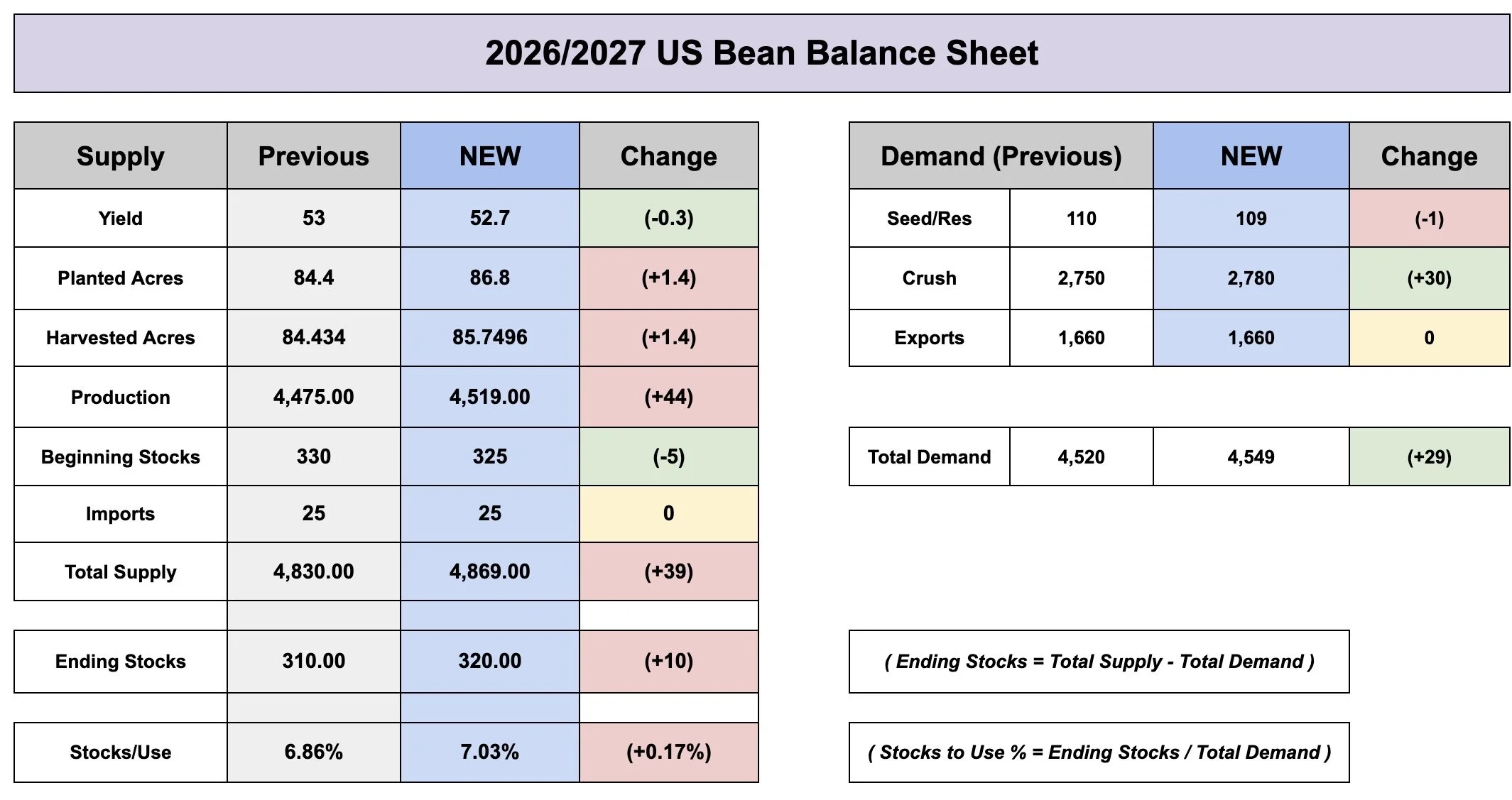
Record Combined Acres
With the extra acres, this would actually be the largest combined corn and soybean acres on record.
It's the largest by around +3 million acres.
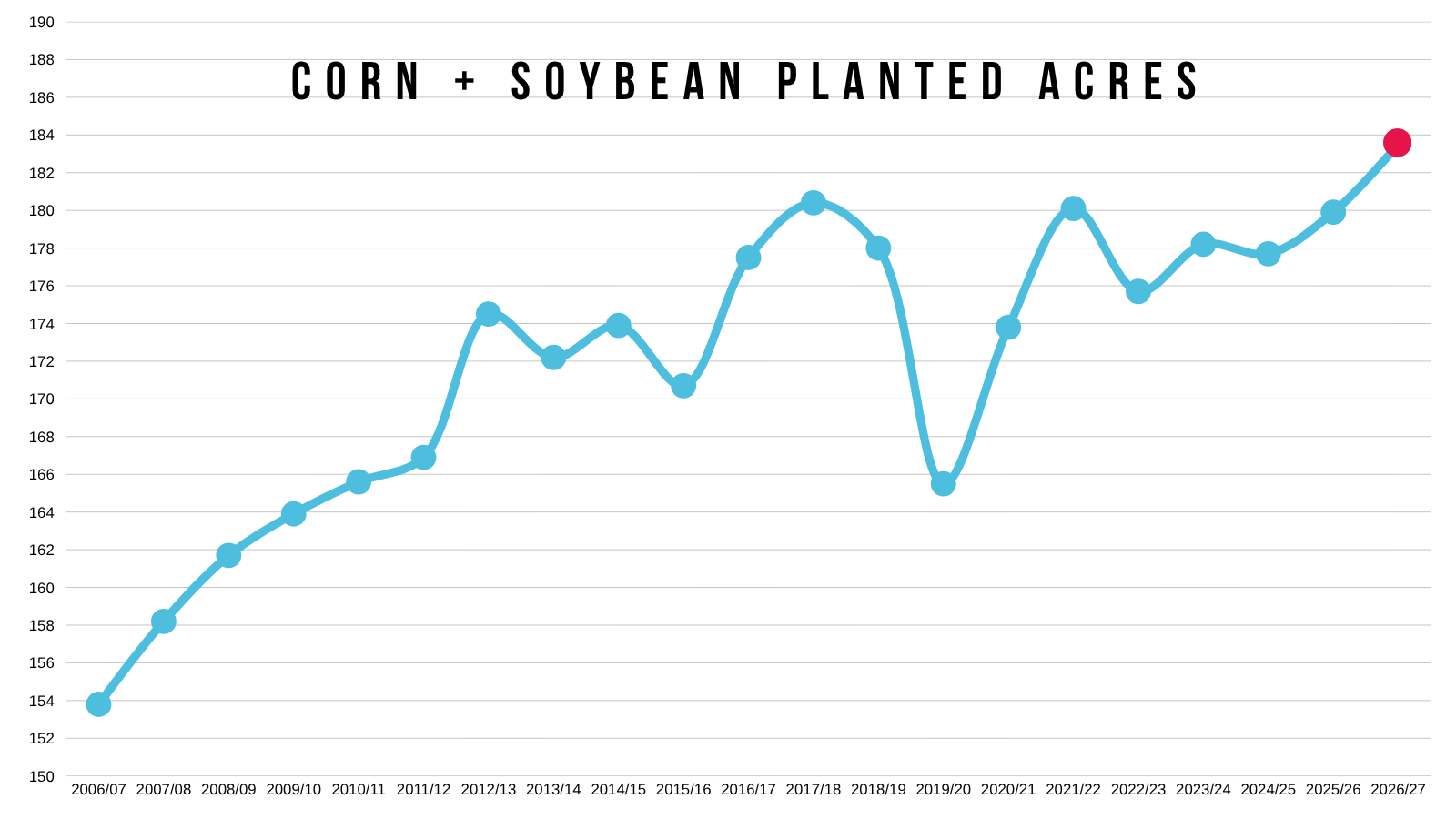
Could we see the USDA continue to bump corn acres?
Who knows. Here is the history of corn June to final acres.
Last year we had that anomoly of a miss.
This year would also be the 2nd largest increase.
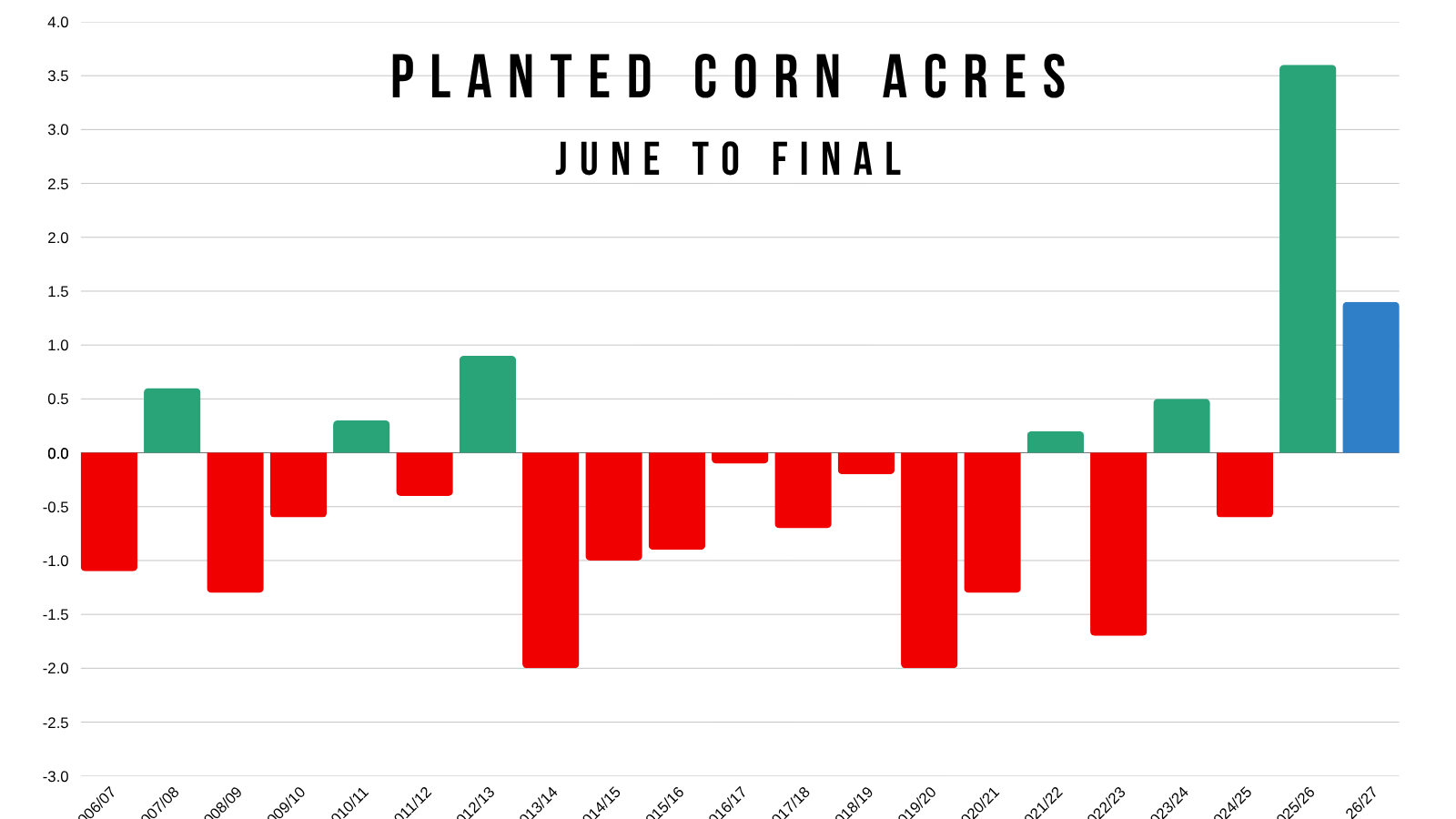
Today's Main Takeaways
Corn
As we had been talking about the last few weeks, the crop ratings did suggest a below trend yield.
We went over a ton of data suggesting this.
I was skeptical that the USDA would admit it this early, but it was great to see they made the adjustment.
To see yield increase from here, we might need to see those ratings improve from here.
(Below is final ratings vs how yield changed from May)
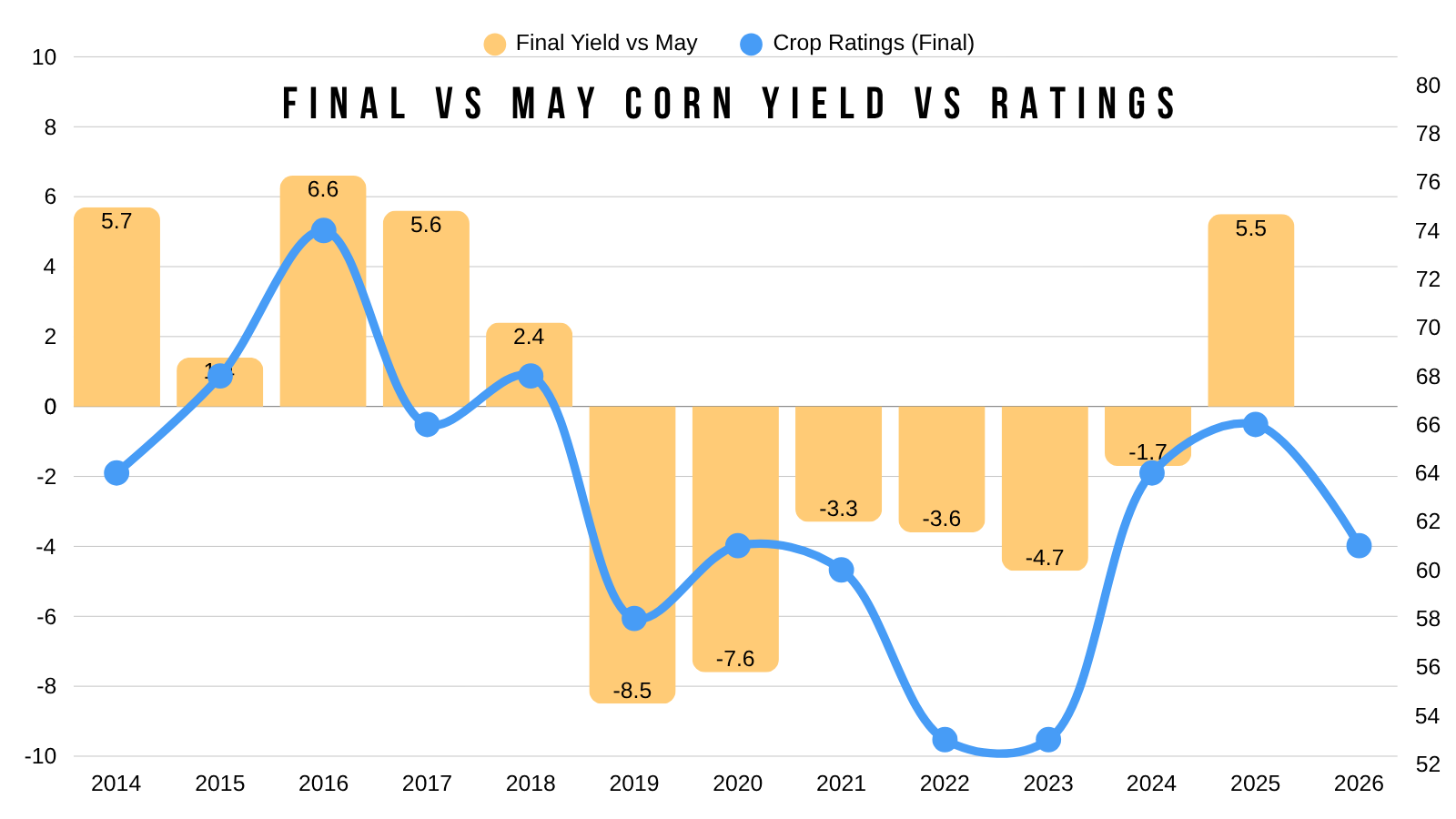
However they do historically tend to decrease as the year goes on.
The last time today's ratings were better than the final was 2019.
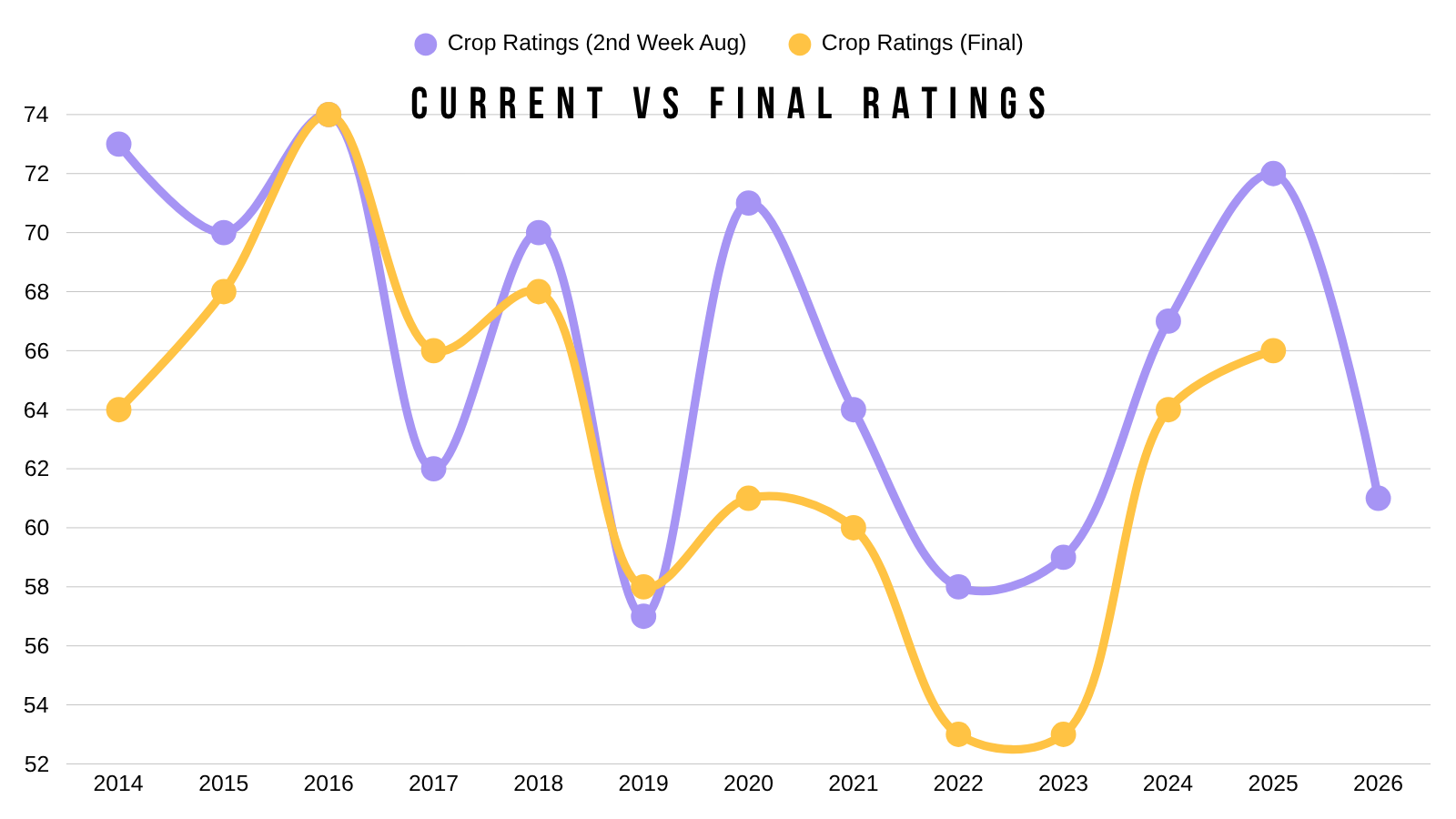
Stocks to Use:
For the last several months, we had been talking about how there were several pathways for the new crop stocks to use to drop into that 10% or lower range.
Yesterday the USDA just dropped our new crop stocks to use from 11% down to nearly 10%.
Which is down a pretty sizeable amount from old crop's 11.68%.
Why is this a big deal?
I've shown this chart a thousand times.
It compares our stocks to use, with our highest price of the year for the front-month contract.
Usually, for us to see front-month corn much above $5.00 we need to see that stocks to use drop below 10%.
So we are not in full blown bull market territory just yet.. but essentially we are knocking on the door of a bullish situation.
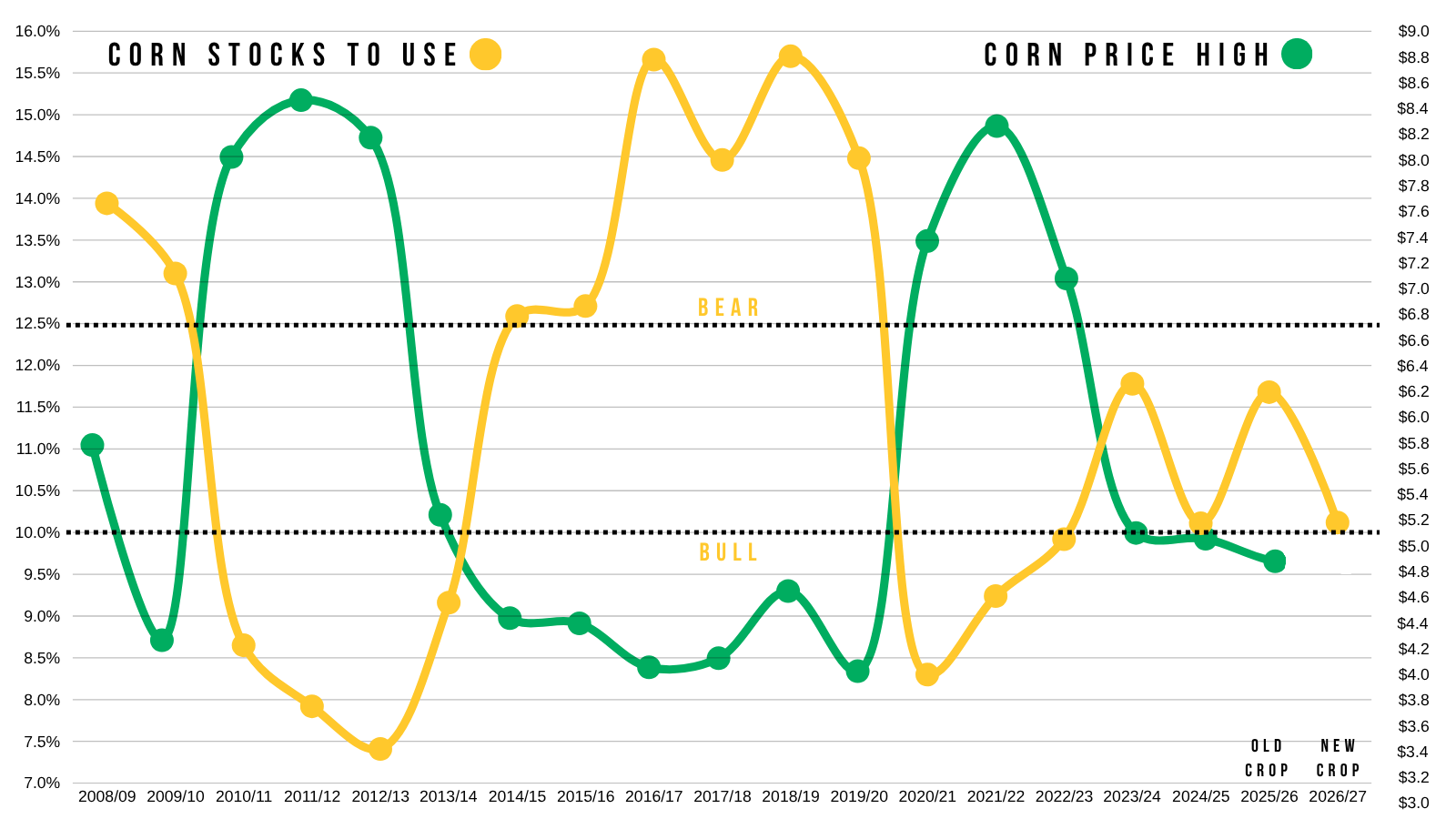
Here is a spreadsheet example for every year.
A 10% stocks to use is not associated with $4.50, it's more so associated with corn in that $5.00 range.
But again, to get corn much above $5.00, you usually need to see it drop into that 8% to 9% range.
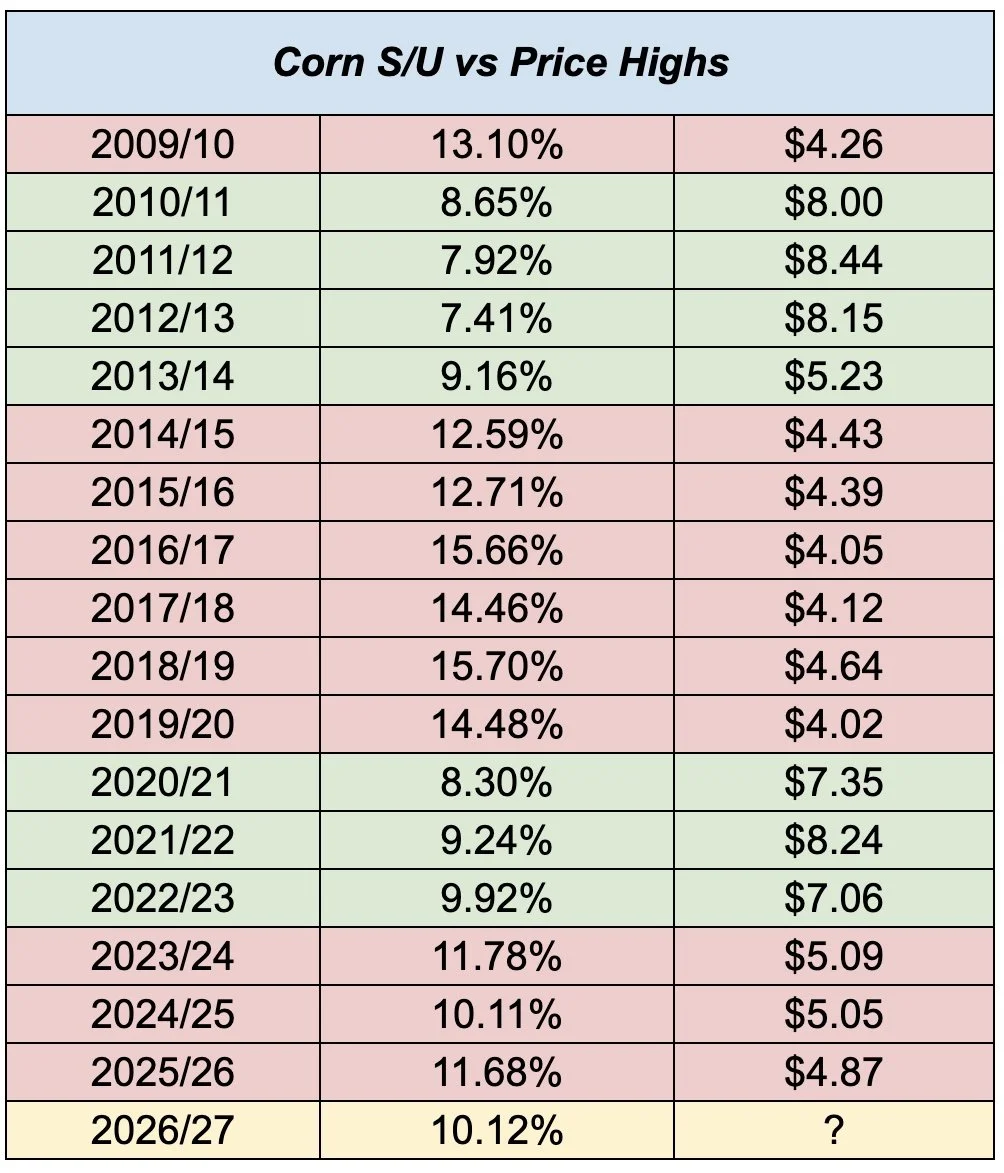
Here is one of the more interesting parts.
This is where our stocks to use ratio was on the August report over the years.
We are STARTING off a lot tigher than usual.
As we haven’t been this tight in August since 2022.
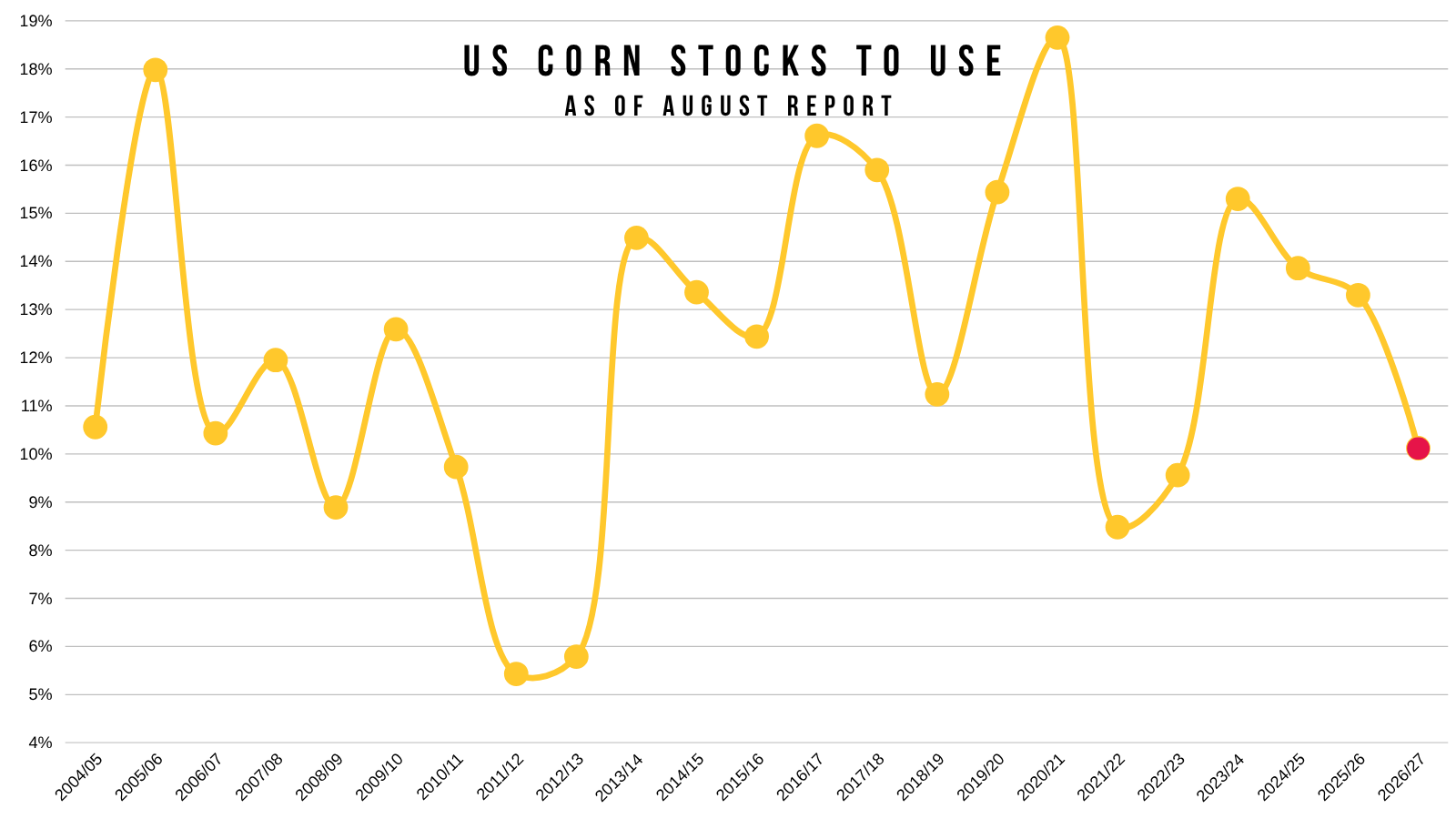
Here is what it looks like if you compare the August S/U to the Final S/U.
The last several years, the final number was a lot tighter than where it was in August.
The last time we saw the final number looser than the August one was back in 2022/23.
You have years such as 2024/25 that ended up around 10%. But we did not start there in August like we are this year.
So we are starting out in a much tighter situation than we have over the last several years.
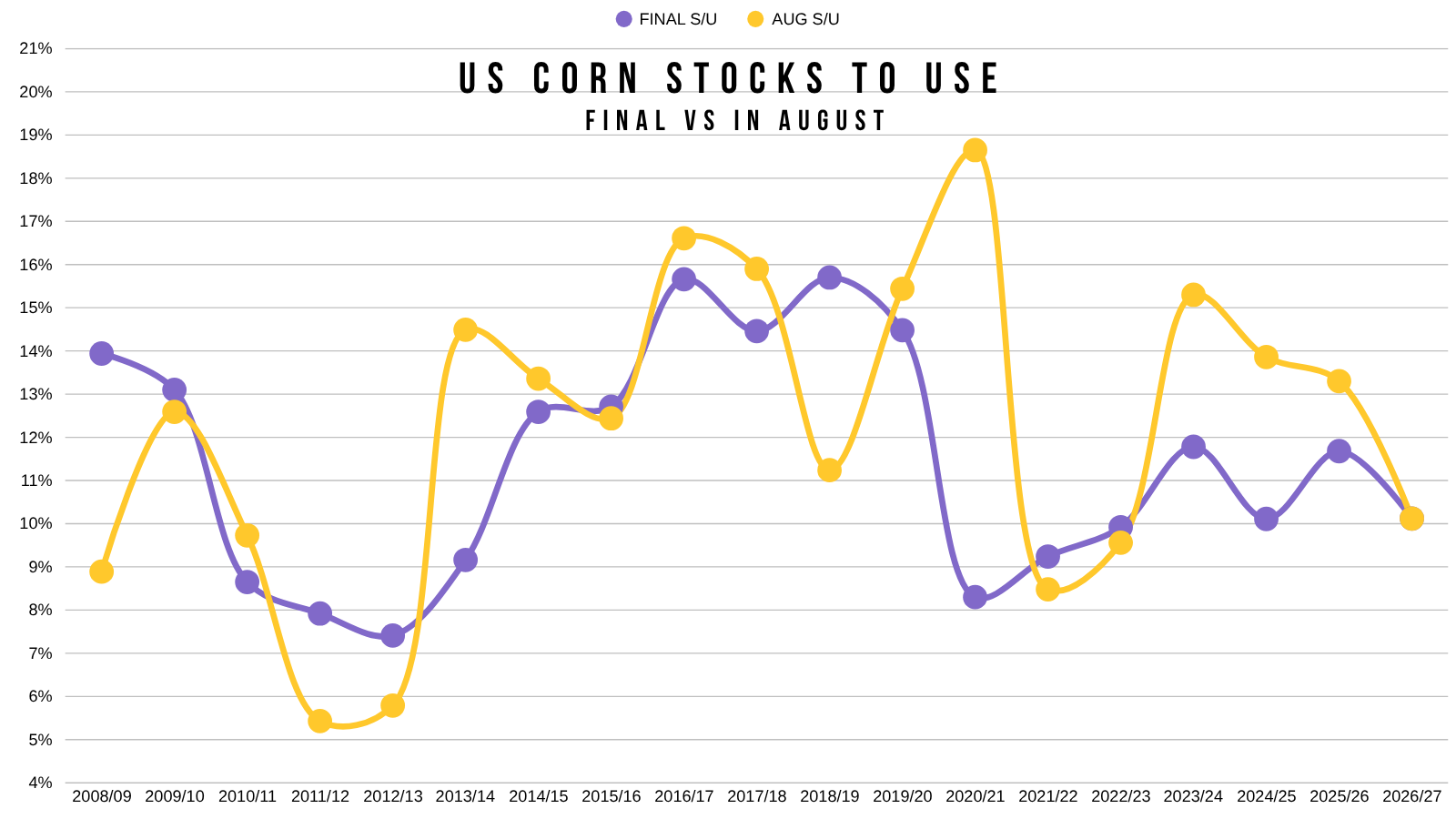
Demand is King:
Like we mentioned. We actually have more production now than we did with a 183 yield simply due to the acres.
The bull case largely resides in the demand arguement.
The USDA is probably going to need to raise the old crop exports gain, given how far ahead of pace we are.
The USDA is expecting our new crop demand to be worse than our old crop demand. That doesn’t magically happen on it's own. Most of the time, if you want to justify lower demand we need to see higher prices justify lower demand.
Just for reference, looks look at how the exports for old crop shaped up.
In July last year, they had exports at 2.70 billion.
Yesterday those exports came in at 3.40 billion.
A very large +700 million increase.
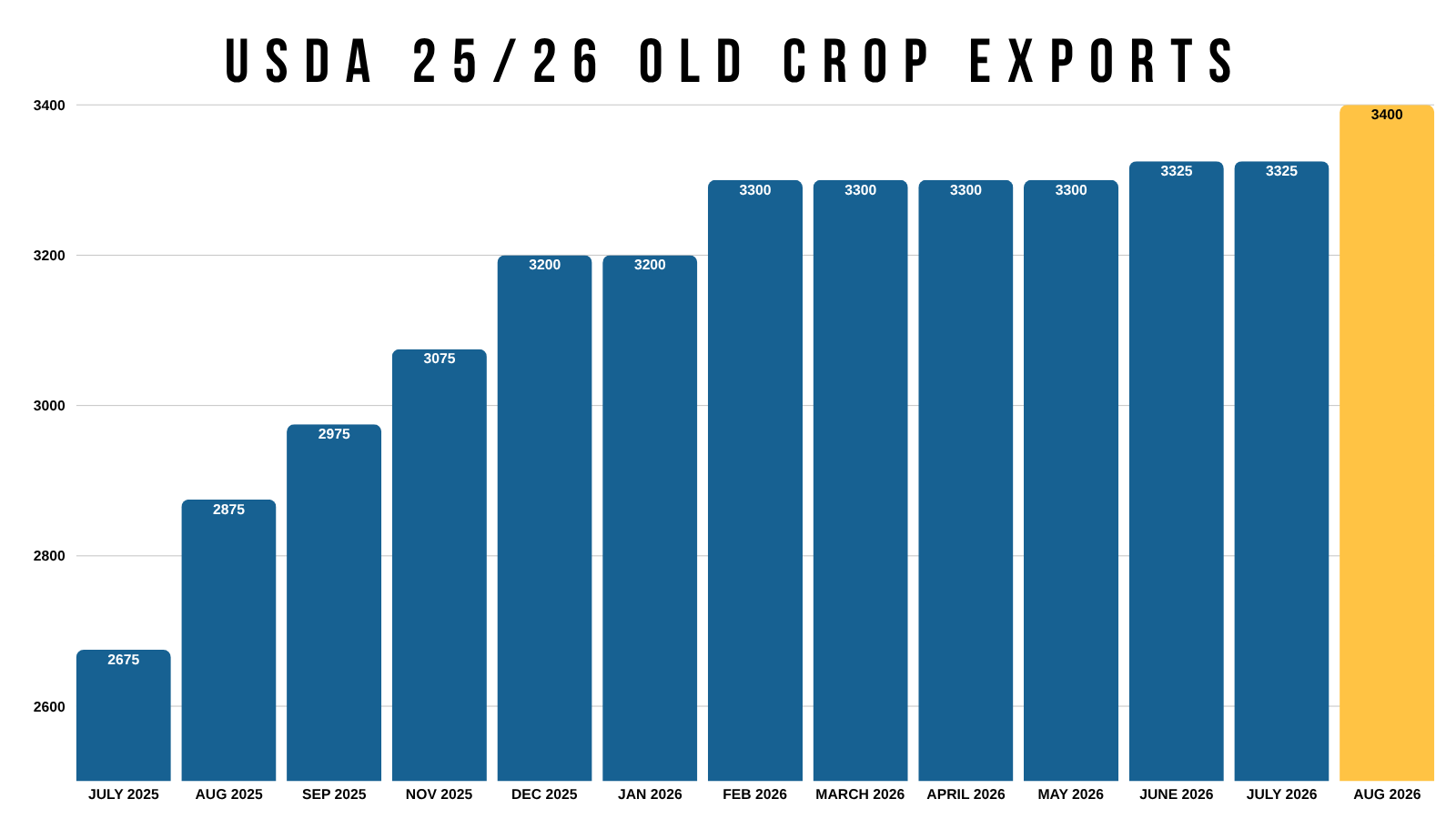
Even our old crop carryout is now under 2 billion due to monster demand.
It took a record yield AND record acres to get this number, and we still couldn’t get carryout above 2 billion.
(Bars = Yield & Line = Acres)
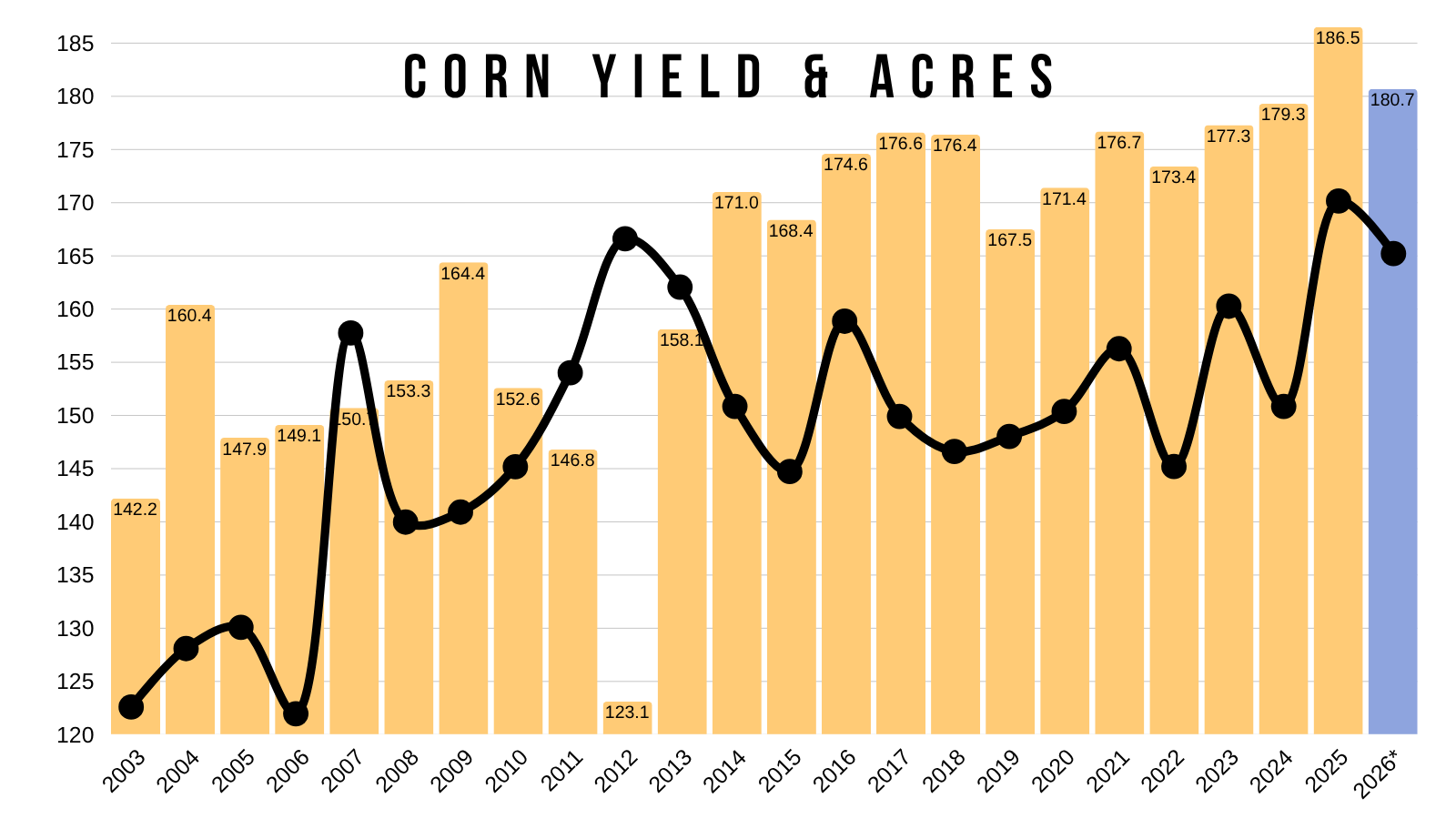
Now we have a 1.65 billion carryout that really doesn’t have much room for error.
As long as acres don’t magically increase from here again, any further cut to yield would likely bring that stocks to use below 10%.
Or for example, let's just say exports ultimately come in 100 million bushels higher when it's all said and done, but yield and acres stay where they are. That gives you a sub 10% stocks to use.
Given how tight we are starting, there just isn’t a massive room for error.
Now yes, some would argue that the USDA has plenty of wiggle room to "fudge" the feed and residual number.
Which is true, the number doesn’t make sense, but they've been arguing this for a very long time. The reason they kept it this high could’ve easily been as simple as they overestimated yield last year, so they used the number as a scapegoat.
(179 Yield Scenario)
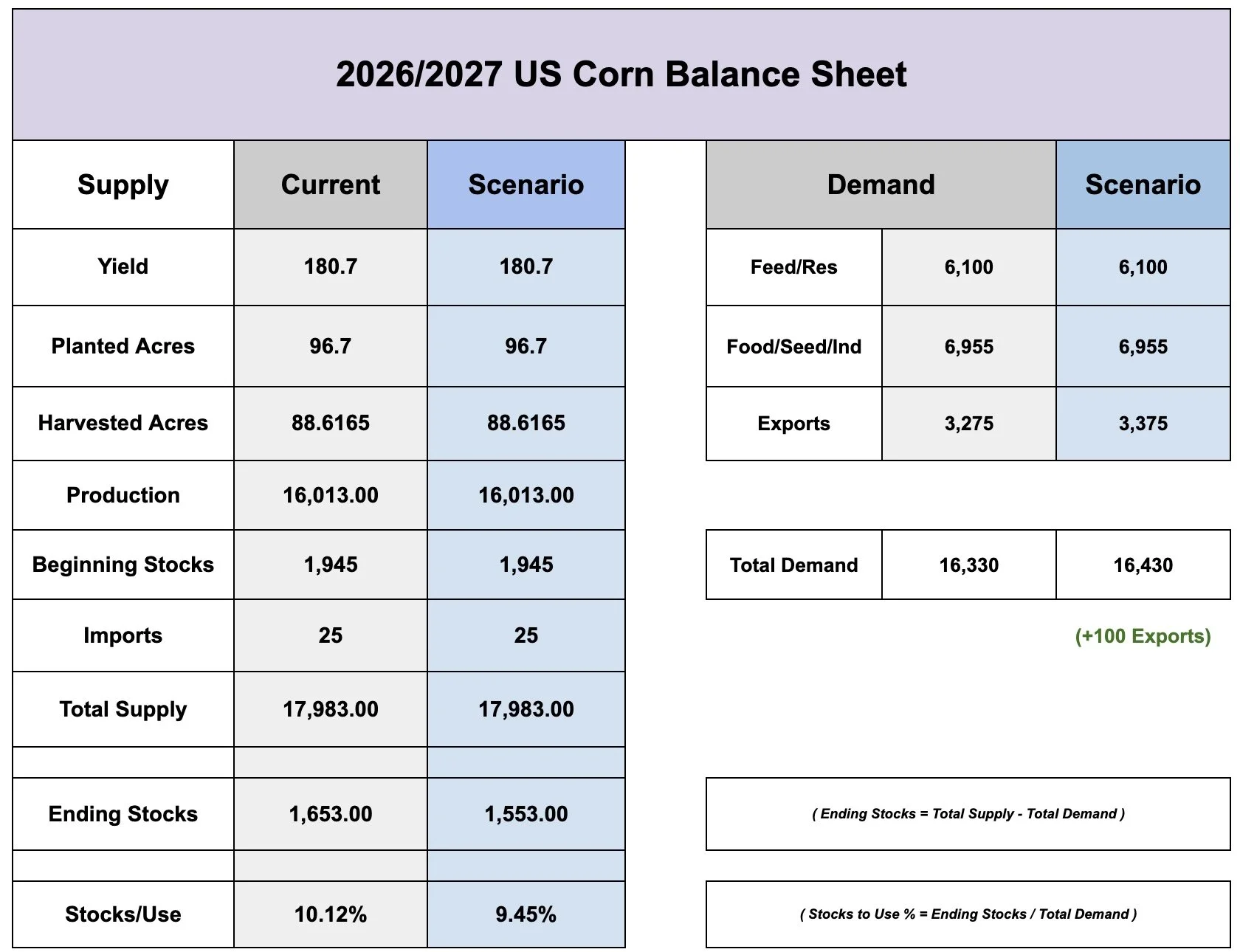
(+100 Exports Scenario)
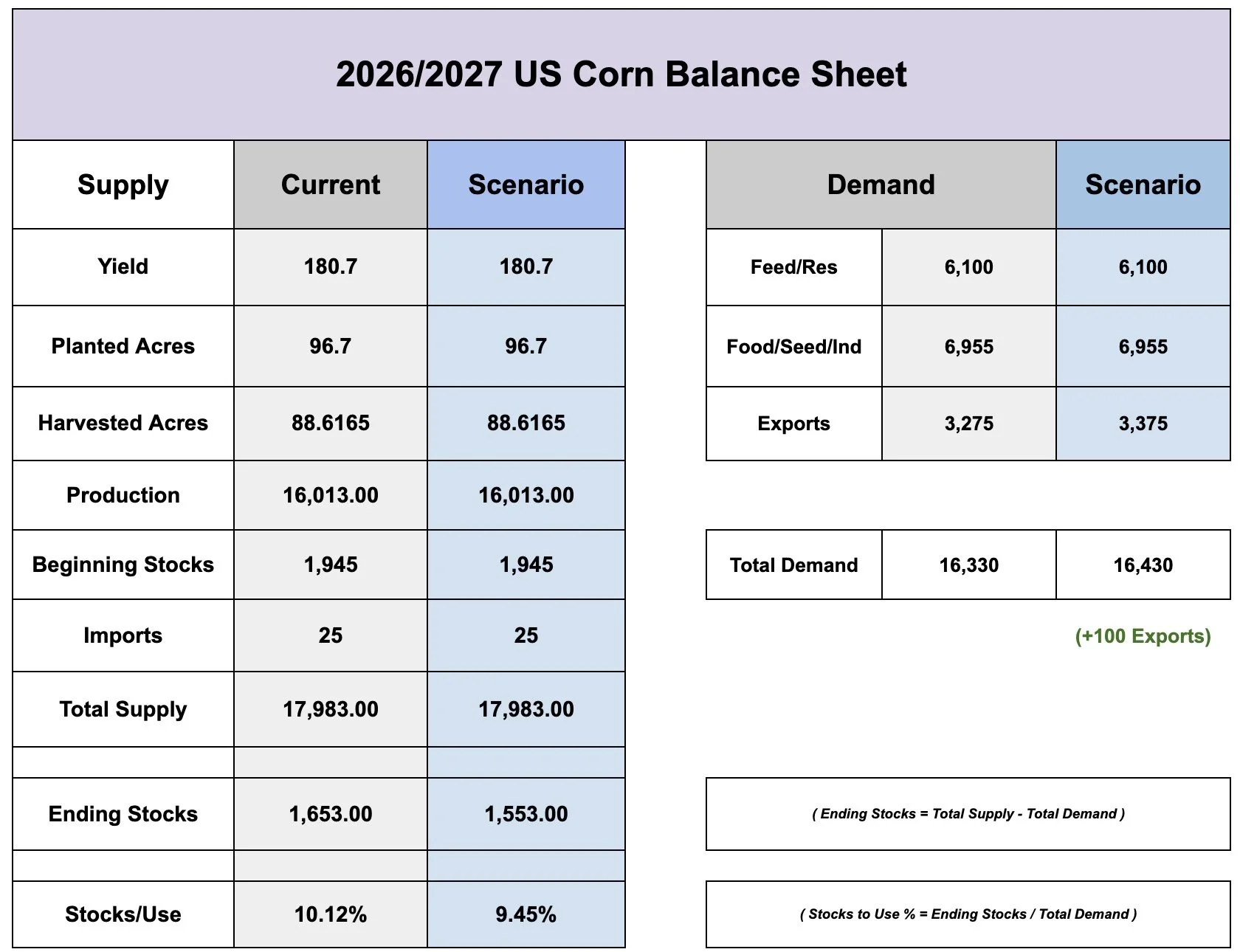
Bottom Line:
I think corn has plenty of potential long term as has been my bias for several months.
People can argue about the numbers from the USDA all day long. All I know is that we have the most "potential" we've had in a long time.
That doesn’t mean we "have" to go a lot higher, but the potential is certainly there long term.
Demand led markets don’t happen overnight. It's not the same as a supply driven market. It can take a while to build.
Overall I am remaining patient waiting for the next opportunity.
However, one thing to note is that short term we are heading into harvest. So that adds some caution with potential harvest pressure.
New crop corn is still +50 cents off the lows and sitting at 4-year highs if you’re someone who knows you are going to have to move something off the combine.
There are several ways you can protect yourself or lock in a floor. Call us if you want to discuss your situation.
Office: (806)484-1214
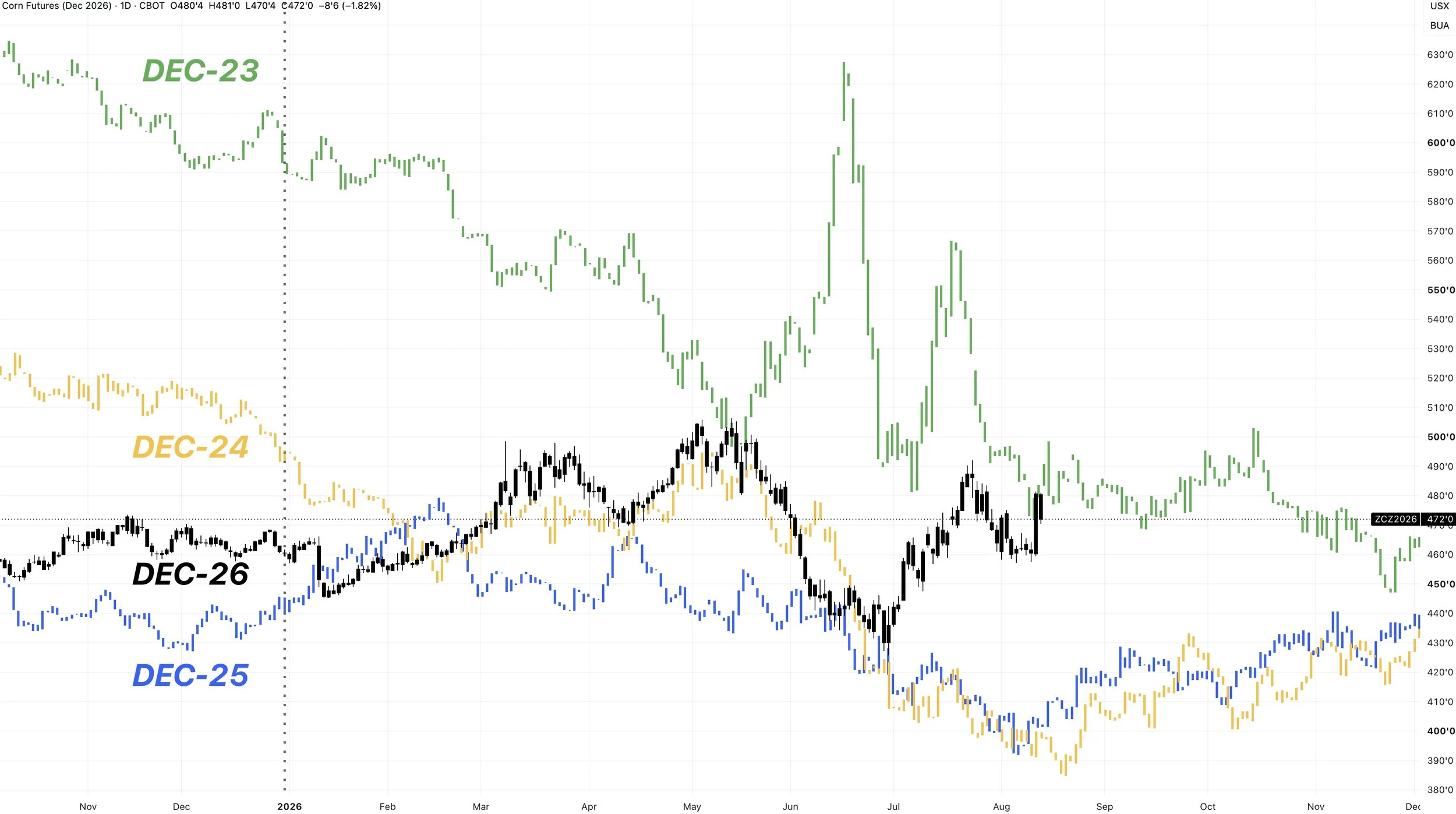
Dec Corn Chart:
Huge day yesterday.
Yes it was disappointing we followed it up with weakness today, but I don’t see any reason to be concerned here. Markets don’t usually go straight up and yesterday was the best day ever for this contract.
The $4.66 to $4.69 level would be a perfectly common spot for us to retrace to before resuming higher.
As that gives back 50% to 61.8% of the recent mini pop. So short term, we'd like to hold there.
We're also sitting right at a bunch of moving averages as well.
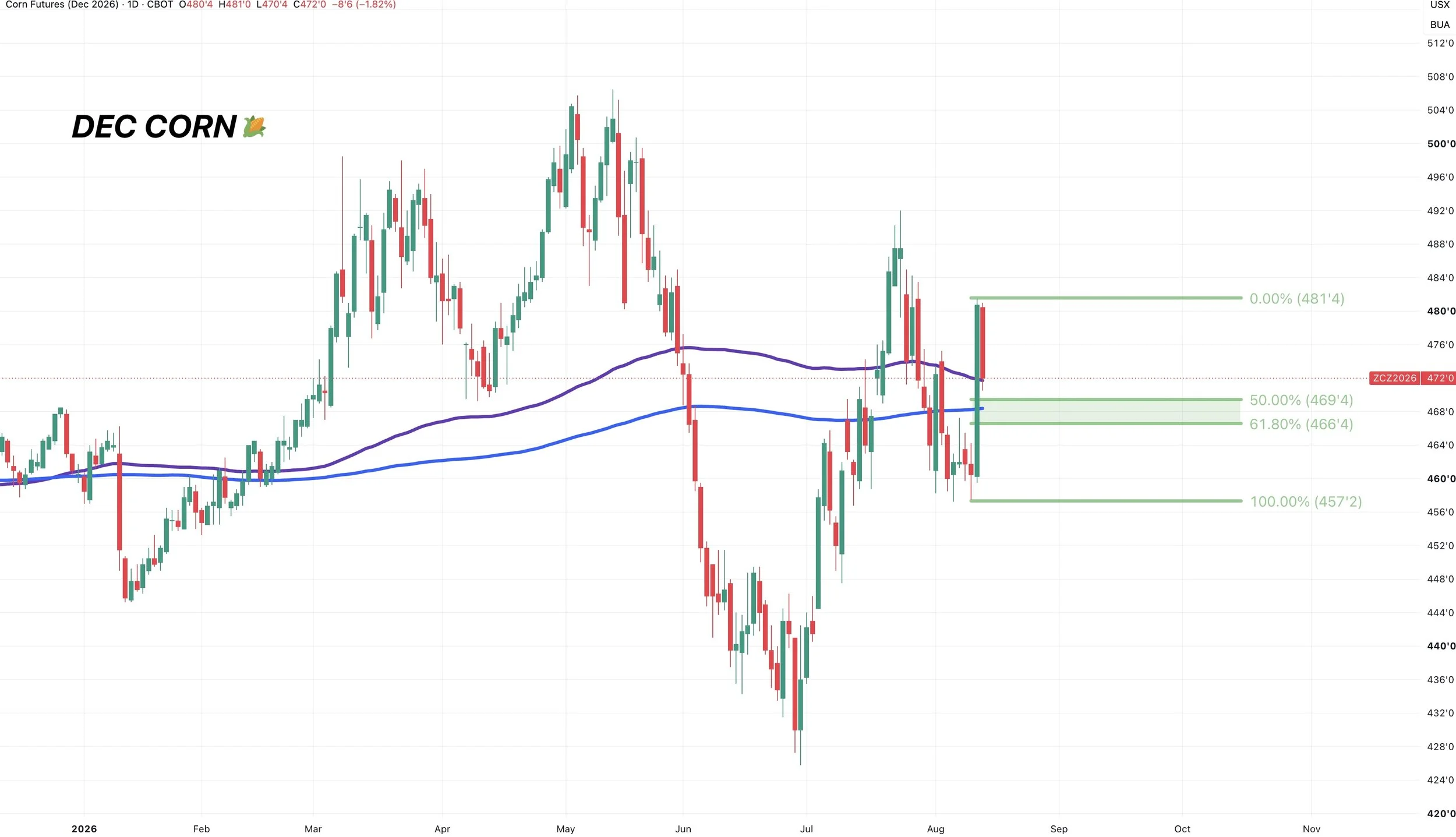
We found life after giving back 50% of the entire rally.
That same level was a massive shelf of volume.
So we bounced right where we needed to.
Even if we don’t hold the levels above, the upward structure still remains in tact, and my bias leans higher unless we break below the 61.8% level down to the contract lows at $4.50
I will be going over some upside targets later as we get closer to them.
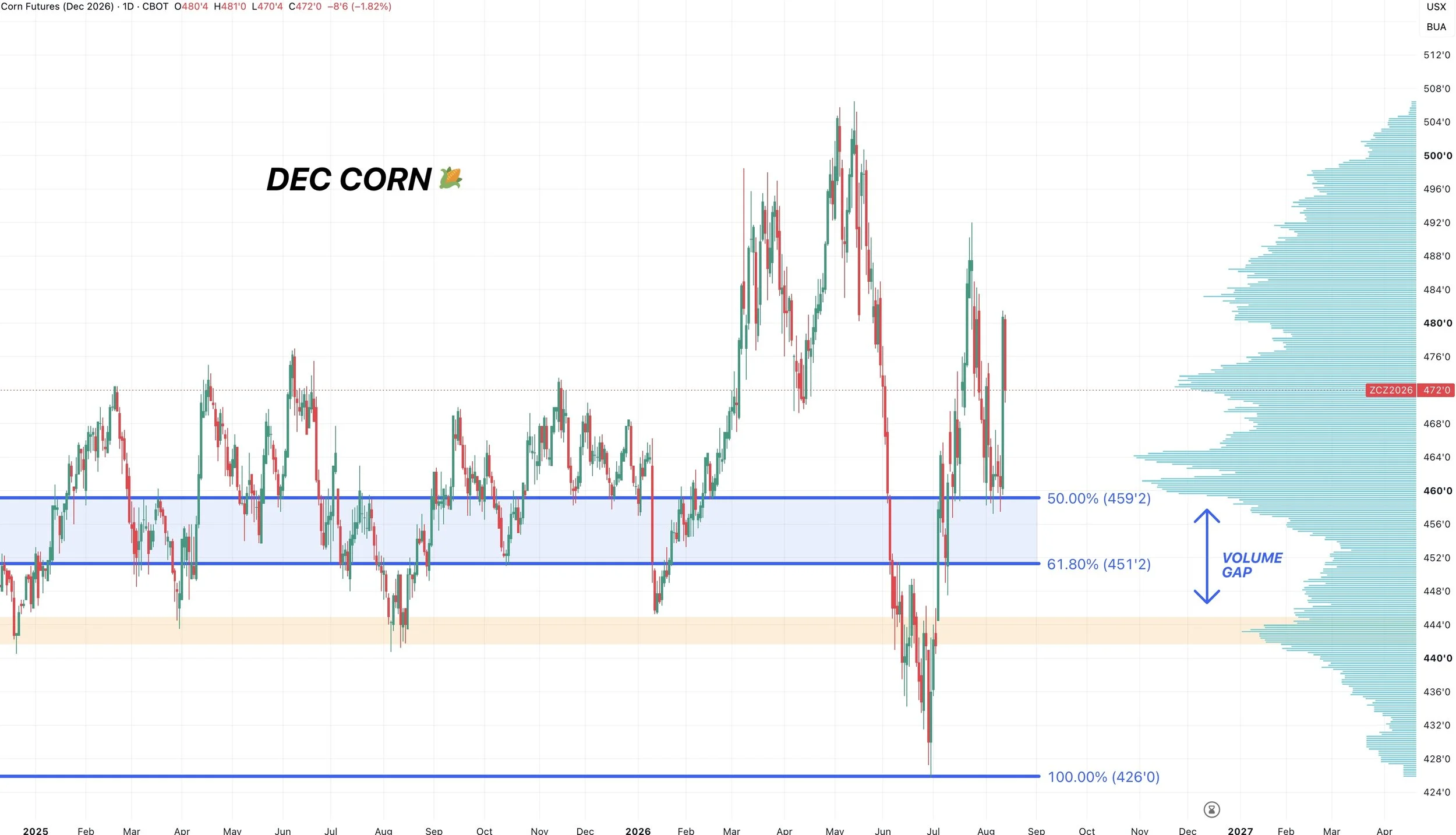
Soybeans
Weather:
Weather isn’t exactly screaming bullish for soybeans.
We still have plenty of rain in the forecasts.
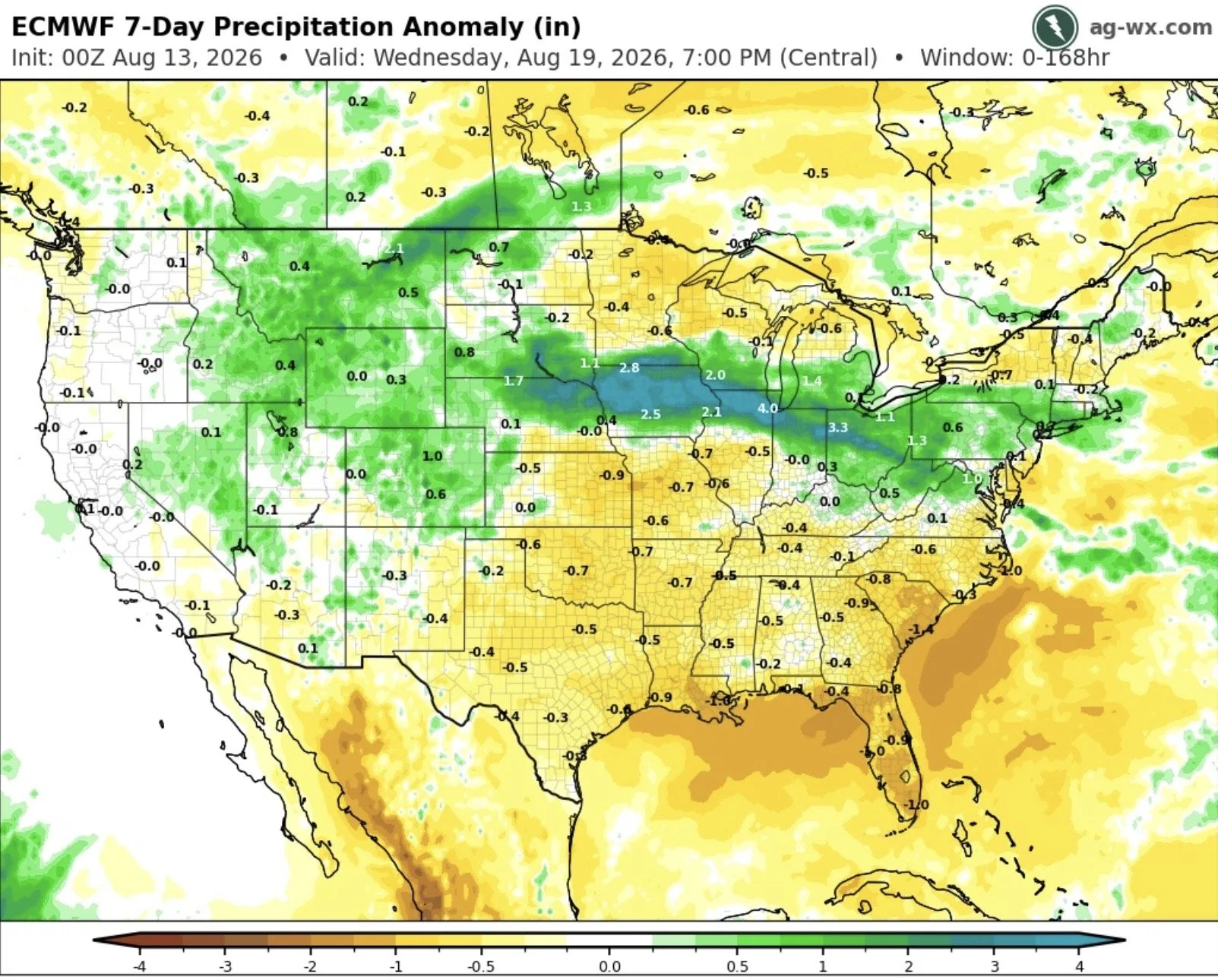
Here is the precip ranks for August so far.
We've seen a very wet month across the I-states.
So you could argue that the soybean crop does still have potential, especially when compared to corn.
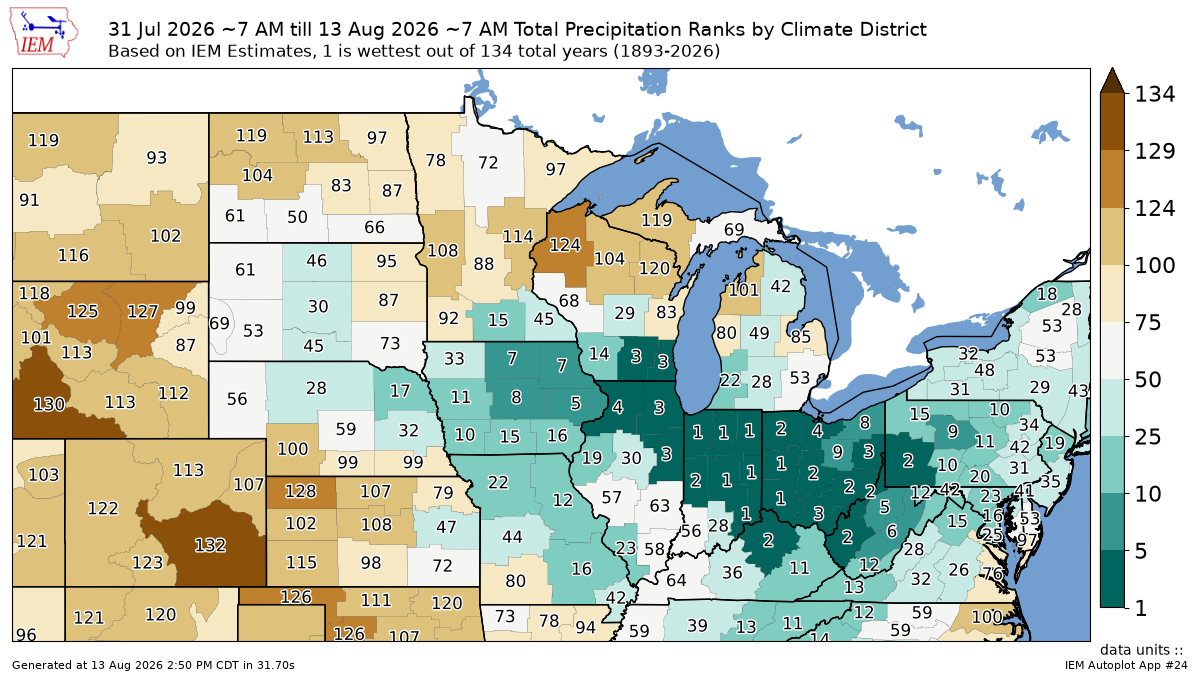
US vs World Story:
Here are some similar charts to the corn stocks to use ratio chart I showed in corn.
This first one is the US carryout vs soybeans highest price of the year.
With the increase to carryout, we are basically right on par with where we were the last two years.
The current US situation right now isn’t considered super bullish, but it's not bearish either.
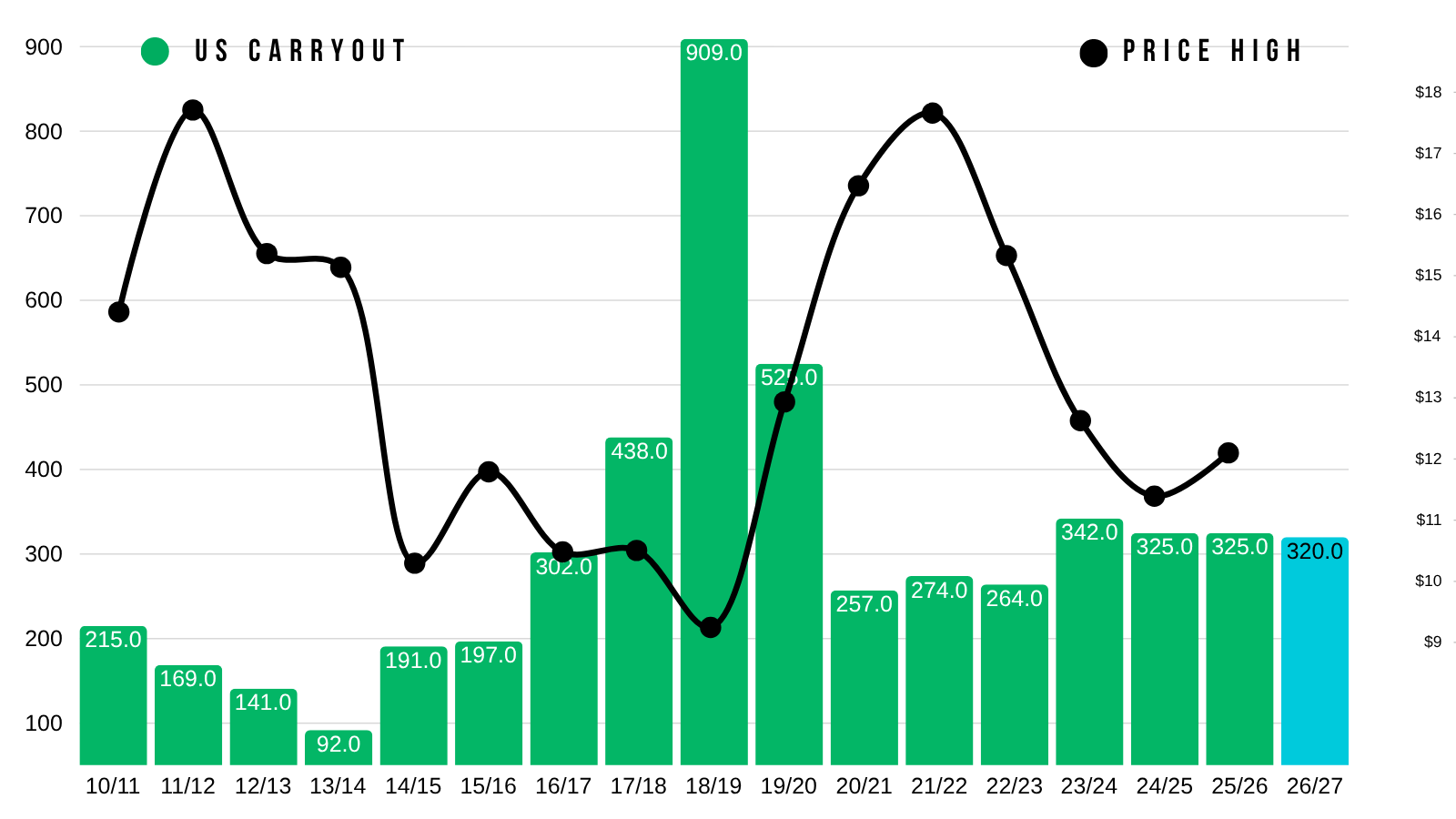
But given that soybeans are more of a global crop than corn is, with Brazil being the dominant player outside of the US.
The world situation is a better resemblance for soybeans.
Right now, the world situation is the tightest it's been in several years.
Not as tight as 2022, but the tightest since 2023.
This is despite Brazil having record crop after record crop. Yet the world story is getting tighter and tighter.
You can imagine what happens if South America where to have a hiccup.
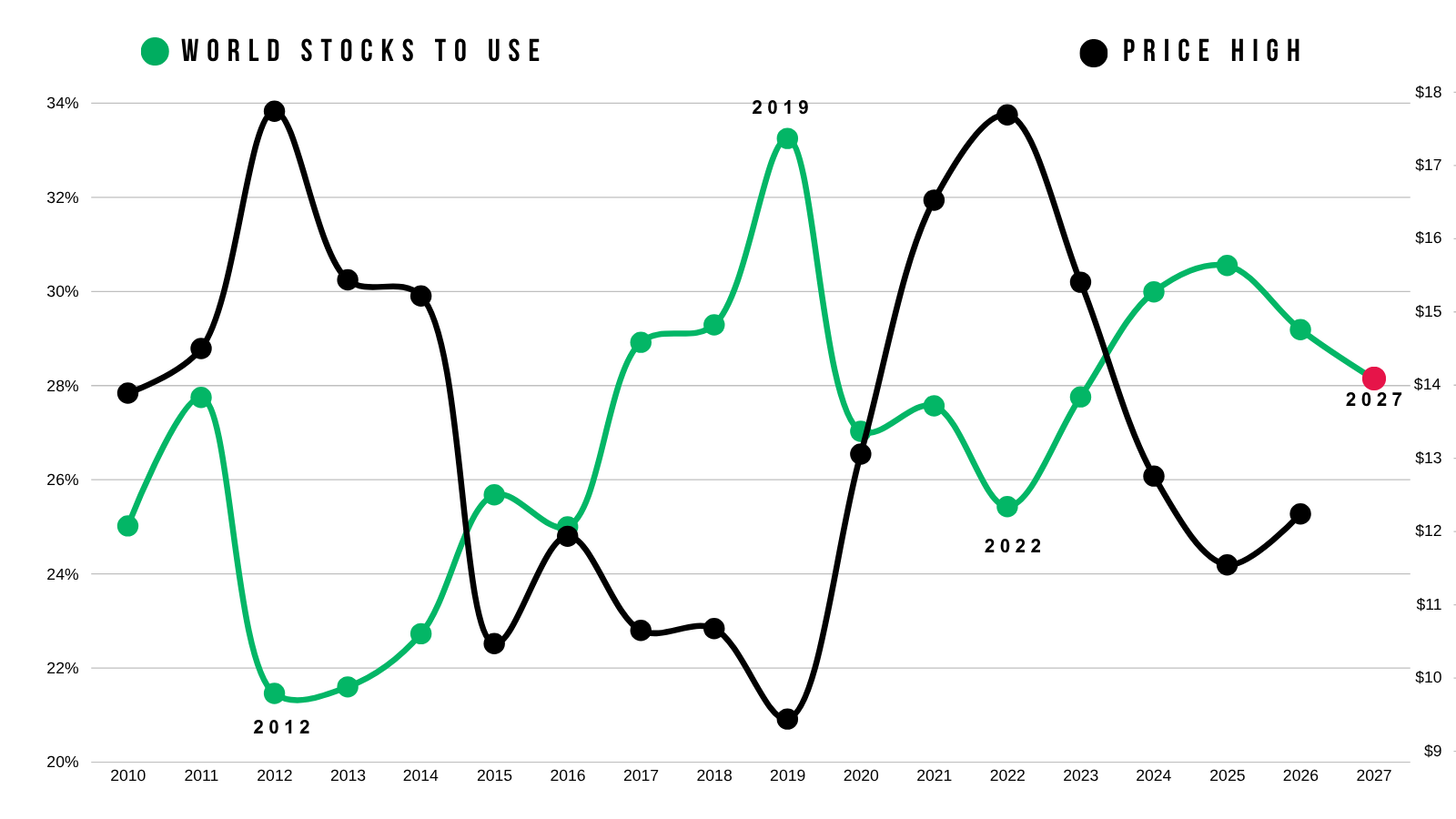
What if China lives up to their goal?:
I touched on this the other day, but the USDA is only expecting China to buy 16 MMT of our soybeans vs the 25 MMT they agreed to.
This isn’t some offical number on the balance sheets, but you can find it if you throw around some numbers.
The USDA has:
Old Crop Exports: 1,520 million bu (41.4 MMT)
New Crop Exports: 1,660 million bu (45.2 MMT)
Difference: 140 milllion bu (3.8 MMT)
Last year China bought 12 MMT or 440 million bu of soybeans.
This year they agreed to buy 25 MMT or 920 million bu of soybeans.
Which is 13 MMT more than last year or 480 million bushels of soybeans.
Yet.. the USDA only expects soybean exports to be up 3.8 MMT or 140 million bu compared to last year.
Which means they are only expecting China to buy 16 MMT or 590 million bu given that demand to non-China remains the same as last year.
So this tells us that if China buys the full 25 MMT (920 million bu), that would be 9 MMT (330 million bu) more than the USDA's guess of 16 MMT (590 million).
This is a big deal because that 9 MMT (330 million bu) is literally the same size as our entire carryout.
So if China even comes close to fulfilling that goal, we simply do not have the supply to meet that number and China's goal.
If this were to happen, we would need to ration demand lower and incentive less non-China demand.
How do you incentive lower demand? Usually through higher prices.
That would be the potential bull case for soybeans and why we have a lot of potential if China agrees to do what they said they would.
I threw together a chart that might help you visualize the numbers. Hopefully it makes sense.
So simplify all of this, the USDA only has exports up 140 million vs last year. But China agreed to buy 480 million more than last year.
Which is over a 300 million difference.
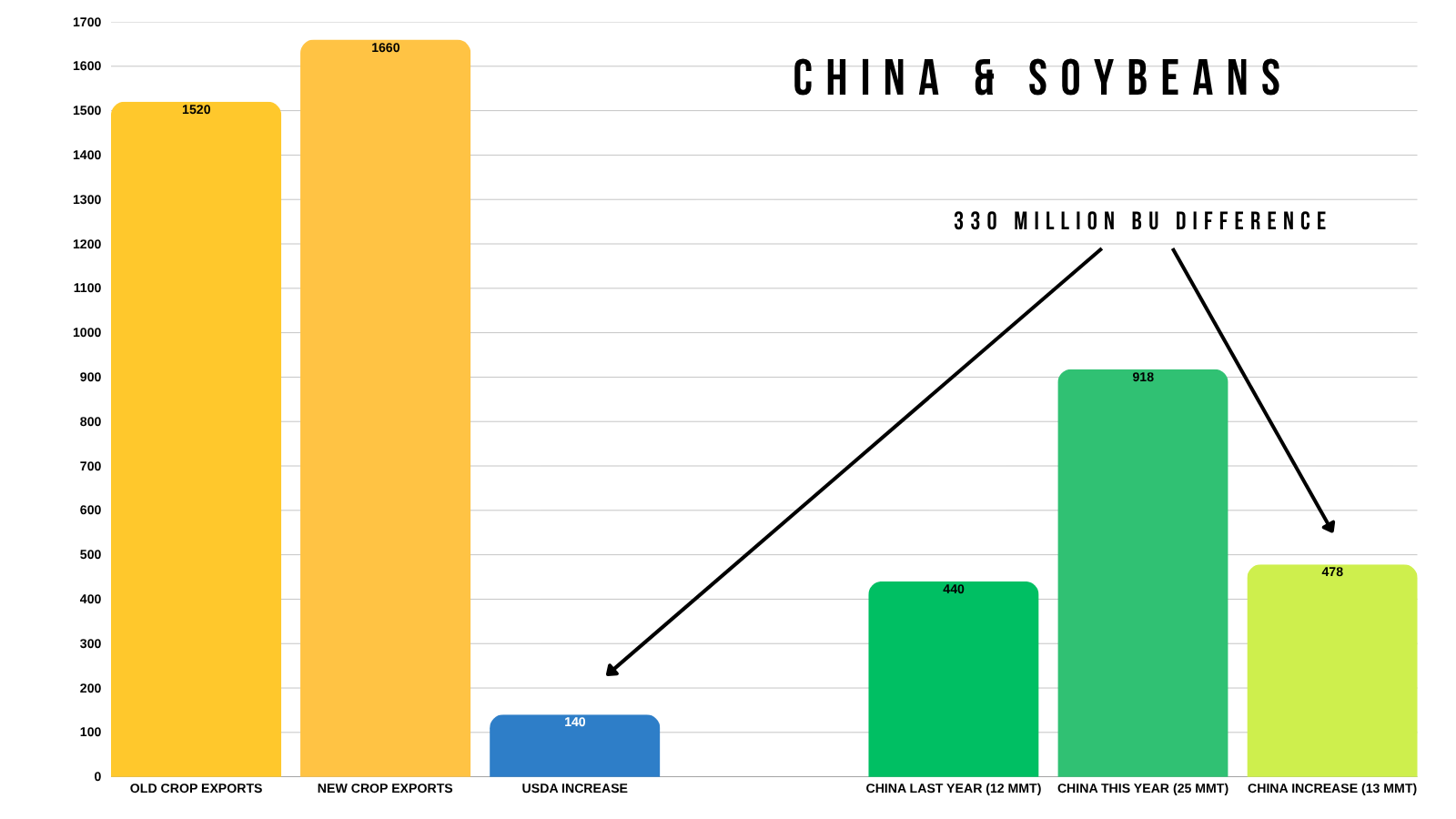
Crush Demand:
Demand is the story for soybeans.
Look at our crush demand. It's not going anywhere.
What happens if exports improve?
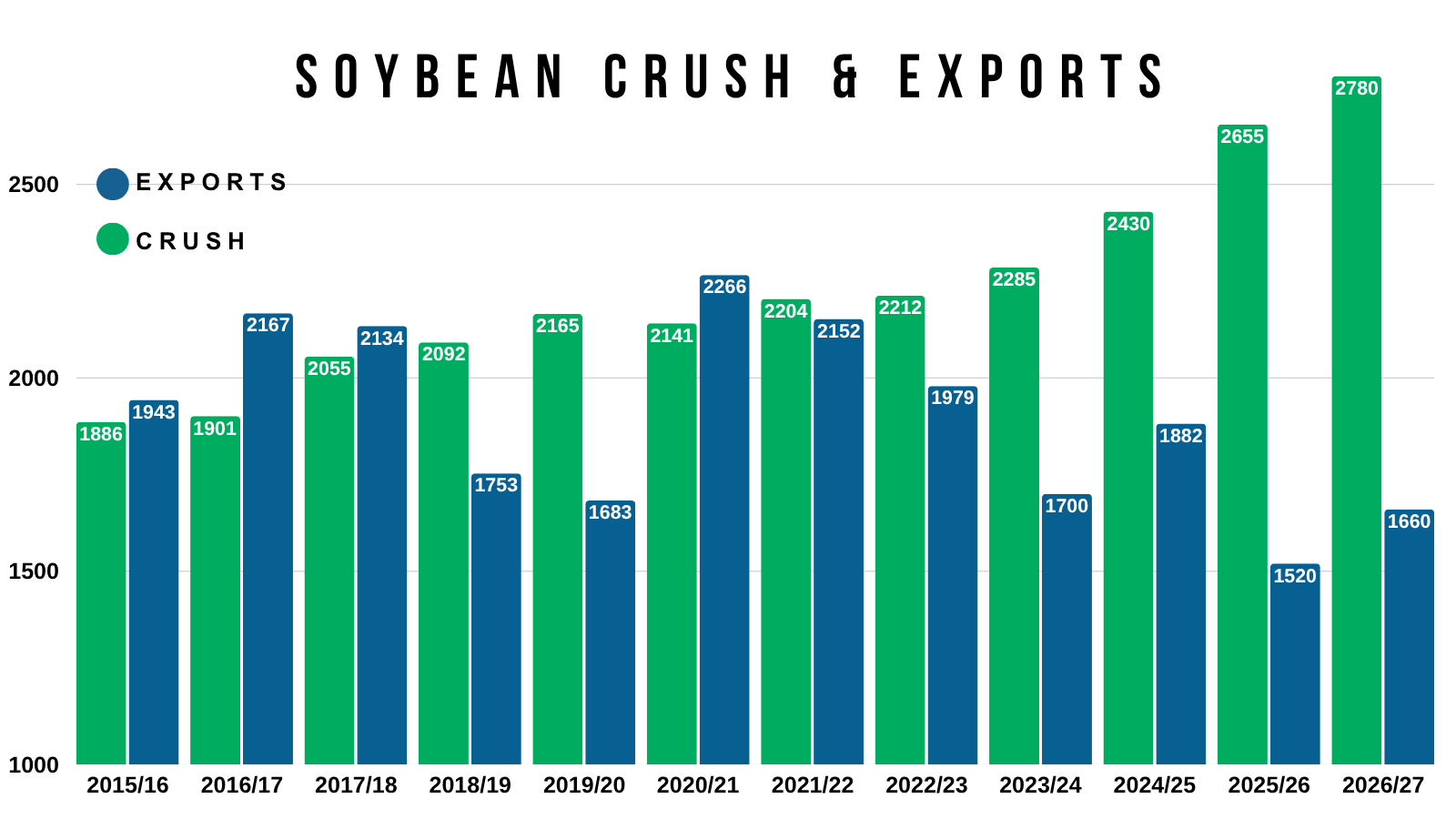
If you add the crush demand plus export demand, it's the best it's ever been.
Meaning the record crush is outpacing the losses in exports.
Resulting in the best domestic demand we've ever seen for soybeans.
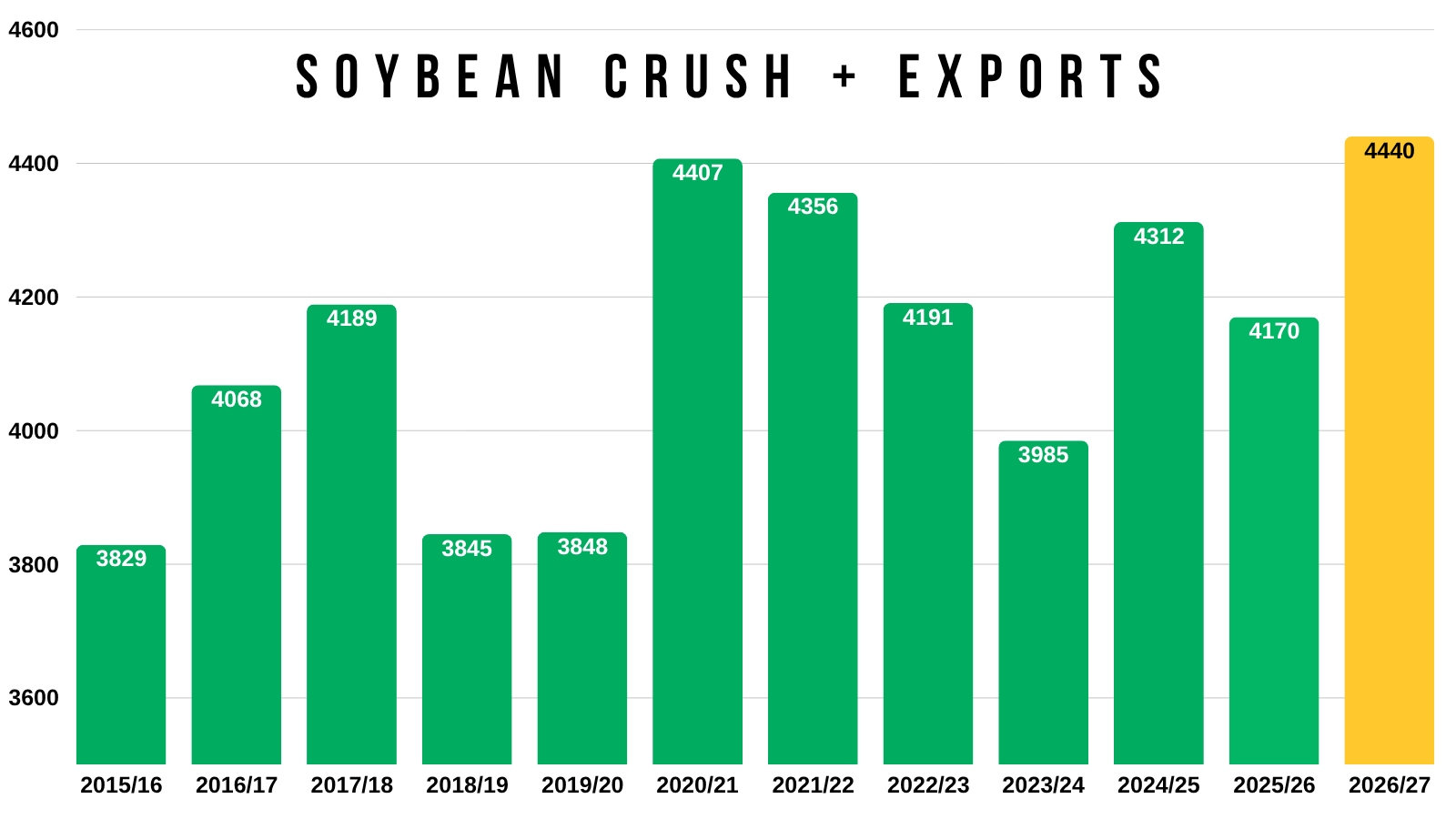
Bottom Line:
Weather isn’t bullish, and seasonallly we could run into some harvest pressure that might try to keep a lid on things.
But looking forward, like corn, soybeans still have a ton of potential. Largely led by potential demand.
The US balance sheet isn’t mega bullish, but the world situation is the tightest it's been in years.
We have a South America weather season right around the corner along with the Super El Nino that's going to make the next few months interesting.
Overall, I'm being patient waiting for the next opportunity.
Nov Beans Chart:
We continue to hold key support right where we need to.
If we are going to bounce, this would still be where we would expect it to happen.
Right at this golden zone and those March highs.
However, despite this being where we'd expect a bounce. It is still a must hold level, as if we break below the recent lows, we will likely spark a leg lower towards the bottom of the range from June.
As we still have a gap of volume to the downside. With plenty of air to the downside if we fail to hold the recent lows.
So there is a defined point of risk here.
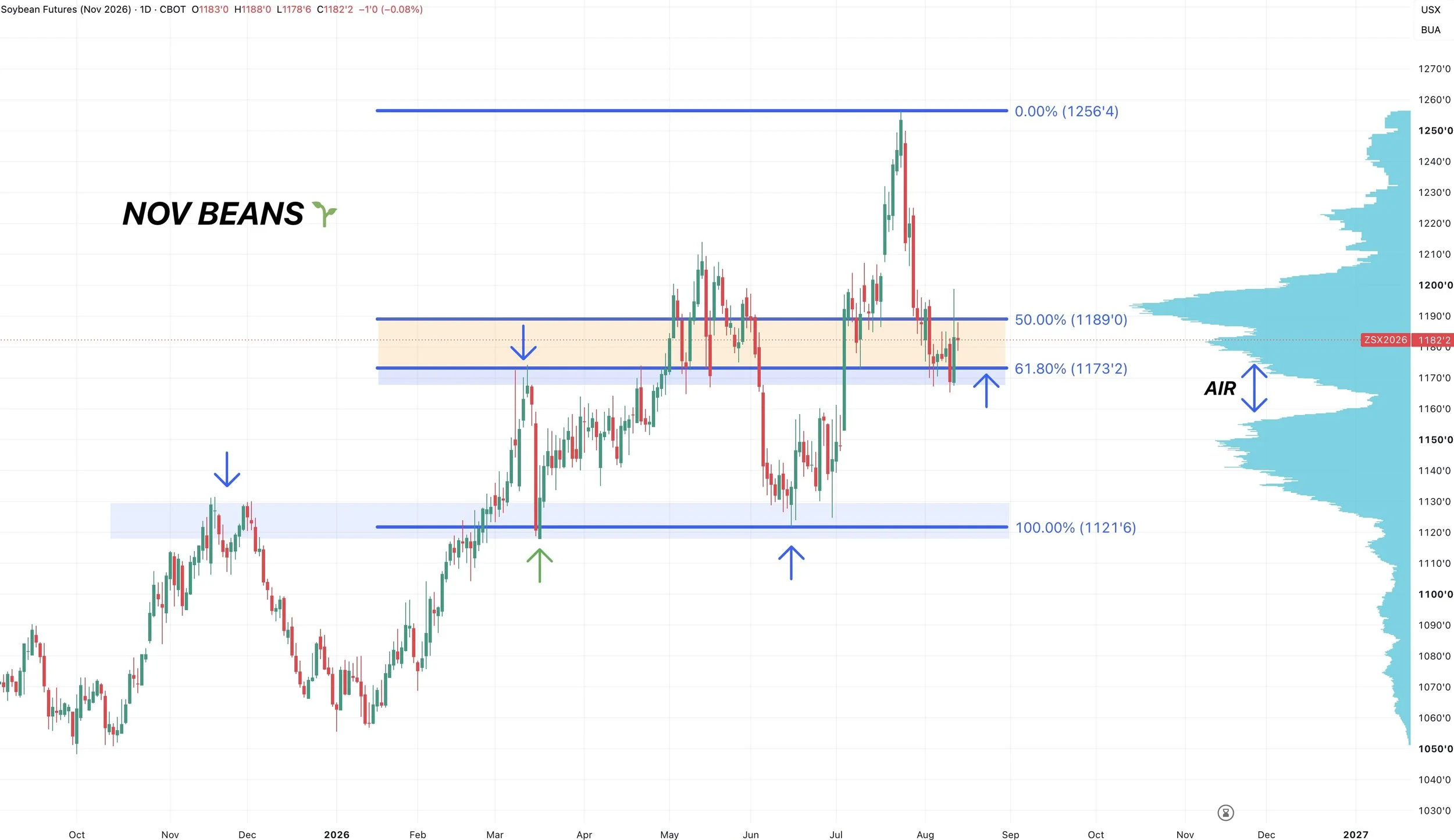
Another reason why this is a big level is that we perfectly hit the 1:1 move from the June sell off.
Meaning this sell off is the exact same size as the June one.
Again, happening right at those highs from March.
So a very crucial level for soybeans to hold.
Support is expected to hold. But if support gives out, it opens the flood gates lower.
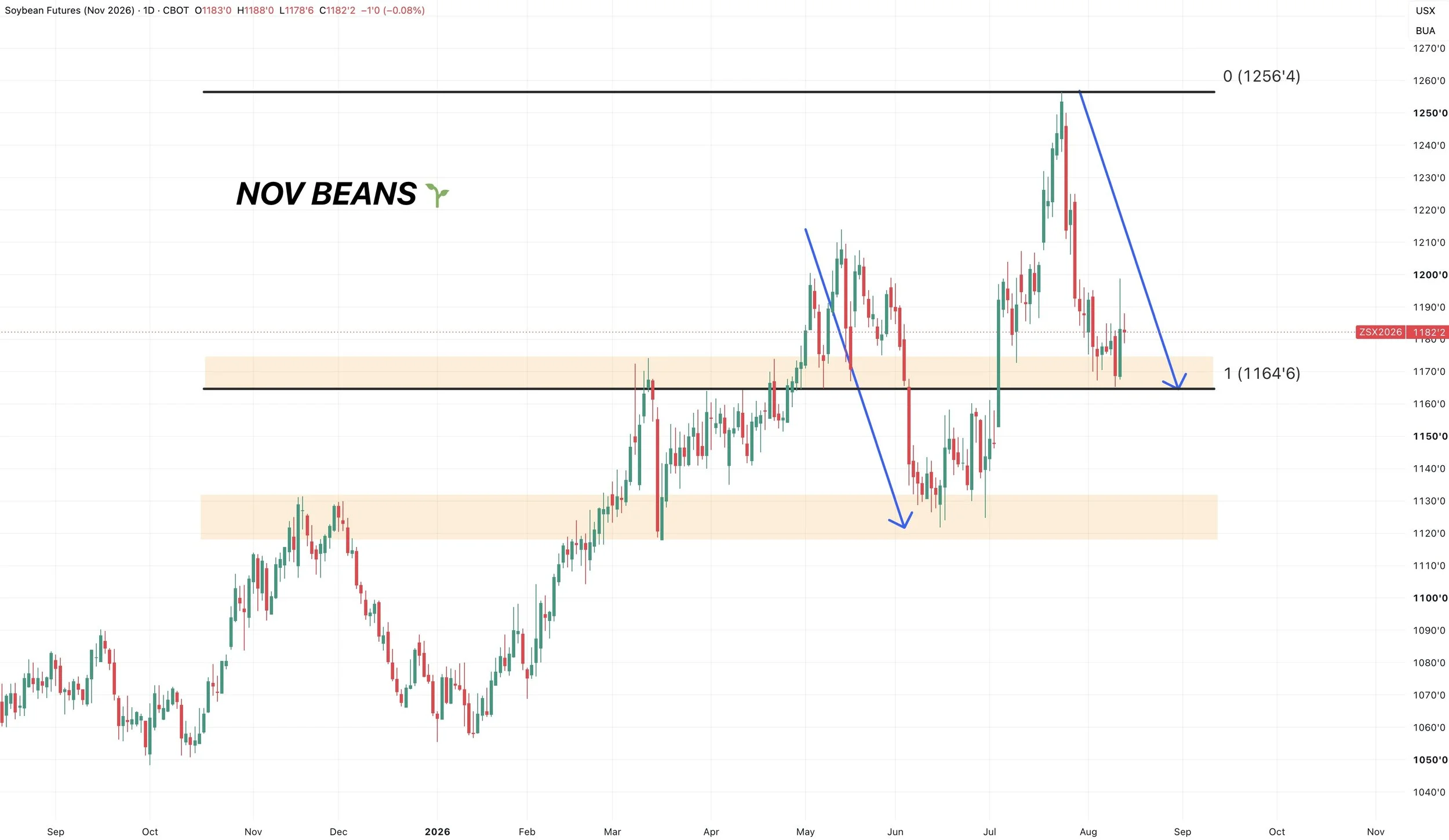
Wheat
The USDA report didn’t have a major impact for wheat. It was pretty much just neutral.
US wheat production is still the lowest ever.
The issues in the Black Sea don’t just make global wheat vanish, but it could certainly impact exports and the flow.
So for now the market seems to have lost interest. Although, I do still think the possible long-term impacts are being somewhat underrated.
Dec KC Wheat Chart:
Nothing has changed.
We are simply chopping around at the bottom of this range and area of high volume.
The structure remains higher as long as we hold the 61.8% level at $6.90
If we break below that key support, I'd start to get concerned. But for now, this is viewed as a healthy pullback and consolidation unless that happens.
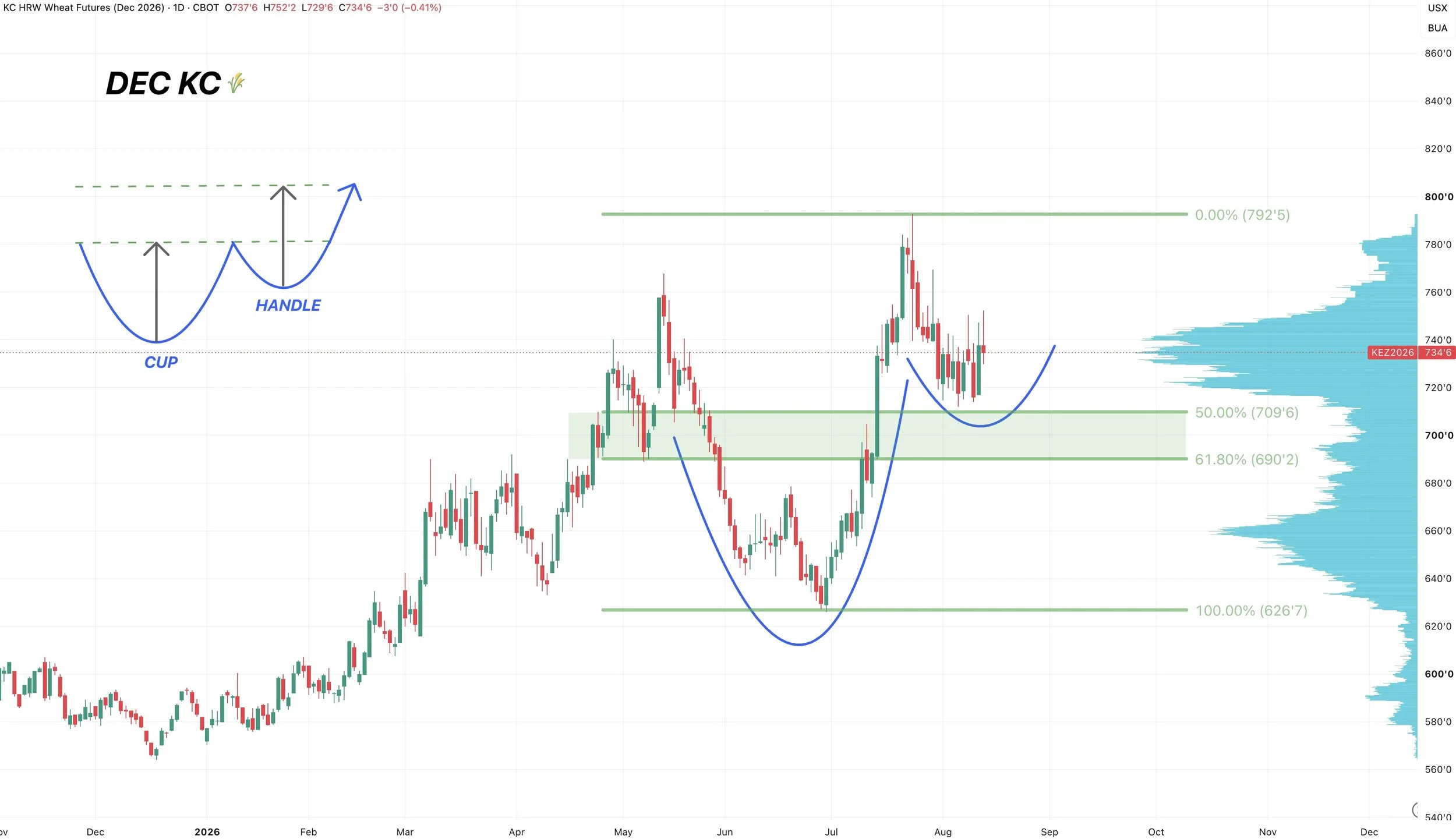
We could be possibly setting up for a cup and handle pattern.
Which would be viewed as a bullish set up if it plays out.
The implied move for this pattern takes you up towards that $8.40 to $8.50 range.
Which is also the golden fib from the May sell off.
Meaning it equals 161.8% of the June lows up to the May highs.
So that would be a possible long term target. $8.40 to $8.50
Of course this target does not have to hit. This one seems pretty far away right now.
Targets are simply out there to let you know it's a good area to de-risk if they do.
Targets are also subject to change as the charts play out.
Before we even think about upside targets, we need to hold this support first.
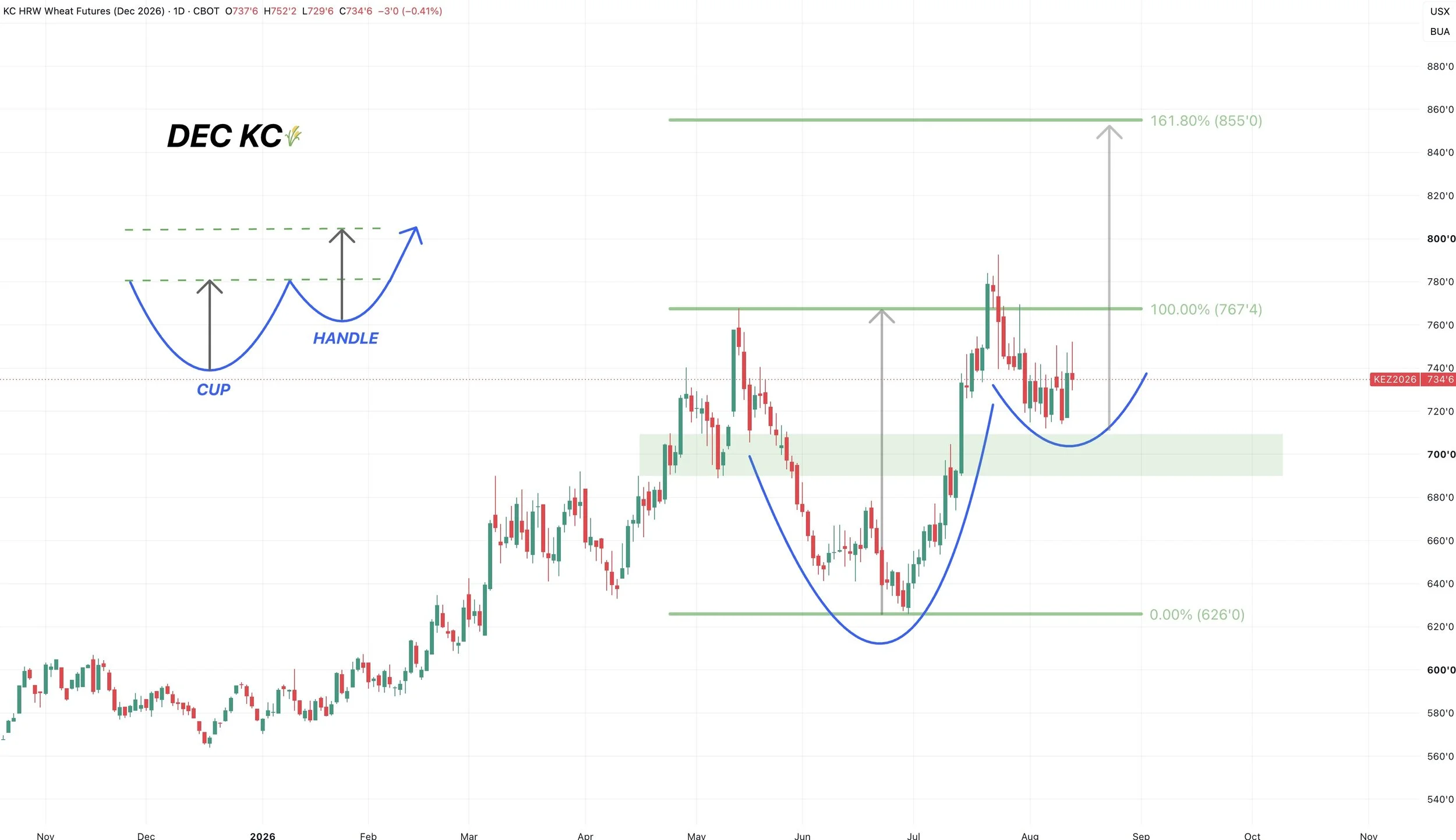
Cattle
Oct Live Chart:
Not great price action in cattle.
There was news about a Tyson Foods in Illinois closing which added pressure.
Something to note is that the last plant closure did mark a bottom in cattle. So I guess we will have to see how the market reacts to the headline tomorrow.
We failed after clawing back 50% of the sell off.
If we fail to hold those recent lows, it does open the door potentially a lot lower.
As if we break below the 61.8% level down to the lows from late last year, it would not be a good sign.
The overall trend in cattle is lower unless we break above the green box. So I still have the mindset of protecting any sort of rally.
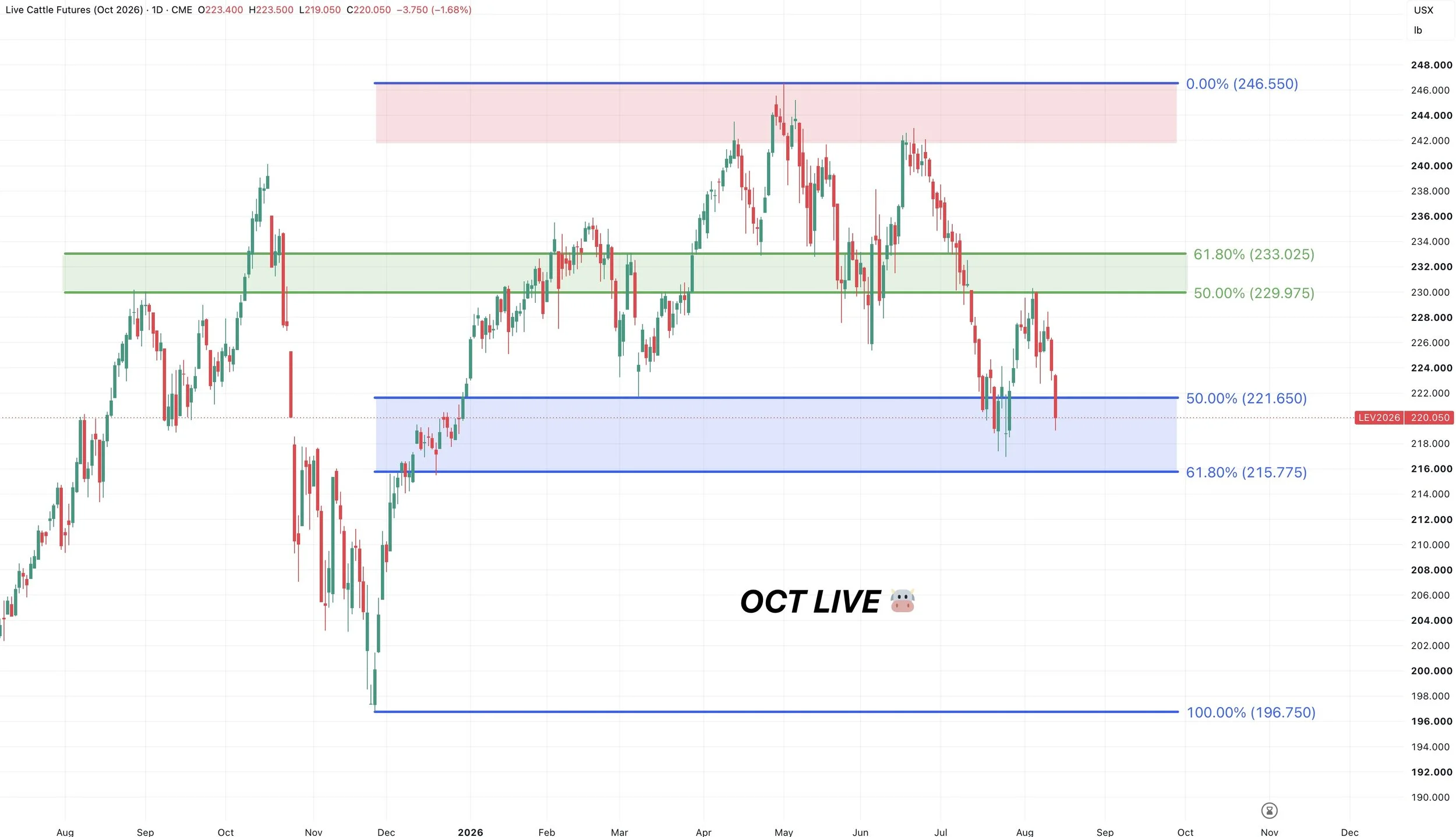
Sep Feeders Chart:
We had a nice candle today, closing well off the lows.
Biggest thing to watch is those recent July lows.
If we break below that, it could open the flood gates lower.
As this is clear key support bulls want to hold. Meaning if it breaks, there is a lot of air to the downside.
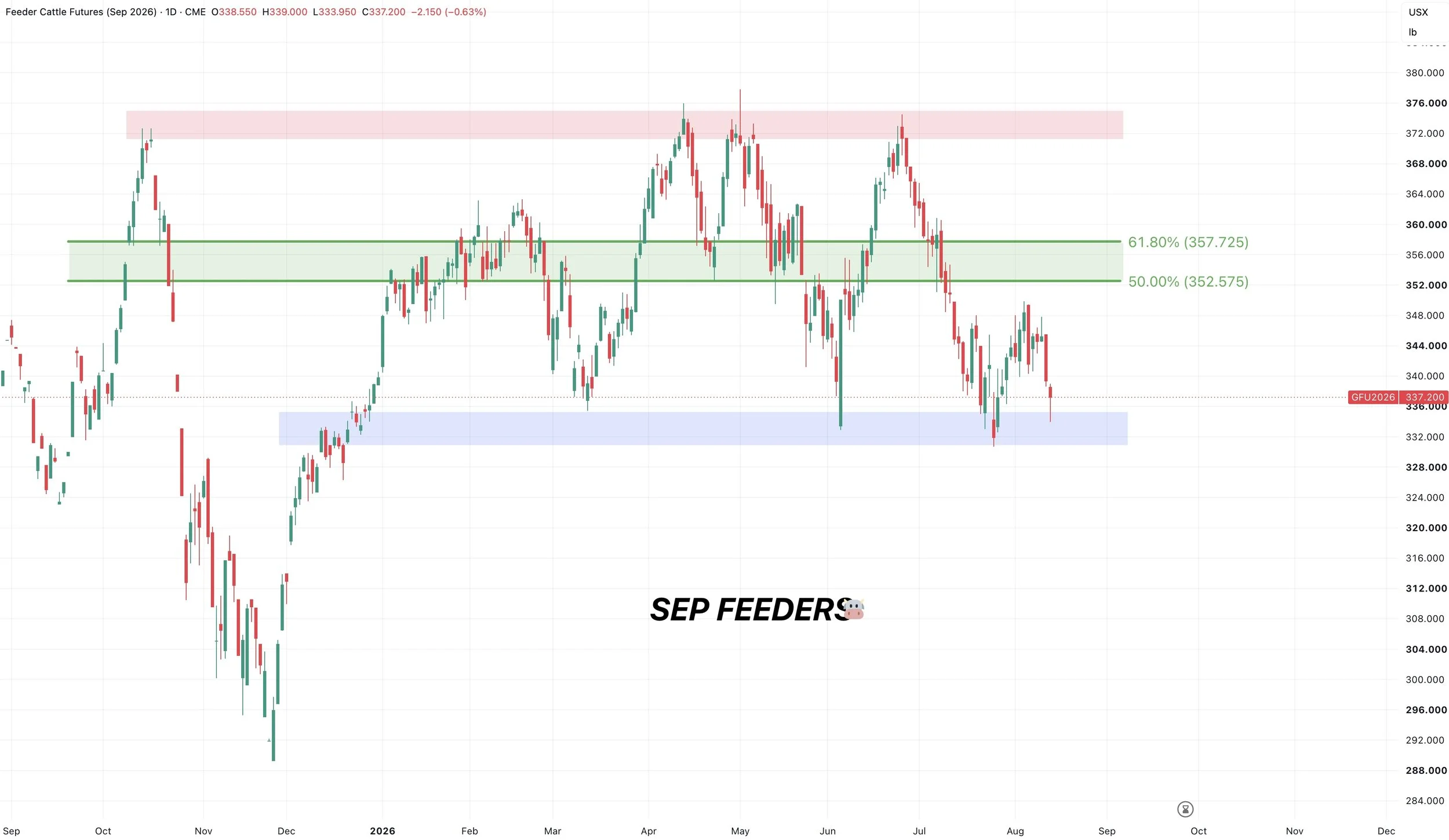
Want to Talk?
Our phones are open 24/7 for you guys if you ever need anything or want to discuss your operation.
Jeremey & Office: (806)484-1214
Sebastian: (605)280-1186
Email: sfrost@dailymarketminute.com
Hedge Account
Interested in a hedge account? Use the link below to set up an account or give us a call.